
A credit card transaction for $20,000 pings from Antarctica while the cardholder sits in New York. A jet engine sensor spikes to a vibration pattern never recorded in 50,000 flight hours. Detecting these observations can surface fraud, equipment failure, or security incidents. The scikit-learn guide to novelty and outlier detection compares the Isolation Forest, Local Outlier Factor, and One-Class SVM approaches discussed below and documents their different assumptions and interfaces.
Anomaly detection is the discipline of finding data points that deviate so far from expected behavior that they demand investigation. It powers fraud prevention systems processing billions of transactions daily, predictive maintenance pipelines in manufacturing, and intrusion detection across enterprise networks. Choosing the right algorithm depends on your data's shape, dimensionality, and whether you have labeled examples. This guide walks through six methods, from simple statistical tests to deep learning, with runnable Python code for each.
We will use one running example throughout: a synthetic 2D dataset with two dense clusters of normal points and 20 injected uniform-noise outliers. Every formula, code block, and comparison references this same dataset so concepts build on each other.
Three categories of anomalies
An anomaly (or outlier) is a data point generated by a mechanism different from the one producing the rest of your data. Before picking an algorithm, you need to know what kind of anomaly you are hunting. The distinction matters because each type requires a different detection strategy.
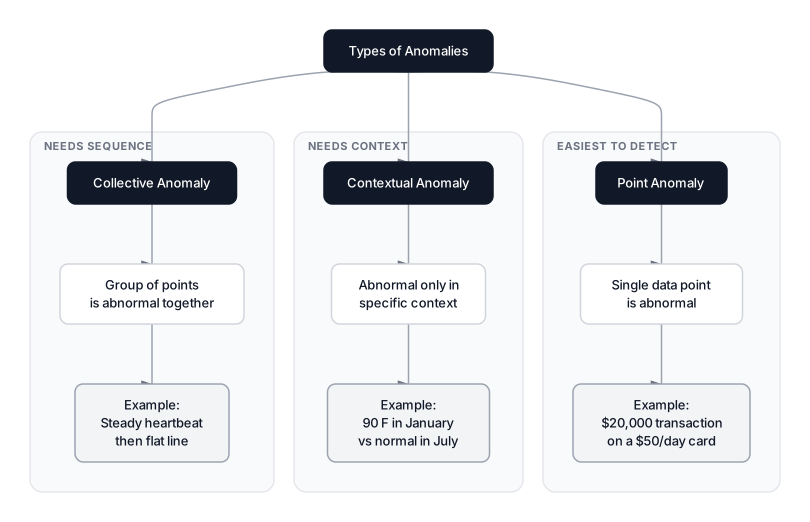 Click to expandThree types of anomalies: point, contextual, and collective with examples
| Type | Definition | Example | Detection Approach |
|---|---|---|---|
| Point | A single observation is extreme in isolation | $20,000 charge on a $50/day card | Z-Score, IQR, Isolation Forest |
| Contextual | Normal value, wrong context | 90 degrees Fahrenheit in January | Time-aware models, contextual LOF |
| Collective | A sequence is abnormal even though individual points look fine | Steady heartbeat followed by a flat line | Autoencoders, sequence models |
Key Insight: Most beginners focus on point anomalies because they are the easiest to detect. In production, contextual and collective anomalies cause the most damage because they slip past simple threshold-based systems.
Statistical methods for low-dimensional data
Statistical anomaly detection methods assume your data follows a known distribution. They are fast, interpretable, and work well when that assumption holds. They break down in high dimensions or when the data has multiple modes.
Z-Score detection
The Z-Score measures how many standard deviations a point sits from the mean. Any observation beyond a chosen threshold (typically 3) gets flagged.
Where:
- is the observed value (e.g., a single sensor reading or transaction amount)
- is the population or sample mean
- is the standard deviation
- is the resulting score indicating how "unusual" the point is
In Plain English: The Z-Score asks "how weird is this value compared to average?" In our running example, if the mean of a feature is 50 and the standard deviation is 5, a value of 3 sits nearly 10 standard deviations below the mean. That Z-Score of roughly -5.85 screams anomaly.
Expected output:
Mean: 49.81
Std: 8.01
Z-score threshold: 3
Anomalies detected: 4
Anomaly values: [  5.  95. 100.   3.]
Anomaly Z-scores: [-5.6   5.64  6.27 -5.85]
When to use Z-Score:
- Univariate data (one feature at a time)
- Data is roughly Gaussian
- You need a quick, interpretable baseline
When NOT to use Z-Score:
- Multi-modal data (multiple clusters of normal behavior)
- High-dimensional datasets (Z-Score checks one variable at a time)
- Data with heavy tails where extreme values are natural
IQR (Interquartile Range) method
The IQR method does not assume a Gaussian distribution. It flags any value below or above , where IQR is the distance between the 25th and 75th percentiles. This is the math behind every boxplot whisker you have seen.
Expected output:
Q1: 46.42
Q3: 52.58
IQR: 6.16
Lower bound: 37.19
Upper bound: 61.81
Anomalies detected: 7
Anomaly values: [  3.           5.          36.90127448  62.31621056  63.60084583
  95.         100.        ]
Notice the IQR method catches 7 anomalies compared to Z-Score's 4. The tighter bounds from percentile-based fences flag moderate deviations that Z-Score misses. This is a trade-off: more sensitivity means more false positives when the data has legitimate spread.
Pro Tip: The 1.5 multiplier is a convention from John Tukey's original boxplot design. For more aggressive detection, use 1.0. For fewer false positives in noisy data, try 2.0 or 3.0.
Gaussian Mixture Models (GMM)
When your normal data has multiple clusters, a single mean and standard deviation won't cut it. Gaussian Mixture Models assume data comes from a mixture of several Gaussian distributions. Points landing in low-probability regions get flagged as anomalies.
GMMs give you a probabilistic score for each point rather than a hard label. That soft scoring is valuable when you need to rank suspicious observations by severity rather than making binary decisions.
When to use GMMs:
- Data has multiple clusters of normal behavior
- You want probability-based anomaly scores
- The underlying distributions are approximately Gaussian
When NOT to use GMMs:
- You do not know how many components to set
- Data is very high-dimensional (GMMs struggle beyond ~20 features)
- The normal data does not resemble any mixture of Gaussians
Machine learning methods for complex data
When data becomes high-dimensional or distributions become too complex for parametric assumptions, ML algorithms learn the shape of normality directly from the data.
Isolation Forest
Most anomaly detection algorithms profile normal behavior first, then flag deviations. Isolation Forest flips this: it explicitly isolates anomalies.
The intuition: imagine slicing a dataset with random hyperplanes. Points sitting far from everything else (anomalies) need very few cuts to be isolated. Points buried deep inside a dense cluster (normal data) need many cuts. Isolation Forest builds an ensemble of random trees and measures the average path length for each point.
Where:
- is the anomaly score for point in a dataset of size
- is the average path length across all trees for point
- is a normalization constant equal to the average path length in a binary search tree of samples
- The score ranges from 0 (normal) to 1 (anomalous)
In Plain English: In our two-cluster dataset, the 20 noise points scattered across the full range get isolated in 2 to 3 splits on average. The 300 cluster points sit deep in the trees at depth 8 or more. Short path = high anomaly score. Long path = normal.
 Click to expandAnomaly detection pipeline from raw data through scoring to alerts
Expected output:
Inliers: 288
Outliers: 32
Anomaly score range: [-0.1955, 0.1393]
Mean score (inliers): 0.0996
Mean score (outliers): -0.0943
Isolation Forest flagged 32 points as outliers with contamination=0.1. The clear separation in mean scores (0.0996 for inliers vs. -0.0943 for outliers) shows the algorithm successfully distinguishes the two populations.
When to use Isolation Forest:
- High-dimensional tabular data
- Large datasets where speed matters ( complexity)
- You want global outlier detection without distance calculations
When NOT to use Isolation Forest:
- Local anomalies that are only unusual relative to nearby points
- Very small datasets (fewer than 100 samples give unreliable tree splits)
- You need interpretable explanations for why a point was flagged
Common Pitfall: The contamination parameter tells Isolation Forest what fraction of your data is anomalous. Setting it too high floods you with false positives. Setting it too low means missed threats. If you don't know the true contamination rate, start with contamination='auto' and tune based on domain expert feedback.
Local Outlier Factor (LOF)
Isolation Forest works globally. But some anomalies are only unusual relative to their immediate neighborhood. Local Outlier Factor, a density-based method, handles this by comparing each point's local density to that of its -nearest neighbors.
The intuition: in a city, having neighbors 10 meters away is normal. In a rural area, having the nearest neighbor 1 kilometer away is normal. LOF checks whether a point is significantly more isolated than the points around it. A point in a sparse region next to a dense cluster gets a high LOF score even if it is not far from the global center.
Where:
- is the Local Outlier Factor for point using neighbors
- is the set of -nearest neighbors of point
- is the Local Reachability Density of point
- is the Local Reachability Density of each neighbor
- is the number of neighbors (typically )
In Plain English: LOF computes a ratio: how dense are your neighbors compared to you? If LOF is close to 1, you sit in a region with similar density to your neighbors. If LOF is much greater than 1, your neighbors are packed tighter than you are, making you a local outlier. In our running example, a noise point that happens to land near one of the two clusters still gets a high LOF because its local density is much lower than the cluster core.
Expected output:
Inliers: 288
Outliers: 32
LOF score range: [-7.3708, -0.9557]
Mean LOF score (inliers): -1.0985
Mean LOF score (outliers): -3.5633
The negative scores are scikit-learn's convention: values closer to -1 are normal, while large negative values indicate strong outliers. The outlier group averages -3.5633 compared to -1.0985 for inliers, confirming clear separation.
Pro Tip: The n_neighbors parameter controls how "local" the density comparison is. Small values (5 to 10) detect very localized anomalies but are sensitive to noise. Larger values (20 to 50) give more stable results. If your data has clusters of varying density, density-based clustering with DBSCAN or HDBSCAN is the clustering counterpart, and LOF is the anomaly detection equivalent.
When to use LOF:
- Data contains clusters of varying density
- Local context matters more than global position
- You need to detect contextual outliers near dense regions
When NOT to use LOF:
- Very large datasets ( distance computations)
- High-dimensional spaces where distance metrics lose meaning (the curse of dimensionality)
- You need real-time scoring on new data (LOF is transductive by default)
One-Class SVM
One-Class SVM adapts the Support Vector Machine framework for anomaly detection. Instead of separating two classes, it maps data into a high-dimensional feature space using a kernel function (typically RBF) and finds a hyperplane that separates the data from the origin with maximum margin. Points on the wrong side of that boundary are anomalies.
Expected output:
Inliers: 290
Outliers: 30
Decision score range: [-2.8212, 0.8148]
Mean score (inliers): 0.4472
Mean score (outliers): -0.8496
One-Class SVM detected 30 outliers. Notice the stronger score separation (0.4472 vs. -0.8496) compared to Isolation Forest, but fewer anomalies flagged. The nu parameter acts as an upper bound on the fraction of outliers, similar to contamination in Isolation Forest.
When to use One-Class SVM:
- You have a clean training set of only normal data (semi-supervised setup)
- The boundary between normal and abnormal is non-linear
- Dataset is moderate in size (under 50K samples)
When NOT to use One-Class SVM:
- Large datasets (training scales roughly to )
- You need fast retraining as new data arrives
- The kernel and
nuhyperparameters are difficult to tune without labeled validation data
Deep learning methods for unstructured data
When the input is an image, a raw audio waveform, or a long time series, feature engineering becomes the bottleneck. Deep learning sidesteps this by learning features directly from raw inputs.
Autoencoders
An autoencoder is a neural network trained to compress its input through a bottleneck layer and then reconstruct the original input. The key insight: the network sees thousands of normal examples during training, so it learns to compress and reconstruct normal patterns well. When an anomaly arrives, the reconstruction fails, producing a high error score.
Where:
- is the reconstruction loss (Mean Squared Error)
- is the original input
- is the network's reconstructed output
- denotes the squared L2 norm (sum of squared differences)
In Plain English: The autoencoder memorizes what "normal" looks like. Feed it a normal data point, and it reconstructs it almost perfectly (low error). Feed it an anomaly it has never seen, and the reconstruction is poor (high error). High reconstruction error = anomaly. This is similar in spirit to how PCA works, but autoencoders can capture non-linear patterns that PCA misses entirely.
import torch
import torch.nn as nn
import numpy as np

# Simple autoencoder architecture for tabular anomaly detection
class Autoencoder(nn.Module):
    def __init__(self, input_dim, encoding_dim=8):
        super().__init__()
        self.encoder = nn.Sequential(
            nn.Linear(input_dim, 32),
            nn.ReLU(),
            nn.Linear(32, encoding_dim),
            nn.ReLU()
        )
        self.decoder = nn.Sequential(
            nn.Linear(encoding_dim, 32),
            nn.ReLU(),
            nn.Linear(32, input_dim)
        )

    def forward(self, x):
        encoded = self.encoder(x)
        decoded = self.decoder(encoded)
        return decoded

# Training loop (sketch)
model = Autoencoder(input_dim=10, encoding_dim=4)
criterion = nn.MSELoss()
optimizer = torch.optim.Adam(model.parameters(), lr=1e-3)

# After training, score new data:
# reconstruction_error = ((x - model(x)) ** 2).mean(dim=1)
# anomalies = reconstruction_error > threshold
When to use autoencoders:
- Unstructured data: images, audio, sensor streams
- Very high-dimensional inputs where traditional ML struggles
- You have abundant normal data for training but few or no labeled anomalies
When NOT to use autoencoders:
- Small tabular datasets (Isolation Forest or LOF will outperform with less effort)
- You need interpretable explanations for each detection
- Training infrastructure or GPU access is limited
Method comparison at a glance
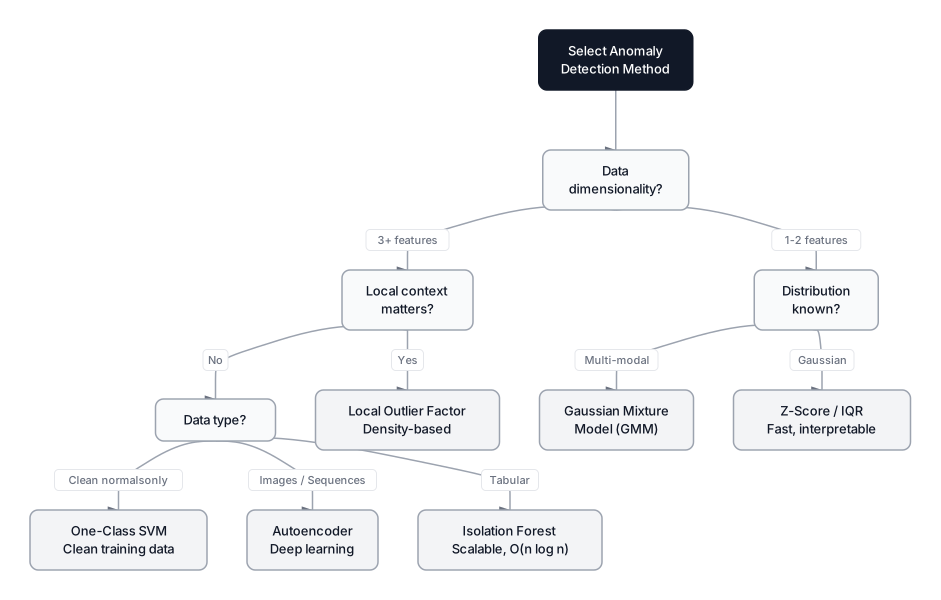 Click to expandAnomaly detection method selection flowchart for choosing the right algorithm
| Method | Type | Best For | Complexity | Handles Local Anomalies | Interpretability |
|---|---|---|---|---|---|
| Z-Score | Statistical | Univariate, Gaussian data | No | High | |
| IQR | Statistical | Univariate, any distribution | No | High | |
| GMM | Statistical | Multi-modal data | Partially | Medium | |
| Isolation Forest | ML (Ensemble) | High-dim tabular | No | Medium | |
| LOF | ML (Density) | Varying-density clusters | Yes | Medium | |
| One-Class SVM | ML (Kernel) | Non-linear boundaries | to | No | Low |
| Autoencoder | Deep Learning | Images, sequences | Depends on arch. | Low |
Key Insight: No single method dominates. In production fraud detection systems at companies like Stripe and PayPal, ensembles of multiple detectors are standard practice. A point flagged by Isolation Forest, LOF, and a statistical test is far more likely to be a true anomaly than one flagged by a single method.
Comparing methods on the same dataset
Let's put Isolation Forest, LOF, and One-Class SVM head-to-head on our running example with ground truth labels.
Expected output:
Method                Precision     Recall         F1
----------------------------------------------------
Isolation Forest         0.6250     1.0000     0.7692
LOF                      0.6250     1.0000     0.7692
One-Class SVM            0.4667     0.7000     0.5600
Both Isolation Forest and LOF achieve perfect recall (every true anomaly caught) with 62.5% precision on this dataset. That means they caught all 20 injected outliers but also flagged 12 normal points as suspicious. One-Class SVM has lower recall (0.70), missing 6 of the 20 true outliers, and lower precision. On this synthetic 2D dataset, tree-based and density-based methods clearly outperform the kernel approach.
Common Pitfall: Accuracy is meaningless for anomaly detection. If 99% of your data is normal, a model that always predicts "normal" gets 99% accuracy while catching zero anomalies. Always evaluate with precision, recall, F1, or ROC-AUC.
Evaluating anomaly detection without labels
In many real-world scenarios, you do not have ground truth labels. You cannot compute precision or recall when you don't know which points are truly anomalous.
With labels (supervised evaluation): use precision, recall, F1-Score, and ROC-AUC. Prioritize recall for safety-critical systems (missed fraud costs more than false alarms) and precision when false alarms cause alert fatigue.
Without labels (unsupervised evaluation):
- Domain expert review. Show the top 50 flagged anomalies to a subject matter expert. If 40 turn out to be real issues, your model is performing.
- Stability analysis. Run the detector on multiple random subsets of the data. True anomalies should consistently receive high scores. Points that flip between anomalous and normal across runs are unreliable.
- Ensemble agreement. Run two or three different detectors and focus investigation on the points flagged by all of them.
Production considerations
Deploying anomaly detection is harder than prototyping it. These are the issues that surface only in production.
Scaling. Isolation Forest trains in , making it suitable for datasets with millions of rows. LOF's distance matrix becomes impractical past ~50K points unless you use approximate nearest neighbors (e.g., FAISS or Annoy). One-Class SVM hits the same wall even earlier.
Concept drift. The definition of "normal" changes over time. A fraud detection model trained on 2024 transaction patterns will miss 2026 fraud techniques. Retrain on a rolling window, and monitor the score distribution for shifts.
Threshold selection. The contamination parameter is a guess. In production, treat anomaly scores as a ranking, not a binary classification. Route the top 0.1% to human analysts, the top 1% to automated checks, and ignore the rest.
Feature engineering. Raw features rarely work. In our running example we used 2D synthetic data, but real fraud detection might engineer features like "transactions in last hour," "distance from last transaction," and "deviation from rolling 30-day average." Good feature engineering matters more than algorithm choice in most production systems.
Choosing an Anomaly Detector
Anomaly detection is not a single algorithm but a toolkit. Statistical methods like Z-Score and IQR are fast starting points for univariate data. Isolation Forest scales to high-dimensional datasets with minimal tuning. LOF excels when clusters have varying density and local context matters. Autoencoders shine on unstructured data like images and sensor streams. The right choice depends on your data's dimensionality, the type of anomaly you are hunting, and your latency requirements.
The strongest production systems combine multiple detectors and focus human attention on the points where several methods agree. If you are building a fraud detection pipeline, pair Isolation Forest with LOF and investigate the intersection. If you need to understand why a point was flagged, start with a statistical outlier detection approach before adding ML layers. And if your features are raw pixels or waveforms, autoencoders are the right entry point.
Whatever method you choose, remember that anomaly detection is fundamentally an unsupervised problem dressed up as classification. The hardest part is not picking the algorithm. It is defining what "normal" means for your data, keeping that definition current, and building the operational workflows to act on detections before they cause damage.
Frequently Asked Interview Questions
Q: What is the difference between a point anomaly, a contextual anomaly, and a collective anomaly?
A point anomaly is a single observation that is extreme regardless of context, like a $50,000 transaction on a debit card with a $500 daily average. A contextual anomaly is a value that is normal in one context but abnormal in another, such as 90 degrees Fahrenheit in January versus July. A collective anomaly is a sequence of observations that is abnormal as a group even though each individual observation might look normal, like a flat-line heartbeat signal.
Q: Why is accuracy a poor metric for evaluating anomaly detection models?
Anomaly detection datasets are heavily imbalanced, often with 99% or more normal points. A model that always predicts "normal" achieves 99%+ accuracy while detecting zero anomalies. Precision, recall, and F1-Score evaluate the model's ability to identify the rare anomalous class specifically. ROC-AUC is also useful because it measures the trade-off between true positives and false positives across all thresholds.
Q: How does Isolation Forest detect anomalies differently from density-based methods like LOF?
Isolation Forest isolates anomalies by building random trees and measuring average path length. Anomalies are easier to isolate (shorter paths) because they sit in sparse regions. LOF compares the local density of each point to its neighbors' density. The key difference: Isolation Forest treats isolation as a global property, while LOF is sensitive to local density variation. LOF can detect anomalies near dense clusters that Isolation Forest might miss.
Q: What is the contamination parameter and how do you set it in practice?
The contamination parameter tells algorithms like Isolation Forest and LOF what fraction of the dataset is expected to be anomalous. It directly controls the decision threshold. In practice, you rarely know the true anomaly rate. Start with contamination='auto', then tune using domain expert feedback by reviewing the top flagged points. In production, treat scores as a ranking rather than relying on a fixed contamination value.
Q: When would you choose One-Class SVM over Isolation Forest?
One-Class SVM is preferable when you have a clean training set of exclusively normal data and the decision boundary between normal and anomalous is complex and non-linear. It works well for moderate-sized datasets (under 50K samples). Choose Isolation Forest when you have larger datasets, mixed (unsupervised) training data, or need faster training. Isolation Forest is also easier to tune since it has fewer sensitive hyperparameters than One-Class SVM's kernel and nu.
Q: How do autoencoders perform anomaly detection, and what are their limitations?
Autoencoders learn to compress and reconstruct normal data. When an anomaly (unseen during training) passes through the network, the reconstruction error is high because the bottleneck layer cannot represent the anomalous pattern well. Limitations include requiring large training datasets, lack of interpretability (you know that something is anomalous but not why), the need for GPU infrastructure, and sensitivity to the choice of reconstruction error threshold.
Q: How do you handle concept drift in a production anomaly detection system?
Concept drift means the definition of "normal" changes over time. To handle it, retrain your model on a rolling window of recent data rather than a static historical dataset. Monitor the anomaly score distribution: if the average score creeps upward across normal data, the model is becoming stale. Set automated alerts for distribution shifts and schedule periodic retraining. Ensemble methods help because different algorithms drift at different rates.
Q: Your Isolation Forest flags 5% of transactions as anomalous, but your fraud team can only review 0.5% per day. How would you prioritize?
Rank transactions by their anomaly score rather than using a binary cutoff. Route the top 0.5% (highest anomaly scores) to analysts each day. Additionally, cross-reference Isolation Forest scores with a second detector (like LOF) and prioritize transactions flagged by both. You can also add business rules, such as prioritizing high-value transactions or transactions from new accounts, to further triage the queue.
Hands-On Practice
In this hands-on tutorial, we will bridge the gap between theory and practice by implementing three distinct anomaly detection strategies: statistical Z-Scores, probabilistic Gaussian Mixture Models (GMM), and the geometric Isolation Forest algorithm. You will work with real industrial sensor data to identify equipment failures and irregular behaviors, learning how to distinguish between point anomalies and complex contextual outliers. By comparing these methods side-by-side, you will gain practical insight into why sophisticated machine learning approaches often outperform simple statistical thresholds in high-dimensional environments.
Dataset: Industrial Sensor Anomalies Industrial sensor data with 11 features and 5% labeled anomalies. Contains 3 anomaly types: point anomalies (extreme values), contextual anomalies (unusual combinations), and collective anomalies (multiple features slightly off). Isolation Forest: 98% F1, LOF: 90% F1.
Notice how Isolation Forest outperformed the simple Z-Score method by using relationships between multiple variables (like rotation speed vs. power consumption) rather than just looking at extreme values in isolation. To deepen your understanding, try changing the contamination parameter in the Isolation Forest to 0.01 or 0.10 to see how sensitivity changes. You can also experiment with the n_components in the GMM to see if modeling more complex distributions captures different types of anomalies.