
Two neighborhoods sit on opposite sides of a map, one residential, one commercial, with a strip of empty land running between them. A city planner drawing the zoning boundary wouldn't hug the edge of either cluster. The smartest line runs down the middle of that buffer zone, giving both sides maximum breathing room. If a new building pops up near the boundary, it still falls clearly on one side.
Support vector machines (SVMs) follow this same instinct. Instead of settling for any line that separates two classes, an SVM finds the line that creates the widest possible margin between them. That obsession with margin width is what gives SVMs their geometric elegance and explains why, even after three decades, they remain the top choice for high-dimensional, small-sample problems like text classification, genomics, and medical imaging. The original "Support-Vector Networks" paper by Cortes and Vapnik (1995) laid the mathematical foundation, and the algorithm's core principles haven't changed since.
Every concept in this guide maps back to a single running example: classifying emails as spam or not-spam based on two features: word frequency (how often suspicious terms appear) and link count (number of hyperlinks in the email body). From hard margins to kernels to hyperparameter tuning, it's all one inbox.
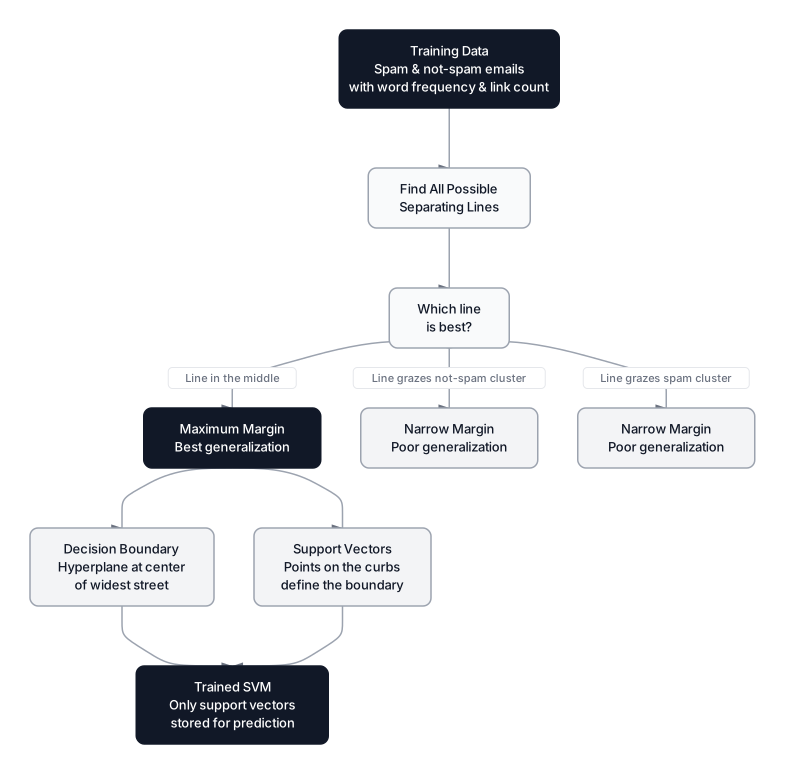 Click to expandSVM margin concept showing the widest street between two classes of data points
The widest-street intuition behind SVMs
The maximum-margin principle is the core idea that separates SVMs from every other linear classifier. Picture every email in your inbox plotted on a 2D chart: the x-axis is word frequency, the y-axis is link count. Spam emails cluster in one region (high word frequency, lots of links) and legitimate emails cluster elsewhere.
You could draw dozens of straight lines to separate spam from not-spam. Some would graze the edge of the spam cluster; others would pass dangerously close to legitimate mail. SVMs reject all of these and instead search for the widest street that fits between the two clusters:
- The center line is the decision boundary (the hyperplane).
- The curbs on each side are parallel lines touching the closest data points from each class.
- The street width is the margin, the perpendicular distance between the two curbs.
- The buildings on each curb are the support vectors, the specific emails sitting exactly on the edge.
Every other email farther from the boundary is irrelevant. You could delete them from the dataset and the boundary wouldn't shift. Move a support vector, though, and the entire street repositions itself. This property makes SVMs remarkably memory-efficient at prediction time: once training finishes, only the support vectors need to be stored.
Key Insight: The term "support vector" isn't abstract jargon. These are literally the data points that support (hold up) the decision boundary. Remove them, and the boundary collapses. Leave everything else untouched, and the boundary stays put.
The hyperplane equation in vector notation
A hyperplane is simply the generalization of a line to any number of dimensions. In two dimensions it's a line; in three, a plane; in 100 dimensions, a 99-dimensional surface.
SVMs define the decision boundary using vector notation:
Where:
- is the weight vector (perpendicular to the hyperplane)
- is a data point's feature vector
- is the bias term that shifts the hyperplane toward or away from the origin
- denotes the dot product of the two vectors
In Plain English: For our spam classifier, is a two-element vector with one weight for word frequency and one for link count. Plugging in any email's features gives a number. If , the email falls on the spam side. If it's negative, it's legitimate. The boundary itself is where the expression equals exactly zero.
The direction of determines how the hyperplane tilts, while slides it left or right. Together they fully specify the decision surface. The sign of tells you which class a new email belongs to, and the magnitude tells you how confident that classification is.
The hard-margin optimization problem
Hard-margin SVM assumes the two classes are perfectly separable; no email sits in the ambiguous zone. Label spam as and not-spam as . The hard-margin constraint demands that every single training email lands on the correct side with at least a unit of functional margin:
Where:
- is the class label ($+1$ for spam, $-1$ for not-spam)
- is the feature vector for training email
- and define the hyperplane
In Plain English: Multiply each email's label by its signed distance from the boundary. The result must be at least 1. Spam emails land on the positive side, legitimate emails on the negative side, and nobody stands in the middle of the street.
The points where equality holds () are the support vectors. They sit exactly on the curb.
Why the margin equals
Take one support vector from the spam side and one from the not-spam side. By definition:
Subtract the second equation from the first:
The shortest path between the two curbs runs parallel to , so the geometric margin is:
Where:
- is the Euclidean norm (length) of the weight vector
In Plain English: A smaller weight vector means a wider street. The SVM's job is to shrink as much as possible while keeping every email on the correct side.
The primal optimization objective
To maximize , we minimize . For mathematical convenience (smooth, differentiable objective), we minimize the squared norm:
Where:
- is the objective we're minimizing (smaller = wider margin)
- The constraints ensure every training point is correctly classified with margin
In Plain English: Find the weight vector with the smallest possible magnitude that still keeps every training email on the correct side of the street. Small weights = wide street = confident, generalizable predictions.
This is a convex quadratic program, meaning there's exactly one global minimum, with no local minima traps. That's a theoretical guarantee most ML algorithms can't offer.
The Lagrangian dual and the kernel doorway
Solving the primal problem directly works but is inconvenient for large feature spaces. Instead, we introduce a Lagrange multiplier for each constraint and form the Lagrangian:
Where:
- is the Lagrange multiplier for training example
- is the total number of training examples
Setting partial derivatives with respect to and to zero and substituting back yields the dual problem:
Subject to for all and .
In Plain English: Instead of searching over the weight vector directly, we search over one multiplier per training email. The dual depends only on dot products between pairs of emails (), not on the raw features. This dot-product structure is the doorway to the kernel trick, and it's why SVMs can learn nonlinear boundaries without changing the optimization algorithm.
Most values end up at zero. Those emails aren't support vectors and play no role in the final model. Only emails with (the support vectors) shape the decision boundary. This sparsity is guaranteed by the complementary slackness condition: .
Soft-margin SVM and the C parameter
Perfect separation is a fantasy. Real inboxes contain newsletters packed with links (looks like spam, isn't) and cleverly disguised phishing messages that mimic casual correspondence. A hard-margin SVM would either fail entirely or produce a razor-thin, overfitted margin to accommodate every edge case.
The soft-margin SVM introduces slack variables , one per training email, that let individual points violate the margin or even land on the wrong side:
Subject to and for all .
Where:
- is the slack variable for email (how far it violates the margin)
- is the regularization hyperparameter controlling the tradeoff
In Plain English: We still want a wide street (small ), but now some emails are allowed to park on the road. Each violating email pays a penalty proportional to how far it intrudes. The hyperparameter sets the exchange rate between margin width and violation penalties.
Here's how behaves in practice:
| value | Effect on boundary | Risk | Spam classifier analogy |
|---|---|---|---|
| Large (1000+) | Tight, contorted boundary classifying nearly every training email correctly | Overfitting | $1,000,000 parking fine; no car dares park, so the road warps around every vehicle |
| Medium (1-10) | Balanced margin with some misclassifications tolerated | Good starting point | Reasonable fine, so most cars stay off the road, occasional violators accepted |
| Small (0.001-0.1) | Wide, smooth margin; many training misclassifications | Underfitting | $5 fine, so cars park freely, but the road itself stays wide and straight |
Pro Tip: Always tune C via cross-validation over a logarithmic grid: 0.001, 0.01, 0.1, 1, 10, 100, 1000. Linear spacing wastes compute on a narrow range.
In the dual formulation, the only change is that each is now bounded above by : . The slack variables themselves vanish from the dual, keeping the optimization clean.
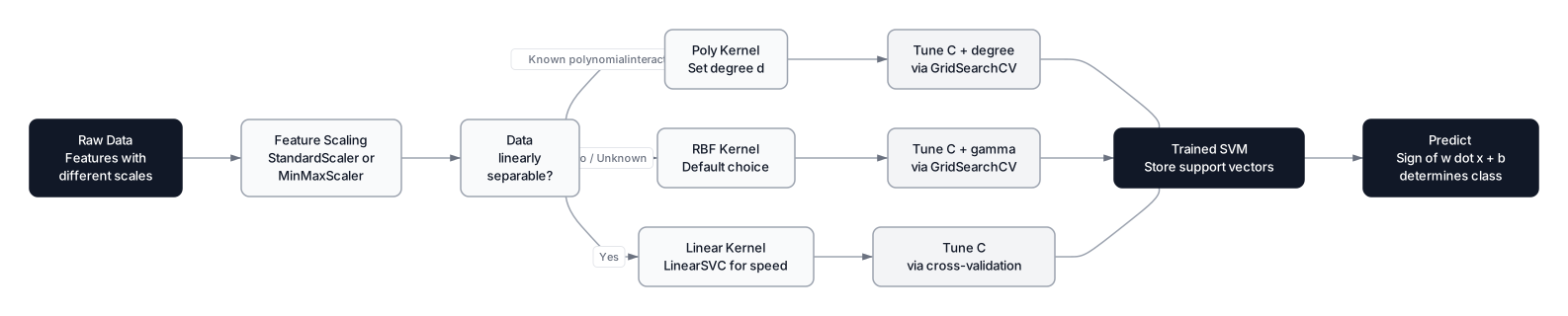 Click to expandSVM decision flow from data preparation through kernel selection to trained model
The kernel trick for nonlinear boundaries
Everything so far has been about straight lines (or flat hyperplanes). But what happens when spam emails cluster in the center of the plot and legitimate emails surround them in a ring? No straight line separates a ring from its interior.
Mapping features to higher dimensions
The solution: transform each 2D email into a higher-dimensional space where the classes become linearly separable. Add a third feature (the squared distance from the origin). Emails in the center now sit at low values; ring emails sit at high values. A flat plane in 3D easily separates them, and when projected back to 2D, that plane traces a circle.
The function performing this transformation is called a feature map . The SVM in the transformed space solves:
Where:
- is the feature-mapped version of email in the higher-dimensional space
The computational shortcut that makes it all work
Computing explicitly can be extraordinarily expensive. The RBF kernel maps data into an infinite-dimensional space, meaning you literally can't store those features. The kernel trick sidesteps the problem entirely: a kernel function computes the dot product in the high-dimensional space directly from the original features, without ever computing :
In Plain English: Instead of lifting every email into a 1,000-dimensional space and then measuring similarity, the kernel function measures that high-dimensional similarity using only the original word frequency and link count. Everywhere the dual has a dot product , swap in , and the SVM learns nonlinear boundaries at the computational cost of a linear model.
This works because of Mercer's theorem: any positive semi-definite function can serve as a kernel, guaranteeing that some (possibly infinite-dimensional) feature space exists where the kernel computes a valid inner product.
Common kernel functions and when to pick each
| Kernel | Formula | Boundary shape | Best suited for |
|---|---|---|---|
| Linear | Straight line / flat hyperplane | High-dimensional data (text, genomics) where features already outnumber samples | |
| Polynomial | Curved, controlled by degree | Interaction features, image processing with known polynomial relationships | |
| RBF (Gaussian) | Arbitrary (infinite-dimensional mapping) | General-purpose classification; the default when you don't know the data's structure | |
| Sigmoid | Similar to neural network activation | Rarely used in practice; included for historical completeness |
The gamma parameter shapes the RBF boundary
Gamma () controls how far the influence of a single training email extends.
- High gamma: each email influences only its immediate neighborhood. The boundary hugs individual points tightly, forming small islands around each support vector. Risk: overfitting, because the model memorizes noise.
- Low gamma: each email casts a wide net. The boundary smooths out, ignoring local structure. Risk: underfitting, because real patterns get blurred away.
Pro Tip: In scikit-learn 1.8, the default gamma='scale' sets , which adapts automatically to the data's spread. Start there before manual tuning. The alternative gamma='auto' uses and ignores variance, and it's almost always worse.
The C-gamma interaction defines bias-variance tradeoff
The interplay between C and gamma is where most practitioners struggle. Think of it as two dials on a mixing board:
| Combination | Bias | Variance | Boundary behavior |
|---|---|---|---|
| High C + High gamma | Low | High | Extremely complex; wraps tightly around every point |
| High C + Low gamma | Low-medium | Medium | Smooth but tries hard to classify everything correctly |
| Low C + High gamma | Medium | Medium | Allows misclassifications but boundary still wiggly |
| Low C + Low gamma | High | Low | Very smooth, simple boundary; may underfit |
Grid search over both simultaneously is standard. A practical initial search can test C=[0.1, 1, 10, 100] and gamma=['scale', 0.01, 0.1, 1], then expand or narrow the range based on cross-validation results. This connects directly to the broader bias-variance tradeoff that governs all supervised learning.
Multi-class SVM strategies
SVMs are inherently binary classifiers. Extending them to $k > 2$ classes (say, classifying emails as spam, promotions, or personal) requires a decomposition strategy:
One-vs-One (OvO): Train one binary SVM for every pair of classes, producing classifiers. At prediction time, each classifier votes. The class with the most votes wins. Scikit-learn's SVC uses OvO internally, regardless of the decision_function_shape parameter.
One-vs-Rest (OvR): Train classifiers, each separating one class from all others. The class whose classifier produces the highest confidence score wins. OvR needs fewer classifiers ( versus ), but each one trains on the full dataset.
| Strategy | Number of classifiers | Training cost per classifier | Scikit-learn default |
|---|---|---|---|
| OvO | Small (only 2 classes per model) | SVC uses this internally | |
| OvR | Large (full dataset, imbalanced) | LinearSVC uses this |
Common Pitfall: Setting decision_function_shape='ovr' on SVC does NOT change the training strategy to one-vs-rest. It only reshapes the output decision function into OvR format for API convenience. If you need true OvR training, wrap your SVM in OneVsRestClassifier.
Support Vector Regression (SVR)
The margin concept translates naturally to regression. Instead of maximizing the empty street between two classes, Support Vector Regression defines an epsilon-tube (-tube) around the predicted function and ignores errors smaller than .
Subject to:
Where:
- controls the tube width (tolerance for error)
- are slack variables for overestimation and underestimation
- controls how harshly outliers beyond the tube are punished
In Plain English: If our spam classifier were instead predicting the number of spam emails per day, SVR would say: "I'm okay being off by emails. Only penalize me when I'm further off than that." Predictions inside the tube incur zero loss. Only predictions that stray outside get penalized, proportionally to the distance.
SVR supports all the same kernels. In scikit-learn 1.8, use SVR(kernel='rbf', C=100, epsilon=0.1) for nonlinear regression tasks.
Computational complexity and practical scaling limits
SVM training solves a quadratic programming (QP) problem. The standard solver (libsvm, used by scikit-learn's SVC) has time complexity between and depending on the dataset, where is the number of training samples. Memory scales as for the kernel matrix.
| Dataset size | Training feasibility | Recommended approach |
|---|---|---|
| Under 10,000 samples | Fast (seconds to minutes) | SVC with any kernel; SVMs often outperform tree-based models here |
| 10K-100K samples | Slow but feasible | LinearSVC (liblinear, ) or SGDClassifier(loss='hinge') |
| Over 100K samples | Impractical for kernel SVMs | Use gradient-boosted trees (XGBoost, LightGBM) or neural networks |
Prediction time is per sample, where is the number of support vectors. Models with heavy class overlap produce many support vectors and become slow at inference.
Pro Tip: If you're stuck with a large dataset but need an SVM, SGDClassifier(loss='hinge', penalty='l2') in scikit-learn 1.8 trains a linear SVM via stochastic gradient descent and scales to millions of rows. It supports online learning too, so you can train in batches.
When to use SVMs (and when not to)
SVMs aren't a universal solution. Here's a concrete decision framework:
When SVMs shine
- Features outnumber samples. Text classification with bag-of-words (10,000+ features, hundreds of documents), gene expression arrays, and similar setups. The maximum-margin principle acts as a natural regularizer.
- Clear margin of separation. When classes are well-separated in feature space, SVMs exploit the gap more effectively than probabilistic models like logistic regression.
- Small to medium datasets. Under 50,000 samples, kernel SVMs are competitive with everything. They often beat random forests on high-dimensional data.
- Binary or few-class problems. SVMs were designed for binary classification. With 2-5 classes, they're perfectly effective.
- Need for geometric interpretability. The hyperplane equation and support vectors give direct geometric insight into the decision boundary.
When SVMs are the wrong choice
- Large tabular datasets (100K+ rows). Gradient-boosted trees dominate here. An XGBoost model trains in seconds where an SVM would take hours.
- Many classes (50+). OvO decomposition produces classifiers, which becomes unwieldy.
- Unstructured data (images, audio, text sequences). Deep learning has largely replaced SVMs for these tasks since ~2014.
- When you need probability estimates. SVMs don't natively output probabilities. Setting
probability=Truebolts on Platt scaling via internal cross-validation, which is slow and sometimes poorly calibrated. For well-calibrated probabilities, consider probability calibration techniques. - When training speed matters. Even on moderate datasets, RBF SVMs are slower than tree ensembles.
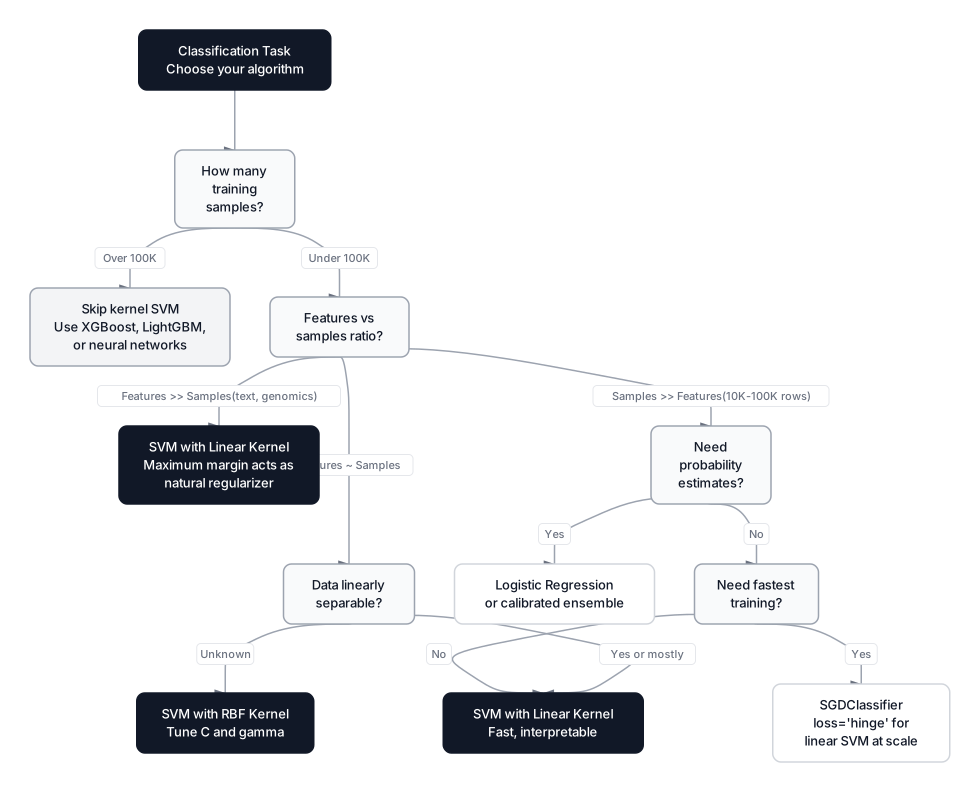 Click to expandDecision flowchart for choosing SVM versus other classifiers
Feature scaling is non-negotiable for SVMs
SVMs compute distances and dot products, so features with larger ranges dominate the margin calculation. If word frequency ranges from 0 to 100 and link count ranges from 0 to 5, the SVM will almost entirely ignore link count.
Two common approaches:
| Scaler | Formula | When to use |
|---|---|---|
StandardScaler | General purpose; assumes roughly Gaussian features | |
MinMaxScaler | When you want features in $[0, 1]$; preserves zero entries in sparse data |
Warning: Always fit the scaler on the training set only, then transform both train and test. Fitting on the test set leaks information and inflates your accuracy estimates. This is the single most common SVM mistake I see in production code. For a deeper dive, see Standardization vs Normalization.
Complete SVM classification in Python
The code below classifies a nonlinear dataset (two interleaving half-moons) using scikit-learn's SVC with an RBF kernel. It includes proper scaling, training, evaluation, and decision boundary visualization.
Expected output:
Test accuracy: 0.9400
Support vectors per class: [32 32]
Total support vectors: 64 out of 400 training samples

Classification Report:
              precision    recall  f1-score   support

    Not-spam       0.94      0.94      0.94        50
        Spam       0.94      0.94      0.94        50

    accuracy                           0.94       100
   macro avg       0.94      0.94      0.94       100
weighted avg       0.94      0.94      0.94       100
Hyperparameter tuning with GridSearchCV
Tuning C and gamma simultaneously is essential for RBF SVMs. Here's a practical tuning pipeline:
Expected output:
Best parameters: {'C': 1, 'gamma': 1, 'kernel': 'rbf'}
Best CV accuracy: 0.9550
Test accuracy:    0.9500

Top 5 parameter combinations:
 param_C param_gamma  mean_test_score  std_test_score
     1.0           1           0.9550        0.024495
    10.0       scale           0.9550        0.024495
   100.0       scale           0.9550        0.023184
    10.0           1           0.9525        0.030000
   100.0           1           0.9500        0.028504
Pro Tip: For larger datasets or wider parameter grids, replace GridSearchCV with RandomizedSearchCV or use Optuna for Bayesian optimization. Grid search with 5 C values x 5 gamma values x 5 folds = 125 model fits. That's fine for 500 samples, but brutal for 50,000. See our hyperparameter tuning guide for more details.
Comparing SVM kernel performance
Let's see how different kernels perform on the same dataset:
Expected output:
Kernel                CV Accuracy  Test Accuracy  Support Vectors
------------------------------------------------------------------
Linear                    0.8500        0.8300             130
Polynomial (d=3)          0.8575        0.8400             132
RBF                       0.9550        0.9400              64
The RBF kernel achieves the highest accuracy with the fewest support vectors on this nonlinear dataset. The linear kernel struggles because the half-moon data isn't linearly separable. This is exactly the scenario where kernels earn their keep.
SVM quick-reference parameter cheat sheet
| Parameter | Class | Default | Typical range | What it does |
|---|---|---|---|---|
C | SVC, SVR | 1.0 | 0.001-1000 (log scale) | Tradeoff between margin width and misclassification penalty |
kernel | SVC, SVR | 'rbf' | 'linear', 'poly', 'rbf', 'sigmoid' | Type of decision boundary |
gamma | SVC, SVR | 'scale' | 'scale', 'auto', 0.001-10 | Reach of each support vector (RBF, poly, sigmoid only) |
degree | SVC, SVR | 3 | 2-5 | Polynomial degree (poly kernel only) |
epsilon | SVR | 0.1 | 0.01-1.0 | Tube width for zero-loss zone in regression |
class_weight | SVC | None | 'balanced', dict | Adjusts C per class for imbalanced data |
probability | SVC | False | True/False | Enables Platt scaling for probability output (slower) |
max_iter | All | -1 (no limit) | 1000-100000 | Iteration cap; increase if convergence warning appears |
When an SVM Fits
Support vector machines combine geometric elegance with mathematical rigor. The core idea (find the widest margin between classes) produces a convex optimization problem with a single global minimum and strong theoretical guarantees that most ML algorithms can't match. The kernel trick extends this framework to nonlinear boundaries without sacrificing convexity, and the C and gamma hyperparameters give you precise control over the bias-variance tradeoff.
SVMs remain the go-to method for high-dimensional, small-sample classification: text categorization, genomics, medical imaging. For everything else, they've largely given ground to gradient-boosted trees on tabular data and deep learning on unstructured data. But the concepts behind SVMs (margins, duality, kernel functions, regularization) form the intellectual backbone of modern ML. Understanding them makes you better at every other algorithm.
If you're building out your supervised learning toolkit, pair this guide with logistic regression for the probabilistic counterpart to SVMs, decision trees to see how rule-based splitting handles nonlinearity without kernels, and K-nearest neighbors for a distance-based approach that makes zero assumptions about boundary shape.
Frequently Asked Interview Questions
Q: What makes SVMs different from logistic regression for binary classification?
SVMs maximize the geometric margin between classes, focusing only on the hardest-to-classify points (support vectors). Logistic regression minimizes log-loss across all training points, producing probability estimates natively. SVMs tend to outperform logistic regression when classes are well-separated and features are high-dimensional. Logistic regression wins when you need calibrated probabilities or when the dataset is very large.
Q: Why do SVMs require feature scaling while decision trees don't?
SVMs compute dot products and distances to define the margin. Features with larger numerical ranges dominate these calculations, distorting the boundary. Decision trees split on individual features independently using threshold comparisons, so the absolute scale of each feature doesn't matter. Always apply StandardScaler or MinMaxScaler before training an SVM.
Q: A colleague trained an SVM on 500K rows and it's been running for hours. What do you suggest?
Kernel SVMs (libsvm) scale between and , making them impractical beyond roughly 50-100K samples. I'd switch to LinearSVC (which uses liblinear and scales as ) if a linear boundary suffices, or SGDClassifier(loss='hinge') for even faster stochastic optimization. If the problem requires a nonlinear boundary at that scale, gradient-boosted trees are the better tool.
Q: Explain the kernel trick in simple terms.
The kernel trick lets an SVM learn nonlinear boundaries without actually transforming the data into a higher-dimensional space. It works because the SVM's dual formulation depends only on dot products between data points. A kernel function computes what that dot product would be in the high-dimensional space, using only the original features. The RBF kernel, for example, implicitly maps to infinite dimensions, but you never compute or store those features.
Q: How would you diagnose an overfitting SVM?
High training accuracy but low test/validation accuracy is the classic sign. For RBF SVMs, overfitting usually means C is too high (the model contorts the boundary to classify every training point) or gamma is too high (the boundary wraps tightly around individual points). The fix: reduce C, reduce gamma, or both. Use cross-validation to find the sweet spot. Also check the number of support vectors: if it's close to the total training set size, the model isn't generalizing.
Q: When would you choose an SVM over XGBoost in 2026?
SVMs still dominate when features vastly outnumber samples (text classification with TF-IDF, genomics with 20,000 genes and 200 patients). They also have strong theoretical guarantees from the maximum-margin principle. But for typical tabular data with thousands to millions of rows, XGBoost or LightGBM almost always wins on both accuracy and training speed. Pick SVMs for small-sample, high-dimensional problems; pick boosted trees for everything else.
Q: What's the role of slack variables in soft-margin SVM?
Slack variables relax the hard-margin constraint, allowing individual data points to violate the margin or even land on the wrong side of the boundary. Each violation costs in the objective function. This tradeoff between margin width and misclassification tolerance is what makes SVMs work on real-world data where perfect separation is impossible. The parameter C controls how expensive each violation is.
Q: How does SVR differ from standard regression algorithms like linear regression?
Standard linear regression minimizes the total squared error across all predictions. SVR defines an -tube around the predicted function and ignores errors smaller than entirely. Only points outside the tube contribute to the loss. This makes SVR more robust to small noise and outliers within the tolerance band. The kernel trick also lets SVR learn nonlinear functions, which basic linear regression can't do without manual feature engineering.
Hands-On Practice
While Support Vector Machines (SVM) are famous for classification, their geometric power extends smoothly to regression tasks through Support Vector Regression (SVR). In this hands-on tutorial, you will apply the core concepts of margins and hyperplanes to predict housing prices, learning how SVR attempts to fit the error within a specific threshold rather than just minimizing it blindly. Using the House Prices dataset, we will implement an SVR model to understand how kernel tricks and regularization parameters like 'C' influence the model's ability to capture complex relationships between square footage and price.
Dataset: House Prices (Linear) House pricing data with clear linear relationships. Square footage strongly predicts price (R² ≈ 0.87). Perfect for demonstrating linear regression fundamentals.
Try modifying the C parameter (e.g., change from 100 to 1 or 1000) to see how strictly the model tries to fit the training data; a lower C creates a smoother, more generalized boundary, while a higher C attempts to capture every nuance. You can also experiment with the epsilon parameter to widen or narrow the 'tube' of error tolerance, which directly visualizes the SVM's unique concept of ignoring small errors. Finally, try changing the kernel from 'rbf' to 'linear' to see if a simple straight hyperplane can perform just as well on this dataset.