
A single decision tree is fast to train, easy to explain, and dangerously brittle. Change a handful of training rows and the entire tree structure reshapes itself, producing wildly different predictions on the same test set. This high variance is one reason teams often prefer ensembles when prediction stability matters. Random Forest fixes it by growing hundreds of trees on slightly different views of the data, then combining their votes into a single prediction that is far more stable than any individual tree could produce.
Leo Breiman formalized the algorithm in his 2001 paper (cited over 100,000 times as of 2026), and it remains one of the most widely deployed supervised learning methods across industries from healthcare to finance. Throughout this article, we will build one consistent example: predicting employee attrition from a dataset with four features (satisfaction score, average monthly hours, tenure in years, and department). Every formula, code block, and diagram references this same scenario so the ideas compound rather than scatter.
The Two Mechanisms Behind Random Forest
Random Forest is a supervised ensemble method that trains many decision trees in parallel and aggregates their outputs. Classification tasks use majority vote (the class most trees predict). Regression tasks use the mean of all tree predictions. Two mechanisms force diversity among the trees, and without both, the forest collapses back into a single repeated guess.
Bagging (Bootstrap Aggregating). Each tree trains on a different bootstrap sample of the dataset: a random draw of rows sampled with replacement from the original rows. Some rows appear multiple times in a given sample, while roughly 36.8% are left out entirely.
Feature randomness. At every split inside every tree, the algorithm restricts the candidate feature set to a random subset of features out of the total . For classification, the default is ; for regression, $m = p/3$.
Bagging alone decorrelates trees somewhat by giving each one a different subset of rows. Feature randomness goes further by preventing a single dominant predictor, say satisfaction_score, from appearing as the root split in every tree. Together, these two mechanisms guarantee the trees learn different decision boundaries, which is the entire reason their combined vote outperforms any single tree.
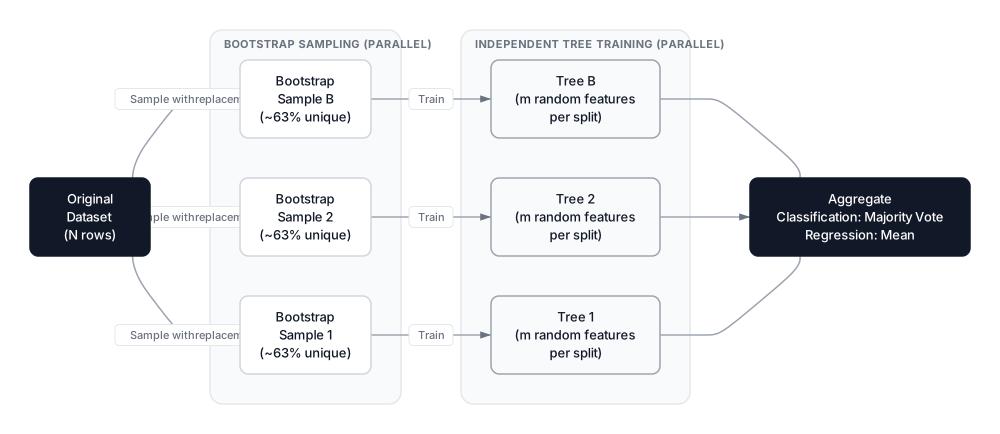 Click to expandBagging pipeline showing bootstrap sampling, parallel tree training, and prediction aggregation
Variance Reduction Through Decorrelation
The theoretical justification for Random Forest ties directly to the bias-variance tradeoff. A single deep decision tree has low bias (it fits training data well) but high variance (it shifts dramatically with new data). Averaging many such trees keeps the low bias but shrinks the variance, provided the trees are not all making the same errors.
If trees were completely independent, each with variance , the variance of their average would simply be . But trees trained on the same dataset are never fully independent. The general formula for the variance of an average of correlated estimators is:
Where:
- is the ensemble prediction (the average of all tree outputs)
- is the average pairwise correlation between any two trees in the forest
- is the variance of a single tree's prediction
- is the number of trees in the forest
In Plain English: Consider our attrition model with 200 trees. Increasing from 100 to 200 shrinks the second term toward zero, but the first term, , stays put. That first term is the floor: the irreducible ensemble variance that depends entirely on how correlated the trees are. If every tree splits on satisfaction_score first, stays high and the forest barely improves over a single tree. Feature randomness forces some trees to split on hours_worked or tenure_years first, which pushes down and lowers that floor.
This is why max_features is the single most impactful hyperparameter. Smaller values increase tree diversity (lower ) at the cost of individual tree accuracy (higher ). Larger values produce stronger individual trees but more correlated ones. The defaults of and represent well-tested compromises between these opposing forces.
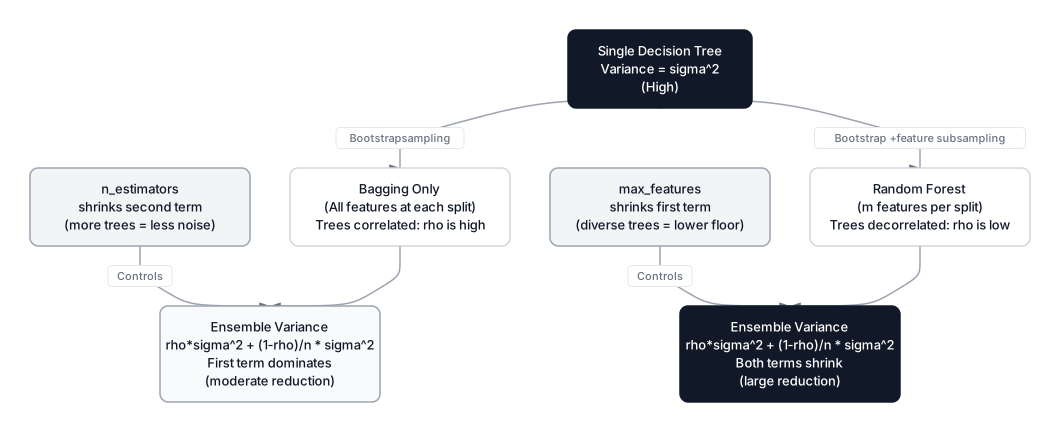 Click to expandHow feature subsampling and bagging reduce tree correlation and ensemble variance
The Bagging Process Step by Step
Understanding bagging concretely matters more than memorizing it abstractly. Here is the full procedure for our attrition dataset with $N = 5,000$ employees and $p = 4$ features.
Step 1: Bootstrap sampling. For each of the trees (say $B = 300$), draw 5,000 rows from the dataset with replacement. Each bootstrap sample contains roughly 63.2% unique rows and 36.8% duplicates. The missing rows become Out-of-Bag (OOB) samples.
Step 2: Tree training. Grow a full, unpruned decision tree on each bootstrap sample. At every split, randomly select candidate features, evaluate every possible threshold among those two features, and pick the split that maximizes impurity reduction (Gini or entropy).
Step 3: Aggregation. For a new employee with known features, pass their data through all 300 trees.
- Classification: Each tree votes "Will leave" or "Will stay." The class with the most votes wins.
- Regression: Each tree outputs a numeric prediction (e.g., expected months until attrition). The forest returns the mean.
Key Insight: The prediction probabilities from predict_proba are more useful in practice than hard class labels. They represent the fraction of trees voting for each class, giving you a calibrated confidence score for free. An employee where 285 out of 300 trees predict "Will leave" is a more urgent retention case than one where the split is 155/145.
Out-of-Bag Evaluation
Every bootstrap sample leaves out roughly 36.8% of the training data. Those leftover rows were never seen by that particular tree. This creates a free validation mechanism that closely approximates cross-validation performance, often within 1-2%.
For each training row:
- Identify every tree whose bootstrap sample did not include that row.
- Collect predictions from only those trees.
- Aggregate them (majority vote for classification, mean for regression).
- Compare the OOB prediction to the true label.
Pro Tip: In scikit-learn, set oob_score=True when initializing RandomForestClassifier. After fitting, check model.oob_score_. If it diverges significantly from test accuracy, your test set may not be representative of the training distribution, a signal worth investigating before deployment.
Feature Importance: Two Competing Methods
One of Random Forest's most practical outputs is a ranking of which features matter most. Two approaches exist, and they disagree more often than practitioners expect.
Impurity-Based Importance (Mean Decrease in Impurity)
Every time a tree splits on a feature, the impurity (Gini index or entropy) decreases by some amount. Impurity-based importance sums these reductions across all trees and normalizes.
Where:
- is the total number of trees in the forest
- is the set of all internal (non-leaf) nodes in tree
- $v(t) = f$ means node splits on feature
- is the fraction of training samples reaching node
- is the decrease in impurity (Gini or entropy) caused by the split at node
In Plain English: Across our 300 attrition trees, satisfaction_score might appear as the splitting feature at 4,200 different nodes. At each of those nodes, the split made the child groups purer (less mixed between "stayed" and "left"). We add up all that "cleanup" work and divide by the total cleanup across all features. If satisfaction_score accounts for 38% of the total impurity reduction, its importance score is 0.38.
The catch. This method is biased toward high-cardinality features and features with many possible split points. A numeric feature with 500 unique values gets more chances to appear as a split than a binary feature, even if the binary feature carries more real signal. Scikit-learn's feature_importances_ attribute uses this method by default.
Permutation Importance
Permutation importance measures how much a model's performance degrades when a feature's values are randomly shuffled, breaking the relationship between that feature and the target.
- Train the forest and record a baseline accuracy (say 0.91 on the test set).
- Take the
satisfaction_scorecolumn and shuffle it randomly. - Pass the corrupted dataset through the fitted forest.
- If accuracy drops to 0.74, the importance of
satisfaction_scoreis $0.91 - 0.74 = 0.17$. - Repeat for every feature.
Permutation importance is model-agnostic, works on any scoring metric, and does not suffer from the cardinality bias. The tradeoff is computation: it requires one full prediction pass per feature. Scikit-learn provides this through sklearn.inspection.permutation_importance.
Common Pitfall: Permutation importance can undervalue a feature when two features are highly correlated. Shuffling hours_worked barely hurts accuracy if overtime_flag (which is derived from hours) still provides the same information. Always check feature correlations before interpreting permutation importance results.
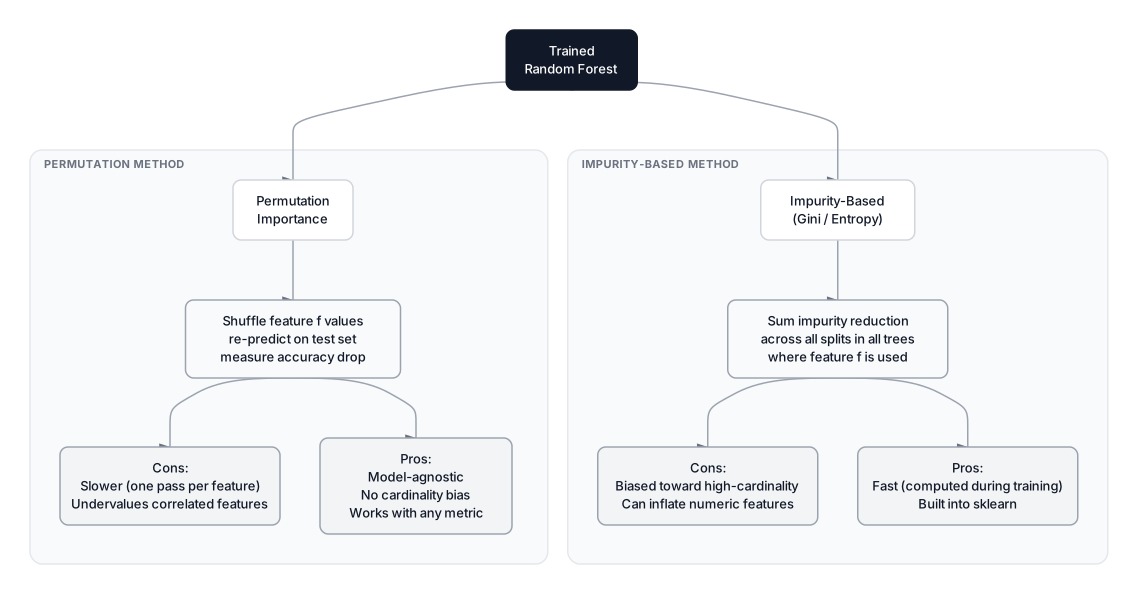 Click to expandComparison of impurity-based vs permutation importance methods, with pros and cons of each
Hyperparameter Tuning Guide
Random Forest works well with default settings, which is part of its appeal. But when you need to push performance further, these are the knobs that matter, ordered by impact.
| Hyperparameter | What It Controls | Default | Tuning Direction |
|---|---|---|---|
n_estimators | Number of trees | 100 | More trees reduce variance with diminishing returns past 300-500. No overfitting risk. |
max_features | Features per split | sqrt(p) (clf), p/3 (reg) | Lower values increase diversity (lower ), higher values strengthen individual trees. |
min_samples_leaf | Minimum samples in a leaf | 1 | Increasing to 5-20 smooths predictions and acts as regularization. |
max_depth | Maximum tree depth | None (unlimited) | Capping at 15-25 saves memory. Usually less impactful if min_samples_leaf is tuned. |
max_samples | Bootstrap sample size | Setting to 0.7-0.9 increases tree diversity at the cost of individual accuracy. | |
class_weight | Handling class imbalance | None | Set to "balanced" when the minority class is underrepresented. |
The key insight for hyperparameter tuning is that n_estimators and max_features interact with the variance formula directly. More trees shrinks the term, and lower max_features shrinks . Tune them together, not in isolation.
Pro Tip: Start with n_estimators=500 and oob_score=True. Plot OOB error as a function of tree count. Once the curve flattens, you have found your sweet spot without needing a separate validation set.
Running Example: Predicting Employee Attrition
Time to put everything together. This code trains a Random Forest classifier on our attrition dataset, evaluates it with OOB scoring, and compares impurity-based and permutation importance side by side.
Expected Output:
=== Random Forest: Employee Attrition ===
OOB Score:      0.8875
Test Accuracy:  0.8812

              precision    recall  f1-score   support

      Stayed       0.91      0.95      0.93       133
        Left       0.68      0.56      0.61        27

    accuracy                           0.88       160
   macro avg       0.80      0.75      0.77       160
weighted avg       0.87      0.88      0.88       160

Impurity-Based Importance:
  satisfaction         0.7352
  hours_worked         0.1393
  tenure_years         0.1020
  department           0.0235

Permutation Importance:
  satisfaction         0.1244
  tenure_years         0.0075
  department           0.0006
  hours_worked         -0.0013
Both importance methods agree that satisfaction is the strongest predictor, but the magnitudes differ substantially. Impurity-based importance gives department 7.9% importance because it has four unique split points that collectively reduce impurity across many trees. Permutation importance tells a clearer story: shuffling department barely hurts accuracy (0.25%), meaning the model does not actually depend on it for correct predictions.
When to Use Random Forest
Random Forest is a strong default choice, but no algorithm fits every situation. Here is a practical decision framework.
Use Random Forest when:
- You need a reliable baseline model with minimal preprocessing (no scaling required)
- The dataset has mixed numeric and categorical features with moderate dimensionality (under 500 features)
- Interpretability through feature importance matters to stakeholders
- Training time needs to stay short, since trees train in parallel
- You want built-in OOB validation without the overhead of cross-validation
Do NOT use Random Forest when:
- You need maximum accuracy on structured tabular data. Gradient boosting methods like XGBoost typically outperform Random Forest by 1-3%.
- The dataset is very high-dimensional and sparse (thousands of features with mostly zeros), where linear models or boosting with L1 regularization work better.
- Real-time inference latency is critical. A 500-tree forest requires 500 traversals per prediction, which can be too slow for sub-millisecond requirements.
- The relationship between features and target is primarily linear. A regularized linear model will be faster, more interpretable, and similarly accurate.
- You are working with image, text, or sequential data. Neural network architectures dominate these domains.
| Scenario | Best Choice | Why |
|---|---|---|
| Quick baseline on tabular data | Random Forest | Minimal tuning, good out of the box |
| Kaggle competition final model | XGBoost / LightGBM | Higher ceiling with careful tuning |
| Need to explain predictions to executives | Random Forest | Feature importance is intuitive |
| Millions of rows, 1000+ features | LightGBM | Faster training, lower memory |
| Streaming data, model updated hourly | Online learners | Random Forest requires full retrain |
Production Considerations
Time complexity. Training is where is the number of trees, is sample size, and is features per split. Since trees are independent, training parallelizes linearly across CPU cores.
Space complexity. Each tree stores its full structure in memory. A 500-tree forest on a large dataset can consume several gigabytes. Control tree size with max_depth and min_samples_leaf when memory matters.
Prediction latency. Inference requires traversing all trees. For a 500-tree forest with depth 20, that is 10,000 node comparisons per sample. Batch predictions are fast due to CPU caching, but single-sample latency can be a bottleneck in serving systems.
Pro Tip: If prediction speed matters, train a large forest, measure performance, then try halving n_estimators. If accuracy barely drops, you were carrying dead weight. Many production forests run fine with 100-200 trees despite being trained with 500.
When Random Forest Is the Right Baseline
Random Forest earns its reputation as the workhorse of tabular machine learning by doing one thing exceptionally well: turning a collection of high-variance, overfit-prone decision trees into a stable, accurate ensemble. The math is straightforward. Bagging reduces variance by averaging. Feature randomness decorrelates the trees so that averaging actually works. OOB evaluation gives you a validation score without extra computation. And feature importance, especially the permutation variant, provides the interpretability that stakeholders consistently demand.
The algorithm is not perfect. It will rarely match the peak accuracy of a well-tuned XGBoost model on competitive benchmarks, and its memory footprint grows linearly with tree count. But for the vast majority of production scenarios where reliability, speed of development, and explainability matter more than marginal accuracy gains, Random Forest remains the first model worth training and often the last one you need.
For a deeper treatment of how individual trees make splitting decisions, see the Decision Trees guide. To understand how boosting takes the opposite approach by building trees sequentially to correct errors, read the Gradient Boosting article.
Interview Questions
1. Random Forest reduces variance but not bias. Why?
Each individual tree is grown deep and has low bias but high variance. Averaging many such trees preserves the low bias (since averaging does not introduce systematic error) but cancels out the uncorrelated portions of variance across trees. The forest's bias is approximately equal to a single tree's bias, while its variance drops as shrinks with more decorrelated trees.
2. Setting max_features equal to the total feature count effectively disables feature randomness.
Correct. You get bagged decision trees, not a Random Forest. Every tree sees all features at every split, so they select the same dominant features and produce highly correlated trees ( approaches 1). The ensemble still benefits somewhat from bootstrap sampling, but far less than a true Random Forest with restricted feature subsets.
3. The OOB score is 0.88 but test accuracy is 0.79. Diagnosing the gap.
This gap usually indicates a distribution shift between training and test data. OOB evaluation measures performance on held-out portions of the training set, which shares the same distribution as the training data. If the test set comes from a different time period, geography, or population segment, the model's effective accuracy drops. Investigate whether the test set's feature distributions have shifted relative to training.
4. Handling a dataset with 95% negative and 5% positive examples.
Three practical approaches: set class_weight="balanced" so the loss function penalizes misclassification of the minority class proportionally, undersample the majority class in each bootstrap sample using BalancedRandomForestClassifier from imbalanced-learn, or adjust the classification threshold on predict_proba output. Avoid oversampling with SMOTE before bagging, since bootstrap sampling already introduces duplication and the interaction can distort class boundaries.
5. Gini importance and permutation importance disagree. Which do you trust?
Gini importance accumulates impurity reduction from every split involving a feature across all trees. It is computed during training and biased toward high-cardinality features. Permutation importance measures the drop in a chosen metric when a feature's values are shuffled at test time. They disagree most when features have different cardinalities or when two features are correlated. Permutation importance is more trustworthy for feature selection decisions because it measures actual prediction impact rather than structural contribution.
6. "More trees can never cause overfitting." True or false?
True in practice. Unlike gradient boosting where adding more iterations can overfit, each additional tree in Random Forest is trained independently on a bootstrap sample and then averaged. Adding more trees monotonically reduces variance without increasing bias. The only downside is increased computation and memory. Breiman proved this convergence property in the original 2001 paper.
7. How does Random Forest handle missing values?
Scikit-learn's implementation supports missing values natively since version 1.4. During each split evaluation, the splitter tests sending missing values to both left and right child nodes and picks whichever direction reduces impurity more. Some other implementations (H2O, R's randomForest) use surrogate splits instead. In interviews, always clarify which implementation you are discussing.
Hands-On Practice
Understanding Random Forest requires seeing the 'wisdom of the crowd' in action, rather than just reading about ensemble theory. In this hands-on tutorial, you will build a solid Random Forest Classifier to predict customer churn, demonstrating how combining multiple decision trees stabilizes predictions and reduces overfitting compared to single models. We will use the E-commerce Transactions dataset, which provides rich behavioral data like tenure, spending habits, and satisfaction scores, ideal features for observing how Random Forest handles complex, non-linear relationships.
Dataset: E-commerce Transactions Customer transactions with demographics, product categories, payment methods, and churn indicators. Perfect for regression, classification, and customer analytics.
Now that you have a working forest, try experimenting with the n_estimators parameter by changing it from 100 to 10 and then to 500 to observe how model stability changes. You should also investigate min_samples_leaf; increasing this value forces trees to be more general and can further reduce overfitting. Finally, try removing the least important feature identified in the plot to see if you can maintain accuracy with a simpler model.