
In January 2025, a Chinese AI lab released a reasoning model under an MIT license that matched OpenAI's o1 on several benchmarks. The company reported a $5.9 million training cost for the underlying model, and NVIDIA lost $589 billion in market value in a single day. The release intensified the debate over open-weight models and proprietary APIs.
Fourteen months later, the open source vs closed source LLM debate has only intensified. Qwen 3.5 scores 88.4 on GPQA Diamond, beating every closed model except the most expensive frontier options. Kimi K2.5 hits 99.0 on HumanEval. Meanwhile, GPT-5.3 Codex and Claude Opus 4.6 keep pushing the ceiling on agentic coding and complex reasoning. If you're choosing a model for production in March 2026, this guide gives you the data, the economics, and the decision framework to choose well.
The Performance Gap Collapsed in 18 Months
The benchmark distance between open source and closed source LLMs has shrunk from a canyon to a crack. At the end of 2023, the best closed model scored around 88% on MMLU while the best open alternative managed roughly 70.5%, a gap of 17.5 percentage points. By early 2026, that gap is effectively zero on knowledge benchmarks, and single digits on most reasoning tasks.
The Stanford AI Index 2025 Report confirmed this convergence across multiple evaluation suites. Here is where things stand:
| Benchmark | Best Open Model | Score | Best Closed Model | Score |
|---|---|---|---|---|
| MMLU | Kimi K2.5 | 92.0 | Gemini 3 Pro | ~92 |
| MATH-500 | Kimi K2.5 | 98.0 | OpenAI o3 | ~97 |
| AIME 2025 | Step-3.5-Flash | 97.3 | OpenAI o3 | 96.7 |
| GPQA Diamond | Qwen 3.5-397B | 88.4 | Claude Opus 4.6 | ~85 |
| HumanEval | Kimi K2.5 | 99.0 | GPT-5.3 Codex | ~96 |
| SWE-bench Verified | Qwen 3.5-397B | 76.4 | Claude Opus 4.6 | ~80 |
| Chatbot Arena Elo | Kimi K2.5 | 1447 | Gemini 3.1 Pro | ~1510 |
The pattern is clear. Open models now match or beat closed models on knowledge (MMLU), math (MATH-500, AIME), and even graduate-level science (GPQA Diamond). Closed models maintain a lead on production coding (SWE-bench), overall human preference (Chatbot Arena), and complex agentic tasks. That remaining gap is real, but it narrows with every quarterly release cycle.
Key Insight: The performance convergence is not a single-model story. Five independent open model families (DeepSeek, Qwen, Kimi, GLM, Mistral) simultaneously reached frontier quality, making the trend structural rather than a one-off anomaly.
The Open Source Model Families in 2026
The open model ecosystem has matured into five dominant families, each with distinct strengths and licensing terms. Understanding their differences matters more than knowing which one "wins" on any single benchmark.
DeepSeek: The Cost-Efficiency Pioneer
DeepSeek R1, released in January 2025 under an MIT license, was an important milestone for open-weight reasoning models. Built on the DeepSeek V3 base (671B total parameters, 37B active per token via Mixture-of-Experts), R1 used reinforcement learning to improve reasoning behavior. DeepSeek reported an approximately $5.9 million training cost for V3's final training run; that figure should not be presented as the complete cost of developing R1.
DeepSeek kept iterating. V3-0324 (March 2025) outperformed GPT-4.5 on math and coding. R1-0528 (May 2025) climbed to second on AIME behind only o3. By late 2025, DeepSeek V3.2 reached an LMArena Elo of ~1421, matching Qwen 3 235B and placing it firmly in the S-tier of open models. Key innovations include FP8 mixed-precision training at scale, Multi-Head Latent Attention (MLA) reducing KV cache by 93.3%, and Group Relative Policy Optimization (GRPO) cutting RL costs by roughly 50%.
DeepSeek V4, expected imminently as of March 2026, targets 1 trillion total parameters with 32B active, native multimodality, and a 1M-token context window, all trained on Huawei Ascend chips rather than NVIDIA hardware.
Qwen 3.5: The New Open Frontier
Alibaba's Qwen team released Qwen 3.5 on February 16, 2026, and it immediately became the strongest open model on several reasoning benchmarks. The flagship Qwen3.5-397B-A17B uses a MoE architecture (397B total, 17B active) and scores 88.4 on GPQA Diamond, surpassing every other open model. Its SWE-bench Verified score of 76.4 and IFEval score of 92.6 demonstrate strong coding and instruction-following capability.
The earlier Qwen 3 family (April 2025) introduced hybrid thinking modes, letting a single model toggle between fast inference and slow chain-of-thought reasoning. Every Qwen model ships under Apache 2.0, allowing unrestricted commercial use, modification, and redistribution with no monthly active user limits.
Kimi K2.5: The Coding and Math Champion
Moonshot AI's Kimi K2.5 packs 1 trillion total parameters with 32B active across 384 experts. It posts the highest HumanEval score ever recorded (99.0) and scores 96.1 on AIME 2025. With a Chatbot Arena rating of 1447, it sits among the top three open models for human preference. The model is a native multimodal system supporting text, image, and video input with a 256K context window.
Llama 4 and Mistral Large 3
Meta's Llama 4 (April 2025) pushed context length boundaries with Scout's 10M-token window and Maverick's 400B/17B MoE architecture. However, Llama ships under the Llama Community License, not Apache 2.0 or MIT. Any organization with 700 million or more monthly active users needs separate permission from Meta, and "Built with Llama" attribution is required.
Mistral Large 3 (December 2025) is a 675B/41B MoE model with a 256K context window, scoring 93.60% on MATH-500. The significant development: Mistral Large 3 ships under Apache 2.0, a shift from the restrictive custom licenses Mistral used for its earlier large models.
Pro Tip: For small-model deployments, Microsoft's Phi-4 (14B, MIT license) approaches full DeepSeek R1 performance on AIME 2025. A 14B model rivaling a 671B model makes Phi-4 the poster child for efficient small language models, perfect for edge and on-device use cases.
The Closed Source Lineup in 2026
Closed models compete primarily on three axes: peak capability on the hardest tasks, ease of integration, and specialized features like extended context or agentic coding.
| Model | Provider | Release | Context | Input $/MTok | Output $/MTok |
|---|---|---|---|---|---|
| Claude Opus 4.6 | Anthropic | Feb 2026 | 200K (1M beta) | $5.00 | $25.00 |
| GPT-5.3 Codex | OpenAI | Feb 2026 | 400K | $1.75 | $14.00 |
| GPT-5.2 | OpenAI | Dec 2025 | 400K | $1.75 | $14.00 |
| Gemini 3.1 Pro | Feb 2026 | 1M | $2.00 | $12.00 | |
| Claude Sonnet 4.5 | Anthropic | Sep 2025 | 200K (1M beta) | $3.00 | $15.00 |
| o3 | OpenAI | Apr 2025 | 200K | $2.00 | $8.00 |
Budget-tier closed models have become remarkably cheap. GPT-4.1 nano costs just $0.10/$0.40 per million tokens, and Gemini 2.5 Flash runs at $0.50/$3.00. All major providers now offer prompt caching with 50-90% discounts on repeated input tokens. Claude Opus 4.6's cached reads cost just $0.50 per million tokens, 10% of the base rate.
Key Insight: LLM inference costs have dropped roughly 10x annually. GPT-4-equivalent performance cost $20 per million tokens in late 2022 and approximately $0.40 per million tokens in early 2026.
The Licensing Spectrum: "Open" Doesn't Mean What You Think
One of the most misunderstood aspects of this debate is what "open" actually means. The Open Source Initiative (OSI) published the Open Source AI Definition (OSAID) 1.0 in October 2024, establishing clear criteria: an open-source AI model must provide sufficiently detailed data information, complete training code, and model weights, and must allow use for any purpose, study, modification, and sharing without restriction.
By this strict definition, almost none of the popular "open" models qualify. DeepSeek R1, Llama 4, Qwen 3.5, and Mistral Large 3 all release weights but not their training data. The models that do meet OSI's standard (Pythia, OLMo, T5) are not the ones topping benchmark leaderboards.
What most people call "open-source LLMs" are more accurately called "open-weight models." The practical distinction matters because the license attached to those weights determines what you can actually build:
 Click to expandLLM licensing spectrum from fully permissive to closed source
| License Tier | License | Models | Key Restrictions |
|---|---|---|---|
| Fully permissive | MIT | DeepSeek R1, Phi-4 | None |
| Fully permissive | Apache 2.0 | Qwen 3.5, Mistral Large 3 | None |
| Conditionally permissive | Llama Community | Llama 4, Llama 3.x | 700M MAU limit, attribution required |
| Restrictive | Gemma ToU | Gemma 3 | Google can remotely restrict usage |
| Closed | Proprietary | GPT-5.x, Claude 4.x, Gemini 3.x | API-only, no weight access |
For enterprise deployments, this spectrum matters enormously. A company building on Llama 4 faces different legal exposure than one building on Qwen 3.5, even though both are commonly called "open source." If you're building a product where licensing risk is a concern, stick with MIT or Apache 2.0 models.
The Economics: When Self-Hosting Beats API Calls
The decision to self-host an open model versus calling a closed API is fundamentally an economic calculation. The math has shifted dramatically in favor of self-hosting at scale, but the full picture includes costs most teams underestimate.
API Cost Comparison at Production Volume
Consider a production application processing 10 million tokens per day (roughly 7.5 million words, a mid-size customer support chatbot or document processing pipeline):
| Approach | Monthly Cost | Annual Cost |
|---|---|---|
| GPT-5.2 API (50/50 input/output split) | ~$36,000 | ~$432,000 |
| Claude Sonnet 4.5 API | ~$41,400 | ~$496,800 |
| Gemini 3.1 Pro API | ~$32,200 | ~$386,400 |
| Llama 3.3 70B on Groq (managed) | ~$10,000 | ~$120,000 |
| Llama 3.3 70B self-hosted (2x H100) | ~$4,500 | ~$54,000 |
Pro Tip: The breakeven point between premium closed APIs and self-hosted open models is approximately 5-10 million tokens per month. Below that volume, APIs are simpler and cheaper. Above it, self-hosting saves 50-90% annually.
Hardware Requirements for Self-Hosting
Running open models requires understanding VRAM constraints. Here's what you need in early 2026:
| Model Size | FP16 VRAM | INT4 (Q4) VRAM | Minimum Hardware | Approximate Cost |
|---|---|---|---|---|
| 7-8B | ~14 GB | ~4-5 GB | 1x RTX 4090 (24 GB) | ~$1,600 |
| 14B | ~28 GB | ~8 GB | 1x RTX 4090 or A100 | ~$1,600-$2,000 |
| 70B | ~140 GB | ~35 GB | 2x RTX 5090 or 1x H100 | ~$4,000-$25,000 |
| 400B+ | ~960 GB | ~240 GB | 8x H100 (640 GB) | ~$200,000+ |
Cloud GPU rental prices have stabilized in early 2026. H100 80GB runs $1.49-$3.90/hour depending on provider (Vast.ai at $1.49, RunPod at $2.00-$2.69, Lambda at $2.99, AWS at $3.90). A100 80GB has dropped to $0.66-$0.78/hour on spot markets.
The Hidden Costs Most Teams Miss
Self-hosting is not just GPU rental. A realistic total cost of ownership includes:
- Infrastructure staff: At least one MLOps engineer to manage deployment, monitoring, and updates
- Inference optimization: Choosing and tuning serving frameworks (vLLM, SGLang, TensorRT-LLM)
- Quantization trade-offs: 4-bit quantization (Q4_K_M) retains approximately 92% of original quality; AWQ retains approximately 95%
- Uptime and redundancy: No SLA unless you build one yourself
- Model updates: When a better model drops, you handle the migration
A realistic minimal production deployment costs $125,000-$190,000 annually when factoring in staff time, infrastructure, and operations. That is still 50-75% cheaper than premium closed APIs at high volume, but it is not "free" just because the model weights are.
Common Pitfall: Teams often compare raw GPU costs to API prices and declare self-hosting the winner. They forget about the engineer-hours for setting up vLLM, tuning batch sizes, handling failovers, and staying current with model releases. Factor in at least 0.5 FTE of MLOps time for any production self-hosted deployment.
Where Closed Models Still Win
Despite the benchmark convergence, closed models maintain meaningful advantages in several areas that matter for production systems.
Frontier Reasoning and Agentic Tasks
On the hardest reasoning and coding tasks, closed models still lead. OpenAI's o3 scores 96.7% on AIME 2024 versus DeepSeek R1's 79.8%. Claude Opus 4.6 achieves ~80% on SWE-bench Verified, above Qwen 3.5's 76.4%. GPT-5.3 Codex sets new highs on SWE-Bench Pro and Terminal-Bench for agentic coding. For applications requiring peak performance on complex multi-step problems, closed frontier models still outperform their open counterparts.
Latency and Managed Infrastructure
Closed API providers invest heavily in inference optimization that individual teams cannot replicate. No deployment to manage, no VRAM to calculate, no models to update. For teams without MLOps expertise, the simplicity of curl is worth the premium. Automatic safety patches, rate limiting, and content filtering come built in.
Instruction Following
On IFEval, Qwen 3.5 scores an impressive 92.6%, but GPT-4.1 and Claude Opus 4.6 remain strong here as well. For applications where precise adherence to complex, multi-constraint instructions matters (structured data extraction, multi-format output generation), closed models have been fine-tuned extensively on instruction-following datasets through RLHF pipelines that open model teams are still catching up on.
Where Open Models Win
Data Sovereignty and Compliance
For healthcare organizations subject to HIPAA, financial institutions under FINRA, any company operating under GDPR, or organizations subject to the EU AI Act (with penalties up to 7% of global annual turnover), running models on your own infrastructure is often a regulatory requirement. Closed model APIs may use interactions to improve future models, and LLMs have demonstrated the ability to memorize and reproduce training examples under targeted querying.
Fine-Tuning on Proprietary Data
Closed APIs offer limited fine-tuning through parameter-efficient methods, but true weight access is exclusive to open models. The fine-tuning ecosystem in 2026 is mature. LoRA recovers 90-95% of full fine-tuning quality while training only 0.1-1% of parameters. QLoRA enables fine-tuning a 7B model on a single RTX 4090 or a 70B model on a single A100. Tools like Unsloth deliver 2x faster fine-tuning with 70% less VRAM, and Axolotl provides YAML-driven configuration for the full pipeline.
For domain-specific applications like legal document analysis, medical coding, or financial compliance, a fine-tuned 7B open model often outperforms a general-purpose frontier model while running on a single consumer GPU. This is where understanding how LLMs work at the architecture level pays off in practice.
No Vendor Lock-In
OpenAI retired 33 models in January 2025 alone. When GPT-5 launched, its changed model routing broke production workflows overnight. Companies with hundreds of prompt-based automations had to debug broken integrations under pressure. OpenAI is planning to retire GPT-4o, GPT-4.1, and o4-mini, pushing developers toward GPT-5.x.
With open models, you control the version. You can freeze a model that works and run it indefinitely. No deprecation notices, no forced migrations, no breaking changes to your prompt stack.
Managed Open Model Hosting: The Middle Ground
You don't have to self-host to use open models. Managed inference providers offer open models via API at significantly lower cost than closed alternatives:
| Provider | Llama 3.3 70B (input/output $/MTok) | Key Feature |
|---|---|---|
| Groq | $0.59 / $0.79 | LPU hardware, 800+ tok/s |
| Cerebras | $0.25 / $0.69 | WSE-3 chip, 2,900 tok/s on large models |
| Together AI | $0.88 (blended) | GPU clusters, broad model selection |
| DeepInfra | $0.36 (blended) | Lowest cost for 70B class models |
Compare Groq's $0.59/$0.79 for Llama 3.3 70B against GPT-5.2's $1.75/$14.00. That is roughly a 3-18x cost reduction while maintaining competitive quality for most tasks.
The MoE Architecture Driving Convergence
A key architectural trend explains why open models caught up so fast: Mixture-of-Experts (MoE). Every major open model released in 2025 and early 2026 uses MoE.
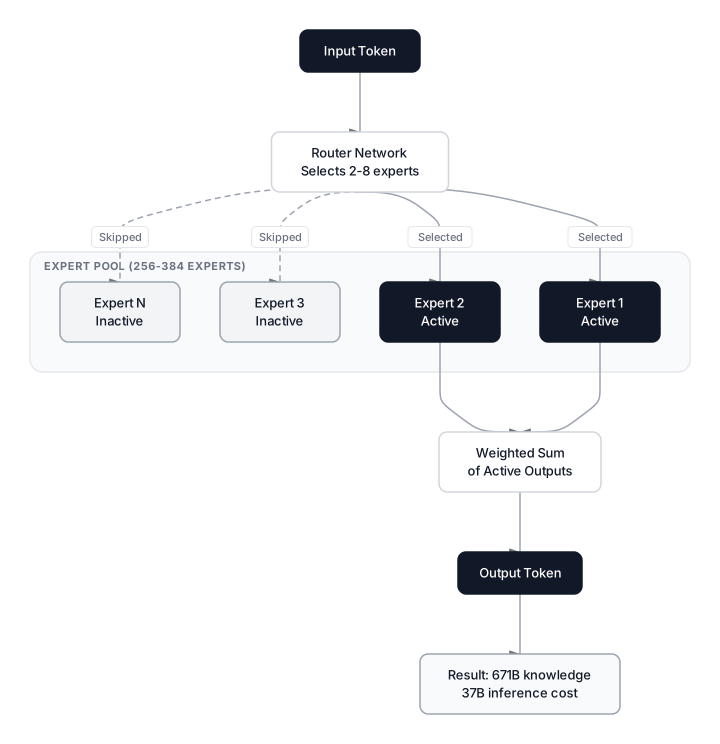 Click to expandHow MoE architecture enables open models to match closed model performance
| Model | Total Parameters | Active Parameters | Efficiency Ratio |
|---|---|---|---|
| Kimi K2.5 | 1,000B | 32B | 3.2% |
| DeepSeek V3.2 | 685B | 37B | 5.4% |
| Qwen 3.5-397B | 397B | 17B | 4.3% |
| Mistral Large 3 | 675B | 41B | 6.1% |
| Llama 4 Maverick | 400B | 17B | 4.3% |
MoE models activate only a small fraction of their total parameters per token. DeepSeek V3 has 671B total parameters but only 37B fire per token, meaning inference cost is comparable to a 37B dense model while knowledge breadth approaches that of a much larger dense model.
This architecture, combined with innovations like Multi-Head Latent Attention (93.3% KV cache reduction in DeepSeek) and FP8 training, is why a $5.9M training run can produce frontier-level models. The brute-force scaling hypothesis (that more compute always wins) has been challenged by architectural efficiency. For a deeper look at how these models process tokens internally, see How Large Language Models Actually Work.
A Practical Decision Framework
The open vs closed choice is not binary. Most production systems in 2026 use a hybrid approach. Here is a practical framework:
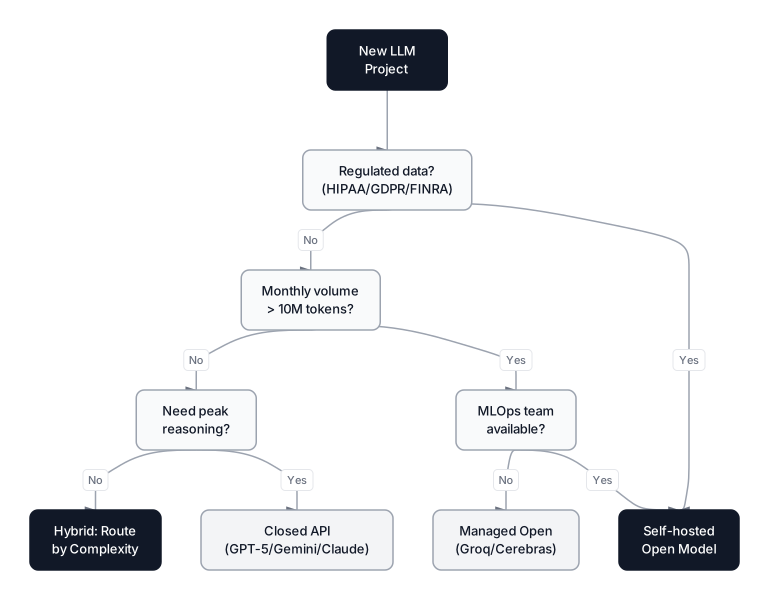 Click to expandDecision tree for choosing between open source and closed source LLMs
Choose closed APIs when:
- You need peak reasoning performance (o3, Gemini 3.1 Pro, Claude Opus 4.6)
- Your volume is under 5 million tokens per month
- You lack MLOps expertise and don't want to build it
- Speed to market matters more than per-token cost
- You need the absolute best instruction-following precision
Choose open models (self-hosted) when:
- You process more than 10 million tokens per month
- Data must stay on your infrastructure (regulatory or compliance requirements)
- You need to fine-tune on proprietary data
- Vendor lock-in is a strategic risk
- You want to freeze a specific model version long-term
Choose managed open model hosting when:
- You want open model economics without self-hosting complexity
- Latency matters (Groq and Cerebras offer industry-leading inference speed)
- You want to switch models freely without rewriting integration code
Pro Tip: A common production pattern is intelligent routing. Use a fast, cheap open model (7-14B, self-hosted or on Groq) for 80% of requests, and escalate to a frontier closed model for the 20% that require maximum capability. This can reduce costs by 70-80% versus using a frontier model for everything. Context engineering techniques help you design the routing logic that decides which tier handles each request.
Conclusion
The open-versus-closed LLM decision in March 2026 depends on capability, licensing, deployment control, and cost. DeepSeek R1, Qwen 3.5, and Kimi K2.5 report strong results on the benchmarks discussed above while offering permissive or open-weight distribution. Whether self-hosting is cheaper depends on utilization, hardware, operations, and the model quality required for the workload.
But closed models are not standing still. Gemini 3.1 Pro holds the top Chatbot Arena spot. Claude Opus 4.6 and GPT-5.3 Codex push the frontier on agentic coding. For teams that value simplicity over optimization, the managed API experience remains hard to beat.
The winning strategy in 2026 is not picking a side. It is understanding the trade-offs well enough to pick the right model for each use case. Route intelligently, benchmark on your specific workload, and do not let ideology substitute for measurement. For teams building retrieval pipelines on top of their chosen models, Retrieval-Augmented Generation (RAG) is the natural next step. And if you're working with embeddings to power semantic search alongside your LLM, our guide on text embeddings covers the full pipeline from intuition to production.
Frequently Asked Interview Questions
Q: What is the practical difference between "open source" and "open weight" LLMs?
Open-weight models release trained parameters (weights) for download and use, but typically withhold training data and sometimes training code. True open source under the OSI definition requires releasing data information, training code, and weights with no usage restrictions. Most models people call "open source" (DeepSeek R1, Qwen 3.5, Llama 4) are technically open-weight, and the license attached to those weights varies from fully permissive (MIT, Apache 2.0) to conditionally restrictive (Llama Community License).
Q: When would you recommend a closed API over self-hosting an open model?
Three scenarios favor closed APIs. First, low volume (under 5 million tokens per month), where the operational overhead of self-hosting exceeds the API premium. Second, when you need peak frontier performance on the hardest reasoning or coding tasks, where models like o3 and Claude Opus 4.6 still lead. Third, when your team lacks MLOps expertise and the time cost of setting up inference infrastructure would delay shipping.
Q: How does Mixture-of-Experts (MoE) architecture relate to the performance convergence between open and closed models?
MoE allows models to store knowledge across hundreds of billions of parameters while only activating a small subset (3-6%) per token during inference. This means a 671B MoE model costs roughly the same to run as a 37B dense model, but matches the knowledge breadth of a much larger system. Every major open model in 2025-2026 adopted MoE, enabling frontier performance at a fraction of the training and inference cost that previously required closed-lab budgets.
Q: Your company processes 50 million tokens per day of customer support conversations. You need to choose between GPT-5.2 and a self-hosted Qwen 3.5 70B. Walk through your decision process.
First, estimate monthly API cost: 50M tokens/day at GPT-5.2's blended rate would exceed $100,000/month. Self-hosting Qwen 3.5 70B on 2-4 H100s costs roughly $10,000-$15,000/month in GPU rental plus $8,000-$12,000/month in MLOps labor. The cost savings are 60-80%, so self-hosting wins on economics. Next, validate that Qwen 3.5 meets quality requirements by running a benchmark suite on your actual support conversations. Finally, assess data sensitivity: if conversations contain PII, self-hosting also addresses compliance concerns. The main risk is operational: ensure your team can maintain uptime and handle model upgrades.
Q: What are the key licensing risks when deploying Llama 4 in a commercial product?
Llama 4 uses the Llama Community License, which requires "Built with Llama" attribution, includes an acceptable use policy, and imposes a hard limit: organizations with 700 million or more monthly active users must obtain separate permission from Meta. Unlike MIT or Apache 2.0, the license terms could change in future versions, and the acceptable use policy gives Meta discretion over permitted use cases. For maximum legal safety in commercial products, MIT-licensed (DeepSeek R1) or Apache 2.0 (Qwen 3.5, Mistral Large 3) models carry less risk.
Q: Explain the trade-off between quantization and model quality for self-hosted deployments.
Quantization reduces model precision from 16-bit floating point to 4-bit or 8-bit integers, cutting VRAM requirements by 50-75%. A 70B model that normally needs ~140 GB VRAM fits into ~35 GB at INT4 quantization. The quality trade-off depends on the method: GPTQ and AWQ retain approximately 95% of original quality at 4-bit, while simpler round-to-nearest methods retain about 92%. For most production use cases (chatbots, document processing, classification), the quality loss is imperceptible. For tasks requiring maximum precision (complex math, code generation), the degradation can matter.
Q: How would you design a hybrid routing system that uses both open and closed models?
Route based on task complexity and cost sensitivity. Classify incoming requests using a lightweight classifier or heuristic rules (request length, presence of code, domain keywords). Send simple queries (FAQ answers, summarization, classification) to a self-hosted 7-14B model or a cheap managed endpoint like Groq. Escalate complex queries (multi-step reasoning, code generation, tasks requiring latest knowledge) to a frontier closed model. Monitor quality metrics on both tiers and adjust routing thresholds. This pattern typically handles 70-80% of requests on the cheap tier, cutting total costs by a similar percentage.