
An autoencoder trained on representative normal data learns to reconstruct that distribution. Inputs that differ materially from its training examples can produce larger reconstruction errors, which makes the error useful as an anomaly score rather than proof of an anomaly.
Autoencoders for anomaly detection work on exactly this principle. Instead of teaching a model to label data as "fraud" or "not fraud," you train it to compress and reconstruct normal data. When something abnormal arrives, the reconstruction falls apart, and that failure becomes your signal. It's detection by incompetence, and it works remarkably well.
We'll use a manufacturing quality control scenario throughout this article: sensor readings from a factory production line, where normal operations produce correlated signals and equipment failures break those correlations.
The Problem with Labeled Anomaly Data
Standard classifiers like logistic regression or random forests need labeled examples of both "normal" and "anomaly" classes. But anomalies are, by definition, rare. In manufacturing, a defective product might appear once per 10,000 units. In cybersecurity, a zero-day attack has no historical examples at all.
This creates three compounding problems:
| Challenge | Impact | Why Classifiers Struggle |
|---|---|---|
| Extreme class imbalance | 99.9% normal, 0.1% anomalous | Decision boundary skews toward majority class |
| Evolving anomaly types | New failure modes appear over time | Model can't detect what it's never seen |
| Labeling cost | Expert review of each sample is expensive | Labeled anomaly datasets stay small and stale |
Autoencoders sidestep all three by never looking at anomalies during training. They learn what "normal" looks like, and anything that doesn't fit gets flagged. This is why autoencoder-based detection dominates in domains like network intrusion detection, where the NSL-KDD benchmark (Tavallaee et al., 2009) showed reconstruction-based approaches outperforming signature-based methods on novel attack types.
Autoencoder Architecture for Anomaly Detection
An autoencoder is a neural network trained to output a copy of its input, but forced through a narrow bottleneck layer that compresses the representation. It consists of two halves:
- Encoder: Maps the input to a lower-dimensional latent vector where .
- Decoder: Maps back to a reconstruction .
 Click to expandAutoencoder architecture showing encoder, bottleneck, and decoder for anomaly detection
The bottleneck forces the network to learn a compressed representation. It can't memorize every input feature. Instead, it captures the dominant patterns and correlations present in normal data.
In Plain English: Think of the bottleneck as a translator who only speaks "factory operations." Give them a standard production report, and they'll summarize it into shorthand, then rewrite it perfectly from memory. Give them a heavy metal concert review, and they'll try to rewrite it using factory terminology. The garbled result (high reconstruction error) tells you the input wasn't a production report.
In our manufacturing scenario, the encoder learns that when Sensor A rises, Sensors B and C rise proportionally. The decoder expects this correlation. When equipment fails and Sensor A spikes while B and C stay flat, the decoder can't reconstruct that pattern. The mismatch flags the anomaly.
The Reconstruction Error Mechanism
Reconstruction error is the distance between the original input and the autoencoder's output. During training, we minimize this error over the normal dataset:
Where:
- is the total loss as a function of network weights
- is the -th input data point (a sensor reading vector in our factory example)
- is the encoder function, mapping input to the latent bottleneck
- is the decoder function, reconstructing from the bottleneck back to input space
- is the number of training samples
- is the squared L2 norm, penalizing large deviations more than small ones
In Plain English: This formula asks: "On average, how badly did we fail at copying each sensor reading?" We adjust the network's weights to minimize this average failure on normal production data. The squared term means a sensor reading that's off by 10 units costs 100 times more than one that's off by 1. This forces the network to prioritize getting the big patterns right.
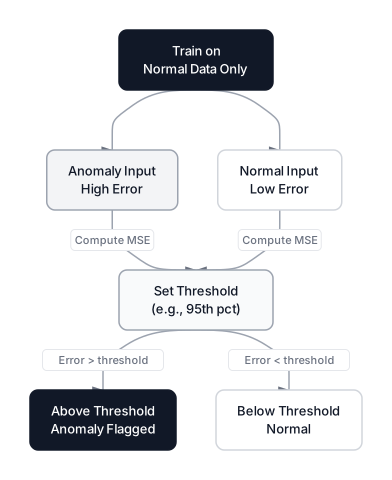
After training, we freeze the weights and calculate error for each new data point:
Normal data scores low. Anomalous data scores high. That's the entire detection mechanism.
Key Insight: The autoencoder doesn't learn what anomalies look like. It learns what normal looks like so well that anything else produces a measurably bad reconstruction. This is why autoencoders can detect anomaly types they've never encountered before.
Threshold Selection Strategies
A raw anomaly score isn't useful without a threshold that separates "normal" from "anomalous." Getting this threshold wrong is the most common failure mode in production autoencoder systems.
Statistical Thresholding
Calculate the mean and standard deviation of reconstruction errors on a clean validation set:
Where:
- is the detection threshold
- is the mean reconstruction error on normal validation data
- is the standard deviation of those errors
- is a multiplier (typically 2 or 3) controlling sensitivity
In Plain English: We measure how well the autoencoder reconstructs normal sensor readings, then draw a line at " standard deviations above average." Anything above that line is too poorly reconstructed to be normal. Setting $k = 3$ catches only extreme outliers; $k = 2$ catches more but risks false alarms.
Percentile Thresholding
When reconstruction errors aren't normally distributed (common with high-dimensional data), percentile-based thresholds are safer:
Threshold = 95th or 99th percentile of validation errors
This approach makes no distributional assumptions. The 95th percentile flags roughly 5% of normal data as suspicious; the 99th percentile is more conservative. In our factory scenario, the 99th percentile works better because false alarms that halt production are expensive.
Common Pitfall: Never compute your threshold on the same data you used for training. The model has already optimized for those exact samples, so training-set errors will be artificially low. Always use a held-out validation set of normal data.
Reconstruction Error in Practice with NumPy and Scikit-Learn
Before building a full neural network, let's see the reconstruction error concept with a simpler model. Scikit-learn's MLPRegressor can approximate a basic autoencoder, and PCA offers a linear version of the same idea.
The following block generates synthetic factory sensor data, fits a PCA model on normal readings, and shows how reconstruction error separates normal from anomalous samples.
Expected Output:
Mean error (normal):  0.0202
Mean error (anomaly): 2.0635
Threshold (99th pct): 0.0425
Anomalies detected:   50/50 (100.0%)
False alarms:         10/1000 (1.0%)
The error gap between normal and anomalous samples is two orders of magnitude: 0.02 vs 2.06. Anomalies break the sensor correlations that PCA learned to compress, producing reconstruction errors 100x higher. This is the exact same principle autoencoders exploit, just with a linear model instead of a neural network.
Autoencoders vs. PCA for Anomaly Detection
A linear autoencoder with a single hidden layer and linear activations learns the same subspace as PCA. The difference matters only when your data lives on a nonlinear manifold.
| Criterion | PCA | Autoencoder (Deep, Nonlinear) |
|---|---|---|
| Relationships captured | Linear correlations only | Arbitrary nonlinear mappings |
| Training speed | Instant (closed-form SVD) | Minutes to hours (gradient descent) |
| Hyperparameters | 1 (n_components) | Architecture, learning rate, epochs, regularization |
| Interpretability | High (principal components are linear) | Low (latent space is opaque) |
| Best for | Tabular data with linear structure | Images, audio, high-dimensional sensor data |
| Scaling to 1M+ rows | Easy (incremental PCA available) | Needs mini-batch training, GPU helps |
If your normal data lies on a curved manifold (imagine sensor readings that follow a circular pattern rather than a linear one), PCA will produce high reconstruction error even for normal points near the curve's extremes. A deep autoencoder with ReLU activations can bend its internal representation to fit that curvature, keeping errors low for normal data while remaining sensitive to genuine anomalies.
Pro Tip: Start with PCA. If its anomaly detection performance is already strong (AUC above 0.95), you probably don't need the added complexity of a neural autoencoder. Graduate to autoencoders only when PCA's linear assumption clearly limits detection accuracy.
Full PyTorch Implementation
Here's a complete autoencoder for anomaly detection in our factory sensor scenario. Since PyTorch is not available in browser-based environments, this code is display-only.
import numpy as np
import torch
import torch.nn as nn
import torch.optim as optim
from sklearn.model_selection import train_test_split
from sklearn.preprocessing import StandardScaler
from sklearn.metrics import precision_recall_fscore_support
import matplotlib.pyplot as plt

# --- Data Generation (factory sensors) ---
np.random.seed(42)
n_samples = 3000
input_dim = 20
latent_true = 5

mixing = np.random.randn(input_dim, latent_true)
X_normal = np.dot(np.random.randn(n_samples, latent_true), mixing.T)
X_normal += np.random.normal(0, 0.1, (n_samples, input_dim))

X_anomalies = np.random.normal(0, 2.5, (200, input_dim))

X_train, X_val_normal = train_test_split(X_normal, test_size=0.2, random_state=42)
X_test = np.vstack([X_val_normal, X_anomalies])
y_test = np.hstack([np.zeros(len(X_val_normal)), np.ones(len(X_anomalies))])

scaler = StandardScaler()
X_train_s = scaler.fit_transform(X_train)
X_test_s = scaler.transform(X_test)

train_tensor = torch.FloatTensor(X_train_s)
test_tensor = torch.FloatTensor(X_test_s)

# --- Model ---
class SensorAutoencoder(nn.Module):
    def __init__(self, input_dim):
        super().__init__()
        self.encoder = nn.Sequential(
            nn.Linear(input_dim, 14),
            nn.ReLU(),
            nn.Linear(14, 7),
            nn.ReLU(),
        )
        self.decoder = nn.Sequential(
            nn.Linear(7, 14),
            nn.ReLU(),
            nn.Linear(14, input_dim),
        )

    def forward(self, x):
        return self.decoder(self.encoder(x))

model = SensorAutoencoder(input_dim)
criterion = nn.MSELoss()
optimizer = optim.Adam(model.parameters(), lr=0.005)

# --- Training (normal data only) ---
loader = torch.utils.data.DataLoader(train_tensor, batch_size=64, shuffle=True)

for epoch in range(50):
    epoch_loss = 0
    for batch in loader:
        optimizer.zero_grad()
        reconstruction = model(batch)
        loss = criterion(reconstruction, batch)
        loss.backward()
        optimizer.step()
        epoch_loss += loss.item()
    if (epoch + 1) % 10 == 0:
        avg = epoch_loss / len(loader)
        print(f"Epoch {epoch+1:3d} | Loss: {avg:.4f}")

# --- Detection ---
model.eval()
with torch.no_grad():
    recon = model(test_tensor)
    errors = torch.mean((test_tensor - recon) ** 2, dim=1).numpy()

threshold = np.percentile(errors[y_test == 0], 95)
predictions = (errors > threshold).astype(int)

prec, rec, f1, _ = precision_recall_fscore_support(
    y_test, predictions, average="binary"
)
print(f"\nThreshold:  {threshold:.4f}")
print(f"Precision:  {prec:.3f}")
print(f"Recall:     {rec:.3f}")
print(f"F1 Score:   {f1:.3f}")
Several design choices here are worth noting. The architecture tapers 20 to 14 to 7 (roughly 3:1 compression), which forces learning without being so aggressive that normal data can't be reconstructed. The Adam optimizer with a learning rate of 0.005 converges within 50 epochs for this data size. And we compute precision, recall, and F1 rather than just accuracy, because accuracy is meaningless with imbalanced test sets.
Quantifying Separation with the Score Distribution
The reconstruction error distribution tells you more than just "normal or anomalous." Its shape reveals how confidently your model separates the two classes.
 Click to expandReconstruction error distribution showing normal vs anomaly separation
The following EXEC block demonstrates this concept by plotting error distributions from our PCA-based detector.
Expected Output:
(The plot shows two clearly separated distributions: normal errors clustered tightly near zero in blue, anomaly errors spread across much higher values in red, with a dashed threshold line separating them.)
Normal  | mean: 0.0202, std: 0.0075
Anomaly | mean: 1.9873, std: 0.7241
Threshold (95th percentile): 0.0338
A well-trained autoencoder produces two clearly separated peaks: normal errors clustered near zero, anomaly errors spread across higher values. When the peaks overlap significantly, your bottleneck is either too wide (the model reconstructs everything) or too narrow (it can't reconstruct anything well).
Common Pitfalls and How to Avoid Them
The Identity Function Trap
If the bottleneck has too many neurons, the autoencoder memorizes inputs instead of learning patterns. It becomes an identity function: for all inputs, including anomalies.
Symptoms: Training loss near zero, but the model reconstructs anomalies just as well as normal data. The error distribution shows a single overlapping peak.
Fix: Reduce bottleneck dimensionality. A compression ratio of 3:1 to 10:1 (input dimensions to bottleneck dimensions) is a solid starting point. For our 20-sensor example, a bottleneck of 5 to 7 neurons works well. You can also add dropout (0.1 to 0.3) to the encoder layers, which acts as a regularizer against memorization.
Contaminated Training Data
The assumption is that training data contains only normal samples. In practice, a small percentage of anomalies always sneak in.
Consequence: The autoencoder partially learns to reconstruct anomalies, reducing their error scores and making them harder to detect.
Fix: Pre-filter your training data using a simpler method first. Run Isolation Forest or Local Outlier Factor on the training set and remove the top 1 to 2% of flagged samples before training the autoencoder. Alternatively, denoising autoencoders (which add noise to inputs during training and learn to reconstruct the clean version) are naturally more resistant to contamination because they learn the underlying data distribution rather than memorizing specific samples.
Ignoring Temporal and Contextual Features
Raw feature values alone miss important context. In our factory, a temperature reading of 95 degrees Celsius might be normal during a heat treatment cycle but anomalous during an idle period.
Fix: Engineer temporal features before feeding data into the autoencoder. Rolling averages, time-of-day indicators, and lag features give the model context. For time-series specifically, LSTM autoencoders (Malhotra et al., 2016) process sequences directly, capturing temporal dependencies that feedforward architectures miss.
When to Use Autoencoders (and When Not To)
 Click to expandDecision guide for choosing anomaly detection methods
Use Autoencoders When
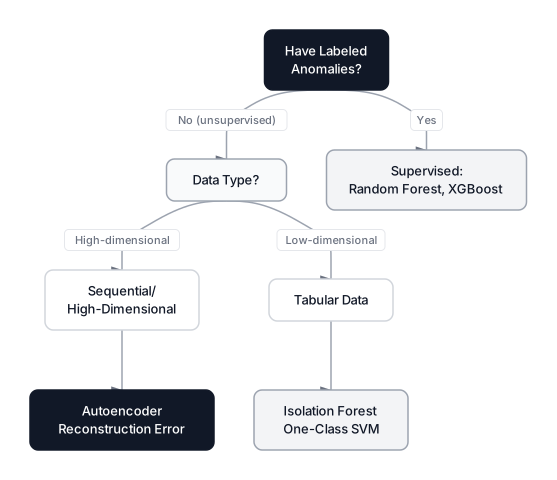
- Labeled anomalies are scarce or nonexistent. You only need normal data for training.
- Data is high-dimensional. Images, audio spectrograms, or sensor arrays with 50+ features benefit from the nonlinear compression.
- Anomaly types evolve. The model detects anything that deviates from normal, including attack types or failure modes that didn't exist during training.
- You need a continuous anomaly score. Reconstruction error provides a gradient, not just a binary label, which is useful for prioritizing alerts.
Don't Use Autoencoders When
- You have a small, low-dimensional dataset. One-Class SVM or Isolation Forest will be faster to train, easier to debug, and often just as accurate on tabular data under 50 features.
- Interpretability is non-negotiable. Autoencoders are black boxes. If stakeholders need to understand why a specific sample was flagged, tree-based methods or PCA with component analysis provide clearer explanations.
- Latency budget is sub-millisecond. A forward pass through a deep autoencoder is slower than a PCA projection or a tree traversal. For real-time high-frequency trading or network packet inspection at line rate, simpler models win.
- Normal data itself is heterogeneous. If "normal" covers wildly different operational modes, a single autoencoder may reconstruct all modes poorly. Consider training separate models per mode or using a conditional architecture.
Production Considerations
Computational Complexity
| Operation | Time Complexity | Memory | Notes |
|---|---|---|---|
| Training | Proportional to batch size and model params | = epochs, = samples, = input dim, = hidden dim | |
| Inference | per sample | Fixed after model is loaded | Easily batched for throughput |
| Threshold computation | Stores all validation errors | One-time cost during deployment |
A feedforward autoencoder with 20 input features and 2 hidden layers (14, 7 neurons) has roughly 700 parameters. Training on 10,000 samples for 50 epochs completes in under 5 seconds on a CPU. Inference at 100,000 samples per second on a modern CPU is achievable.
Scaling Strategies
For datasets beyond 1 million rows, mini-batch training is essential. PyTorch's DataLoader handles this natively. For truly massive streams (100 million+ events per day in network security), train the autoencoder on a representative sample and deploy the frozen model for inference. Retrain periodically (weekly or monthly) to account for concept drift as "normal" behavior evolves.
Feature scaling deserves special attention in production. Fit the scaler on training data and serialize it alongside the model. Applying a stale scaler to data with shifted distributions is a common silent failure that degrades detection without raising errors.
Monitoring and Drift Detection
Track the median reconstruction error over time. A gradual increase signals concept drift (normal behavior is changing), and the model needs retraining. A sudden spike suggests either a genuine anomaly wave or a data pipeline issue (schema change, missing features, encoding errors). Building automated alerts on both the anomaly rate and the median normal error keeps the system healthy.
Recent Advances (March 2026)
The autoencoder family has expanded significantly. Variational autoencoders (VAEs) add a probabilistic layer, letting you sample from the latent space and compute likelihood-based anomaly scores. Adversarial autoencoders combine reconstruction error with a discriminator network that enforces a prior distribution on the latent space, which Pidhorskyi et al. (2020) showed improves detection on image datasets.
Graph autoencoders extend the architecture to network-structured data. For detecting anomalous transactions in financial networks or unusual communication patterns in cybersecurity, these models operate directly on graph adjacency matrices rather than flattened feature vectors.
Federated LSTM autoencoders allow training across distributed edge devices without centralizing sensitive data. Each factory site trains a local model, shares only gradient updates, and the aggregated model captures normal behavior across the entire fleet. This approach has gained traction in industrial IoT deployments where data sovereignty rules prohibit centralized collection.
For a broader view of how autoencoders fit into the anomaly detection ecosystem, the survey by Pang et al. (2021) in ACM Computing Surveys provides an excellent taxonomy of deep learning approaches.
When Reconstruction Error Is Useful
Autoencoders detect anomalies by learning what normal looks like so thoroughly that abnormal data produces measurably bad reconstructions. The core loop is simple: compress, reconstruct, measure the error, and threshold. Everything else, from architecture design to feature scaling, is about making that loop work reliably on real data.
Start with PCA-based reconstruction as a baseline. If the linear model's detection is strong enough, ship it. When nonlinear relationships in your data demand more expressive models, graduate to a deep autoencoder. And regardless of which approach you use, invest serious effort in threshold calibration on clean validation data. A sophisticated model with a poorly chosen threshold will underperform a simple model with a well-tuned one.
The bias-variance tradeoff applies directly here: a bottleneck that's too narrow underfits (high bias, poor reconstruction even on normal data), while one that's too wide overfits (high variance, reconstructs anomalies too well). Finding the sweet spot is the art behind this technique.
For simpler tabular datasets where you want faster iteration, explore Isolation Forest and Local Outlier Factor as alternatives that require no neural network infrastructure at all.
Frequently Asked Interview Questions
Q: Why would you choose an autoencoder over Isolation Forest for anomaly detection?
Autoencoders excel on high-dimensional data (images, audio, sensor arrays with hundreds of features) where they can learn nonlinear compressed representations. Isolation Forest is faster and more interpretable on tabular data with fewer features. The choice depends on dimensionality, data complexity, and whether you need nonlinear feature extraction.
Q: How do you set the anomaly threshold for an autoencoder in production?
Compute reconstruction errors on a held-out validation set of known-normal data, then set the threshold at the 95th or 99th percentile depending on your tolerance for false positives. Never use training data for this step, because the model has already optimized on those samples and their errors will be artificially low.
Q: What happens if your training data contains some anomalies?
The autoencoder partially learns to reconstruct those anomalies, reducing their error scores and making them harder to detect. The standard mitigation is pre-filtering: run Isolation Forest or a similar method on the training set and remove the top 1 to 2% of suspicious samples before autoencoder training.
Q: A colleague suggests using a very large bottleneck to "capture more information." What's wrong with that approach?
A bottleneck that's too wide lets the autoencoder learn a near-identity mapping. It reconstructs everything well, including anomalies, which destroys its detection ability. The bottleneck must be small enough to force the network to learn only the dominant patterns in normal data, not memorize individual samples.
Q: How does a variational autoencoder (VAE) differ from a standard autoencoder for anomaly detection?
A VAE adds a probabilistic layer that models the latent space as a distribution (typically Gaussian). This provides two anomaly signals: reconstruction error and latent-space likelihood. A sample can score as anomalous if its latent representation falls in a low-probability region, even if reconstruction error is moderate. VAEs are particularly useful when you want to model uncertainty around the anomaly decision.
Q: Your autoencoder anomaly detector worked well for six months, but detection performance has degraded. What do you investigate?
The most likely cause is concept drift: the definition of "normal" has shifted, but the model still reflects old patterns. Check whether the median reconstruction error on flagged-normal data has trended upward. If it has, retrain on recent normal data. Also verify the preprocessing pipeline: schema changes, new feature encodings, or a stale scaler can silently degrade performance without any model-level issue.
Q: When would you use a convolutional autoencoder instead of a feedforward one?
Convolutional autoencoders are designed for data with spatial structure, like images or spectrograms. They use convolutional layers in the encoder and transposed convolutions in the decoder, which preserves spatial relationships that feedforward architectures would flatten and lose. For tabular or 1D sensor data, a feedforward autoencoder is more appropriate.
Q: How do you evaluate an autoencoder-based anomaly detector when you have very few labeled anomalies?
Use the labeled anomalies purely for evaluation, never for training. Compute precision, recall, and the area under the precision-recall curve (AUPRC) rather than accuracy or ROC-AUC, because AUPRC is more informative under extreme class imbalance. If you have fewer than 20 labeled anomalies, treat evaluation as directional rather than definitive, and supplement with domain expert review of the model's top-scoring detections.