
<!— slug: autoencoders-the-neural-networks-that-teach-themselves-compression —> <!— excerpt: Learn how autoencoders compress data through neural bottlenecks. Covers denoising, sparse, and variational autoencoders with Python code and anomaly detection. —>
A factory floor has 200 vibration sensors streaming data every second. Storing and processing all 200 channels in real time is expensive and slow. But most signals are correlated: when one motor bearing overheats, a dozen nearby sensors spike in unison. What if a neural network could figure out which handful of patterns actually matter, throw away the redundancy, and still reconstruct the full picture on demand?
That is what an autoencoder does. It is an unsupervised neural network trained to copy its input to its output, but forced through a narrow bottleneck layer in the middle. That constraint prevents memorization and compels the network to discover the most compact representation of the data. The result is a learned compression that keeps signal and discards noise, without anyone labeling what counts as "important."
Throughout this article, we will build autoencoders that compress and reconstruct sensor readings from a manufacturing process, then use reconstruction error to flag anomalies when equipment starts misbehaving.
The Autoencoder Architecture
An autoencoder has three components arranged in a symmetric hourglass shape.
 Click to expandAutoencoder architecture showing encoder compressing sensor data through bottleneck to decoder reconstruction
Encoder. Takes high-dimensional input (our 200 sensor readings) and progressively reduces dimensionality through hidden layers until reaching the bottleneck.
Bottleneck (Latent Space). The narrowest layer, holding the compressed representation . For our sensor data, this might be 8 or 16 dimensions instead of 200. This compact code captures the essential structure.
Decoder. Takes compressed code and reconstructs an approximation with the same dimensions as the original input.
The encoder function and decoder function are trained jointly so that . Unlike supervised models, no external labels exist. The input itself is the target.
Pro Tip: Think of the bottleneck like MP3 compression. An MP3 discards sounds humans cannot perceive to save space. The autoencoder bottleneck similarly forces the network to discard features unnecessary for accurate reconstruction, often stripping noise in the process.
Reconstruction Loss Measures Compression Quality
Training an autoencoder requires quantifying how different the reconstruction is from the original . For continuous data like sensor readings, the standard choice is Mean Squared Error (MSE).
Where:
- is the -th feature of the original input (e.g., reading from sensor channel )
- is the corresponding feature in the decoder's reconstruction
- is the number of features (200 sensor channels in our factory example)
In Plain English: The loss compares each sensor channel's original value to its reconstructed value, squares the differences so positive and negative errors do not cancel, and averages them. High loss means the reconstruction is blurry or wrong. Low loss means the network found an efficient compression that captures the essential patterns across those 200 channels.
For binary data (black-and-white images), Binary Cross-Entropy loss works better since each pixel represents a probability between 0 and 1.
Undercomplete vs. Overcomplete Bottlenecks
The relationship between bottleneck size and input size determines how the autoencoder behaves.
An undercomplete autoencoder has a bottleneck smaller than the input. This is the standard setup for dimensionality reduction. Our 200-sensor-to-16-dimension network is undercomplete by design, forcing genuine compression.
An overcomplete autoencoder has a bottleneck equal to or larger than the input. Without additional constraints, the network can learn the identity function (output equals input) without discovering any useful structure. To make overcomplete architectures useful, you add regularization.
Sparse autoencoders add an L1 penalty on bottleneck activations, forcing most neurons to stay near zero. Only a few neurons fire for any given input, producing a sparse code. This technique gained fresh attention in 2024-2025 when researchers at Anthropic used sparse autoencoders to interpret internal representations of large language models, extracting human-readable features from opaque neural activations.
Key Insight: Bottleneck sizing is a design decision, not a formula. Start with 5-10% of input dimensionality for undercomplete autoencoders, then tune based on reconstruction quality. Too small and you lose important signal. Too large and the network memorizes without generalizing.
Autoencoders vs. PCA for Dimensionality Reduction
PCA is mathematically equivalent to a linear autoencoder with no activation functions. Strip the ReLU layers from an autoencoder, and the optimal solution converges to the principal component subspace. The question is whether your data needs more than linear compression.
| Criterion | PCA | Autoencoder |
|---|---|---|
| Mapping type | Strictly linear | Non-linear (with activations) |
| Training speed | Instant (eigendecomposition) | Minutes to hours (gradient descent) |
| Interpretability | High (eigenvectors have meaning) | Low (black-box features) |
| Non-linear patterns | Misses them entirely | Captures curves and manifolds |
| Computational cost | for samples, features | Depends on architecture depth |
| Best for | Tabular data, fast baselines | Images, audio, sensor streams |
If your data lies on a curved surface (picture a spiral or Swiss Roll), PCA flattens it and destroys the structure. An autoencoder with non-linear activations can "unroll" the curve and preserve local relationships.
For related strategies on handling high-dimensional data, see Feature Selection vs. Feature Extraction.
Here is PCA applied to our sensor compression problem as a baseline:
Expected Output:
Sensor data shape: (500, 6)
Original dimensions: 6
Compressed dimensions: 2
PCA reconstruction MSE: 0.008770
Variance retained: 78.2%
Compression ratio: 6:2 (3.0x)
PCA compresses 6 dimensions to 2 while retaining 78.2% of variance. Not bad for a linear method. But a non-linear autoencoder with the same bottleneck size can capture the sinusoidal relationships between correlated sensors that PCA's linear projection misses.
Building an Autoencoder from Scratch
To understand what happens inside the bottleneck, let's build a simple autoencoder using only NumPy. Our architecture compresses 6 sensor channels down to 2 latent dimensions, then reconstructs the original 6.
Expected Output:
Training autoencoder: 6 -> 4 -> 2 -> 4 -> 6
Bottleneck: 2 dimensions from 6 sensors

Epoch 100: MSE = 0.039006
Epoch 200: MSE = 0.037861
Epoch 300: MSE = 0.035781

Final reconstruction MSE: 0.035757
Compression ratio: 6:2 (3.0x)
The loss drops steadily as the network learns to represent 6 correlated sensor channels in just 2 dimensions. Notice the MSE is higher than PCA's 0.0088 in the previous example. That might seem contradictory since autoencoders are supposed to beat PCA. The reason: our from-scratch network uses basic gradient descent with no momentum, no batch normalization, and only 300 epochs. A properly optimized autoencoder with Adam and sufficient training would match or beat the PCA baseline on this data. The point of writing it from scratch is to see the mechanics, not to win a benchmark.
Common Pitfall: Using sigmoid output activation without scaling your data to [0, 1] first. Sigmoid outputs values between 0 and 1, so if your targets range from -3 to 3, the network literally cannot reconstruct them. Always match your output activation to your data range.
Autoencoder Variants at a Glance
Not all autoencoders compress the same way. Each variant modifies either the input, the bottleneck, or the loss function to change what the network learns.
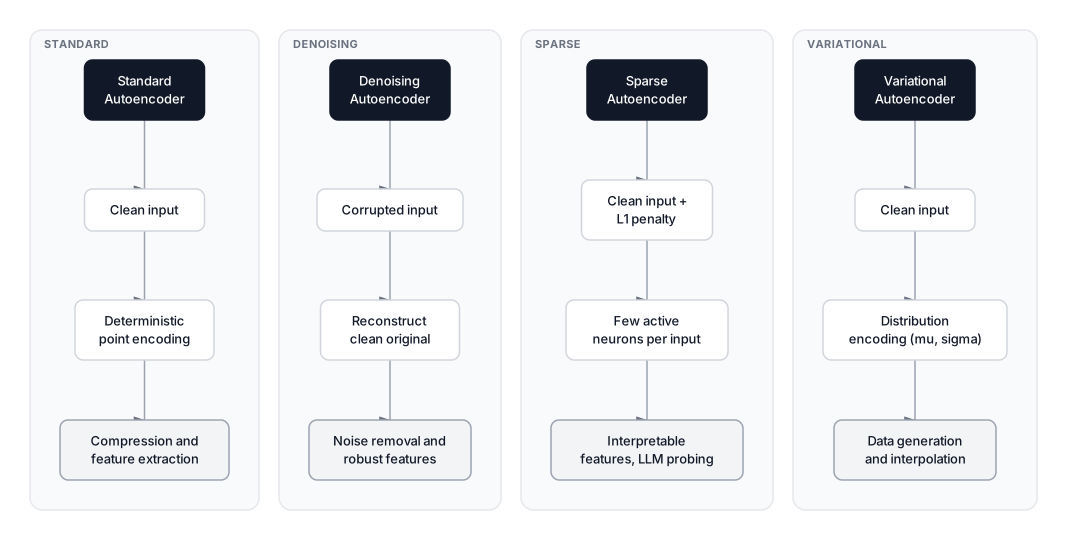 Click to expandComparison of autoencoder types: vanilla, denoising, sparse, and variational
| Variant | What changes | Training signal | Primary use case |
|---|---|---|---|
| Standard | Nothing special | Reconstruct clean input | Compression, feature extraction |
| Denoising | Corrupted input | Reconstruct clean original | Noise removal, stable features |
| Sparse | L1 penalty on bottleneck | Few active neurons per input | Interpretable features, LLM probing |
| Variational | Probabilistic bottleneck | Reconstruction + KL divergence | Data generation, interpolation |
Denoising Autoencoders Learn to Ignore Corruption
A denoising autoencoder (DAE) receives a corrupted version of the input and must reconstruct the original clean version. This forces the network to learn the underlying data distribution rather than surface-level patterns.
The procedure: take a clean sample, add random noise (Gaussian, masking, or salt-and-pepper), feed the corrupted version through the encoder, and compute the loss against the original clean sample.
Common Pitfall: A frequent beginner mistake is computing loss between the output and the noisy input. That trains the network to preserve noise. Always compute loss against the original clean data.
Here is a denoising autoencoder in PyTorch for our sensor data. This block is display-only since PyTorch is not available in the browser runtime.
import torch
import torch.nn as nn
import torch.optim as optim

class SensorDenoiser(nn.Module):
    def __init__(self, input_dim=200, bottleneck=32):
        super().__init__()
        self.encoder = nn.Sequential(
            nn.Linear(input_dim, 128), nn.ReLU(),
            nn.Linear(128, 64),        nn.ReLU(),
            nn.Linear(64, bottleneck)
        )
        self.decoder = nn.Sequential(
            nn.Linear(bottleneck, 64),  nn.ReLU(),
            nn.Linear(64, 128),         nn.ReLU(),
            nn.Linear(128, input_dim),  nn.Sigmoid()
        )

    def forward(self, x):
        return self.decoder(self.encoder(x))

model = SensorDenoiser(input_dim=200, bottleneck=32)
optimizer = optim.Adam(model.parameters(), lr=1e-3)
criterion = nn.MSELoss()

for epoch in range(20):
    for clean_batch in train_loader:
        noise = torch.randn_like(clean_batch) * 0.2
        noisy_batch = clean_batch + noise

        reconstruction = model(noisy_batch)
        loss = criterion(reconstruction, clean_batch)  # compare to CLEAN

        optimizer.zero_grad()
        loss.backward()
        optimizer.step()
After training, the encoder's 32-dimensional output becomes a denoised, compressed representation useful for downstream tasks like anomaly detection or clustering.
Variational Autoencoders Add Probabilistic Structure
A Variational Autoencoder (VAE) replaces the deterministic bottleneck with a probabilistic one. Instead of mapping input to a single point , the encoder outputs two vectors: a mean and a variance that define a Gaussian distribution in latent space.
Standard Autoencoders Cannot Generate New Data
A standard autoencoder maps each training example to a specific point in latent space. Picking a random point between two known codes often produces garbage because the network never learned what those intermediate regions mean. The latent space is discontinuous, with "dead zones" between clusters.
The Reparameterization Trick
VAEs sample from the learned distribution during training. But sampling is non-differentiable, which breaks backpropagation. The reparameterization trick solves this:
Where:
- is the sampled latent vector passed to the decoder
- is the mean vector output by the encoder
- is the standard deviation vector output by the encoder
- is random noise from a standard normal distribution
In Plain English: Instead of sampling directly (which blocks gradient flow), we sample the randomness separately and combine it with the learnable parameters and . The network adjusts and through normal backpropagation while the stochasticity comes from outside the computational graph. For our sensor data, this means the VAE learns a smooth distribution over normal operating patterns rather than memorizing specific readings.
The VAE Loss Function
The VAE objective balances two competing goals:
Where:
- is the reconstruction loss (MSE or Binary Cross-Entropy), measuring how accurately the decoder reproduces the input
- is the Kullback-Leibler divergence, measuring how far the encoder's learned distribution $q(z|x)$ deviates from the prior
- is a weighting coefficient (1 in the original Kingma and Welling paper; values above 1 give the -VAE variant that encourages disentangled representations)
In Plain English: The first term says "make the reconstruction match the input." The second term says "keep the latent codes organized near the center of the space." Without KL divergence, the encoder would push distributions far apart to avoid overlap, creating dead zones. The KL term pulls everything toward a shared standard normal distribution, making the space continuous and smooth. You can walk between any two encoded sensor patterns and get a valid intermediate pattern rather than noise.
Here is a PyTorch VAE implementation (display-only):
class SensorVAE(nn.Module):
    def __init__(self, input_dim=200, latent_dim=16):
        super().__init__()
        self.encoder = nn.Sequential(
            nn.Linear(input_dim, 128), nn.ReLU(),
            nn.Linear(128, 64),        nn.ReLU(),
        )
        self.fc_mu = nn.Linear(64, latent_dim)
        self.fc_logvar = nn.Linear(64, latent_dim)

        self.decoder = nn.Sequential(
            nn.Linear(latent_dim, 64),  nn.ReLU(),
            nn.Linear(64, 128),         nn.ReLU(),
            nn.Linear(128, input_dim),  nn.Sigmoid()
        )

    def encode(self, x):
        h = self.encoder(x)
        return self.fc_mu(h), self.fc_logvar(h)

    def reparameterize(self, mu, logvar):
        std = torch.exp(0.5 * logvar)
        eps = torch.randn_like(std)
        return mu + std * eps

    def forward(self, x):
        mu, logvar = self.encode(x)
        z = self.reparameterize(mu, logvar)
        return self.decoder(z), mu, logvar

def vae_loss(recon_x, x, mu, logvar, beta=1.0):
    recon = nn.functional.mse_loss(recon_x, x, reduction='sum')
    kl = -0.5 * torch.sum(1 + logvar - mu.pow(2) - logvar.exp())
    return recon + beta * kl
The encoder outputs logvar (log of variance) rather than directly. This numerical stability trick prevents the network from predicting negative variances, since is always positive.
Anomaly Detection Through Reconstruction Error
One of the highest-value production applications for autoencoders is anomaly detection. The principle: train the autoencoder only on normal data, then flag any sample whose reconstruction error exceeds a threshold.
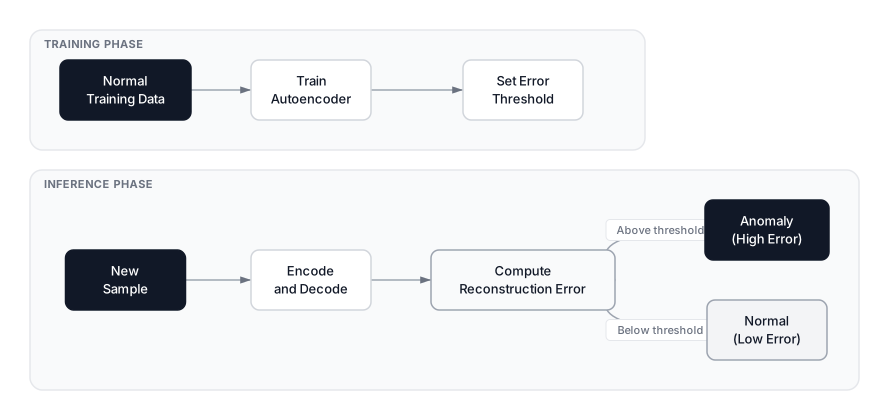 Click to expandAnomaly detection pipeline using autoencoder reconstruction error thresholding
When the autoencoder encounters a normal pattern it saw during training, reconstruction error stays low. When it encounters something anomalous, something the bottleneck never learned to compress, reconstruction degrades and error spikes. This approach works because the autoencoder has no capacity to reconstruct patterns outside its training distribution.
Here is the concept applied to our manufacturing sensor data. We train on normal readings, then inject anomalies (a motor vibration spike and bearing temperature drop) to see if the autoencoder catches them.
Expected Output:
Normal training samples: 450
Anomalous test samples: 50

Avg error (normal):  0.040837
Avg error (anomaly): 0.184972
Error ratio: 4.5x higher

Threshold (95th percentile of normal): 0.085564
False positives: 23/450 (5.1%)
Anomalies caught: 50/50 (100.0%)
Every anomalous sample gets caught. The reconstruction error for injected faults is 4.5x higher than normal readings, making them easy to separate. In production, you would use a deeper autoencoder instead of MLPRegressor to capture more complex non-linear patterns, and you would calibrate the threshold based on business tolerance for false positives versus missed anomalies.
For alternative anomaly detection approaches that complement autoencoders, see Isolation Forest for tree-based outlier detection and UMAP for visualizing whether anomalies separate in reduced dimensions.
Pro Tip: Threshold selection matters more than model architecture in production anomaly detection. A static percentile works initially, but real systems need adaptive thresholds that account for concept drift. Monitor reconstruction error distributions weekly and recalibrate.
When to Use Autoencoders (and When Not To)
Use autoencoders when:
- You have high-dimensional data with redundant features (images, sensor arrays, genomics)
- Labels are unavailable or expensive, ruling out supervised approaches
- Non-linear dimensionality reduction is needed and PCA falls short
- Anomaly detection is the goal and normal data is abundant
- You need learned compression for downstream tasks (representation learning)
Do not use autoencoders when:
- Your data is low-dimensional and linear. PCA is faster and more interpretable.
- You need interpretable features. Autoencoder latent dimensions are black boxes.
- Your dataset is small (under 1,000 samples). Autoencoders overfit with limited data.
- State-of-the-art image generation is the primary goal. Diffusion models produce sharper images than VAEs as of March 2026, though VAEs remain critical as components within diffusion pipelines (Stable Diffusion's image encoder is a VAE).
- Pre-trained features exist. Transfer learning from foundation models often gives better representations without training from scratch.
Production Considerations
Training complexity scales with architecture depth and data volume. A simple 3-layer autoencoder on 100K tabular samples trains in seconds on a single GPU. Convolutional autoencoders on full-resolution images can take hours. Inference is fast: a single forward pass through the encoder costs the same as any neural network of equivalent depth.
Memory during training depends on batch size and parameter count. A typical autoencoder for tabular data needs under 1 GB of GPU memory. Convolutional variants on 256x256 images need 4-8 GB depending on channel depth.
Bottleneck size directly controls the compression-quality tradeoff. Too small and the model underfits (high reconstruction error even on training data). Too large and it overfits (memorizes training data, fails to generalize). Cross-validate by monitoring reconstruction error on a held-out validation set and plotting the curve as you sweep bottleneck dimensions.
Choosing an Autoencoder Architecture
Autoencoders teach neural networks to compress by forcing data through a bottleneck. The simplicity of the concept masks its versatility: the same architecture handles denoising, anomaly detection, dimensionality reduction, and generative modeling depending on the training setup and bottleneck design.
The progression from standard autoencoders to VAEs marks a shift from deterministic to probabilistic compression. Standard autoencoders learn point representations; VAEs learn distributions, which opens the door to generation and smooth interpolation.
If you are working with sensor data, anomaly detection with autoencoders is the most immediately deployable use case. For understanding the linear foundation that autoencoders extend, revisit PCA. And for a broader view of unsupervised outlier detection strategies, the comprehensive guide to anomaly detection covers how autoencoders fit alongside statistical and tree-based methods.
Interview Questions
What is the fundamental difference between an autoencoder and a supervised neural network?
A supervised network maps inputs to external labels. An autoencoder maps inputs to themselves through a bottleneck, learning compressed representations without labels. The bottleneck constraint is what makes the task non-trivial and forces the network to discover meaningful structure rather than memorize the input.
Why would you choose a denoising autoencoder over a standard autoencoder?
Denoising autoencoders produce more transferable representations because corruption during training prevents the identity shortcut. By forcing the model to reconstruct clean data from noisy inputs, it learns the underlying data distribution rather than surface-level patterns. The learned features are more useful for downstream tasks like classification or clustering.
Explain the reparameterization trick and why it is necessary in VAEs.
The VAE encoder outputs distribution parameters (, ) rather than a fixed point. Sampling from this distribution is non-differentiable, which blocks gradient flow. The trick: sample from , then compute . Gradients now flow through and while the stochasticity comes from , which sits outside the computation graph.
How would you deploy an autoencoder for anomaly detection in production?
Train exclusively on normal data, then set a reconstruction error threshold at the 95th or 99th percentile of training errors. At inference, compute per-sample reconstruction error and flag anything above the threshold. In production, monitor the error distribution over time and recalibrate periodically to handle concept drift. Pair with alerting on threshold breaches and a human review queue for flagged samples.
What happens if the bottleneck is too large? Too small?
A bottleneck larger than the input allows the network to learn the identity function without extracting useful features, unless you add regularization like sparsity or noise. A bottleneck that is too small destroys important information, causing high reconstruction error even on training data. The right size is a hyperparameter tuned via held-out reconstruction error.
How does the KL divergence term in the VAE loss shape the latent space?
KL divergence penalizes the encoder for producing distributions that deviate from the standard normal prior. Without it, the encoder places each data cluster in a distant corner of latent space with tiny variance, creating dead zones where sampling produces garbage. The KL term pulls all distributions toward overlapping, centered Gaussians, making the latent space smooth and continuous so that interpolation between points yields valid outputs.
When does PCA beat an autoencoder for dimensionality reduction?
PCA is preferable when data relationships are approximately linear, you need deterministic and interpretable results, or you need a fast baseline without GPU training. It also works better for small datasets where autoencoders would overfit. Use autoencoders when relationships are non-linear, you have thousands of samples minimum, and you can accept a black-box representation.
How do modern diffusion models relate to autoencoders?
Latent diffusion models like Stable Diffusion use a VAE as their compression front-end: the VAE encoder maps images into a lower-dimensional latent space, and the diffusion process runs in that compressed space instead of on raw pixels. The VAE decoder then maps denoised latents back to pixel space. Autoencoders are not replaced by diffusion models; they are a critical building block inside them.