
Your dataset has 50 features. Maybe 500. Maybe 10,000 pixel values from a single image. You need to see structure in that data, but the human brain taps out at three dimensions. t-SNE (t-Distributed Stochastic Neighbor Embedding) solves this by converting high-dimensional relationships into a 2D map that preserves the local neighborhoods you actually care about. Since its introduction by van der Maaten and Hinton (2008), t-SNE is widely used to visualize local neighborhoods in data such as single-cell measurements and image embeddings.
But it's also one of the most misread algorithms in machine learning. People draw conclusions from cluster sizes, inter-cluster distances, and overall shapes that the algorithm never promised to preserve. This guide walks through the math, shows you how to tune it properly, and teaches you what you can and cannot trust in the output.
We'll use a single running example throughout: three synthetic clusters in 10-dimensional space, small enough to fit in EXEC blocks but rich enough to show real behavior.
t-SNE Core Idea
T-SNE is a nonlinear dimensionality reduction algorithm designed specifically for visualization. Unlike PCA, which finds the directions of maximum variance and projects data onto them, t-SNE asks a different question entirely: "Which points are neighbors in high-dimensional space, and can I arrange a 2D map where those same points stay close together?"
The distinction matters. PCA is a linear projection that preserves global geometry. t-SNE is an optimization that preserves local neighborhoods. When your data lives on a curved manifold (think: a Swiss roll, or handwritten digits that vary smoothly from one style to another), PCA flattens the manifold and smashes distant clusters together. t-SNE unrolls it.
 Click to expandt-SNE algorithm pipeline from high-dimensional distances to low-dimensional embedding
The algorithm works in three stages:
- Compute pairwise similarities in high-D using Gaussian distributions.
- Compute pairwise similarities in low-D using Student's t-distributions.
- Minimize the mismatch between these two similarity matrices via gradient descent.
Each stage has a specific mathematical purpose. Let's break them down.
Gaussian Similarities in High Dimensions
T-SNE starts by measuring how "close" every pair of points is in the original high-dimensional space. For each point , the algorithm defines a conditional probability that would pick as its neighbor:
Where:
- is the probability that point picks as its neighbor
- is the squared Euclidean distance between points and
- is the bandwidth of the Gaussian centered on point (set automatically via perplexity)
- The denominator sums over all other points , normalizing probabilities to sum to 1
In Plain English: Imagine you're standing at a point in our 10D cluster dataset. You shine a flashlight outward. Nearby points in your cluster glow bright (high probability). Points in a different cluster, far away in 10 dimensions, get almost zero light. The width of the flashlight beam () adjusts automatically based on how dense your local neighborhood is.
The conditional probabilities are then symmetrized into joint probabilities: , ensuring the relationship between any two points is mutual.
Here's this computation on a tiny 5-point example:
Pairwise distances:
  Point 0: [0.00  0.36  5.20  5.37  0.33]
  Point 1: [0.36  0.00  4.91  5.08  0.24]
  Point 2: [5.20  4.91  0.00  0.22  4.91]
  Point 3: [5.37  5.08  0.22  0.00  5.09]
  Point 4: [0.33  0.24  4.91  5.09  0.00]

Conditional probabilities p(j|i=0), sigma=0.5:
  p(0|0) = 0.000000
  p(1|0) = 0.490001
  p(2|0) = 0.000000
  p(3|0) = 0.000000
  p(4|0) = 0.509999
Points 1 and 4 are close to point 0 and split nearly all the probability mass. Points 2 and 3, sitting 5+ units away, get effectively zero. This is exactly the behavior t-SNE relies on: only local neighbors matter.
The Crowding Problem and Student's t-Distribution
Here's where t-SNE gets clever. If we used the same Gaussian distribution in the 2D output space, we'd hit the crowding problem.
In 10 dimensions, there's plenty of room. You can fit many points equidistant from a center without them interfering with each other. In 2D, that room vanishes. Try placing 20 equidistant neighbors around a point in a plane. You can't do it without pushing some of them much further away than others. If we enforce Gaussian similarities in 2D, moderately distant points get crushed into the center of the map, creating a giant blob with no visible structure.
T-SNE fixes this by using a Student's t-distribution with one degree of freedom (a Cauchy distribution) for the low-dimensional similarities:
Where:
- is the similarity between points and in the 2D embedding
- is the squared Euclidean distance in the 2D map
- The denominator normalizes over all pairs to form a valid probability distribution
- The kernel is the Cauchy distribution, which has heavier tails than a Gaussian
In Plain English: The t-distribution has "fat tails" compared to the Gaussian. In our 10D cluster example, points from cluster 0 and cluster 2 are far apart. The t-distribution says, "That's fine, push them really far apart in 2D. I won't penalize you much." This creates the beautiful white space between clusters that makes t-SNE plots so visually clear.
 Click to expandComparison of PCA vs t-SNE vs UMAP for dimensionality reduction
KL Divergence: The Optimization Objective
With two probability distributions in hand, (high-dimensional) and (low-dimensional), t-SNE minimizes the Kullback-Leibler divergence between them:
Where:
- is the total cost (lower is better)
- is the joint probability from the high-dimensional Gaussian kernel
- is the joint probability from the low-dimensional t-distribution kernel
- The term penalizes mismatches between the two distributions
In Plain English: If two points sit close together in our 10D data ( is large) but the 2D map places them far apart ( is tiny), the ratio explodes and the cost skyrockets. The algorithm responds by dragging those points together. But here's the asymmetry: if two points are far apart in 10D ( is near zero) and happen to end up close in 2D, the cost barely changes. This is why t-SNE is excellent at preserving local structure but doesn't guarantee global distances.
The gradient of this cost function creates attractive forces between nearby points (pulling them together) and repulsive forces between distant points (pushing them apart). Gradient descent iterates until the 2D arrangement stabilizes.
Perplexity: The One Parameter You Must Tune
Perplexity is t-SNE's most important hyperparameter. It controls , the bandwidth of each Gaussian kernel, by specifying the effective number of neighbors each point should have.
Technically, perplexity is defined as where is the Shannon entropy of the conditional distribution around point . Practically, you can think of it as "how many neighbors does each point pay attention to?"
| Perplexity | Behavior | Best For |
|---|---|---|
| 5 | Very local focus, tight micro-clusters | Small datasets (< 100 points) |
| 15-30 | Balanced local structure | Most datasets (100-5000 points) |
| 50 | Broader neighborhoods | Larger datasets with big clusters |
| 100+ | Global structure creeps in | Very large, well-separated groups |
Common Pitfall: There is no single "correct" perplexity. If your t-SNE plot looks like random soup with no structure, try both lower and higher values before concluding the data has no clusters. A perplexity of 30 is the scikit-learn default and a reasonable starting point.
Here's the effect on our 10D cluster data:
Perplexity= 5 | KL=0.5514 | Avg cluster spread=9.52
Perplexity=15 | KL=0.3890 | Avg cluster spread=3.07
Perplexity=30 | KL=0.2495 | Avg cluster spread=1.39
Perplexity=50 | KL=0.1349 | Avg cluster spread=0.76
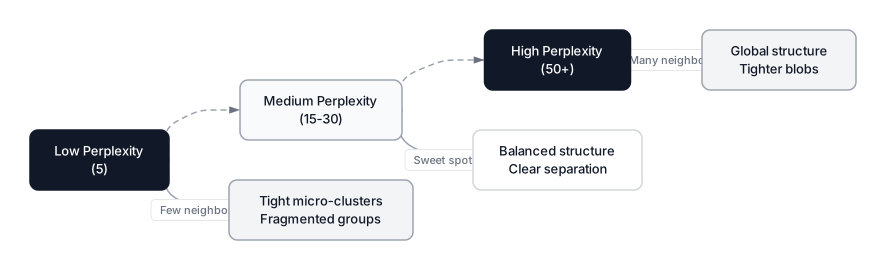 Click to expandEffect of perplexity parameter on t-SNE cluster formation
Notice the tradeoff. Low perplexity (5) gives the highest KL divergence and the widest cluster spread because the algorithm fragments each cluster into micro-groups. Higher perplexity pulls clusters into tighter, more coherent blobs. For this 90-point dataset, perplexity 15 to 30 hits the sweet spot.
Pro Tip: A good rule of thumb from the original paper: set perplexity between 5 and 50, and always try at least 3 different values. The scikit-learn default of 30 works well for datasets between 200 and 5,000 points.
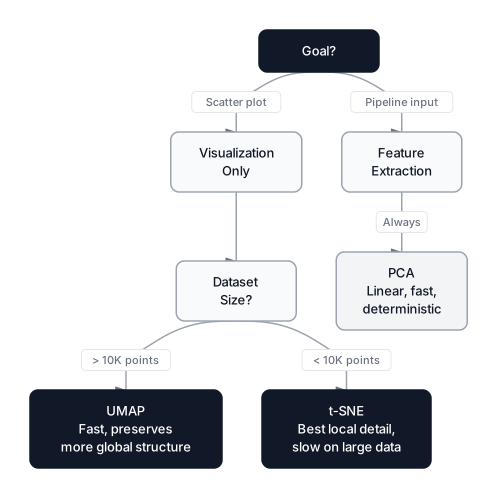
PCA vs t-SNE: A Direct Comparison
The question isn't "which is better?" but rather "what do you want to preserve?" PCA maximizes explained variance along orthogonal axes. It's fast, deterministic, and preserves global geometry. t-SNE preserves local neighborhoods at the expense of global structure. It's slow, stochastic, and purpose-built for visualization.
PCA explained variance (2 components): 47.55%
PCA silhouette score: 0.6059
t-SNE silhouette score: 0.6942
t-SNE KL divergence: 0.3890
Separation improvement: 14.6%
PCA captures less than half the variance in two components, while t-SNE achieves a 14.6% better silhouette score. That said, the PCA result is deterministic and runs in milliseconds. The t-SNE result changes with different random seeds and takes orders of magnitude longer.
Key Insight: Standardize your features before running t-SNE. Both PCA and t-SNE are distance-based, but t-SNE is especially sensitive to scale differences because the Gaussian kernel bandwidth () is calibrated per-point.
| Criterion | PCA | t-SNE |
|---|---|---|
| Speed | , milliseconds | , seconds to minutes |
| Deterministic | Yes | No (stochastic) |
| Preserves | Global variance | Local neighborhoods |
| Invertible | Yes (can reconstruct) | No |
| Use for features | Yes (common) | No (visualization only) |
| Cluster separation | Moderate | Excellent |
Interpreting t-SNE Plots Without Getting Fooled
T-SNE visualizations look compelling. Tight clusters, clear gaps, satisfying spatial separation. But three misinterpretations trip up even experienced practitioners.
Cluster Size Does Not Reflect Density
A tiny, dense blob in t-SNE does not mean that cluster is actually more compact in the original space. t-SNE equalizes local densities by adjusting per point. Dense regions get expanded; sparse regions get compressed. The visual size of a cluster in the 2D map tells you almost nothing about its true spread.
Inter-Cluster Distance Is Often Arbitrary
The gap between two clusters on a t-SNE plot doesn't reliably indicate how far apart they are in high-dimensional space. t-SNE optimizes local neighborhoods, not global geometry. Two clusters might appear close in the map but sit at opposite ends of the original feature space.
Random Noise Produces Fake Clusters
This is the most dangerous pitfall. Run t-SNE with low perplexity on data with no real structure, and it will still produce clusters. The algorithm is designed to find and emphasize local groupings; it will hallucinate them in pure noise.
Silhouette score on random noise (perplexity=5): -0.0361
KL divergence: 0.9535
Note: Low perplexity on random noise often creates spurious clusters.
Always verify t-SNE patterns with a clustering algorithm on the original data.
The negative silhouette score confirms there are no real clusters, but if you only looked at the 2D plot, you might see clumps that look meaningful. Always validate with K-Means or DBSCAN on the original high-dimensional data.
When to Use t-SNE (and When NOT To)
Use t-SNE when:
- You need to visually inspect cluster structure in high-dimensional data
- Dataset size is under 10,000 points (or you can subsample)
- You want publication-quality scatter plots of embeddings
- You're exploring labeled data to check if labels match natural groupings
- You need to spot outliers or data quality issues in embedding spaces
Do NOT use t-SNE when:
- You need a deterministic, reproducible feature extraction step in a pipeline (use PCA)
- Your dataset has more than 50,000 points (use UMAP or consider openTSNE)
- You need to preserve global distances or relative cluster positions
- You want to transform new data points without refitting (t-SNE has no
.transform()method) - Speed matters and you're iterating frequently on embeddings
Production Considerations
T-SNE's computational complexity is for the exact algorithm. The Barnes-Hut approximation, enabled by default in scikit-learn 1.8 (method='barnes_hut'), reduces this to but introduces an approximation controlled by the angle parameter (default 0.5).
Practical scaling limits:
| Dataset Size | scikit-learn t-SNE | Recommendation |
|---|---|---|
| < 5,000 | Fast, use directly | Default settings work |
| 5,000 to 50,000 | Slow but feasible | Pre-reduce with PCA to 50 dims first |
| 50,000 to 500,000 | Impractical | Use openTSNE with FIt-SNE approximation |
| > 500,000 | Don't bother | Use UMAP or subsample |
The PCA preprocessing trick: Always reduce dimensions with PCA before running t-SNE on wide data. Going from 784 features (MNIST) to 50 principal components removes noise and cuts t-SNE runtime dramatically. The init='pca' parameter in scikit-learn 1.8 uses PCA to initialize the embedding coordinates, which is different from preprocessing with PCA first.
Pro Tip: For datasets beyond scikit-learn's practical limits, openTSNE implements the FIt-SNE algorithm (Linderman et al., 2019), which scales linearly with using interpolation-based approximations. It also supports adding new points to an existing embedding without refitting, something scikit-learn's t-SNE cannot do.
Key scikit-learn 1.8 parameter notes:
max_iterreplaced the deprecatedn_iterparameter (changed in v1.5)init='pca'is now the default (changed in v1.2), giving more stable results than random initializationlearning_rate='auto'is the default (changed in v1.2), setting it to
t-SNE vs UMAP
UMAP (Uniform Manifold Approximation and Projection) has largely replaced t-SNE for day-to-day visualization work. The two algorithms share the same high-level goal but differ significantly in practice.
| Criterion | t-SNE | UMAP |
|---|---|---|
| Time complexity | Barnes-Hut | approximate |
| Global structure | Poor preservation | Better preservation |
| Deterministic | No | Closer (with fixed seed) |
| Transform new data | No .transform() | Yes, .transform() supported |
| Use as features | Not recommended | Sometimes viable |
| Cluster quality | Excellent local separation | Good local + decent global |
UMAP is faster, preserves more global structure, and supports transforming new points. t-SNE still produces tighter visual cluster separation in many cases and remains the standard in fields like single-cell genomics where that visual clarity matters.
Reading a t-SNE Map Carefully
T-SNE converts the impossibly complex geometry of high-dimensional data into 2D maps by translating Euclidean distances into probability distributions and optimizing their alignment. The three-stage pipeline (Gaussian similarities, Student's t-distribution, KL divergence minimization) specifically prioritizes keeping neighbors close, which is why it excels at revealing cluster structure that PCA misses.
The algorithm demands careful use. Perplexity must be tuned, cluster sizes and distances in the plot should not be trusted at face value, and random noise will always look like something meaningful. Treat t-SNE as a hypothesis generator, not a proof. Validate any patterns you find with proper clustering algorithms like K-Means or DBSCAN on the original data.
For large-scale work, consider UMAP as your first choice. When you need the sharpest possible visual cluster separation on datasets under 10,000 points, t-SNE remains hard to beat.
Frequently Asked Interview Questions
Q: Why does t-SNE use a Student's t-distribution in the low-dimensional space instead of a Gaussian?
The t-distribution's heavier tails solve the crowding problem. In high dimensions, many points can be roughly equidistant from a center, but in 2D there isn't enough room to preserve those distances. The Cauchy distribution (t with 1 degree of freedom) allows dissimilar points to be placed much further apart in the map without incurring a large penalty, creating the clear gaps between clusters.
Q: Can you use t-SNE embeddings as features for a downstream classifier?
Generally no. t-SNE is non-parametric (no .transform() method for new data), stochastic (different runs produce different layouts), and does not preserve global distances. These properties make the embedding coordinates unreliable as input features. If you need a dimensionality reduction step for a pipeline, use PCA, autoencoders, or UMAP, which supports transforming unseen points.
Q: Your t-SNE plot shows five distinct clusters, but the silhouette score on the original data is near zero. What's happening?
T-SNE can create visually separated groups even in data with no real cluster structure, especially at low perplexity. The negative or near-zero silhouette score on the original high-dimensional data indicates no meaningful separation exists. The visual clusters are an artifact of the algorithm's optimization. Always validate t-SNE patterns with a clustering metric computed on the original features.
Q: How does perplexity relate to the number of neighbors, and how would you choose it?
Perplexity approximates the effective number of nearest neighbors each point considers. A perplexity of 30 means each point's probability distribution has an entropy equivalent to a uniform distribution over roughly 30 neighbors. For small datasets (under 200 points), start with 5 to 15. For medium datasets, 30 is a solid default. Always try at least three values and compare results.
Q: A colleague suggests running t-SNE on 500,000 data points with scikit-learn. What's your advice?
Scikit-learn's t-SNE implementation is impractical at that scale, even with the Barnes-Hut approximation. I'd recommend either subsampling to 10,000 to 50,000 representative points, or switching to openTSNE with its FIt-SNE backend, which scales linearly. UMAP is another strong option at this size and also preserves more global structure.
Q: Why must you standardize features before running t-SNE?
T-SNE computes pairwise Euclidean distances. If one feature ranges from 0 to 1,000 while another ranges from 0 to 1, the first feature will dominate all distance computations. Standardization (zero mean, unit variance) ensures each feature contributes proportionally. This is especially important for t-SNE because the per-point bandwidth is calibrated based on these distances.
Q: t-SNE is stochastic. How do you ensure reproducibility?
Set random_state to a fixed integer and use init='pca' (the default in scikit-learn 1.8). PCA initialization is deterministic and gives a consistent starting point. With both settings fixed, the same data will produce the same embedding. Note that different scikit-learn versions may still produce slightly different results due to implementation changes.
Q: What is the KL divergence in t-SNE, and what does a high value indicate?
KL divergence measures how well the 2D probability distribution matches the high-dimensional distribution . A lower value means the embedding is a better representation of the original neighborhood structure. A high value suggests the algorithm hasn't converged (increase max_iter) or the data's structure is too complex to capture in 2D. It's also useful for comparing different perplexity settings on the same data.
Hands-On Practice
High-dimensional data is notoriously difficult to interpret because our brains can't visualize more than three dimensions. You'll learn how to use t-SNE (t-Distributed Stochastic Neighbor Embedding) to unlock hidden structures in complex datasets that simpler methods like PCA might miss. We will use a high-dimensional Wine Analysis dataset, applying t-SNE to reveal distinct clusters of wine cultivars based on their chemical properties.
Dataset: Wine Analysis (High-Dimensional) Wine chemical analysis with 27 features (13 original + 9 derived + 5 noise) and 3 cultivar classes. PCA: 2 components=45%, 5=64%, 10=83% variance. Noise features have near-zero importance. Perfect for dimensionality reduction, feature selection, and regularization.
Experiment with the perplexity parameter (try 2, 50, and 100) to observe how the cluster tightness changes. You can also try changing the init parameter to 'random' to see how sensitive t-SNE is to initialization compared to 'pca'. Finally, observe the effect of the noisy features in this dataset by trying to run t-SNE only on the first 13 'original' columns versus the full noisy set.