
You're segmenting customers by income and spending habits. K-Means gives you three clean groups, but something feels off. Your premium customers don't form a tight circle; they stretch diagonally because higher income correlates with higher spending. K-Means, which only sees circular boundaries, slices this natural group in half. Worse, the customer sitting right between two segments gets shoved into one with absolute certainty, as if there's zero chance they belong to the other.
Gaussian Mixture Models (GMMs) fix both problems. They model clusters as ellipses instead of circles, and they assign each data point a probability of belonging to each cluster rather than a hard label. That borderline customer? A GMM might say 57% Segment A, 43% Segment B. That uncertainty is information K-Means throws away.
This article builds GMM intuition from the ground up: the mixture density formula, the Expectation-Maximization algorithm that trains it, covariance types that control cluster shape, model selection with BIC/AIC, and a full Python implementation using scikit-learn. The running example throughout is customer segmentation with overlapping spending groups.
The Mixture Model Concept
A Gaussian Mixture Model assumes every data point was generated by one of Gaussian (bell-curve) distributions, but we don't know which one. Each distribution represents a cluster, and the model's job is to figure out three things per cluster:
- Mean (): Where is this cluster centered?
- Covariance (): What shape and orientation does it have?
- Mixing coefficient (): How much of the total data does this cluster explain?
Think of it as a recipe. The final data distribution is a blend of Gaussian "ingredients," each contributing a fraction of the total. All mixing coefficients sum to 1.
The probability density of observing a data point under this mixture is:
Where:
- is a data point (e.g., a customer's income and spending score)
- is the number of mixture components (clusters)
- is the mixing coefficient for component , satisfying
- is the multivariate Gaussian density for component
In Plain English: The probability of observing a particular customer profile equals the sum of contributions from each segment. If 33% of customers fall into the "high-income, low-spending" segment and this customer's profile matches that segment's bell curve closely, that segment contributes a large share to the total probability.
Each individual Gaussian component uses the multivariate normal distribution:
Where:
- is the number of features (2 in our income/spending example)
- is the mean vector (cluster center)
- is the covariance matrix (cluster shape)
- is the determinant of the covariance matrix (normalizes volume)
- The exponent term measures the Mahalanobis distance from to the center
In Plain English: The covariance matrix controls whether the cluster looks like a circle, a stretched ellipse, or a rotated ellipse. Without it, we'd be stuck with circles, which is exactly the K-Means limitation we're trying to escape.
Hard vs. Soft Clustering
The core difference between GMMs and algorithms like K-Means comes down to how they assign points to clusters.
K-Means performs hard clustering: every point gets a single label. If a customer sits right on the boundary between two segments, K-Means picks one and moves on. The assignment is binary, 100% or 0%, with no middle ground.
GMMs perform soft clustering: every point gets a probability distribution over all clusters. That boundary customer might be 57% Segment A and 43% Segment B. This soft assignment captures uncertainty that hard clustering discards.
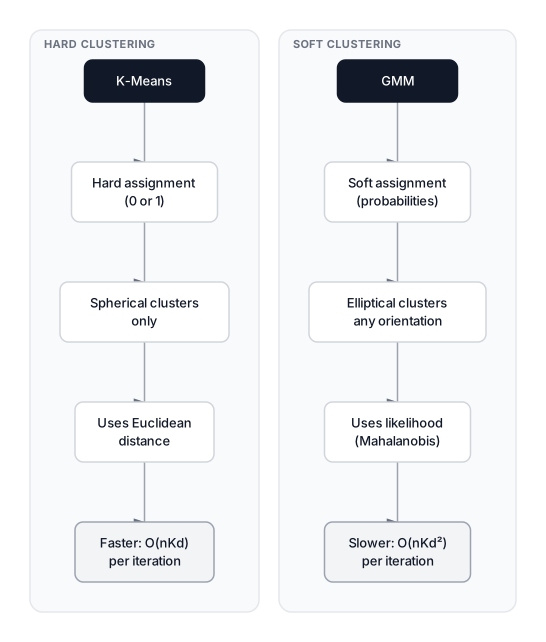 Click to expandGMM vs K-Means: soft probabilistic assignments compared to hard distance-based clustering
Why does this matter in practice? Soft assignments let you:
- Quantify ambiguity: Flag customers who don't fit neatly into any segment for manual review
- Build overlapping segments: A customer can partially belong to multiple marketing campaigns
- Detect distribution shifts: If a customer's probabilities change over time, their behavior is evolving
| Feature | K-Means | GMM |
|---|---|---|
| Assignment | Hard (0 or 1) | Soft (probabilities) |
| Cluster shape | Spherical only | Elliptical, any orientation |
| Distance metric | Euclidean | Mahalanobis (shape-aware) |
| Output | Labels | Labels + probabilities |
| Density estimation | No | Yes (generative model) |
| Complexity per iteration |
Key Insight: K-Means is actually a special case of GMM. Constrain all covariance matrices to be spherical (scalar times identity) with equal mixing coefficients, and the EM algorithm reduces to the K-Means update rule. So GMM is strictly more general.
The EM Algorithm Step by Step
Training a GMM means finding the best values for all , , and . We can't solve this directly because of a chicken-and-egg problem: to compute the means, we need to know which points belong to which cluster; but to assign points, we need to know the cluster parameters.
The Expectation-Maximization (EM) algorithm (Dempster, Laird, and Rubin, 1977) breaks this deadlock by alternating between two steps until convergence.
 Click to expandEM algorithm iterates between computing responsibilities and updating GMM parameters until convergence
The E-Step (Expectation)
Given current parameter estimates, compute the responsibility of each component for each data point. The responsibility answers: "How likely is it that customer was generated by segment ?"
Where:
- is the responsibility of component for data point
- The numerator is the weighted likelihood of point under component
- The denominator normalizes so responsibilities sum to 1 across all components
In Plain English: For each customer, look at every segment and ask: "Given where this segment's bell curve sits right now, how well does this customer fit?" A customer sitting near the center of Segment A gets a responsibility close to 1.0 for A. A customer halfway between two segments might get 0.5 / 0.5.
The M-Step (Maximization)
Given the responsibilities from the E-step, update every parameter by treating the responsibilities as soft weights.
Updated means (weighted average of all points):
Updated covariances (weighted scatter around the new mean):
Updated mixing coefficients (fraction of total responsibility):
Where is the effective number of points assigned to component .
In Plain English: The M-step shifts each segment's center toward the customers that "belong" to it (weighted by responsibility), then stretches or rotates the ellipse to match how those customers are spread out. A segment that claims 40% of 300 customers has an effective size of 120.
The algorithm repeats E-step and M-step until the log-likelihood stops increasing (or changes by less than a tolerance, typically ). Scikit-learn's default max_iter is 100, but most GMMs converge in 10 to 30 iterations.
Common Pitfall: EM finds a local maximum of the log-likelihood, not the global one. Different initializations can produce different solutions. Scikit-learn defaults to n_init=1, but setting n_init=5 or n_init=10 runs multiple initializations and keeps the best result. This costs more compute but dramatically reduces the risk of a poor solution.
GMM Implementation in Python
Let's build a customer segmentation GMM with scikit-learn. We'll generate synthetic customer data with three overlapping segments, fit a GMM, and examine both hard labels and soft probabilities.
Expected Output:
Soft assignment probabilities (first 5 customers):
[[0.000e+00 7.760e-02 9.224e-01]
 [0.000e+00 1.700e-03 9.983e-01]
 [0.000e+00 9.994e-01 6.000e-04]
 [9.998e-01 0.000e+00 2.000e-04]
 [2.200e-03 0.000e+00 9.978e-01]]

Mixing weights: [0.3327 0.3322 0.335 ]
Converged: True
Iterations: 6
The first customer has 92.2% probability of belonging to cluster 2 and 7.8% probability for cluster 1. That 7.8% is information K-Means would discard entirely.
Now let's find the most ambiguous customers and compare GMM's nuance with K-Means' certainty:
Expected Output:
Top 5 most ambiguous customers:
 Index |  Cluster 0 |  Cluster 1 |  Cluster 2
------------------------------------------------
   119 |     0.0000 |     0.4281 |     0.5719
    60 |     0.0000 |     0.3648 |     0.6352
     7 |     0.0000 |     0.3481 |     0.6519
   253 |     0.0000 |     0.6775 |     0.3225
   164 |     0.0000 |     0.3058 |     0.6942

K-Means forces customer 119 into cluster 1 with 100% certainty
GMM says: [ 0.  42.8 57.2]% across clusters
Customer 119 is nearly split between two segments. A marketing team using K-Means would target this customer with only one campaign. With GMM, they'd know to include them in both.
Covariance Types and Their Tradeoffs
The covariance_type parameter is arguably the most important hyperparameter in scikit-learn's GaussianMixture. It controls how many parameters each cluster's covariance matrix uses, directly affecting both flexibility and overfitting risk.
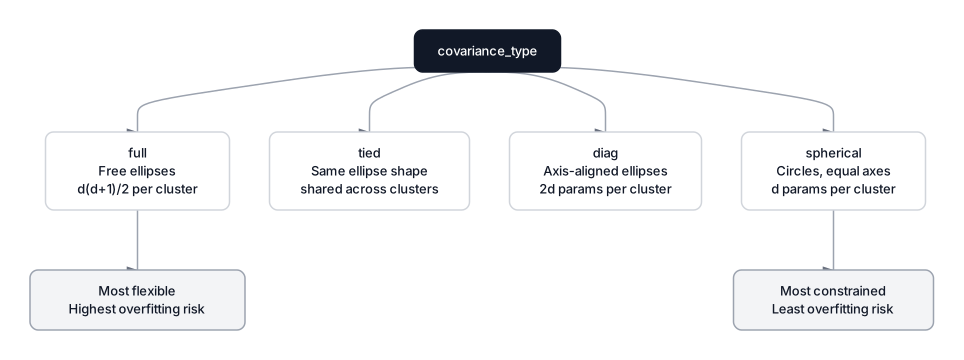 Click to expandFour covariance types from most constrained (spherical) to most flexible (full)
| Type | Shape | Parameters per cluster | Best for |
|---|---|---|---|
spherical | Circles (equal axes) | $1$ | High-dimensional data, few samples |
diag | Axis-aligned ellipses | Features with different variances, independent | |
tied | Same ellipse, shared | (shared) | Clusters with similar shapes |
full | Free ellipses | each | Low-to-medium dimensions, enough data |
For $d = 50$ features, full covariance needs 1,275 parameters per cluster. With 5 clusters, that's 6,375 covariance parameters alone. Unless you have tens of thousands of samples, full will overfit badly. In high dimensions, diag or spherical acts as implicit regularization.
Expected Output:
GMM (full      ): silhouette = 0.5836, BIC = 4815.1
GMM (tied      ): silhouette = 0.5844, BIC = 4799.4
GMM (diag      ): silhouette = 0.5836, BIC = 4802.0
GMM (spherical ): silhouette = 0.5836, BIC = 4791.8
K-Means          : silhouette = 0.5847
All covariance types perform similarly here because our 2D data doesn't have extreme anisotropy. In higher dimensions with correlated features, full covariance would pull ahead significantly. Notice that spherical achieves the lowest BIC despite having fewer parameters; the BIC penalty for extra parameters outweighs the marginal likelihood gain in this case.
Pro Tip: Start with covariance_type='full' for exploratory analysis, then compare BIC values across all four types. If diag or spherical achieves a similar BIC, use them because they're faster and less prone to overfitting.
Component Selection with BIC and AIC
Choosing the right number of components is critical. Too few, and the model misses real structure. Too many, and it overfits noise. Unlike the Elbow Method used with K-Means, GMMs use information-theoretic criteria.
BIC (Bayesian Information Criterion):
AIC (Akaike Information Criterion):
Where:
- is the maximized likelihood of the model
- is the number of free parameters
- is the number of data points
Both balance model fit against complexity. Lower values are better. BIC penalizes complexity more heavily (the term grows with data size), so it favors simpler models. AIC is more permissive.
In Plain English: Imagine you're deciding between a 3-segment and a 5-segment customer model. The 5-segment model fits the data slightly better, but BIC asks: "Is that improvement worth the extra 40 parameters?" Usually, the answer is no, and BIC picks 3.
Expected Output:
Components | BIC       | AIC
-----------------------------------
    1      |    4930.5 |    4912.0
    2      |    4835.7 |    4794.9
    3      |    4815.1 |    4752.1
    4      |    4843.5 |    4758.3
    5      |    4872.6 |    4765.2
    6      |    4888.0 |    4758.3
    7      |    4924.0 |    4772.2

Best by BIC: 3 components
Best by AIC: 3 components
Both criteria correctly identify 3 components. BIC shows a clear minimum at 3, then rises sharply. When BIC and AIC disagree, trust BIC for clustering applications because it's more conservative and less likely to overfit.
Anomaly Detection with Density Estimation
Because GMMs are generative models, they compute the probability density at any point in feature space. Points in low-density regions are unlikely to have been generated by the learned distribution, making them natural anomaly candidates.
This approach has a key advantage over distance-based anomaly detection: it respects cluster shape. A point far from the cluster center in Euclidean terms might still be perfectly normal if it falls along the cluster's stretched axis. GMM density estimation captures this nuance through the Mahalanobis distance embedded in the Gaussian formula.
Expected Output:
Log-density range: [-15.98, -6.67]
Threshold (4th percentile): -9.58
Anomalies detected: 12 / 300

Anomaly indices: [ 65  90 148 152 183 199 206 218 246 274 278 293]
The 4th percentile threshold flags 12 customers (4%) as anomalies. In production, you'd adjust this percentile based on your domain knowledge. For fraud detection, you might use the 1st percentile. For quality control, the 5th percentile is common.
Pro Tip: GMM-based anomaly detection works especially well when anomalies aren't uniformly distributed. If some anomalies cluster near one segment but not others, the shape-aware density correctly flags them while a global distance threshold might miss them entirely.
The Singularity Problem and Regularization
One practical issue with GMMs deserves attention: covariance singularity. If a component collapses onto a single data point (or a low-dimensional subspace), its covariance matrix becomes singular, and the likelihood shoots to infinity. This causes the EM algorithm to crash.
Scikit-learn handles this with the reg_covar parameter (default: ), which adds a small diagonal value to every covariance matrix. This is analogous to L2 regularization and prevents singularity without noticeably affecting results.
When you might need to increase reg_covar:
- High-dimensional data with near-duplicate features
- Very small clusters (fewer than points effectively assigned)
- Poorly initialized models that trap a component on a single point
# If you hit convergence warnings or singular matrix errors:
gmm = GaussianMixture(
    n_components=5,
    covariance_type='full',
    reg_covar=1e-4,  # increased from default 1e-6
    random_state=42
)
When to Use GMMs (and When Not To)
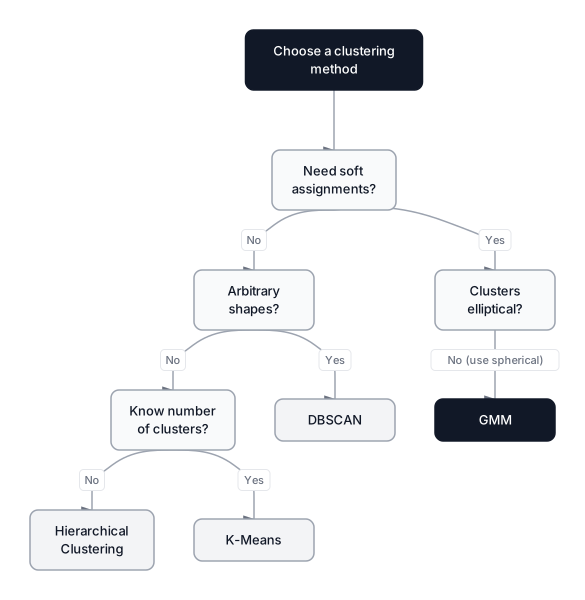 Click to expandDecision guide for choosing between GMM, K-Means, DBSCAN, and Hierarchical Clustering
Use GMMs when:
- You need soft assignments (probability of membership, not binary labels)
- Clusters are elliptical or have different shapes and orientations
- You want density estimation alongside clustering
- The number of clusters is known or can be estimated with BIC/AIC
- Data is roughly Gaussian within each cluster (the key assumption)
Don't use GMMs when:
- Clusters have arbitrary shapes (crescents, rings). Use DBSCAN or Spectral Clustering instead
- You have very high-dimensional data without enough samples (covariance estimation becomes unreliable). Consider PCA first
- Speed is critical on large datasets. K-Means is per iteration versus GMM's due to covariance matrix operations
- You don't know the number of clusters and can't estimate it. DBSCAN or HDBSCAN discover automatically
Production considerations:
- Memory:
fullcovariance stores matrices. With 100 features and 10 clusters, that's 100,000 floats just for covariances - Scaling: GMMs handle 10K to 100K samples well. Beyond 500K samples, consider mini-batch alternatives or K-Means for initial clustering followed by GMM refinement
- Initialization:
init_params='k-means++'(scikit-learn's default since v1.2) provides good starting points. For tricky datasets, increasen_initto 5 or 10
When a Gaussian Mixture Model Fits
Gaussian Mixture Models sit in a sweet spot among clustering methods: more flexible than K-Means, more interpretable than density-based methods, and uniquely capable of quantifying uncertainty through soft assignments. The EM algorithm's E-step/M-step dance is elegant in theory and stable in practice, converging reliably when you choose the right covariance type for your data's dimensionality.
The decision framework is straightforward. If your clusters are roughly Gaussian and you care about membership probabilities, GMMs should be your first choice. If you're dealing with correlated features that create elliptical clusters, full covariance captures what K-Means cannot. And if you're unsure about the number of clusters, BIC gives you a principled answer rather than staring at elbow plots.
For exploring other clustering approaches, see our guide on Hierarchical Clustering when you need a dendrogram-based view of nested structure, or DBSCAN when cluster shapes are too irregular for any Gaussian assumption. If you're new to the Bayesian thinking that underpins mixture models, our Bayesian Statistics guide builds the probabilistic intuition from the ground up.
Frequently Asked Interview Questions
Q: Explain the difference between hard and soft clustering. Why would you prefer soft clustering?
Hard clustering assigns each data point to exactly one cluster (K-Means). Soft clustering assigns a probability distribution over all clusters (GMMs). Soft clustering is preferable when cluster boundaries overlap, because it preserves uncertainty information. In customer segmentation, a soft assignment of 60/40 between two segments tells you far more than an arbitrary hard assignment.
Q: Walk through one iteration of the EM algorithm for a Gaussian Mixture Model.
First, the E-step computes responsibilities: for each data point, calculate the probability it belongs to each component using Bayes' theorem with the current parameter estimates. Second, the M-step updates parameters: recompute each component's mean as a responsibility-weighted average of all points, update covariances using the weighted scatter matrix, and update mixing coefficients as the fraction of total responsibility. The log-likelihood is guaranteed to increase (or stay constant) with each iteration.
Q: Why can't we solve for GMM parameters directly instead of using EM?
The log-likelihood for a mixture model contains a sum inside a logarithm, , which doesn't decompose into a closed-form solution. The latent variable (which component generated each point) couples all parameters together. EM sidesteps this by alternating between estimating the latent variables (E-step) and optimizing parameters given those estimates (M-step).
Q: How do you choose the number of components in a GMM?
Use the Bayesian Information Criterion (BIC). Fit GMMs with different values of , compute BIC for each, and pick the with the lowest BIC. BIC balances model fit against complexity by penalizing the number of parameters with a term. AIC is an alternative but tends to overfit because its penalty grows slower. When BIC and AIC disagree, BIC is safer for clustering.
Q: What happens if a GMM component collapses onto a single data point?
The covariance matrix becomes singular, and the likelihood diverges to infinity. This is the singularity problem. Scikit-learn prevents it by adding a small regularization term (reg_covar, default ) to the diagonal of every covariance matrix. If you encounter convergence warnings, increase reg_covar or use a more constrained covariance type like diag or spherical.
Q: When would you choose GMM over DBSCAN for clustering?
Choose GMM when clusters are approximately elliptical, you know (or can estimate) , and you want soft membership probabilities or density estimates. Choose DBSCAN when clusters have arbitrary non-convex shapes, you don't know , or you need to automatically identify noise points. DBSCAN doesn't assume any particular distribution shape, but it also can't provide membership probabilities.
Q: Your GMM produces very different results on two runs with the same data. What's wrong?
EM converges to a local maximum, so different random initializations can find different solutions. Fix this by setting random_state for reproducibility, increasing n_init (run multiple initializations and keep the best), or using init_params='k-means++' for smarter starting points. If results are unstable across many initializations, you may have too many components for the amount of data.
Q: How does covariance_type affect overfitting in high dimensions?
With full covariance, each component estimates parameters. For 100 features, that's 5,050 parameters per component. Without sufficient data, these estimates are noisy and the model overfits. Using diag reduces this to parameters (100 for $d=100$), and spherical reduces it to 1. In high dimensions, diag often performs as well as full while being far more stable.
Hands-On Practice
Gaussian Mixture Models (GMMs) offer a powerful probabilistic approach to clustering, overcoming the limitations of K-Means by allowing for elliptical cluster shapes and soft membership assignments. In this hands-on tutorial, you will implement GMMs to segment customers based on their spending habits and income, visualizing how the algorithm accommodates complex data structures. Using a real-world customer segmentation dataset, you will explore the differences between hard and soft clustering, learning to interpret the probabilities that define which group a customer belongs to.
Dataset: Customer Segments (Clustering) Customer segmentation data with 5 natural clusters based on income, spending, and age. Silhouette score ≈ 0.75 with k=5.
Try changing covariance_type in the GaussianMixture constructor to 'tied', 'diag', or 'spherical' to see how it restricts the cluster shapes. 'Spherical' will make GMM behave very similarly to K-Means. Also, experiment with n_components to see how the Akaike Information Criterion (AIC) or Bayesian Information Criterion (BIC) can help determine the optimal number of clusters mathematically.