
A temperature sensor on a factory floor reads 82 degrees Celsius. Is that an anomaly? It depends entirely on which machine you're monitoring. For a steel furnace, 82 degrees is ice cold. For a coolant pump, it means something is about to fail.
The same reading. Two completely different conclusions. Context is everything.
Most anomaly detection algorithms ignore this context. They calculate a single global threshold and flag anything beyond it. The Local Outlier Factor (LOF) algorithm takes a fundamentally different approach: it measures how isolated each point is relative to its immediate neighbors. A point surrounded by a tight cluster but sitting slightly outside it is suspicious. That same distance in a naturally sparse region is perfectly normal. LOF, introduced by Breunig et al. in their 2000 ACM SIGMOD paper, formalized this intuition into one of the most widely used density-based anomaly detection algorithms in production today.
Throughout this article, we'll use a running example of industrial sensor readings from two operating modes: a steady-state cluster (dense) and a high-load cluster (sparse). Every formula and code block ties back to this scenario.
The Failure of Global Anomaly Detection
Global anomaly detection methods apply a single decision boundary across the entire dataset. Algorithms like a fixed k-nearest neighbor distance threshold or z-score cutoff assume that "normal" looks the same everywhere. This assumption collapses when your data has clusters of varying density.
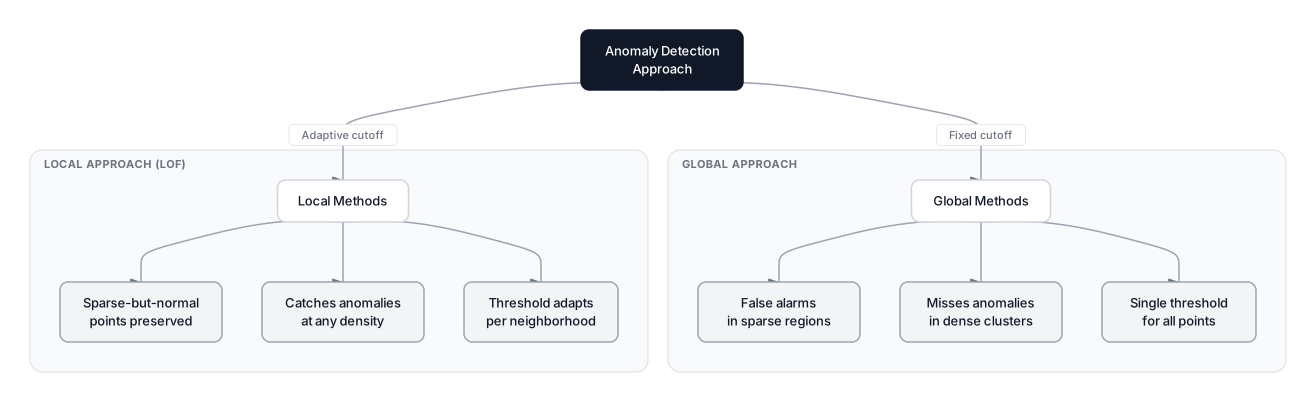 Click to expandComparison of global versus local anomaly detection approaches
Picture our sensor scenario. Steady-state readings form a tight ball: points are typically 0.5 units apart. High-load readings are scattered across a wider region: neighbors sit 4 to 6 units apart. A global method that flags "anything more than 3 units from its neighbor" will flag half the high-load cluster as anomalous (they're naturally spread out) while completely missing a genuine failure that sits 2 units from the steady-state cluster (because 2 is less than 3).
This creates two simultaneous problems:
| Problem | What Happens | Real-World Impact |
|---|---|---|
| False positives in sparse regions | Normal high-load readings flagged | Alert fatigue, operators ignore warnings |
| Missed anomalies in dense regions | Genuine failures in steady-state cluster pass through | Equipment damage, unplanned downtime |
Key Insight: The core problem isn't about choosing a better threshold. It's that no single threshold can work when "normal" means different things in different parts of your data. LOF solves this by computing a separate, local threshold for every point.
If your data truly has uniform density (a single Gaussian blob, for instance), simpler methods like Isolation Forest will be faster and equally effective. LOF earns its keep specifically when density varies.
How LOF Measures Local Density
LOF answers one question: "Is this point more isolated than its neighbors are?" If your neighbors are close to each other but you're far from them, you're an outlier. If your neighbors are also far apart and you fit that pattern, you're normal.
The algorithm builds this answer through four mathematical steps. Each one adds a layer of context.
 Click to expandStep-by-step LOF computation pipeline from input point to final score
Step 1: k-Distance
The k-distance of a point is the Euclidean distance to its -th nearest neighbor. It defines the radius of 's local neighborhood.
Where:
- is the k-distance of point
- is the -th nearest neighbor of
- is the distance function (Euclidean by default)
In Plain English: k-distance answers "how big a net do I need to cast to catch neighbors?" For a steady-state sensor reading surrounded by a tight cluster, the net is tiny (maybe 0.3 units). For a high-load reading in the sparse region, the net is wide (maybe 4 units). This difference in scale is exactly what LOF exploits.
Step 2: Reachability Distance
Reachability distance is the smoothing trick that makes LOF numerically stable. Between point and its neighbor :
Where:
- is the reachability distance from to
- is the k-distance of point (the neighbor)
- is the actual Euclidean distance between and
In Plain English: If sensor reading sits very close to reading (closer than 's typical neighbor distance), we pretend is at least 's k-distance away. This prevents density from exploding to infinity when two readings are nearly identical. Think of it as a minimum "personal space" around each point, equal to that point's own neighborhood radius.
Common Pitfall: Reachability distance is asymmetric. because and can differ. This asymmetry is intentional; each point's context is different.
Step 3: Local Reachability Density (LRD)
Now we compute density. In LOF, density is the inverse of the average reachability distance to a point's neighbors:
Where:
- is the local reachability density of point
- is the set of nearest neighbors of
- is the number of neighbors (usually , can be slightly more with ties)
In Plain English: High LRD means the sensor reading sits in a crowded neighborhood (neighbors are close). Low LRD means it sits in an empty neighborhood (neighbors are far away). A steady-state reading surrounded by 20 neighbors within 0.5 units will have a much higher LRD than a high-load reading whose 20 neighbors span 4 units.
Step 4: The LOF Score
The final LOF score compares 's density against its neighbors' densities:
Where:
- is the local outlier factor of point
- is the local reachability density of neighbor
- is the local reachability density of itself
In Plain English: LOF asks: "Are my neighbors in a denser area than I am?" For a normal steady-state reading, its neighbors have similar density, so the ratio is close to 1. For a genuine anomaly sitting between the two clusters, its nearest neighbors belong to the steady-state cluster (very dense), but the anomaly itself is far from them (low density). The ratio shoots well above 1.
| LOF Score | Meaning | Sensor Example |
|---|---|---|
| Density matches neighbors | Normal reading in either cluster | |
| $> 1.5$ | Significantly less dense than neighbors | Potential sensor fault |
| $< 1$ | Denser than neighbors | Core of a cluster |
LOF on Multi-Density Sensor Data
Let's see LOF in action on synthetic sensor readings with two operating modes. We'll inject four known anomalies and check whether LOF catches them.
Expected output:
Total points: 264
Anomalies detected: 14
True anomalies injected: 4

Point [5.5, 5.5] — LOF score: 5.904, Predicted: Anomaly
Point [3.0, 7.0] — LOF score: 6.367, Predicted: Anomaly
Point [15.0, 7.0] — LOF score: 1.750, Predicted: Anomaly
Point [0.0, 0.0] — LOF score: 7.926, Predicted: Anomaly
All four injected anomalies are caught. The point at [0.0, 0.0] scores highest (7.926) because it's far from everything. The point at [15.0, 7.0] scores lowest among the anomalies (1.750) because it's near the sparse high-load cluster where being somewhat distant is more tolerable. This is exactly the local sensitivity we want.
Notice that LOF also flagged 10 additional points. With contamination=0.05, it forces the top 5% to be outliers. Some of those will be edge points in the sparse cluster. We'll address tuning contamination in the hyperparameters section.
Pro Tip: In scikit-learn, LocalOutlierFactor returns negative_outlier_factor_ as negative values (by convention, so that higher values mean more normal). To get the standard LOF score where higher means more anomalous, negate the attribute: scores = -lof.negative_outlier_factor_.
LOF vs. Global KNN Distance
Does LOF actually outperform a global approach on multi-density data? Let's compare it head-to-head against a global k-nearest neighbor distance threshold, both set to flag the same number of points.
Expected output:
Method              | Precision | Recall | F1    | Flagged
--------------------------------------------------------------
LOF (local)           | 0.286     | 1.000  | 0.444 | 14
KNN distance (global) | 0.143     | 0.500  | 0.222 | 14

Key insight:
  LOF caught all 4 true anomalies (recall=1.0)
  KNN distance flagged 14 points but many are normal sparse-cluster points
Both methods flag 14 points total. But LOF catches all 4 true anomalies (perfect recall), while the global method only catches 2. The global approach wastes its budget flagging normal high-load readings that happen to be far from the nearest neighbor, unable to distinguish "sparse but normal" from "genuinely anomalous."
Critical Hyperparameters
LOF has two parameters that matter and several that rarely need changing.
n_neighbors (k): The Neighborhood Size
This is the single most impactful parameter. It controls how "local" the local analysis is.
Expected output:
k      Detected   True Positives   False Positives
--------------------------------------------------
5      14         4                10
10     14         4                10
20     14         4                10
50     14         3                11
100    14         0                14
At $k=100$, the neighborhood is so large it covers nearly half the dataset. LOF can no longer distinguish local density differences and degenerates into a global method. At $k=50$, one true anomaly slips through. The sweet spot for this data sits between 5 and 20.
| Parameter | Default | Recommended Range | Effect |
|---|---|---|---|
n_neighbors | 20 | 10-50 | Larger = more global; smaller = more sensitive to noise |
contamination | 'auto' | 0.01-0.1 or 'auto' | Fraction of data flagged as outliers |
metric | 'minkowski' | 'euclidean', 'manhattan', 'cosine' | Distance function; cosine works well for text/embedding data |
algorithm | 'auto' | 'ball_tree', 'kd_tree', 'brute' | Neighbor search strategy; auto picks best |
novelty | False | True for streaming | Enables predict() on new data |
Pro Tip: Set larger than the smallest cluster you want to protect. If your smallest legitimate cluster has 30 points, set . Otherwise LOF treats the small cluster as a group of outliers.
contamination: How Aggressive to Flag
When contamination='auto' (the default since scikit-learn 0.22), the threshold is determined by the offset used in the original paper. When set to a float like 0.05, LOF forces exactly that proportion to be flagged, regardless of their actual scores. In practice, try 'auto' first, then look at the distribution of negative_outlier_factor_ scores and pick a manual threshold based on where scores drop sharply.
Novelty Detection Mode
Standard LOF is a transductive algorithm. It can only label the data it was trained on. There's no predict() method for new, unseen points. For production systems that need to evaluate incoming sensor readings in real time, scikit-learn offers a novelty detection mode.
Expected output:
Novelty Detection Results:
Reading                  Score    Verdict
--------------------------------------------------
Normal steady-state      0.995    Normal
Edge of steady-state     1.132    Normal
Far from cluster         7.407    Anomaly
One axis drifted         8.756    Anomaly
The edge reading (score 1.132) stays below the threshold despite being at the cluster boundary. The drifted reading on one axis scores 8.756, higher than the point that's far from the cluster in both dimensions (7.407), because single-axis drift is more contextually abnormal relative to the training distribution.
Common Pitfall: Never call fit_predict() when novelty=True, and never call predict() when novelty=False. Scikit-learn will raise a clear error, but it's a common source of confusion. The two modes serve different use cases: outlier detection (labeling training data) vs. novelty detection (scoring new data).
When to Use LOF (and When Not To)
LOF is not always the right tool. Here's a decision framework.
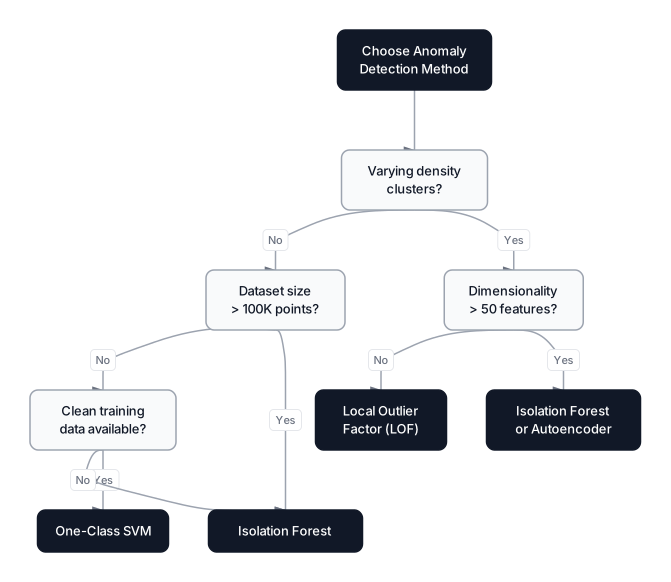 Click to expandAnomaly detection method selection flowchart for choosing between LOF, Isolation Forest, and One-Class SVM
Use LOF when:
- Your data has clusters of varying density (the primary use case)
- You need interpretable scores (LOF scores directly quantify "how anomalous")
- Dimensionality is low to moderate (under 50 features)
- Dataset size is manageable (under 50K points without approximation tricks)
Do NOT use LOF when:
- High dimensionality (> 50 features): Distance becomes meaningless in high dimensions. All points appear equally far from each other. Reduce dimensions first with PCA or apply LOF to learned embeddings.
- Very large datasets (> 100K points): LOF has time complexity for brute-force neighbor search. Isolation Forest scales linearly and handles millions of points.
- Uniform density data: If all clusters have similar density, LOF's local analysis adds overhead without benefit. Use One-Class SVM or Isolation Forest.
- Streaming data in default mode: Standard LOF can't score new points. Either switch to
novelty=True(semi-supervised) or use an incremental variant like Incremental LOF.
Production Considerations
Computational Complexity
- Training: with brute force, with KD-tree or Ball-tree (low dimensions)
- Memory: for storing neighbor distances
- Prediction (novelty mode): per new point (must compare against all training data)
For datasets over 10K points, always set algorithm='ball_tree' or 'kd_tree' explicitly. The 'auto' mode picks well, but verifying it chose a tree-based method avoids surprise slowdowns.
Feature Scaling
LOF is distance-based. Features on different scales will distort distances. Always standardize before fitting. StandardScaler is the standard choice. If your sensor data has extreme outliers in the training set, use RobustScaler from scikit-learn, which uses the interquartile range instead of standard deviation.
Choosing a Contamination Threshold
In production, you rarely know the true contamination rate. A practical workflow:
- Fit LOF with
contamination='auto' - Extract
negative_outlier_factor_scores - Plot sorted scores and look for the "elbow" where scores drop sharply
- Set a manual threshold just past the elbow
- Monitor false positive rate in production and adjust
Ensemble Approach
A single LOF run with one value can miss anomalies. In practice, run LOF with multiple values (say 10, 20, 40) and flag a point as anomalous if any run flags it. This is analogous to how DBSCAN benefits from multiple epsilon values.
When LOF Fits the Anomaly Pattern
Local Outlier Factor remains one of the most effective anomaly detection algorithms for multi-density datasets 26 years after its publication. Its core insight is deceptively simple: judge each point by its neighborhood's standards, not the dataset's global average. The four-step pipeline (k-distance, reachability distance, LRD, LOF score) translates this intuition into a rigorous density ratio that catches anomalies global methods systematically miss.
For production anomaly detection pipelines, LOF pairs well with other methods. Use Isolation Forest as a fast first pass on large datasets, then apply LOF on the flagged subset where local density analysis matters most. For data with extreme class imbalance or when you have clean training data, One-Class SVM provides a complementary boundary-based approach. And when your features number in the hundreds, reduce dimensions with PCA or feature selection before applying any distance-based method.
The next time you see a sensor reading that looks "normal" by global standards but feels wrong in context, LOF is the algorithm that agrees with your gut.
Frequently Asked Interview Questions
Q: Explain the difference between LOF's local approach and a global outlier detection method like z-score.
LOF computes a separate density estimate for each point's neighborhood, then flags points whose density is significantly lower than their neighbors'. A z-score computes a single mean and standard deviation for the entire dataset and flags points beyond a fixed threshold. LOF handles multi-density data where z-score fails because z-score cannot adapt its threshold per region.
Q: What does an LOF score of 1.0 mean, and how does it differ from a score of 3.0?
An LOF score of 1.0 means the point's local density matches its neighbors' densities perfectly; it fits the local pattern. A score of 3.0 means the point's neighbors are, on average, three times denser than the point itself. The higher the score above 1, the stronger the evidence that the point is a local outlier.
Q: Why does LOF use reachability distance instead of raw Euclidean distance?
Reachability distance applies a smoothing floor: the distance between two points is at least the k-distance of the neighbor. This prevents density estimates from exploding to infinity when points are very close together. Without this smoothing, two nearly identical data points would create artificially infinite density, making the LRD and LOF calculations unstable.
Q: Your LOF model flags 15% of your data as anomalous, but domain experts say only 2% are real anomalies. What do you do?
First, check if contamination is set too high and reduce it. If using 'auto', inspect the negative_outlier_factor_ score distribution and set a manual threshold at the elbow point. Also consider increasing n_neighbors to smooth out noisy local density estimates. Finally, validate with domain experts on the flagged points to find the score threshold that best separates true anomalies from false positives.
Q: Can LOF handle categorical features or text data?
Not directly. LOF relies on distance metrics, which require numerical features. For categorical data, apply encoding (one-hot or target encoding) first. For text, convert to embeddings using a sentence transformer, then apply LOF on the embedding vectors. With high-dimensional embeddings, reduce dimensionality first with PCA to avoid the curse of dimensionality.
Q: When would you choose LOF over Isolation Forest for anomaly detection?
Choose LOF when your dataset has clusters of varying density and you need to detect anomalies that are only unusual in their local context. Isolation Forest works better for large datasets (it scales linearly vs. LOF's quadratic complexity), high-dimensional data, and situations where anomalies are globally isolated. In practice, a strong approach is to use Isolation Forest for a fast initial pass and LOF for fine-grained local analysis on the subset.
Q: How does n_neighbors (k) affect LOF's behavior, and how would you choose it?
Small values (3 to 5) make LOF sensitive to micro-clusters and noise, potentially missing anomalies that small groups "protect." Large values (100+) average over too many points and LOF behaves like a global method, losing its local sensitivity. A good starting point is $k=20$, and should always be larger than the smallest cluster you want to preserve. Cross-validation on a labeled holdout set, if available, gives the most reliable choice.
Q: A colleague suggests running LOF on a 500-feature dataset. What concerns would you raise?
Distance metrics become unreliable above roughly 50 dimensions because all pairwise distances converge to similar values. LOF's density estimates depend on meaningful distance differences, so high dimensionality would degrade its performance. I'd recommend dimensionality reduction first (PCA to retain 95% variance, or feature selection to remove irrelevant columns) and then applying LOF to the reduced space.
Hands-On Practice
In this hands-on tutorial, you will master the Local Outlier Factor (LOF) algorithm, a powerful tool for detecting anomalies that hide within dense clusters of data where global thresholds fail. Unlike simpler methods that draw a single boundary around 'normal' data, LOF evaluates the density of each point relative to its local neighborhood, making it essential for complex industrial sensor data. We will apply LOF to a real-world dataset of industrial sensor readings to identify subtle mechanical failures that standard outlier detection often misses.
Dataset: Industrial Sensor Anomalies Industrial sensor data with 11 features and 5% labeled anomalies. Contains 3 anomaly types: point anomalies (extreme values), contextual anomalies (unusual combinations), and collective anomalies (multiple features slightly off). Isolation Forest: 98% F1, LOF: 90% F1.
Try adjusting the n_neighbors parameter from 20 to 5 or 50 to see how the definition of 'local' changes; small values make the model sensitive to micro-clusters, while large values make it behave more like a global outlier detector. You can also experiment with different feature combinations, such as temp_pressure_ratio and power_consumption, to see if anomalies become more distinct in different dimensions. Finally, observe how the contamination parameter directly forces the algorithm to be more or less aggressive in flagging data points.