
Consider a hospital using a machine learning model to screen patients for a rare disease. In this example, the model flags a patient with "87% probability of disease." The doctor, trusting that number, orders an invasive biopsy. But here's the problem: when this model says 87%, the patient actually has the disease only about 55% of the time. The model has strong accuracy (it ranks sick patients above healthy ones), yet its probability calibration is broken. That 87% is a ranking score, not a real probability.
Probability calibration is the process of transforming a classifier's raw confidence scores into outputs that match observed frequencies. A calibrated model that outputs 0.70 for 1,000 patients should see roughly 700 of them actually have the condition. This distinction between discrimination (ranking ability) and calibration (probability accuracy) matters enormously in medicine, finance, insurance, and any domain where the predicted probability directly drives a decision.
Raw Model Scores Are Not Probabilities
Most classifiers don't produce well-calibrated probabilities out of the box. When you call .predict_proba() on a scikit-learn model, the returned values are not guaranteed to match real-world frequencies. They're confidence scores shaped by each algorithm's internal mechanics.
Consider our medical screening model. A Random Forest averages predictions across hundreds of decision trees. This averaging naturally pulls extreme predictions toward the center, so the model rarely outputs values near 0.0 or 1.0. The result: underconfidence at the tails. A patient who truly has a 95% chance of disease might get a predicted probability of only 0.65.
Support Vector Machines have it worse. SVMs compute distances to a decision boundary, not probabilities at all. Converting those distances into the [0, 1] range through naive normalization produces particularly unreliable confidence scores.
Naive Bayes classifiers push probabilities toward extremes (0 and 1) because the conditional independence assumption rarely holds in practice. A patient with three mildly correlated symptoms might receive a 0.99 disease probability when the true risk is 0.40.
The only common classifier with naturally good calibration is Logistic Regression, because its loss function (log loss) directly optimizes for probability accuracy.
| Algorithm | Calibration Tendency | Why |
|---|---|---|
| Logistic Regression | Well-calibrated | Optimizes log loss directly |
| Random Forest | Underconfident | Tree averaging compresses extremes |
| Gradient Boosting / XGBoost | Slightly overconfident | Optimizes for accuracy, not probability |
| Naive Bayes | Severely overconfident | Independence assumption inflates scores |
| SVM | No native probabilities | Outputs margin distances, not probabilities |
Key Insight: High accuracy, AUC, or F1 tells you the model ranks well. Calibration tells you whether you can trust the number it gives you. You need both.
Reliability Diagrams Expose Calibration Failures
A reliability diagram (also called a calibration curve) is the primary visual tool for detecting miscalibrated probabilities. It bins predictions into groups (0-10%, 10-20%, etc.) and plots the average predicted probability against the actual fraction of positives in each bin.
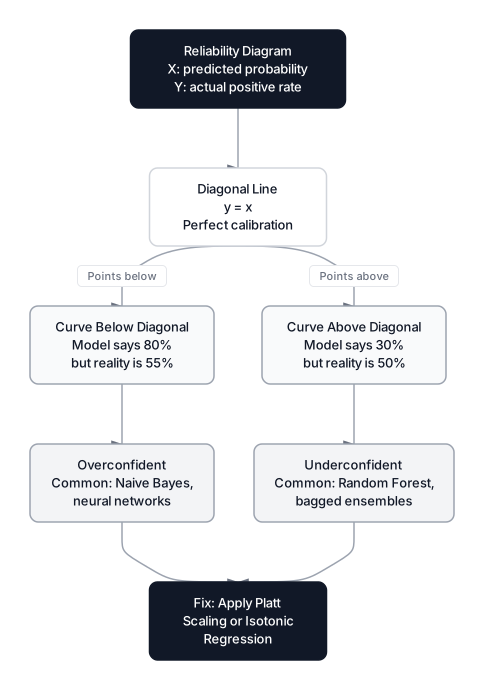 Click to expandHow to read a reliability diagram showing perfect calibration, overconfidence, and underconfidence regions
On a perfectly calibrated model, every point falls on the diagonal line where predicted probability equals observed frequency. In practice, you'll see two common failure modes:
- Overconfident models (Naive Bayes, some neural networks): The curve bows below the diagonal. The model says 80%, reality is 55%.
- Underconfident models (Random Forests, bagged ensembles): The curve bows above the diagonal. The model says 30%, reality is 50%.
For our medical screening model, an underconfident Random Forest is dangerous in a subtle way. It might assign 0.25 to a patient who actually has a 60% chance of disease, causing the doctor to skip a critical follow-up test.
Measuring Calibration with the Brier Score and ECE
Beyond visual inspection, two metrics quantify calibration error numerically.
The Brier Score
The Brier Score measures the mean squared difference between predicted probabilities and actual binary outcomes. Originally introduced by Glenn Brier in 1950 for weather forecast evaluation, it captures both discrimination and calibration in a single number.
Where:
- is the predicted probability for patient
- is the actual outcome (1 = disease, 0 = healthy)
- is the total number of patients
In Plain English: For each patient, the Brier Score squares the gap between your predicted probability and what actually happened. If our screening model predicts 0.90 for a patient who does have the disease, that's a tiny error of . But predicting 0.90 for a healthy patient gives . The average of all these squared gaps is the Brier Score. Lower is better, with 0.0 being perfect.
Expected Calibration Error (ECE)
While the Brier Score blends discrimination and calibration, ECE isolates just the calibration component. It measures the weighted average gap between each bin's predicted confidence and its actual accuracy.
Where:
- is the number of bins
- is the number of patients in bin
- is the actual fraction of positive cases in bin
- is the average predicted probability in bin
In Plain English: ECE asks: "On average, how far off is the model's stated confidence from reality?" If our screening model says "70% disease risk" for a group of patients, but only 50% actually have the disease, that bin contributes a 20% gap. ECE averages these gaps across all bins, weighted by patient count. An ECE of 0.05 means predictions are off by about 5 percentage points on average.
Platt Scaling Fits a Sigmoid Correction Curve
Platt Scaling, proposed by John Platt in 1999, is a parametric calibration method. It trains a logistic regression on the classifier's raw output scores, learning a sigmoid function that maps distorted scores to calibrated probabilities.
Where:
- is the raw score (decision function value or uncalibrated probability) for patient
- and are scalar parameters learned from a held-out calibration set
- is the exponential function
In Plain English: Think of Platt Scaling as fitting an S-shaped correction curve. If our screening model's raw output of 0.35 actually corresponds to a 60% disease rate in historical data, Platt Scaling learns the sigmoid parameters that map 0.35 to 0.60. It only learns two numbers ( and ), so it works well even with small calibration datasets of a few hundred patients.
Platt Scaling assumes the calibration error follows a sigmoid shape, which holds well for SVMs and Naive Bayes but can miss more complex distortion patterns.
Isotonic Regression Handles Complex Distortions
Isotonic Regression is a non-parametric alternative that fits a free-form, monotonically non-decreasing step function. Instead of forcing an S-shape, it creates a piecewise-constant mapping from raw scores to calibrated probabilities.
The only constraint is monotonicity: if raw score A is greater than raw score B, the calibrated probability for A must be greater than or equal to the calibrated probability for B. This is reasonable because higher raw scores should correspond to higher true probabilities.
Because Isotonic Regression fits the data directly without a parametric assumption, it can correct arbitrary distortion shapes. But that flexibility comes at a cost: it needs significantly more calibration data to avoid overfitting. The seminal comparison by Niculescu-Mizil and Caruana (2005) showed that both methods substantially improve calibration for tree-based ensembles and SVMs, with Isotonic Regression having a slight edge when data is plentiful.
Common Pitfall: With fewer than 1,000 calibration samples, Isotonic Regression tends to memorize noise in the calibration set. The resulting step function looks jagged and won't generalize to new patients. Stick with Platt Scaling when calibration data is limited.
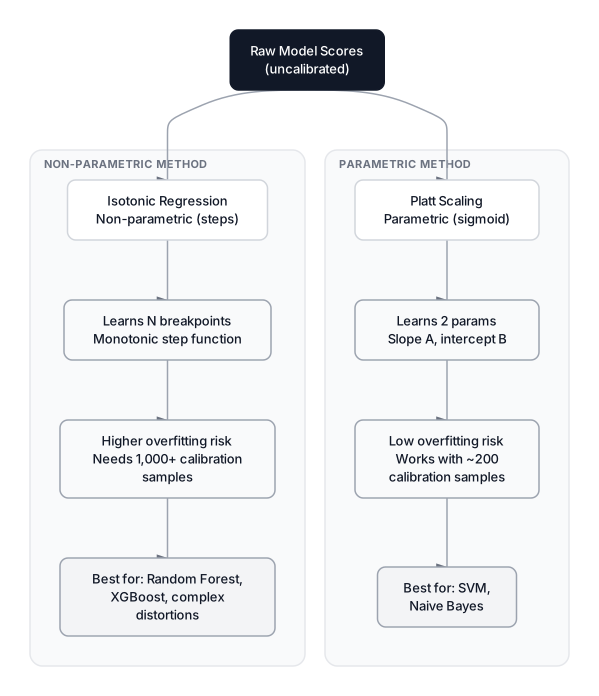 Click to expandComparison of Platt Scaling and Isotonic Regression calibration methods showing when to use each
| Criterion | Platt Scaling | Isotonic Regression |
|---|---|---|
| Type | Parametric (sigmoid) | Non-parametric (stepwise) |
| Parameters learned | 2 (, ) | Up to step points |
| Assumption | S-shaped distortion | Monotonic only |
| Min calibration data | ~200 samples | ~1,000+ samples |
| Overfitting risk | Low | High on small data |
| Best for | SVM, Naive Bayes | Random Forest, XGBoost |
Calibrating a Medical Screening Model in Python
Let's build the full pipeline. We'll simulate a medical screening dataset with ~9% disease prevalence, train a Random Forest, then calibrate it using both methods. The three-way data split (train / calibration / test) is critical: the calibration set must be separate from training data to prevent information leakage.
Expected output:
Training patients: 3000
Calibration patients: 1000
Test patients: 1000
Disease prevalence: 8.9%
Now train the uncalibrated model and apply both calibration methods. FrozenEstimator wraps the already-fitted Random Forest so CalibratedClassifierCV uses it as-is without refitting, learning only the calibration mapping on the held-out set.
Expected output:
Method                  Brier Score   Improvement
----------------------------------------------------
Uncalibrated RF         0.0394        (baseline)
Platt Scaling           0.0329        +16.5%
Isotonic Regression     0.0327        +16.9%
Both methods reduce the Brier Score by roughly 16-17%. In a medical context, that improvement means the gap between stated confidence and actual disease frequency shrinks substantially. A doctor reviewing calibrated scores can trust that "30% risk" actually means about 30%.
Visualizing the Calibration Improvement
The reliability diagram tells the full story. The uncalibrated Random Forest curve bows above the diagonal (underconfident at higher predicted probabilities), while the calibrated curves track the diagonal more closely.
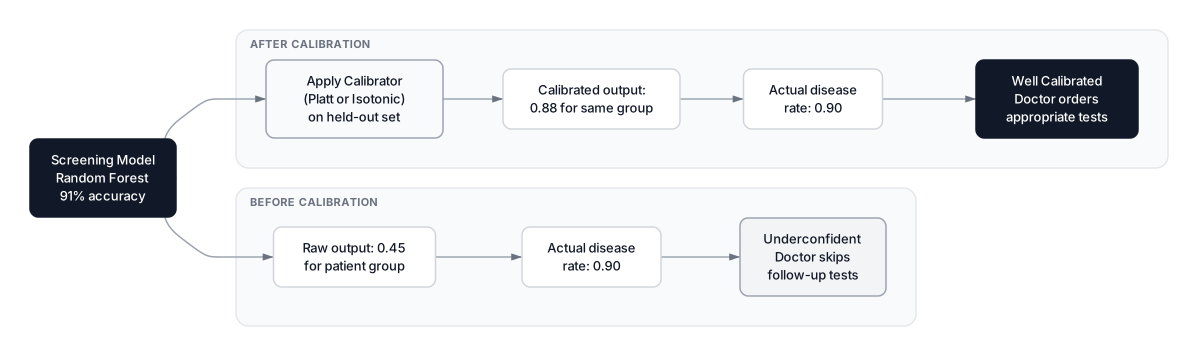 Click to expandBefore and after calibration showing how raw scores transform into meaningful probabilities for patient screening
The calibrated curves hug the diagonal much more closely. Where the uncalibrated model predicted 0.45 for patients who actually had disease 90% of the time, the calibrated versions correct that gap. In clinical practice, this means the doctor sees a number that genuinely reflects the patient's risk.
When to Calibrate (and When Not To)
Calibration isn't always necessary. Here's a practical decision framework.
Calibrate when:
- The predicted probability directly drives a decision (medical triage thresholds, insurance pricing, loan approval cutoffs)
- You're combining predictions from multiple models and need probabilities on the same scale
- Your model feeds into a cost-sensitive framework where dollar amounts multiply predicted probabilities
- You're reporting confidence scores to end users (patients, doctors, customers)
Skip calibration when:
- You only need rankings (which patient is highest risk?), not absolute probabilities
- Your model is already well-calibrated (always check the reliability diagram first)
- You have very little data and can't afford a separate calibration set
- You're using Logistic Regression, which naturally optimizes for calibrated outputs
Pro Tip: Always plot the reliability diagram before deciding to calibrate. Some models, particularly Logistic Regression and well-tuned gradient boosting with log loss, come out of training with decent calibration. Adding a calibration layer to an already-calibrated model can actually make things worse, especially Isotonic Regression on small datasets.
Production Considerations
Calibration adds a post-processing step that requires careful engineering in deployment:
- Data split strategy matters. The calibration set must be separate from training data. A common split is 60/20/20 (train/calibrate/test). Alternatively, use
CalibratedClassifierCVwithcv=5to handle the split internally through cross-validation, avoiding data waste. - Recalibrate on distribution shifts. If your patient population changes (different hospital, different demographics, seasonal disease patterns), the calibration mapping can go stale. Monitor ECE over time and recalibrate when it exceeds your threshold.
- Computational cost is negligible at inference. Platt Scaling adds two multiplications and an exponential. Isotonic Regression does a binary search through the step function. Both add sub-millisecond overhead, even on millions of predictions.
- Calibration doesn't fix bad models. It only adjusts the probability scale. If the model has poor AUC, calibration won't help. Fix discrimination first, then calibrate. The bias-variance tradeoff still applies.
When Calibration Changes the Decision
Probability calibration closes the gap between what a model says and what it means. In our medical screening example, an uncalibrated Random Forest assigned disease probabilities that were consistently off from actual disease frequencies. Both Platt Scaling and Isotonic Regression corrected this gap by roughly 17%, producing probabilities that a doctor can meaningfully interpret when deciding whether to order further tests.
The choice between methods is straightforward: use Platt Scaling when your calibration set is small or the distortion is sigmoid-shaped, and use Isotonic Regression when you have 1,000+ calibration samples and the distortion pattern is irregular. For most production deployments, start with Platt Scaling and switch to Isotonic only if reliability diagrams show non-sigmoid residual error.
If you're building classification pipelines with Random Forest or XGBoost, add CalibratedClassifierCV as the final stage. Two lines of code can be the difference between a model that ranks well and one that a clinician can actually trust with a patient's health.
Interview Questions
Q: What is the difference between a model's discrimination and its calibration?
Discrimination measures how well a model separates positive and negative classes (captured by AUC or accuracy). Calibration measures whether predicted probabilities match observed frequencies. A model can have perfect AUC while being terribly calibrated: it always ranks sick patients above healthy ones, but its stated probability of 90% might correspond to only a 50% actual disease rate. You need both properties for reliable probability estimates in clinical or financial decisions.
Q: Why are Random Forest probabilities typically underconfident?
Random Forests average predictions across many decision trees, and this averaging reduces variance. Individual trees might predict 0.0 or 1.0, but after averaging 100+ trees, extreme values get pulled toward the center. The result is that Random Forests rarely output probabilities near 0.0 or 1.0, even when the true probability warrants it. This is a direct consequence of the variance reduction mechanism that makes ensembles effective.
Q: When would you choose Platt Scaling over Isotonic Regression?
Choose Platt Scaling when the calibration dataset has fewer than 1,000 samples, or when the calibration error follows a roughly sigmoid pattern (common for SVMs and Naive Bayes). Isotonic Regression needs more data because it fits a free-form step function that can overfit on small samples. With 2,000+ calibration samples and non-sigmoid distortion patterns (common in tree-based models), Isotonic Regression typically edges ahead.
Q: Can calibration hurt model performance?
Yes. If a model is already well-calibrated (like Logistic Regression), adding a calibration layer introduces noise without benefit. Isotonic Regression on small datasets is particularly risky because it memorizes the calibration set. Always compare reliability diagrams before and after calibration, and evaluate on a held-out test set that was used for neither training nor calibration.
Q: How would you calibrate a model in production that receives new data daily?
Maintain a rolling calibration buffer with recent labeled outcomes (for example, the last 30 days of confirmed diagnoses). Periodically refit the calibration mapping while keeping the base model fixed. Monitor ECE on incoming data to detect when the calibration degrades due to population drift. The base model and calibration layer should be versioned and updated on independent schedules.
Q: A stakeholder asks you for the "probability of disease" for a patient. Your model outputs 0.73. What do you tell them?
First, check whether the model is calibrated. If calibration hasn't been verified, that 0.73 is a confidence score, not a probability. Report it as "high risk" rather than "73% chance." If the model is calibrated (verified via a reliability diagram on recent test data), you can state that roughly 73 out of 100 patients with this score turn out to have the disease. The distinction matters for informed consent and treatment planning.
Q: Why doesn't calibration improve AUC?
Calibration applies a monotonic transformation to predicted probabilities, which preserves ranking order. Since AUC depends only on how well the model ranks positive examples above negative ones, any monotonic transformation leaves AUC unchanged. The Brier Score improves because it cares about the absolute values of the probabilities, not just their ordering.
Hands-On Practice
Probability calibration is essential when you need to trust your model's confidence scores, not just its predictions. You'll train a classifier on passenger survival data and then calibrate its probability outputs using both Platt Scaling (sigmoid) and Isotonic Regression. By visualizing reliability diagrams, you will see firsthand how calibration transforms unreliable confidence scores into trustworthy probability estimates.
Dataset: Passenger Survival (Binary) Titanic-style survival prediction with clear class patterns. Women and first-class passengers have higher survival rates. Expected accuracy ≈ 78-85% depending on model.
Experiment by changing the base model from RandomForestClassifier to a GaussianNB (which tends to be overconfident) or LogisticRegression (which is naturally well-calibrated). Observe how different classifiers have different calibration curves before and after applying Platt Scaling. You can also try adjusting the number of bins in the calibration_curve function to see how granularity affects the reliability diagram.