
A medical test for a rare disease comes back positive. The test catches 95% of true cases. Your doctor looks worried. But Bayesian statistics reveals something counterintuitive: there's only an 8.8% chance you actually have the disease. The math behind that surprising number is Bayes' Theorem, and it changes how you think about probability itself.
Traditional hypothesis testing treats probability as the long-run frequency of events. Flip a coin infinite times and 50% land heads. Bayesian statistics takes a different stance: probability measures your degree of belief, and that belief updates as evidence arrives. This distinction matters enormously when you have one clinical trial, one product launch, or one hiring decision. You don't have infinite repetitions. You have data, prior knowledge, and a decision to make right now.
We'll build every concept around a single running example: a clinical trial comparing Drug B against a Placebo. By the end, you'll compute exact probabilities like "Drug B has a 99.9% chance of outperforming the Placebo" instead of wrestling with p-values that answer a question nobody asked.
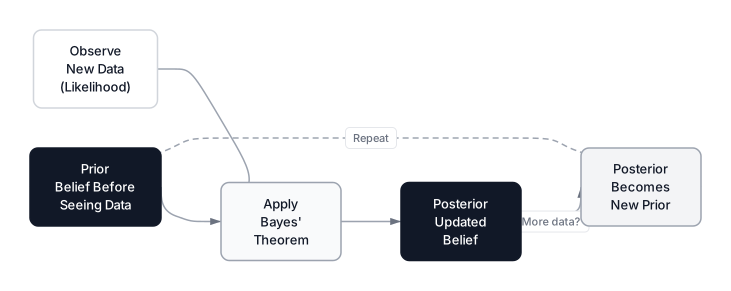 Click to expandBayesian updating cycle showing prior, likelihood, and posterior
The Bayesian vs Frequentist Divide
The split between Bayesian and Frequentist thinking comes down to what you consider "random." Frequentists treat the parameter (say, Drug B's true response rate) as a fixed but unknown constant. Data is random because different samples produce different results. Bayesians flip this: the data you observed is fixed evidence, and the parameter is the random variable, described by a probability distribution that encodes your uncertainty.
This matters at decision time. A Frequentist p-value answers: "If Drug B and the Placebo were identical, how surprised should I be by this data?" That's not what anyone actually wants to know. The Bayesian posterior answers directly: "Given the data, what's the probability Drug B is better?" One of these questions drives better decisions.
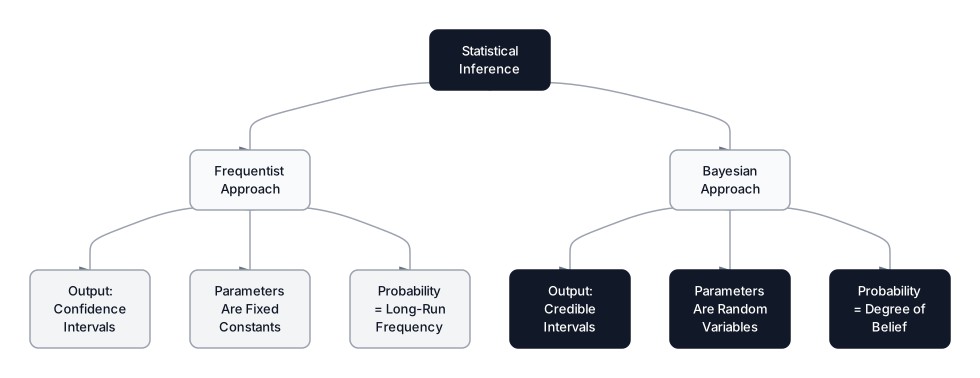 Click to expandBayesian versus frequentist comparison of key philosophical differences
| Criterion | Frequentist | Bayesian |
|---|---|---|
| Parameters | Fixed unknown constants | Random variables with distributions |
| Data | Random (from repeated sampling) | Fixed observed evidence |
| Prior knowledge | Ignored (implicit flat prior) | Explicitly encoded in the prior |
| Interval meaning | "95% of intervals from repeated experiments contain the true value" | "95% probability the true value falls in this range" |
| Typical output | p-value, confidence interval | Posterior distribution, credible interval |
| Small samples | Unreliable; p-values become noisy | Priors stabilize estimates |
| Online learning | Difficult to update incrementally | Natural: yesterday's posterior becomes today's prior |
Key Insight: The Bayesian framework is not "better" or "worse." It answers fundamentally different questions. When your stakeholder asks "What's the probability our new feature improves conversion?" that's a Bayesian question. Frequentist methods cannot answer it, by design.
Bayes' Theorem: The Update Engine
Bayes' Theorem is the mathematical rule that converts prior belief plus new evidence into updated belief. Thomas Bayes described it in a manuscript published posthumously in 1763, and Pierre-Simon Laplace formalized it independently. The theorem itself is just a rearrangement of the definition of conditional probability, but its implications run deep.
Where:
- is the posterior: your updated belief about parameter after seeing data
- is the likelihood: the probability of observing your data given a specific value of
- is the prior: your belief about before seeing any data
- is the evidence (or marginal likelihood): a normalizing constant ensuring probabilities sum to 1
In Plain English: In our clinical trial, is Drug B's true response rate. The prior captures what we believed before running the trial (maybe "response rates for similar drugs tend to be 40-70%"). The likelihood measures how well a particular response rate explains the patient outcomes we observed. The posterior is our updated, data-informed belief about how effective Drug B really is. More patients, tighter posterior. Stronger prior knowledge, more resistance to small samples pulling you off course.
The medical screening problem makes this concrete. A rare disease affects 1% of the population. A diagnostic test catches 95% of true cases (sensitivity) but produces false positives 10% of the time. What does a positive result actually mean?
Medical Test: Bayesian Reasoning in Action
=============================================
Disease prevalence:     1.0%
Test sensitivity:       95.0%
Test specificity:       90.0%
False positive rate:    10.0%

P(Positive test):       0.1085
P(Disease | Positive):  0.0876 (8.8%)

Despite a 95% sensitive test, a positive result
means only a 8.8% chance of actually having the disease.
The base rate (1% prevalence) dominates. Out of every 1,000 people tested, roughly 10 have the disease and 9.5 test positive. But 99 healthy people also test positive (10% false positive rate on 990 healthy people). So 9.5 true positives swim in a pool of 108.5 total positives. That's 8.8%. Ignoring the prior (base rate) leads to panic; Bayes' Theorem corrects the reasoning.
Common Pitfall: This example explains why mass screening for rare conditions is so controversial. Even an excellent test produces mostly false positives when the condition is rare. The prior probability of disease (prevalence) matters just as much as test accuracy.
Prior Distributions: Encoding What You Already Know
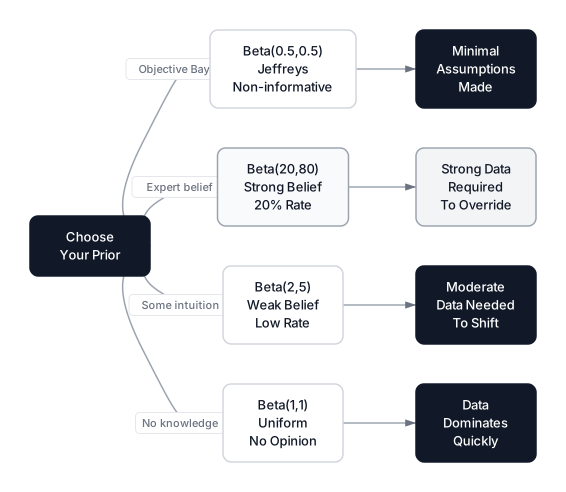
A prior is a probability distribution that captures your knowledge before collecting data. This is the most debated aspect of Bayesian analysis, and for good reason: two analysts with different priors will reach different posteriors from the same data. But here's the thing. Every model encodes assumptions. Frequentist procedures do not assign prior probabilities to parameters. They still depend on modeling choices and assumptions, which should be stated and checked just as Bayesian priors should be examined through sensitivity analysis.
Three categories cover most practical situations:
| Prior Type | Distribution | Clinical Trial Example | When to Use |
|---|---|---|---|
| Uninformative | Beta(1, 1) | "Drug B's response rate could be anything from 0% to 100%" | No prior knowledge; let data speak |
| Weakly informative | Beta(2, 5) | "Response rates for this drug class are usually 10-40%" | General domain knowledge; prevents extreme estimates |
| Informative | Beta(20, 12) | "Phase II showed ~62% response rate with 32 patients" | Strong previous evidence from related studies |
Pro Tip: In practice, weakly informative priors are the sweet spot. They encode reasonable constraints (a conversion rate is unlikely to be 99%) without overpowering the data. The Stan development team's prior recommendations are worth bookmarking. As of March 2026, PyMC 5.28.1 and Stan 2.35+ both provide sensible default prior suggestions in their model-building APIs.
The Beta distribution appears constantly in Bayesian work because of a mathematical property called conjugacy. When your likelihood is Binomial (binary outcomes like "responded" or "didn't respond"), using a Beta prior guarantees the posterior is also a Beta distribution. No iterative sampling required. Just arithmetic.
| Likelihood | Conjugate Prior | Posterior | Use Case |
|---|---|---|---|
| Binomial (binary) | Beta(, ) | Beta(, ) | Response rates, conversion rates, CTR |
| Poisson (counts) | Gamma(, ) | Gamma(, ) | Event counts per time period |
| Normal (known ) | Normal(, ) | Normal (weighted mean, reduced variance) | Continuous measurements |
| Multinomial | Dirichlet() | Dirichlet() | Category probabilities |
 Click to expandBeta distribution shapes for different alpha and beta parameter combinations
Beta-Binomial Updating: Watching Beliefs Evolve
The Beta-Binomial model is the workhorse of applied Bayesian statistics. Start with a Beta prior, observe binary outcomes, and the posterior is another Beta distribution with updated parameters. The update rule is beautiful in its simplicity.
Where:
- and are the prior Beta parameters
- is the number of successes observed
- is the number of failures observed
- and are the posterior Beta parameters
In Plain English: In our clinical trial, we start with Beta(1, 1) because we have no prior knowledge of Drug B. Each patient who responds adds 1 to . Each non-responder adds 1 to . After 30 patients (23 responding), our posterior is Beta(24, 8), centering around a 75% response rate with a credible interval reflecting our remaining uncertainty.
Watch how the posterior evolves as patients enroll in the trial:
Beta-Binomial Conjugate Updating
Prior: Beta(1, 1) — uniform, no prior knowledge
=======================================================
  Patients  Successes            Posterior     Mean               95% CI
-------------------------------------------------------
         5          4 Beta(  5,   2)           0.714 [0.359, 0.957]
        10          7 Beta(  8,   4)           0.667 [0.390, 0.891]
        20         15 Beta( 16,   6)           0.727 [0.528, 0.887]
        30         23 Beta( 24,   8)           0.750 [0.589, 0.881]

As data accumulates, the posterior concentrates around
the true response rate and the credible interval narrows.
After 5 patients, the 95% credible interval spans from 35.9% to 95.7%. That's a massive range. After 30 patients, it tightens to 58.9% to 88.1%. The posterior mean drifts toward the true rate as evidence accumulates. This is Bayesian learning in its purest form.
Key Insight: Notice the credible interval width dropped from 59.8 percentage points (after 5 patients) to 29.2 points (after 30). Each additional observation contributes less and less to narrowing the interval. This is diminishing returns on sample size, and it's one reason Bayesian methods are so useful for deciding when to stop collecting data.
Credible Intervals vs Confidence Intervals
The distinction between Bayesian credible intervals and Frequentist confidence intervals is subtle but important. Both produce a range of plausible parameter values. The interpretation is where they differ.
A 95%** credible interval** means: "Given the data and prior, there is a 95% probability that the true parameter falls within this range." That's the probability statement everyone wants.
A 95%** confidence interval** means: "If we repeated this experiment infinitely, 95% of computed intervals would contain the true value." For any single interval, you can't say the probability is 95% that the true value is inside. It either is or it isn't.
Credible Interval vs Confidence Interval
==================================================
Data: 21/30 patients responded (70.0%)

Frequentist (Wald 95% CI):
  Point estimate: 0.7000
  95% CI: [0.5360, 0.8640]

Bayesian (Beta(1,1) prior, 95% credible interval):
  Posterior mean:  0.6875
  95% CI: [0.5196, 0.8332]

Interpretation difference:
  Frequentist: 'If we repeated this trial infinitely,
    95% of such intervals would contain the true rate.'
  Bayesian: 'There is a 95% probability the true rate
    lies between 52.0% and 83.3%.'
With an uninformative prior (Beta(1,1)), the Bayesian credible interval is slightly tighter and shifted toward 50%. The prior adds two "pseudo-observations" (one success, one failure), which introduces mild shrinkage. With 30 real observations, the difference is small. With 5 observations, the prior's influence would be more noticeable.
Pro Tip: The Bayesian posterior mean (0.6875) differs from the Frequentist point estimate (0.7000) because the Beta(1,1) prior acts as a mild regularizer, pulling the estimate slightly toward 0.5. This shrinkage is actually desirable in small samples because it prevents overconfident estimates from noisy data.
Bayesian A/B Testing in Practice
Bayesian A/B testing replaces the binary "significant or not" verdict with a richer answer: the probability that one variant outperforms the other, and by how much. This approach is standard at companies like Netflix, Spotify, and Google as of 2026, and it maps directly to business decisions.
Here's the setup: an e-commerce team tests two checkout button designs. Control (A) gets 38 conversions from 200 visitors. Variant (B) gets 52 conversions from 200 visitors. Is B better, and should they ship it?
Bayesian A/B Test: Checkout Button Redesign
==================================================
Control (A): 38/200 conversions (19.0%)
Variant (B): 52/200 conversions (26.0%)
Prior: Beta(2, 20)

Posterior A: Beta(40, 182), mean = 0.1802
Posterior B: Beta(54, 168), mean = 0.2432

P(B > A):         0.9480 (94.8%)
Expected lift:    37.7%
95% lift CI:      [-6.1%, 96.3%]

Decision: Continue testing (< 95% confidence threshold)
This result is more useful than a p-value. We know there's a 94.8% probability that B is better, with an expected lift of 37.7%. But notice the 95% lift confidence interval includes negative values (down to -6.1%). The expected improvement is substantial, but we haven't nailed down the magnitude yet. A Frequentist test might return "p = 0.06, not significant," which tells the product team nothing actionable. The Bayesian result says "probably better, but collect more data to be sure."
Common Pitfall: Don't confuse "P(B > A) = 94.8%" with a p-value. A p-value of 0.05 does not mean "5% chance the null is true." These are fundamentally different quantities. The Bayesian probability directly answers "how confident should we be that B beats A?"
MCMC and Modern Bayesian Software
Conjugate priors work beautifully for simple problems. But real-world models, like Bayesian regression with hierarchical priors, mixed likelihoods, or custom link functions, rarely have closed-form posteriors. That's where Markov Chain Monte Carlo (MCMC) sampling comes in.
MCMC algorithms generate correlated samples from the posterior distribution without needing to compute the normalizing constant . Modern samplers like the No-U-Turn Sampler (NUTS) from Hoffman and Gelman (2014) are highly efficient and form the backbone of every major Bayesian library.
The Python ecosystem for Bayesian modeling in March 2026:
| Library | Version | Strength | Best For |
|---|---|---|---|
| PyMC | 5.28.1 (Feb 2026) | Pythonic API, ArviZ integration | General-purpose Bayesian modeling |
| NumPyro | 0.16+ | JAX backend, GPU acceleration | High-performance inference |
| Stan (via CmdStanPy) | 2.35+ | Battle-tested, best HMC | Research-grade inference |
| ArviZ | 1.0+ (major refactor) | Visualization, diagnostics | Post-inference analysis |
| scipy.stats | 1.17.0 | Built-in bayes_mvs() | Quick Bayesian intervals |
Here's what a PyMC model looks like for our clinical trial (display-only since PyMC requires compilation and is not available in Pyodide):
import pymc as pm
import arviz as az

with pm.Model() as clinical_model:
    # Priors: weakly informative Beta for each group
    p_placebo = pm.Beta("p_placebo", alpha=2, beta=5)
    p_drug_b = pm.Beta("p_drug_b", alpha=2, beta=5)

    # Likelihoods
    obs_placebo = pm.Binomial("obs_placebo", n=287, p=p_placebo, observed=116)
    obs_drug_b = pm.Binomial("obs_drug_b", n=242, p=p_drug_b, observed=157)

    # Derived quantity: probability of superiority
    diff = pm.Deterministic("diff", p_drug_b - p_placebo)

    # Sample posterior with NUTS
    trace = pm.sample(2000, tune=1000, random_seed=42)

# Summarize results
print(az.summary(trace, var_names=["p_placebo", "p_drug_b", "diff"]))
This declarative style is where Bayesian modeling shines in practice. You state priors, state the likelihood, and let the sampler figure out the posterior. PyMC 5.28.1 added improved support for censored data models, and ArviZ 1.0 brought a complete API refactor with better modularity for diagnostic workflows.
Key Insight: The FDA published draft guidance in January 2026 formally endorsing Bayesian methods for primary inference in Phase III clinical trials. This guidance specifically covers prior elicitation, sensitivity analysis, and trial operating characteristics. Bayesian statistics has moved from academic curiosity to regulatory acceptance.
When to Use Bayesian Methods (and When Not To)
Bayesian methods aren't always the right choice. Here's a decision framework:
Use Bayesian methods when:
- Small samples dominate. With 15 patients or 50 A/B test visitors, Frequentist estimates are unstable. Priors act as regularizers.
- Prior knowledge exists. Previous studies, domain expertise, or historical data should influence your analysis. Ignoring it wastes information.
- Sequential decisions matter. Bayesian updating works naturally for monitoring dashboards, adaptive clinical trials, and real-time bidding.
- Stakeholders need probabilities. "There's an 87% chance this variant is better" is more actionable than "p = 0.04."
- You need the full uncertainty picture. Posterior distributions reveal multimodality, skew, and tail risks that point estimates hide.
Avoid Bayesian methods when:
- You have massive data and simple models. With 10 million rows, the prior is irrelevant and MCMC is slow. Maximum likelihood gives the same answer in seconds.
- Regulatory or organizational norms require Frequentist methods. Some fields still mandate p-values (though this is changing; see the FDA guidance).
- Computational budget is tight. MCMC sampling for complex hierarchical models can take hours. Consider whether the inferential gain justifies the compute.
- You can't justify your prior. If prior selection feels arbitrary and you have enough data, the simpler Frequentist approach removes that debate.
Pro Tip: In practice, most production Bayesian systems use conjugate models (Beta-Binomial for conversion rates, Gamma-Poisson for count data) specifically because they avoid MCMC entirely. The fancy PyMC/Stan models are for research and complex hierarchical problems. Simple conjugate updating handles 80% of industry Bayesian use cases.
Production Considerations
Computational complexity. Conjugate models update in . MCMC sampling is where is chain length, is chains, and is parameter dimensionality. For models with hundreds of parameters, expect minutes to hours.
Memory. Storing full posterior traces for a model with 500 parameters and 4,000 samples per chain (4 chains) means 8 million floating-point values, roughly 64 MB. ArviZ 1.0's InferenceData format (built on xarray) handles this efficiently with lazy loading.
Scaling. Naive Bayes classifiers, which apply Bayes' Theorem with independence assumptions, scale to millions of documents. Full Bayesian regression with MCMC does not. For production logistic regression at scale, variational inference (ADVI in PyMC, or NumPyro's SVI) trades some posterior accuracy for 10-100x speedup.
Statistical power. Bayesian power analysis uses simulation: generate data under the alternative hypothesis, compute posteriors, check how often the credible interval excludes the null value. It's more flexible than Frequentist power formulas but requires more setup.
Conclusion
Bayesian statistics gives you a principled framework for combining prior knowledge with observed evidence. The mechanics are straightforward: encode what you know as a prior distribution, observe data through a likelihood function, and Bayes' Theorem produces an updated posterior. For binary outcomes, the Beta-Binomial conjugate pair makes this update a matter of addition.
The practical advantages become clear in settings where Frequentist methods struggle. Small clinical trials, sequential A/B tests, and problems with strong prior information all benefit from the Bayesian approach. The FDA's January 2026 draft guidance on Bayesian clinical trials signals that regulatory acceptance has caught up with the methodology's theoretical strengths.
To go deeper, explore Bayesian regression for continuous outcomes, or see how these ideas connect to A/B testing design and confidence intervals. Start with conjugate models for your next binary outcome problem. They require no special libraries, run instantly, and will change how you think about uncertainty.
Interview Questions
Q: Explain Bayes' Theorem and its components in the context of a real problem.
Bayes' Theorem computes the posterior probability of a hypothesis given evidence: . In a spam filter, is "this email is spam," is the base rate of spam (say 30%), is the probability of seeing these words given it's spam, and is the updated probability after examining the email content. The normalizing constant ensures the posterior sums to 1 across all hypotheses.
Q: What is the difference between a credible interval and a confidence interval?
A 95% Bayesian credible interval directly states: "There is a 95% probability the parameter lies in this range." A 95% Frequentist confidence interval means: "If this experiment were repeated infinitely, 95% of computed intervals would contain the true value." For any single experiment, the confidence interval either contains the true value or it doesn't. The Bayesian interpretation is what most practitioners actually want.
Q: How does the choice of prior affect Bayesian inference?
With large samples, the prior's influence diminishes and the posterior is dominated by the likelihood (data). This is called being "swamped by the data." With small samples, the prior matters substantially. An overly strong prior can bias results, while a flat prior may lead to unstable estimates. Sensitivity analysis, where you rerun the model with different reasonable priors, is standard practice for checking whether conclusions depend on prior choice.
Q: Your A/B test shows P(B > A) = 92%. The product manager wants to ship. What do you advise?
The 92% probability means there's still an 8% chance that B is worse than A. I'd check two things: the expected loss if B is actually worse (risk magnitude, not just probability), and the cost of collecting more data. If the downside of a wrong decision is small (e.g., button color) and the expected lift is substantial, 92% might be good enough. For a pricing change affecting millions in revenue, I'd want 97%+ and would recommend extending the test.
Q: Why is the Beta distribution the conjugate prior for the Binomial likelihood?
Conjugacy means the posterior belongs to the same distribution family as the prior. When you combine a Beta(, ) prior with Binomial data (s successes, f failures), the posterior is Beta(, ). This closed-form update avoids MCMC sampling entirely. The Beta distribution is conjugate because its functional form (proportional to ) has the same structure as the Binomial likelihood.
Q: When would you choose MCMC over conjugate models in production?
Conjugate models handle simple cases: binary outcomes (Beta-Binomial), count data (Gamma-Poisson), and normal means (Normal-Normal). When the model involves hierarchical structure, multiple parameters with dependencies, non-standard likelihoods, or mixture components, conjugacy breaks down and MCMC (or variational inference) is necessary. Conjugate models provide closed-form posterior updates for compatible prior-likelihood pairs. Models without tractable closed forms may require computational inference such as MCMC, which tools such as PyMC and Stan provide.
Q: A colleague says Bayesian methods are "subjective" and therefore unscientific. How do you respond?
All statistical methods embed assumptions. Frequentist methods assume a flat prior (all parameter values equally likely), choose a significance threshold (typically 0.05), and select a test statistic, all of which are subjective choices. Bayesian methods make the prior assumption explicit, which is arguably more transparent. The real test is whether conclusions are sensitive to reasonable alternative priors. If they are, you need more data. If they aren't, the prior choice was inconsequential.
Q: How does Bayesian updating enable early stopping in clinical trials?
In Bayesian adaptive trials, you compute the posterior after each interim analysis. If P(treatment is effective) exceeds a prespecified threshold (say 99%), you can stop for efficacy. If P(treatment is futile) is high, you stop for futility. Unlike Frequentist sequential testing, which requires alpha-spending corrections to control Type I error, the Bayesian approach naturally handles multiple looks at the data because the posterior incorporates all evidence accumulated so far.
Hands-On Practice
A Bayesian A/B testing engine from scratch using Python. Rather than relying on p-values, which often confuse 'significance' with 'impact', we will use the Clinical Trial dataset to generate full probability distributions for the effectiveness of a Placebo versus Drug B. This allows us to answer the direct business question: 'What is the exact probability that Drug B is superior to the Placebo?'
Dataset: Clinical Trial (Statistics & Probability) Clinical trial dataset with 1000 patients designed for statistics and probability tutorials. Contains treatment groups (4 levels) for ANOVA, binary outcomes for hypothesis testing and A/B testing, confounders for causal inference, time-to-event data for survival analysis, and pre-generated distribution samples.
By shifting from Frequentist point estimates to Bayesian distributions, we've gained a much richer understanding of our data. We don't just know that Drug B is 'statistically significant'; we can quantify that there is a near-100% probability it is superior, with an expected lift of over 60%. This direct quantification of risk and opportunity is what makes Bayesian methods so powerful for decision-making under uncertainty.