
You train a decision tree on wine chemical data, hold out 25% for testing, and get 97.8% accuracy. Impressive. You change one line of code, random_state=3 instead of random_state=0, and accuracy drops to 86.7%. Same model, same data, same hyperparameters. The only thing that changed was which samples landed in the test set.
That 11-point swing is the lucky split problem, and cross-validation is the standard solution. Instead of betting your evaluation on a single random partition, cross-validation tests the model against multiple slices of data and averages the results. The score you get back reflects genuine generalization ability rather than the luck of one particular draw.
Every formula and code block in this article uses one running example: the classic Wine dataset from scikit-learn (178 samples, 13 chemical features, 3 cultivar classes). We will progress from basic K-Fold through stratified splits, time series validation, and nested CV for unbiased model selection.
The Lucky Split Problem
A single train/test split (the holdout method) produces one number. That number depends entirely on which samples ended up in the test set. For small to medium datasets, this randomness creates unacceptable instability in your reported performance.
Consider the Wine dataset. A decision tree trained ten times with different random splits yields accuracies ranging from 86.7% to 97.8%. If you reported the 97.8% run, you would dramatically overstate the model's true capability. If you reported the 86.7% run, you would understate it. Neither number alone tells the full story.
Key Insight: A single test set gives you a point estimate of performance. Cross-validation gives you a distribution of performance, showing both the average score and how stable that score is across different data partitions.
The root cause is variance in the estimate. Smaller datasets amplify this variance because each test set contains fewer samples, making it easier for a handful of unusual examples to skew the result. Even with larger datasets, a single split can mask systematic weaknesses in the model if the test set happens to dodge the hard cases.
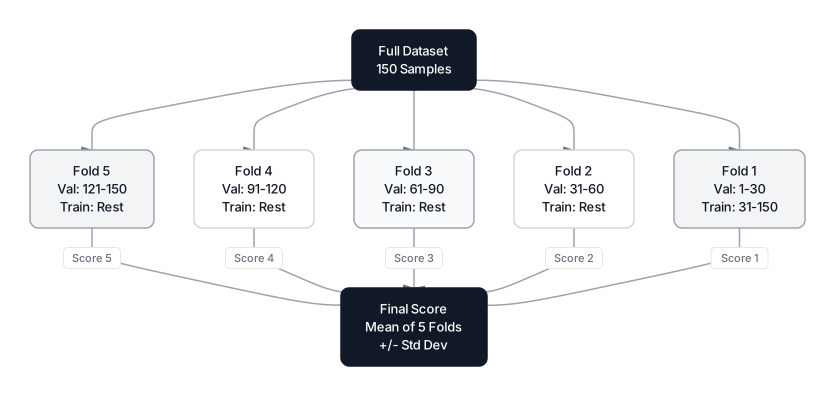 Click to expandK-Fold cross-validation showing train and validation splits across 5 folds
K-Fold Cross-Validation Mechanics
K-Fold cross-validation eliminates the lucky split problem by rotating through different test sets so that every sample serves as test data exactly once. The scikit-learn cross-validation documentation describes it as the default evaluation strategy for good reason.
The algorithm works in four steps:
- Shuffle the dataset randomly.
- Split it into equal-sized groups called folds.
- Iterate: for each fold, hold it out as the test set and train on the remaining folds. Record the test score.
- Average the scores to produce the final performance metric.
The cross-validation score is the mean of the individual fold scores:
Where:
- is the overall cross-validation score
- is the number of folds
- is the score (accuracy, F1, R2, etc.) on fold
- The summation runs over all folds
In Plain English: Train the decision tree five times, each time holding out a different 20% slice of the wine data for testing. Average those five accuracy scores. The result is far more stable than any single split because every wine sample contributed to the evaluation exactly once.
Here is the lucky split problem versus 5-fold CV on the Wine dataset:
Wine dataset: 178 samples, 13 features, 3 classes

--- 10 random train/test splits (Decision Tree) ---
  random_state=0: 0.9111
  random_state=1: 0.9556
  random_state=2: 0.9556
  random_state=3: 0.8667
  random_state=4: 0.8667
  random_state=5: 0.9111
  random_state=6: 0.9778
  random_state=7: 0.9111
  random_state=8: 0.9111
  random_state=9: 0.9556
Best:   0.9778
Worst:  0.8667
Spread: 11.1 percentage points

--- 5-Fold Cross-Validation (same model) ---
  Fold 1: 0.9167
  Fold 2: 0.8056
  Fold 3: 0.8333
  Fold 4: 0.9143
  Fold 5: 0.8571
Mean: 0.8654 +/- 0.0440
The single splits range from 86.7% to 97.8%. Cross-validation collapses that uncertainty into one reliable number: 86.5% with a standard deviation of 4.4%. Always report both the mean and the standard deviation. A score of "86.5% +/- 4.4%" is far more honest than cherry-picking the 97.8% run.
Pro Tip: When you pass cv=5 to cross_val_score with a classifier, scikit-learn automatically uses StratifiedKFold under the hood. For regression, it defaults to regular KFold. This is a sensible default, but you should understand the difference (covered next).
Choosing the Right K
The choice of involves a tradeoff between computational cost and the bias-variance tradeoff of the score estimate itself.
| Training Set Size | Bias of Estimate | Variance of Estimate | Compute Cost | Best For | |
|---|---|---|---|---|---|
| 2 or 3 | 50-67% of data | High (underfits) | Low | Fastest | Quick prototyping on large datasets |
| 5 | 80% of data | Low | Low | Moderate | General default |
| 10 | 90% of data | Very low | Moderate | Higher | Smaller datasets, final evaluation |
| (LOOCV) | samples | Lowest | Highest | model fits | Very small datasets (< 50 rows) |
With $K=2$, each fold trains on only half the data. The model may underfit, biasing the score downward. With $K=N$ (Leave-One-Out), you train on nearly all data, minimizing bias. But the training sets overlap almost completely, producing highly correlated fold scores. The average of correlated estimates has high variance, which is counterintuitive but mathematically real.
$K=5$ or $K=10$ occupies the sweet spot. Empirical studies by Ron Kohavi (1995) found that stratified 10-fold cross-validation provides the best balance for most classification tasks. In practice, 5-fold is often sufficient and cuts compute by half.
Common Pitfall: LOOCV sounds appealing because it maximizes training data, but the high variance in the score estimate makes it unreliable for model comparison. Two models with true accuracy difference of 1% can easily flip rankings under LOOCV due to score variance. Stick with 5 or 10 folds unless your dataset is truly tiny.
Stratified K-Fold for Imbalanced Classes
Standard K-Fold shuffles data randomly and splits it into equal chunks. When class distributions are uneven, this randomness can produce folds where the minority class is severely underrepresented or entirely absent.
Stratified K-Fold enforces the original class distribution in every fold. If the full dataset has 33% Class 0, 40% Class 1, and 27% Class 2, each fold will approximate those same proportions. For classification problems, this is almost always what you want.
The Wine dataset has three cultivar classes in a roughly 33/40/27 split. Watch how regular KFold lets the class ratios wander while StratifiedKFold pins them down:
Overall class distribution:
  Class 0: 59 samples (33.1%)
  Class 1: 71 samples (39.9%)
  Class 2: 48 samples (27.0%)

=== Regular KFold: class distribution per test fold ===
  Fold 1: Class 0=39%, Class 1=39%, Class 2=22%  (n=36)
  Fold 2: Class 0=33%, Class 1=36%, Class 2=31%  (n=36)
  Fold 3: Class 0=28%, Class 1=47%, Class 2=25%  (n=36)
  Fold 4: Class 0=34%, Class 1=37%, Class 2=29%  (n=35)
  Fold 5: Class 0=31%, Class 1=40%, Class 2=29%  (n=35)

=== StratifiedKFold: class distribution per test fold ===
  Fold 1: Class 0=33%, Class 1=39%, Class 2=28%  (n=36)
  Fold 2: Class 0=33%, Class 1=39%, Class 2=28%  (n=36)
  Fold 3: Class 0=33%, Class 1=39%, Class 2=28%  (n=36)
  Fold 4: Class 0=34%, Class 1=40%, Class 2=26%  (n=35)
  Fold 5: Class 0=31%, Class 1=43%, Class 2=26%  (n=35)
Look at Fold 1 under regular KFold: Class 0 balloons to 39% (should be 33%) while Class 2 drops to 22% (should be 27%). The stratified version keeps every fold within a percentage point or two of the true distribution.
The impact on accuracy is modest with the Wine dataset's mild imbalance. But for fraud detection (0.1% positive), medical diagnosis (5% disease prevalence), or any problem where evaluation metrics beyond accuracy matter, stratified splitting is essential. A fold with zero positive samples will produce meaningless precision and recall scores.
Pro Tip: Scikit-learn's cross_val_score already uses StratifiedKFold when the estimator is a classifier. But when you build custom loops, always instantiate StratifiedKFold explicitly. It costs nothing and prevents a class of bugs that are hard to diagnose.
Group K-Fold for Repeated Subjects
This is the most dangerous trap in cross-validation: data leakage through subject identity.
Suppose you are classifying wine samples, but each vineyard contributed 5 bottles. Standard K-Fold might put 4 bottles from Vineyard A in training and 1 bottle from Vineyard A in testing. The model learns Vineyard A's chemical signature rather than general wine properties. It scores well on the test fold because it recognizes the vineyard, not because it generalizes.
Real-world examples where this leakage happens constantly:
- Medical imaging: multiple scans per patient
- NLP: multiple reviews per customer
- Sensor data: multiple readings per device
- Finance: multiple transactions per account
GroupKFold ensures that all samples from a given group appear exclusively in training or testing, never both.
from sklearn.model_selection import GroupKFold
import numpy as np

# 12 wine samples from 4 vineyards (3 samples each)
X = np.random.randn(12, 5)
y = np.array([0, 0, 0, 1, 1, 1, 2, 2, 2, 0, 0, 1])
groups = np.array([1, 1, 1, 2, 2, 2, 3, 3, 3, 4, 4, 4])

gkf = GroupKFold(n_splits=4)
for fold, (train_idx, test_idx) in enumerate(gkf.split(X, y, groups)):
    train_groups = np.unique(groups[train_idx])
    test_groups = np.unique(groups[test_idx])
    print(f"Fold {fold+1}: Train vineyards {train_groups}, Test vineyard {test_groups}")

# Output:
# Fold 1: Train vineyards [2 3 4], Test vineyard [1]
# Fold 2: Train vineyards [1 3 4], Test vineyard [2]
# Fold 3: Train vineyards [1 2 4], Test vineyard [3]
# Fold 4: Train vineyards [1 2 3], Test vineyard [4]
Vineyard 1 never appears in both train and test simultaneously. The model must prove it can generalize to entirely unseen vineyards.
Common Pitfall: If your data has any repeated structure (multiple rows per user, session, or entity), standard K-Fold will overestimate performance. The model memorizes entity-specific patterns that won't exist at deployment. Always ask: "Does my data have groups?" If yes, use GroupKFold.
Time Series Cross-Validation
Random K-Fold fails for temporal data because it breaks the arrow of time. If you randomly place January 2025 data in training and December 2024 data in testing, the model trains on the future to predict the past. This is lookahead bias, and it produces scores that are pure fantasy.
TimeSeriesSplit in scikit-learn solves this with an expanding window approach. Each successive fold adds more historical data to the training set while always testing on the next unseen time period. For a deeper treatment of temporal modeling, see our guide on time series fundamentals.
=== TimeSeriesSplit (5 folds, 24 months of data) ===
  Fold 1: Train [1-4] (4 mo)  Test [5-8] (4 mo)
  Fold 2: Train [1-8] (8 mo)  Test [9-12] (4 mo)
  Fold 3: Train [1-12] (12 mo)  Test [13-16] (4 mo)
  Fold 4: Train [1-16] (16 mo)  Test [17-20] (4 mo)
  Fold 5: Train [1-20] (20 mo)  Test [21-24] (4 mo)

=== With gap=2 (skip 2 months to avoid autocorrelation) ===
  Fold 1: Train [1-2]  ... 2-month gap ...  Test [5-8]
  Fold 2: Train [1-6]  ... 2-month gap ...  Test [9-12]
  Fold 3: Train [1-10]  ... 2-month gap ...  Test [13-16]
  Fold 4: Train [1-14]  ... 2-month gap ...  Test [17-20]
  Fold 5: Train [1-18]  ... 2-month gap ...  Test [21-24]
Notice two things. First, the training window expands with each fold. Fold 1 trains on 4 months; Fold 5 trains on 20. This mirrors reality: you always have more history available for later predictions. Second, the gap parameter inserts a buffer between training and testing, which is critical when your features include lagged values. Without the gap, the most recent training observations leak information into the test period through autocorrelation.
The test_size parameter (available since scikit-learn 1.0) lets you fix the test window size. Combined with max_train_size, you can build a true sliding window instead of an expanding one.
Key Insight: Time series cross-validation scores tend to improve with later folds because the model sees more training data. Don't panic if Fold 1 scores poorly. Report the mean across all folds, but pay extra attention to the later folds since they better represent your production scenario (training on all available history).
CV Strategy Selection Decision Framework
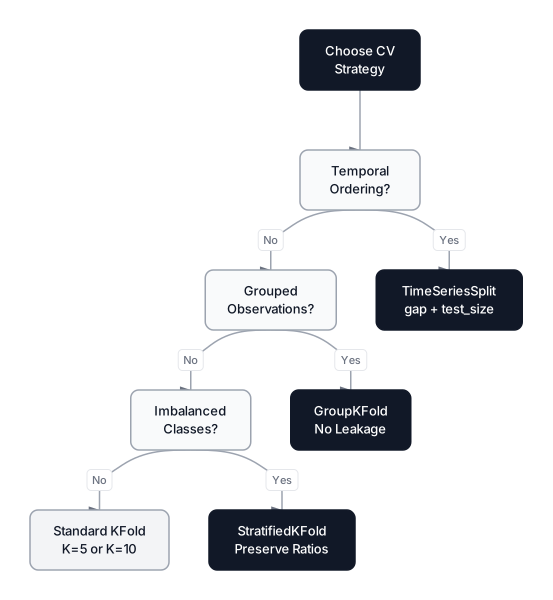 Click to expandCross-validation strategy selection decision tree
Choosing the right CV strategy matters more than choosing the right . Here is a quick decision framework:
| Scenario | Strategy | Why |
|---|---|---|
| Standard classification | StratifiedKFold(n_splits=5) | Preserves class balance |
| Standard regression | KFold(n_splits=5, shuffle=True) | No class to stratify |
| Multiple samples per subject | GroupKFold | Prevents identity leakage |
| Temporal ordering matters | TimeSeriesSplit | Respects arrow of time |
| Groups + time ordering | GroupTimeSeriesSplit (mlxtend) | Both constraints |
| Very small data (< 50 rows) | RepeatedStratifiedKFold | Averages over multiple shuffles |
| Hyperparameter tuning + evaluation | Nested CV | Separates tuning from scoring |
Pro Tip: When in doubt, ask yourself two questions: "Is there a group structure?" and "Is there a time component?" If neither applies, StratifiedKFold with $K=5$ covers the vast majority of cases.
Preprocessing Inside CV Folds
A subtle but devastating mistake is fitting your preprocessing on the entire dataset before splitting into folds. If you standardize all 178 wine samples and then run K-Fold, the scaler's mean and standard deviation contain information from the test fold. The model indirectly "sees" test data through the scaled features, inflating scores.
The fix is Pipeline. Wrapping the scaler and model in a single pipeline ensures that cross_val_score refits the scaler on each fold's training data independently. Every EXEC block in this article already follows this pattern.
from sklearn.pipeline import Pipeline
from sklearn.preprocessing import StandardScaler
from sklearn.tree import DecisionTreeClassifier

# The scaler is refit inside each fold automatically
pipe = Pipeline([
    ('scaler', StandardScaler()),
    ('dt', DecisionTreeClassifier(random_state=42))
])
scores = cross_val_score(pipe, X, y, cv=5)
This also applies to feature engineering steps like imputation, encoding, and PCA. Anything that learns parameters from data must go inside the pipeline to prevent leakage.
Common Pitfall: Applying PCA to the entire dataset, then splitting into CV folds, is one of the most common leakage patterns. The principal components encode information from test samples. Always put PCA inside a Pipeline so it refits on training data alone in each fold.
Nested Cross-Validation for Unbiased Model Selection
If you use cross-validation to tune hyperparameters (find the best max_depth for a decision tree) and then report that same CV score as your model's expected performance, the score is biased upward. The model was selected because it scored well on those particular folds. This is a form of overfitting to the validation data.
Nested CV separates tuning from evaluation with two loops:
- Inner loop runs hyperparameter tuning (e.g.,
GridSearchCV) to find the best configuration for each outer fold's training data. - Outer loop evaluates the tuned model on held-out data that was never used during tuning.
The outer score is an unbiased estimate of how the entire pipeline (tuning + training) will perform on truly unseen data.
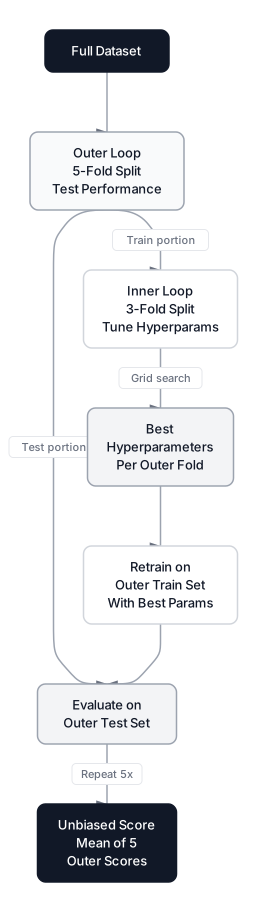 Click to expandNested cross-validation showing inner and outer loops
Non-nested CV score (biased):    0.8987
Best params: max_depth=5, min_samples_leaf=1
  Outer fold 1: 0.9444
  Outer fold 2: 0.8889
  Outer fold 3: 0.8056
  Outer fold 4: 0.8857
  Outer fold 5: 0.8571
Nested CV score (unbiased):      0.8763 +/- 0.0453

Optimism gap (non-nested minus nested): 0.0223
The non-nested score (89.9%) overestimates by 2.2 percentage points compared to the nested score (87.6%). On larger datasets with bigger hyperparameter grids, this optimism gap can reach 5 to 10 points. The nested score is the number you should trust and report.
Key Insight: Nested CV is computationally expensive. With 5 outer folds and 3 inner folds searching 15 hyperparameter combinations, you train 5 x 3 x 15 = 225 models. For a random forest with 200 trees each, that is 45,000 trees. Use nested CV for final publication-grade evaluation, not for everyday iteration.
When to Use Cross-Validation (and When Not To)
Cross-validation is not always the right answer. Here are the situations where it shines and where it falls short.
Use CV when:
- You need a reliable performance estimate for model comparison
- Your dataset has fewer than ~50,000 samples (where split variance is meaningful)
- You are selecting between model families (decision tree vs. ridge, lasso, and elastic net)
- You need to report performance in a paper, presentation, or stakeholder meeting
Skip CV when:
- Your dataset is so large (> 1 million rows) that a single 80/20 split is stable enough
- Training a single model takes hours or days (deep learning on GPUs)
- You are doing exploratory analysis and need quick feedback
For deep learning, a common compromise is to use a single validation split during training (for early stopping and learning rate scheduling) and a separate holdout test set for final evaluation. The sheer cost of training neural networks makes 5-fold CV impractical in most settings.
Production Considerations
Computational cost: K-Fold trains models instead of 1. Nested CV multiplies that further. Budget accordingly. For scikit-learn estimators on tabular data with < 100K rows, 5-fold CV typically finishes in seconds.
Memory: Each fold creates a new copy of the training data. With a Pipeline, scikit-learn also stores intermediate transformed arrays. For large datasets, use cross_validate with return_estimator=False and return_train_score=False to minimize memory overhead.
Parallelism: cross_val_score accepts an n_jobs parameter. Setting n_jobs=-1 distributes folds across all CPU cores, providing roughly linear speedup.
Reporting: Always report mean +/- std. If the standard deviation is large relative to the difference between models, the comparison is not statistically meaningful. Consider using a paired t-test or Wilcoxon signed-rank test on the fold-level scores for formal comparison.
Choosing a Validation Strategy
Cross-validation replaces the dice roll of a single train/test split with a systematic evaluation that exposes both average performance and stability. The core idea is simple: test on every portion of the data, then average. The choice of strategy (stratified, grouped, temporal, nested) depends on your data's structure, not on arbitrary convention.
If you are comparing model families, understanding why one model outperforms another requires a solid grasp of the bias-variance tradeoff. When tuning the winning model's hyperparameters, nested CV ensures your reported score reflects real-world generalization rather than optimistic overfitting to the validation set. And for any problem involving temporal data, time series fundamentals and TimeSeriesSplit are non-negotiable.
The next time someone shows you a single accuracy number from train_test_split, ask: "What was the standard deviation across folds?" If they can't answer, they don't know how much to trust that number. You will.
Interview Questions
Q: Why is a single train/test split unreliable for model evaluation?
A single split produces one score that depends heavily on which samples land in the test set. Changing the random seed can swing accuracy by 10+ percentage points on medium-sized datasets. Cross-validation averages across multiple splits, giving a stable estimate with a standard deviation that quantifies uncertainty.
Q: When should you use Stratified K-Fold instead of regular K-Fold?
Use Stratified K-Fold for any classification task, especially with imbalanced classes. It ensures each fold preserves the original class distribution. Without stratification, a fold might have zero minority-class samples, making metrics like precision and recall undefined for that fold.
Q: How does data leakage occur through preprocessing, and how do you prevent it?
Leakage happens when you fit a scaler, imputer, or PCA on the full dataset before splitting into folds. The test fold's statistics bleed into the transformation. The fix is to wrap all preprocessing and modeling steps inside a Pipeline, so each fold independently fits the transformer on its training data only.
Q: Explain the difference between nested and non-nested cross-validation.
Non-nested CV uses the same folds for both hyperparameter tuning and performance reporting, which produces an optimistically biased score. Nested CV adds an outer loop: the inner loop tunes hyperparameters, and the outer loop evaluates the tuned model on data it has never seen during tuning. The outer score is unbiased.
Q: Your team reports 95% accuracy from GridSearchCV. You run nested CV and get 88%. Which number should go in the stakeholder report, and why?
The 88% nested CV score belongs in the report. The 95% from GridSearchCV is biased because the model was selected for performing well on those specific validation folds. The nested score reflects what will happen when the model encounters genuinely new data in production.
Q: When is LOOCV a poor choice compared to 5-fold or 10-fold CV?
LOOCV has surprisingly high variance in the score estimate because the training sets overlap almost entirely, producing highly correlated fold scores. The average of correlated estimates is noisy. LOOCV also costs model fits. For most datasets above 50 samples, 5- or 10-fold CV gives a more stable estimate at a fraction of the compute.
Q: Why does TimeSeriesSplit use an expanding training window instead of random shuffling?
Random shuffling would let the model train on future data and predict the past, producing unrealistically high scores (lookahead bias). The expanding window respects temporal ordering: each fold trains only on data that precedes the test period. The gap parameter adds an extra buffer to prevent autocorrelation leakage between adjacent time steps.
Q: You have a medical imaging dataset with 5 CT scans per patient. What cross-validation strategy would you use, and what happens if you use standard K-Fold instead?
Use GroupKFold with patient ID as the group variable. Standard K-Fold might place 4 scans from the same patient in training and 1 in testing. The model would memorize patient-specific anatomy rather than learning disease markers. GroupKFold ensures entire patients are held out, testing true generalization to unseen individuals.
Hands-On Practice
Now why cross-validation matters with real data. In this exercise, you'll compare the instability of single train/test splits against the reliability of K-Fold cross-validation. You'll also see how Stratified K-Fold preserves class balance in imbalanced datasets.
Dataset: ML Fundamentals (Loan Approval) A loan approval dataset with categorical features, missing values, and class imbalance (~76/24 split) - perfect for demonstrating why Stratified K-Fold is essential.
Try experimenting with different classifiers (LogisticRegression, GradientBoostingClassifier) to see how the CV variance changes. Also try increasing n_estimators in RandomForest to see if it reduces the variance across folds.