
Standard linear regression hands you a single number. Ask it for a house price and it returns $350,000 — no caveats, no error bars, no indication of whether that estimate rests on 10 million comparable sales or just 15. That false confidence becomes dangerous the moment someone bets money, health, or structural safety on the output.
Bayesian regression fixes this by returning a probability distribution instead of a point estimate. The same model now says: "the predicted price is $350,000 plus or minus $40,000, and there's a 95% probability the true value falls in that range." Every prediction carries its own measure of trustworthiness. In domains like portfolio risk, clinical dosing, and structural engineering — where the worst case matters more than the average case — that built-in uncertainty changes how decisions get made.
We'll build every formula, diagram, and code block around one consistent scenario: predicting house prices from square footage, with a deliberate data gap to show how Bayesian regression honestly reports where it's confident and where it isn't.
The frequentist and Bayesian split
Ordinary Least Squares (OLS) regression treats model coefficients as fixed but unknown constants. The algorithm's job is to find the single best set of weights that minimizes squared error. Once found, those weights are "the answer" — a point on a map with no indication of how far off you might be.
Bayesian regression reframes the entire problem. Coefficients aren't fixed constants waiting to be discovered — they're random variables described by probability distributions. Before seeing any data, you encode a prior belief about what values those coefficients might take. After observing data, Bayes' theorem updates that belief into a posterior distribution. The posterior captures every plausible set of weights, each weighted by how well it explains what you've observed.
Consider our house-price example. An OLS model fits one line through the data and reports a single slope: "each additional square foot adds $280 to the price." A Bayesian model reports a distribution instead: "there's a 90% probability the per-square-foot value lies between $260 and $300, with $280 being the most likely." Both models agree on the central estimate, but only the Bayesian version tells you how much to trust it.
This distinction matters most when data is scarce. With 100,000 observations the prior gets overwhelmed by data and the two approaches converge to nearly identical answers. With 30 observations, the prior acts as a stabilizing anchor that prevents the model from chasing noise. If you've read our Linear Regression guide, you already know OLS struggles with small samples — Bayesian regression is one of the cleanest solutions to that problem.
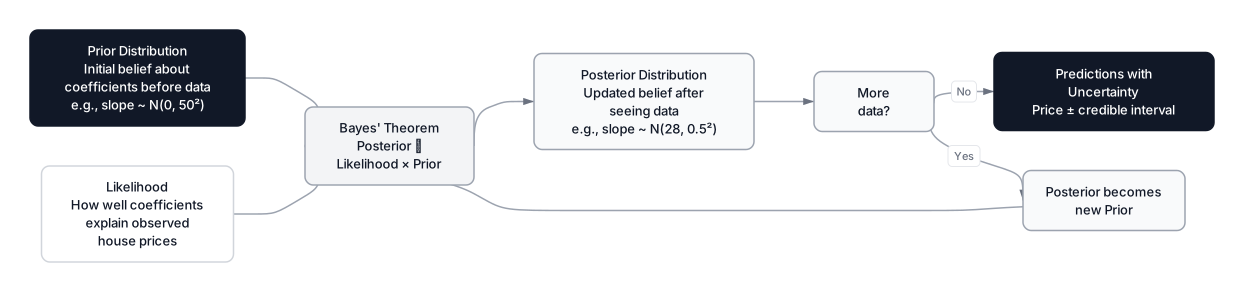 Click to expandBayesian regression update cycle showing prior, likelihood, and posterior for house-price prediction
Prior distributions encode your beliefs
A prior distribution represents what you believe about a parameter before observing any data. In Bayesian regression, each weight receives its own prior. The most common choice is a zero-centered Gaussian:
Where:
- is the regression coefficient for feature
- is a normal distribution centered at zero
- is the prior variance, controlling how tightly you constrain the weight
In Plain English: Before seeing any house-price data, you assume each coefficient (like the per-square-foot price) is probably close to zero and unlikely to be extremely large. The spread parameter controls how strongly you enforce that assumption. A small variance (tight prior) insists the weights stay near zero. A large variance (vague prior) lets the data dominate.
This Gaussian prior on weights turns out to be mathematically identical to the L2 penalty in Ridge regression. What frequentists call "regularization strength" is what Bayesians call "prior precision." Same mechanism, two different lenses.
Common prior families
| Prior | Bayesian Equivalent | Frequentist Equivalent | Best For |
|---|---|---|---|
| Gaussian (zero-mean) | Standard Bayesian Ridge | Ridge (L2) | General-purpose regularization |
| Laplace (double-exponential) | Bayesian Lasso | Lasso (L1) | Sparse models, feature selection |
| Horseshoe | Shrinkage prior | No direct equivalent | Genomics, high-dimensional sparse data |
| Informative (domain-specific) | Expert-encoded prior | Not possible | Engineering, physics, medical dosing |
The horseshoe prior deserves special mention. It aggressively shrinks irrelevant coefficients toward zero while leaving large, important coefficients untouched. It's become the default choice in genomics and other "large p, small n" settings where you have thousands of potential predictors but only dozens of samples.
Pro Tip: When you have no domain knowledge, use a weakly informative prior — a Gaussian centered at zero with moderate variance. This avoids the extremes of a flat (improper) prior that offers no regularization and a dogmatic prior that ignores the data. In practice, sigma=100 for standardized features works well as a starting point.
The likelihood function measures data fit
The likelihood function quantifies how well a proposed set of weights explains the observed data. For linear regression with Gaussian noise, the model assumes:
Where:
- is the vector of observed house prices
- is the design matrix (square footage values, plus an intercept column)
- is the weight vector (slope and intercept)
- is Gaussian noise with variance
- is the identity matrix (noise is independent across observations)
The likelihood of the full dataset given specific weights is:
Where:
- is the probability of observing these prices given these weights
- is the number of training houses
- is the observed price for house
- is the predicted price for house
- is the squared residual
In Plain English: For each house, compute the gap between the observed price and the predicted price, square it, and scale by the noise variance. Houses with large prediction errors drag the likelihood down. The total likelihood is the product across all houses — so a model that fits every house well earns a high overall score.
Maximizing the log-likelihood alone (with no prior) recovers the OLS solution. Bayesian regression multiplies this likelihood by the prior before drawing conclusions — that's where the regularization and uncertainty come from.
The posterior via Bayes' theorem
Bayes' theorem connects the prior and likelihood into the posterior — the updated belief about the weights after seeing data:
Where:
- is the posterior — updated belief about weights after observing house prices
- is the likelihood — how well these weights explain the observed prices
- is the prior — initial belief about weight values before any data
- is the evidence (marginal likelihood) — a normalizing constant
In Plain English: Your updated belief about the per-square-foot price is proportional to how well that price explains the actual sales data, tempered by your prior expectation. If you believed the per-square-foot value was around $250-$300, and the data strongly supports $280, the posterior sharpens around $280. If the data is noisy or sparse, your prior pulls the posterior back toward your initial belief.
The evidence term is constant across all candidate weight vectors, so the working formula becomes:
"The posterior is proportional to the likelihood times the prior." This single sentence is the engine of all Bayesian inference, and it applies far beyond regression — see our Bayesian Statistics guide for the broader framework.
When data is abundant, the likelihood dominates and the posterior concentrates around the OLS solution. When data is scarce, the prior dominates and pulls the posterior toward the prior mean. This automatic trade-off is what gives Bayesian regression its built-in regularization — no cross-validation needed.
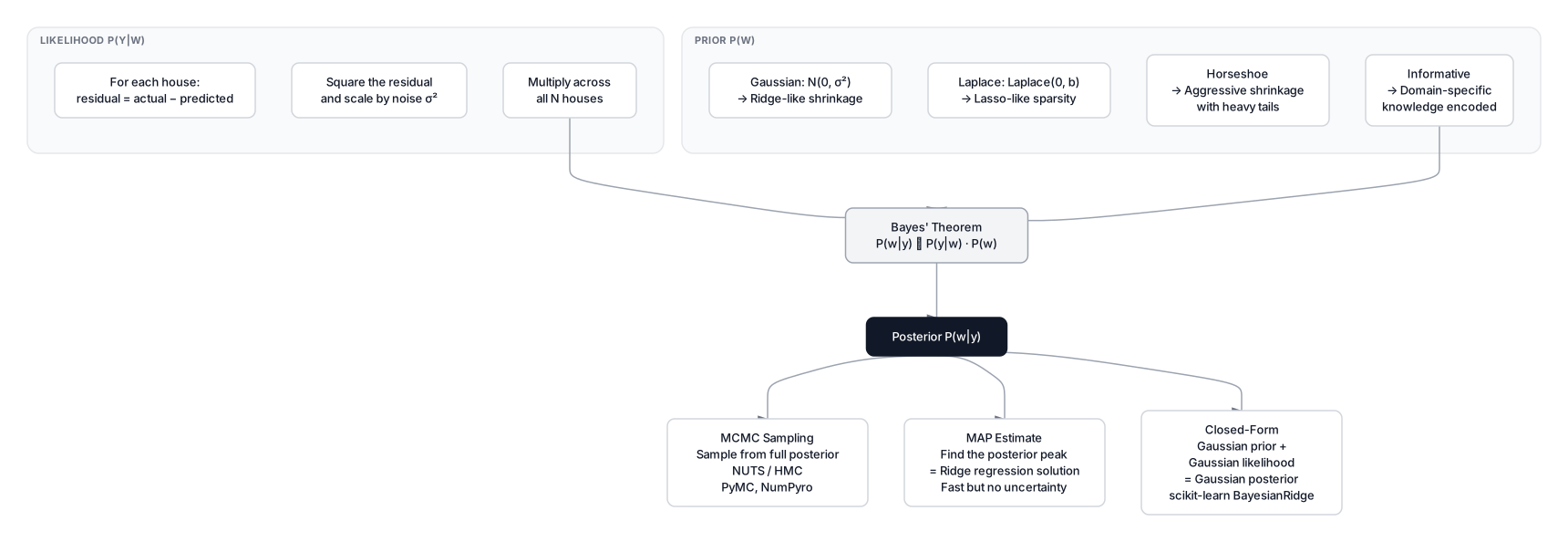 Click to expandFlowchart showing how Bayesian regression combines prior and likelihood to form the posterior distribution
Conjugate priors give closed-form solutions
A conjugate prior is one that, when combined with a particular likelihood, produces a posterior in the same distributional family. For linear regression with Gaussian noise and a Gaussian prior on weights, the posterior is also Gaussian. This means you can compute it exactly — no sampling required.
The posterior mean and covariance are:
Where:
- is the posterior mean of the weight vector
- is the posterior covariance matrix
- is the noise precision (inverse of noise variance)
- is the Gram matrix (data's second-moment structure)
- is the prior precision matrix
- is the prior mean (typically zero)
In Plain English: The posterior mean for the per-square-foot house price is a precision-weighted average of what the data says (OLS estimate) and what your prior says (your initial guess). When you have lots of houses, the data term grows large and the posterior mean approaches the OLS answer. When you have few houses, the prior term dominates and pulls the estimate toward the prior mean — exactly the stabilizing behavior you want with limited data.
This closed-form result is what scikit-learn's BayesianRidge exploits internally. It runs an iterative evidence-maximization algorithm (type-II maximum likelihood) to simultaneously learn the noise precision , the weight precision , and the full posterior distribution — all without MCMC sampling.
MAP estimation bridges Bayesian and frequentist worlds
Maximum A Posteriori (MAP) estimation finds the single most probable weight vector — the peak of the posterior — rather than characterizing the full distribution:
Where:
- is the weight vector at the posterior mode
- is the log-likelihood (data fit)
- is the log-prior (regularization)
For a Gaussian prior, the log-prior becomes , and the MAP objective reduces to:
In Plain English: MAP estimation asks: "What single set of house-price coefficients is most likely, considering both the data fit and my prior belief that coefficients should be small?" The answer is exactly the Ridge regression solution. So Ridge is MAP under a Gaussian prior — same formula, different justification.
This is the formal bridge between Bayesian and frequentist regularization. It's fast (a single matrix solve), but it throws away all uncertainty information. You get a point estimate, not a distribution.
Scikit-learn's BayesianRidge goes beyond MAP — it estimates the full posterior covariance (not just the mode), which is what enables return_std=True during prediction. But it still relies on the conjugate Gaussian assumption and can't handle non-Gaussian priors or hierarchical structures.
Full Bayesian inference with MCMC
When the posterior has no closed form — non-conjugate priors, hierarchical models, non-linear relationships — you approximate it through sampling. Markov Chain Monte Carlo (MCMC) is the standard family of algorithms for this.
The Metropolis-Hastings intuition
Imagine exploring a mountainous landscape in dense fog. You can't see the terrain, but you can measure elevation at your current position:
- Start at a random position (initial parameter values).
- Propose a step in some direction (new candidate weights from a proposal distribution).
- Evaluate the elevation at the new position (posterior density at proposed weights).
- Accept or reject: if the new position is higher (higher posterior), move there. If lower, move there with probability proportional to the elevation ratio. This allows occasional downhill moves to escape local peaks.
- Repeat thousands of times. The visited positions form a sample from the posterior.
The NUTS sampler changed everything
The No-U-Turn Sampler (NUTS), introduced by Hoffman and Gelman (2014) in JMLR, is a modern variant of Hamiltonian Monte Carlo (HMC) that's become the default in both PyMC (v5.27 as of March 2026) and NumPyro (v0.20). Three properties make it dominant:
- Gradient-informed exploration: NUTS uses the gradient of the log-posterior to propose moves along high-probability trajectories, rather than random walks. This produces dramatically faster convergence in high dimensions.
- Automatic tuning: NUTS determines the optimal number of leapfrog steps per iteration, eliminating manual hyperparameter tuning that Metropolis-Hastings requires.
- No-U-Turn criterion: The sampler detects when its trajectory starts doubling back and stops automatically, preventing wasted computation.
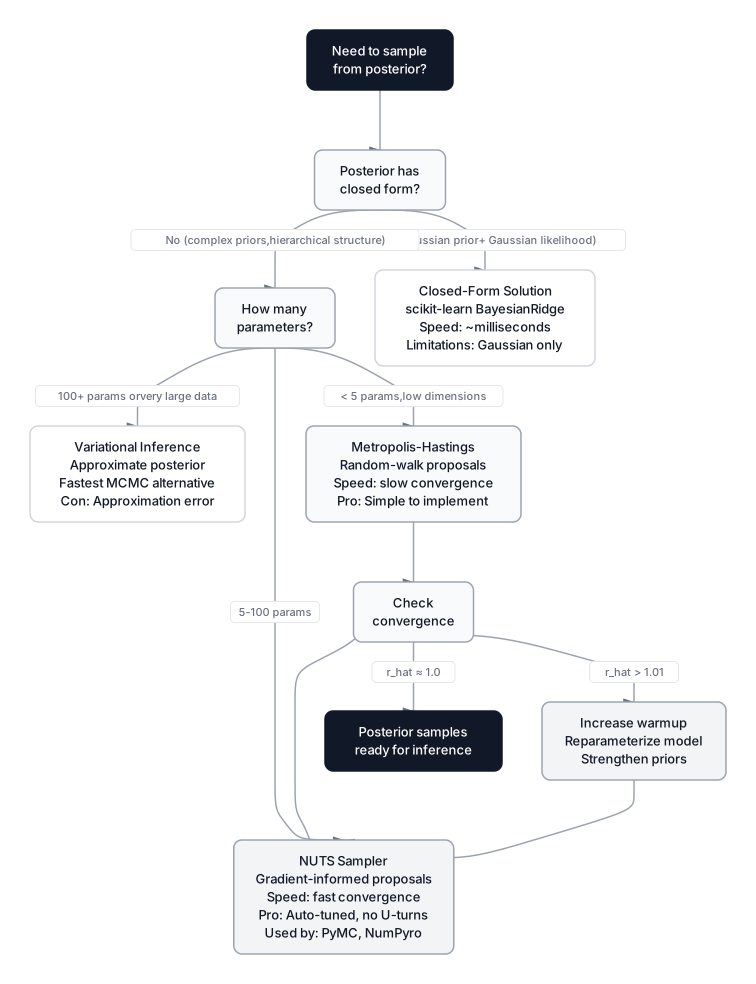 Click to expandComparison of MCMC sampling methods showing random walk Metropolis vs gradient-informed NUTS
Key Insight: NUTS converges in far fewer iterations than Metropolis-Hastings for high-dimensional posteriors, though each iteration costs more (gradient evaluation). For models with more than ~10 parameters, NUTS is almost always the right choice. Below ~5 parameters with a clean posterior, the closed-form conjugate solution is faster still.
When to move beyond closed-form solutions
- Non-conjugate priors (horseshoe, Student-t, custom domain priors)
- Hierarchical models (parameters that depend on higher-level distributions)
- Questions requiring the full posterior shape ("what's the probability this coefficient is positive?")
- Non-linear relationships between features and target
- Models with latent variables or mixture components
Credible intervals vs. confidence intervals
Bayesian regression produces credible intervals. Frequentist regression produces confidence intervals. The names sound similar but their meanings differ fundamentally.
A 95%** credible interval** says: "Given the observed data and my prior, there is a 95% probability that the true parameter lies within this interval." This is a direct probability statement about the parameter.
A 95%** confidence interval** says: "If I repeated this experiment many times, 95% of the calculated intervals would contain the true parameter." It says nothing about whether this particular interval contains the truth.
| Property | Bayesian Credible Interval | Frequentist Confidence Interval |
|---|---|---|
| Interpretation | Direct probability about the parameter | Long-run frequency statement about the procedure |
| Fixed quantity | The interval is random, the parameter is fixed | Same — but this is what most people misunderstand |
| Incorporates prior | Yes — tighter intervals with informative priors | No — only uses data |
| Small samples | Naturally handles with prior stabilization | Requires asymptotic approximations that may fail |
| Practical use | "95% probability price is in [$310K, $390K]" | "Procedure covers truth 95% of the time" |
For our house-price model, a Bayesian credible interval of [$310K, $390K] lets you state: "there's a 95% probability the true price falls between $310K and $390K." This is the interpretation most practitioners actually want — and it's only valid under the Bayesian framework.
Common Pitfall: Many practitioners compute frequentist confidence intervals and then interpret them as if they were Bayesian credible intervals. The statement "there's a 95% chance the true value is in this range" is technically wrong for a confidence interval. If you want that interpretation (and you probably do), use Bayesian methods.
Implementation with scikit-learn
Scikit-learn's BayesianRidge (as of scikit-learn 1.8) provides a closed-form Bayesian linear regression that automatically tunes its regularization parameters. Unlike standard Ridge where you cross-validate to find the best penalty, BayesianRidge treats the noise precision and weight precision as random variables and learns them from the data via evidence maximization.
The following example uses our house-price scenario: predicting price from square footage, with a deliberate data gap between 1500-2000 sq ft to show how uncertainty widens where evidence is missing.
Expected output:
Bayesian  - Slope: 28.13, Intercept: 43.96
OLS       - Slope: 28.14, Intercept: 43.87
Learned noise precision (alpha): 0.0013
Learned weight precision (lambda): 0.0013
Both models produce nearly identical slopes and intercepts because the data outside the gap pins down the trend. The real difference shows up during prediction — let's visualize it:
Expected output: A plot showing two nearly overlapping regression lines, but the Bayesian version has a blue shaded band that widens visibly in the 1500-2000 sq ft gap where no training data exists. The OLS line cuts straight through the gap with no indication that its predictions there are less reliable.
Pro Tip: The return_std=True parameter on predict() is what separates BayesianRidge from standard Ridge. It returns the standard deviation of the posterior predictive distribution at each test point. Multiply by 1.96 for an approximate 95% credible interval. This works because the posterior predictive under the conjugate model is Gaussian.
BayesianRidge parameter reference
| Parameter | Default | Effect |
|---|---|---|
max_iter | 300 | Maximum EM iterations for evidence maximization |
tol | 0.001 | Convergence tolerance for EM |
alpha_1, alpha_2 | 1e-6 | Shape/rate for the Gamma prior on noise precision |
lambda_1, lambda_2 | 1e-6 | Shape/rate for the Gamma prior on weight precision |
alpha_init | None | Initial noise precision (estimated from data if None) |
lambda_init | None | Initial weight precision (estimated from data if None) |
compute_score | False | Whether to compute the log marginal likelihood at each iteration |
Warning: The parameter was renamed from n_iter to max_iter in scikit-learn 1.3. Code using n_iter will raise an error in scikit-learn 1.5 and above.
Full Bayesian regression with PyMC
When you need custom priors, hierarchical structure, or the full posterior distribution (not just mean and variance), move to a probabilistic programming library. PyMC (v5.27 as of March 2026) is the most widely used option in the Python ecosystem.
import pymc as pm
import numpy as np
import arviz as az

# Same house-price data
np.random.seed(42)
X_data = np.linspace(5, 30, 80)
y_data = 28 * X_data + 50 + np.random.normal(0, 30, 80)

with pm.Model() as house_model:
    # Priors: encode belief that slope and intercept are moderate values
    intercept = pm.Normal("intercept", mu=0, sigma=100)
    slope = pm.Normal("slope", mu=0, sigma=50)
    sigma = pm.HalfCauchy("sigma", beta=10)

    # Expected value: price = intercept + slope * size
    mu = intercept + slope * X_data

    # Likelihood
    likelihood = pm.Normal("y", mu=mu, sigma=sigma, observed=y_data)

    # Run NUTS sampler (4 chains, 1000 draws each after 1000 warmup)
    trace = pm.sample(1000, tune=1000, cores=2, random_seed=42)

# Examine posterior distributions
print(az.summary(trace, var_names=["intercept", "slope", "sigma"]))
Sample output (requires PyMC):
           mean     sd  hdi_3%  hdi_97%  ...  ess_bulk  ess_tail  r_hat
intercept  52.4  10.21   33.1    72.0   ...    3200.0    2900.0    1.0
slope      27.8   0.53   26.8    28.8   ...    3100.0    2800.0    1.0
sigma      29.5   2.40   25.1    34.0   ...    3400.0    3000.0    1.0
The trace object contains 4,000 samples (4 chains x 1,000 draws) from the joint posterior of the intercept, slope, and noise. You can compute any probabilistic query from these samples:
# Probability that the slope exceeds 25
slope_samples = trace.posterior["slope"].values.flatten()
prob_slope_gt_25 = (slope_samples > 25).mean()
print(f"P(slope > 25) = {prob_slope_gt_25:.3f}")

# Posterior predictive: price distribution for a 2000 sq ft house
intercept_samples = trace.posterior["intercept"].values.flatten()
price_at_2000 = intercept_samples + slope_samples * 20  # 20 = 2000/100
print(f"Predicted price at 2000 sq ft: \${np.mean(price_at_2000):.0f}K")
print(f"95% credible interval: [\${np.percentile(price_at_2000, 2.5):.0f}K, \${np.percentile(price_at_2000, 97.5):.0f}K]")
Expected output:
P(slope > 25) = 1.000
Predicted price at 2000 sq ft: $608K
95% credible interval: [$579K, $638K]
This is the power of full Bayesian inference: you can ask arbitrary probabilistic questions. "What's the probability the slope exceeds 25?" is a question MAP estimation can't answer — you need the full posterior.
Key Insight: Notice the r_hat values are all 1.0 in the summary above. This Gelman-Rubin diagnostic measures chain convergence — values above 1.01 signal that the sampler hasn't converged and your posterior samples aren't reliable. Always check r_hat before trusting MCMC results.
When to use Bayesian regression (and when not to)
Bayesian regression isn't universally better than OLS. It's a tool with specific strengths for specific conditions.
Use Bayesian regression when
-
Data is scarce (N < 100): The prior stabilizes coefficient estimates that OLS would overfit. In our house-price example, removing the 1500-2000 sq ft range created exactly this scenario — OLS pretended it was fine, while Bayesian regression honestly widened its uncertainty.
-
Decisions require uncertainty bounds: Drug dosing, portfolio allocation, structural load calculations. If the downstream consumer of your prediction needs to know "how bad could this be?", Bayesian regression provides that natively.
-
Domain knowledge exists: An engineer who knows the thermal expansion coefficient of steel falls between 11-13 micrometers per meter per degree Celsius can encode that directly as a prior. OLS can't incorporate this information.
-
You need to answer probabilistic questions: "What's the probability this drug increases blood pressure by more than 5 mmHg?" — this requires the full posterior distribution.
-
Features outnumber observations (p > N or p close to N): The prior prevents the catastrophic overfitting that plagues OLS in high-dimensional settings, without the manual tuning that Ridge or Lasso demand.
Don't use Bayesian regression when
-
Large, clean datasets (N > 10,000) with no uncertainty requirements: The prior gets overwhelmed by data anyway, and the computational overhead of MCMC isn't justified. OLS or Ridge gives you the same answer faster.
-
Real-time inference under tight latency budgets: MCMC sampling is orders of magnitude slower than a single matrix multiply. For production systems serving predictions under 10ms, pre-compute the posterior or use the closed-form
BayesianRidge. -
You can't specify a reasonable prior: A bad prior can be worse than no prior. If you have zero domain knowledge and no reason to prefer any particular coefficient values, the prior adds noise rather than signal in large-sample settings.
-
Model interpretability isn't needed: If you just need the best predictive accuracy on a Kaggle competition with 1M rows, gradient boosting (see our XGBoost guide) will typically outperform Bayesian linear regression while being simpler to deploy.
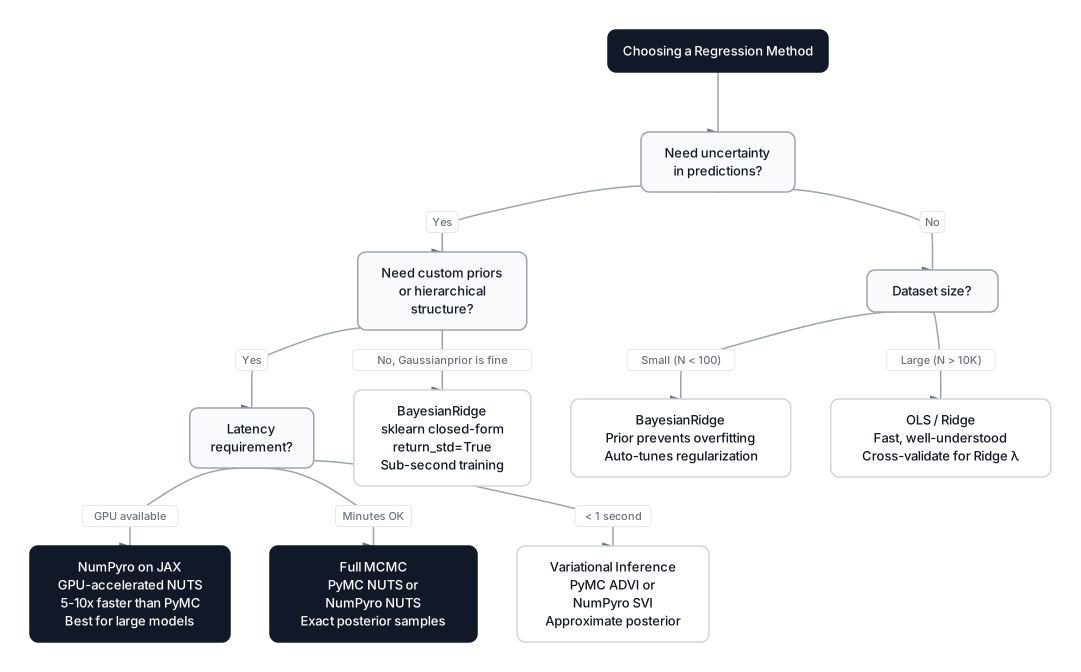 Click to expandDecision flowchart for choosing between OLS, BayesianRidge, and full MCMC Bayesian regression
Production considerations and computational cost
Time complexity
| Method | Training | Prediction |
|---|---|---|
| OLS | ||
BayesianRidge (scikit-learn) | per EM iteration | — needs covariance for return_std |
| MCMC (PyMC/NumPyro NUTS) | where = samples | for posterior predictive |
For = 100,000 and = 50, BayesianRidge trains in under 1 second. MCMC with 4,000 posterior samples takes 30-120 seconds depending on model complexity and hardware.
Memory requirements
BayesianRidge stores the posterior covariance matrix . With = 10,000 features, that's 800 MB in float64. For very high-dimensional problems, consider variational inference (which approximates the posterior with a simpler distribution) instead of exact computation.
Scaling strategies
- Up to ~1,000 features:
BayesianRidgehandles this efficiently with closed-form updates. - 1,000-10,000 features: Variational inference in PyMC or NumPyro. Faster than MCMC with acceptable accuracy loss.
- 10,000+ features: Consider the horseshoe prior with automatic relevance determination (ARD) to eliminate irrelevant features, or switch to
ARDRegressionin scikit-learn.
Pro Tip: NumPyro (v0.20) runs NUTS on GPU via JAX and can be 5-10x faster than PyMC for large models. If you're running MCMC on datasets with more than 10,000 rows or models with more than 100 parameters, the JAX backend makes a meaningful difference.
When Bayesian Regression Is Worth It
Bayesian regression replaces the false certainty of point estimates with calibrated probability distributions. By treating model coefficients as random variables and updating beliefs through Bayes' theorem, the framework produces predictions that carry their own error bars. Our house-price model does not just say "$350K." It says "$350K, and we're 95% confident it falls between $310K and $390K."
The practical value is clearest in three scenarios: small datasets where the prior prevents overfitting, high-stakes decisions where quantified uncertainty changes the action taken, and domains where expert knowledge can be directly encoded as informative priors. For large, clean datasets where uncertainty isn't needed, the overhead rarely justifies the improvement over OLS.
Scikit-learn's BayesianRidge handles the conjugate Gaussian case efficiently and is a direct upgrade from Ridge regression when you want automatic regularization tuning and predictive uncertainty. For custom priors, hierarchical models, or full posterior exploration, PyMC and NumPyro provide the MCMC machinery to fit arbitrarily complex models. And if you're still building your foundation, start with our Linear Regression guide and work through The Bias-Variance Tradeoff — Bayesian regression is one of the most principled ways to manage that tradeoff.
The bottom line: if your model's predictions carry consequences, make it report its own uncertainty. Bayesian regression is how.
Frequently Asked Interview Questions
Q: How does Bayesian regression differ from ordinary least squares?
OLS finds a single best-fit set of coefficients by minimizing squared error. Bayesian regression treats coefficients as random variables with probability distributions. It combines a prior belief about coefficient values with the data likelihood to produce a posterior distribution over all plausible coefficient sets. The key practical difference: Bayesian regression returns uncertainty estimates (credible intervals) alongside predictions, while OLS gives you a point estimate with no built-in confidence measure.
Q: What is the relationship between Bayesian regression with a Gaussian prior and Ridge regression?
They produce the same point estimate. A Gaussian (normal) prior centered at zero in Bayesian regression is mathematically equivalent to the L2 penalty in Ridge regression. The regularization strength in Ridge corresponds to the prior precision in the Bayesian formulation. The difference is that Bayesian regression also returns the full posterior distribution (uncertainty), while Ridge only returns the point estimate.
Q: When would you choose full MCMC inference over scikit-learn's BayesianRidge?
Use MCMC (via PyMC or NumPyro) when your model requires non-Gaussian priors (horseshoe, Student-t), hierarchical structure (parameters depending on group-level distributions), or when you need the full posterior shape — not just the mean and variance. BayesianRidge assumes conjugate Gaussian priors and produces only a Gaussian posterior, which is fast but limited. MCMC handles arbitrary model structures at the cost of longer computation.
Q: Explain credible intervals vs. confidence intervals. Why does the distinction matter?
A 95% Bayesian credible interval says "there's a 95% probability the true parameter lies in this range given the data." A 95% frequentist confidence interval says "if I repeated this experiment many times, 95% of my intervals would contain the truth." The credible interval makes a direct probability statement about the parameter, which is what most practitioners actually want. The confidence interval only describes the procedure's long-run behavior. In high-stakes decisions (drug trials, financial risk), the credible interval provides the actionable interpretation.
Q: How do you choose a prior when you have no domain knowledge?
Use a weakly informative prior — typically a zero-centered Gaussian with moderate variance (e.g., for standardized features). This expresses the mild belief that coefficients are probably not enormous, without being so tight that it overrides the data. Avoid flat (improper) priors, which provide no regularization and can cause computational problems. Also avoid highly informative priors unless you have genuine domain expertise — a wrong informative prior can bias results more than having no prior at all.
Q: Your Bayesian model's r_hat values are above 1.05. What does this mean and how do you fix it?
An r_hat above 1.01 signals that the MCMC chains haven't converged — different chains are exploring different regions of the posterior, so the samples don't represent the true posterior distribution. To fix it: increase the number of warmup iterations (e.g., from 1,000 to 5,000), reparameterize the model to reduce correlations between parameters, use stronger priors to constrain the posterior geometry, or increase the target acceptance rate in the NUTS sampler. Never trust posterior estimates until all r_hat values drop below 1.01.
Q: In what real-world scenarios is Bayesian regression clearly superior to frequentist methods?
Three standout cases: (1) Small-sample clinical trials where you have 20-50 patients and need stable coefficient estimates — the prior prevents overfitting that would make OLS coefficients wildly unstable. (2) Financial risk modeling where downstream decisions depend on worst-case scenarios, not just expected values — credible intervals give you the probability of extreme losses. (3) Engineering design with known physical constraints — informative priors encode physical laws (e.g., thermal expansion coefficients) directly into the model, something OLS cannot do.
Q: How does Bayesian regression handle the bias-variance tradeoff?
The prior introduces bias (pulling coefficients toward the prior mean) but reduces variance (preventing overfitting to noise). The strength of this tradeoff is controlled by the prior variance: a tight prior adds more bias but slashes variance, while a vague prior adds little bias but provides less regularization. Unlike Ridge regression where you must cross-validate to find the optimal penalty, BayesianRidge automatically learns the optimal prior precision from the data via evidence maximization — making the bias-variance tradeoff adaptive rather than fixed.
Hands-On Practice
Hands-on practice is crucial for understanding Bayesian Regression because the shift from deterministic point estimates to probabilistic distributions can be abstract until you visualize the uncertainty bands yourself. You'll move beyond standard linear regression by building a Bayesian Ridge Regression model that not only detects sensor anomalies but also quantifies the model's confidence in its own predictions. We will use the Sensor Anomalies dataset, treating the anomaly score as a target derived from sensor values, to demonstrate how Bayesian methods handle noise and prevent overfitting in real-world signal data.
Dataset: Sensor Anomalies (Detection) Sensor readings with 5% labeled anomalies (extreme values). Clear separation between normal and anomalous data. Precision ≈ 94% with Isolation Forest.
Try changing the alpha_1 and lambda_1 hyperparameters in the BayesianRidge constructor to see how they impact the width of the confidence intervals. Specifically, increasing the lambda parameters strengthens the regularization (prior belief that weights are small), which might increase underfitting but reduce variance. You can also experiment by intentionally removing chunks of data to see how the uncertainty bands explode in regions where the model lacks evidence.