
<!— excerpt: Master regularization with Ridge, Lasso, and Elastic Net. Compare L1 vs L2 penalties, tune alpha via cross-validation, and choose the right method for your data. —>
A linear regression model trained on 20 house-price features achieves near-perfect fit on training data. Square footage, lot size, number of bedrooms, neighborhood rating, garage capacity — every coefficient finds a value that minimizes error. Then the model meets new data, and its predictions miss by tens of thousands of dollars. The coefficients that looked precise were actually inflated, compensating for noise rather than capturing genuine relationships.
This failure has a name: overfitting. Ordinary Least Squares (OLS) regression minimizes training error without any constraint on coefficient size. When features outnumber observations, or when predictors are correlated, OLS assigns enormous weights that cancel noise rather than model signal. Regularization fixes this by adding a penalty to the loss function that constrains coefficient magnitude — forcing the model to trade a small increase in training error for a large decrease in prediction error on unseen data.
Ridge, Lasso, and Elastic Net are the three foundational regularization methods for linear models. Each adds a different penalty term, and that difference determines whether coefficients shrink toward zero, hit exactly zero, or do both.
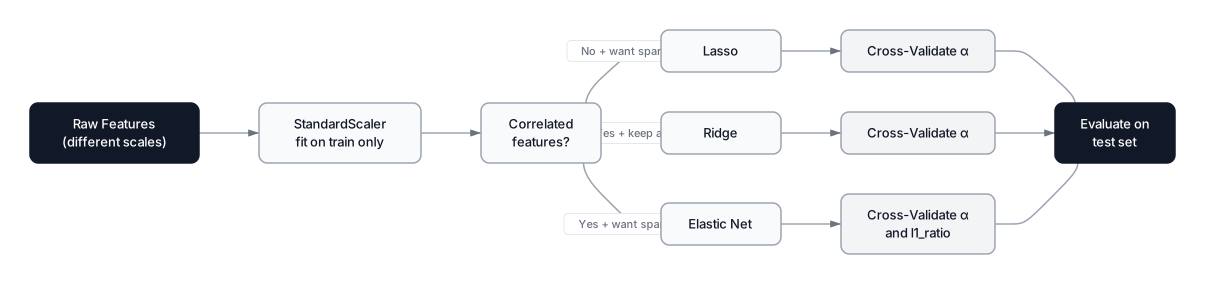 Click to expandRegularization pipeline from raw features through standardization, method selection, and tuning
OLS breaks down with many correlated features
Standard linear regression minimizes the Residual Sum of Squares (RSS):
Where:
- is the actual house price for observation
- is the value of feature for observation
- is the coefficient (weight) for feature
- is the number of houses in the training set
- is the number of features (20 in our dataset)
In Plain English: Find the set of coefficients that makes predicted house prices as close to actual prices as possible, measured by the total squared gap between each prediction and reality.
OLS has a closed-form solution:
Where:
- is the feature matrix (200 houses by 20 features)
- is the transpose of
- is the vector of actual house prices
- is the inverse of the Gram matrix
In Plain English: Plug the feature matrix and price vector into this formula and out come the coefficients — no iteration, just matrix algebra.
This works when is small relative to and when features aren't highly correlated. But consider our house-price dataset with 20 features, several of which measure related concepts — total square footage, first-floor square footage, second-floor square footage, and basement square footage all capture overlapping information. This creates multicollinearity: the matrix becomes nearly singular, its inverse amplifies small data perturbations, and the resulting coefficients become unstable.
Worse, if some of those 20 features are irrelevant — the house's street address number or the day the listing was posted — OLS still assigns them nonzero coefficients. The model fits training noise that won't generalize. As explored in The Bias-Variance Tradeoff, an unconstrained model has low bias but dangerously high variance.
The regularization penalty constrains coefficient size
Regularization modifies the OLS objective by adding a penalty term that grows with coefficient magnitude:
Where:
- is the usual RSS (data-fit term)
- is the regularization strength (called
alphain scikit-learn) - is a function of the coefficient vector that grows as coefficients get larger
In Plain English: The model now has two jobs: predict house prices accurately and keep its coefficient weights small. The parameter is the dial between these goals — turn it up and the model cares more about small coefficients, turn it down and it cares more about fitting the data.
When , the penalty disappears and the model reverts to OLS. As increases, the model is forced to keep coefficients small, accepting higher training error in exchange for lower complexity.
The form of the penalty determines everything. Squared coefficient magnitude (L2 norm) gives Ridge regression. Absolute magnitude (L1 norm) gives Lasso. A weighted combination gives Elastic Net.
Ridge regression shrinks coefficients without eliminating them
Ridge regression, introduced by Hoerl and Kennard (1970), adds the squared L2 norm of the coefficient vector to the loss:
Where:
- is the RSS (sum of squared prediction errors)
- is the regularization strength
- is the squared coefficient for feature
- is the L2 penalty — the sum of all squared coefficients
In Plain English: Minimize the usual squared error on house prices, plus a penalty proportional to the sum of all squared coefficients. A coefficient of 10 incurs 100 units of penalty; a coefficient of 1 incurs just 1 unit. The squared penalty punishes large coefficients aggressively while going easy on ones already near zero.
The closed-form solution for Ridge:
Where:
- is the identity matrix
- adds to every diagonal element of
In Plain English: Adding to the Gram matrix before inverting is like adding ballast to a wobbly ship. Even when is nearly singular from correlated features, the addition of stabilizes it and guarantees a unique solution.
This is why Ridge is sometimes called Tikhonov regularization in the broader mathematics literature.
Back to our house-price example: suppose total square footage and first-floor square footage are 95% correlated. OLS might assign +500 to one and -480 to the other — a volatile pair of large coefficients that happens to fit training data. Ridge instead assigns moderate positive coefficients to both, say +120 and +100. The individual coefficients are less extreme, and the model is far more stable on new houses.
Pro Tip: Ridge has a closed-form solution because the L2 penalty is differentiable everywhere. This makes it computationally faster than Lasso for the same number of features, since Lasso requires iterative coordinate descent optimization.
The circular constraint region
Geometrically, Ridge regression is equivalent to minimizing RSS subject to the constraint:
Where:
- is the coefficient for feature
- is a budget that shrinks as increases (inversely related to )
For two coefficients, this constraint defines a circle (sphere in higher dimensions). Picture the RSS loss as elliptical contour lines radiating outward from the unconstrained OLS solution. The Ridge solution sits where these contour ellipses first touch the circular boundary.
Because a circle has no corners aligned with the axes, the point of tangency almost always falls where both and are nonzero. Ridge shrinks coefficients but virtually never sets any to exactly zero. Every feature stays in the model, just dampened.
Lasso regression drives irrelevant coefficients to exactly zero
Lasso, proposed by Robert Tibshirani (1996), stands for Least Absolute Shrinkage and Selection Operator. It swaps the squared penalty for absolute values:
Where:
- is the absolute value of the coefficient for feature
- is the L1 penalty — the sum of all absolute coefficients
In Plain English: The penalty is now proportional to the sum of absolute coefficient values. A coefficient of 10 incurs 10 units of penalty; a coefficient of 1 incurs 1 unit. The penalty grows linearly, not quadratically, which means Lasso applies constant pressure to reduce every coefficient by the same amount. For small enough coefficients, that constant pressure pushes them all the way to zero.
Back to house prices: Lasso examines the 20 features and discovers that street address number and listing weekday have minimal predictive power. It sets their coefficients to exactly 0.0, removing them from the model. The remaining features — square footage, lot size, neighborhood rating — receive nonzero coefficients. Lasso has performed automatic feature selection.
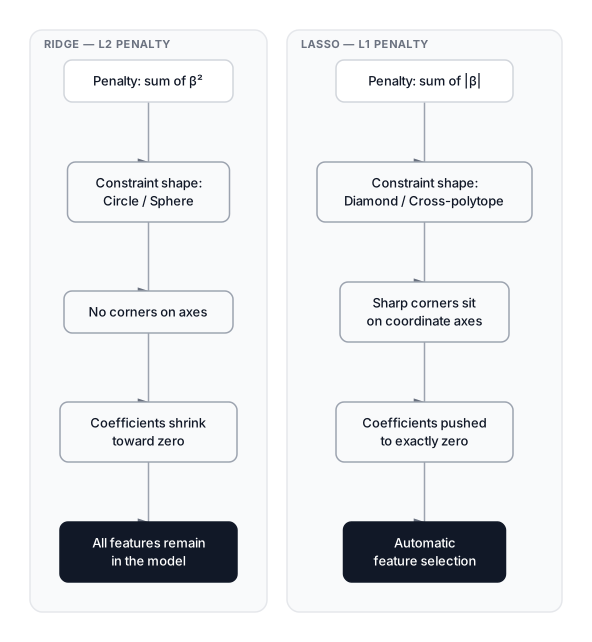 Click to expandL1 diamond vs L2 circle constraint regions showing why Lasso produces sparse solutions
The diamond constraint region
The geometric explanation for Lasso's sparsity is one of the most elegant results in statistical learning. The L1 constraint region for two coefficients:
Where:
- and are the absolute values of two feature coefficients
- is the constraint budget (shrinks as increases)
This defines a diamond (cross-polytope in higher dimensions). The diamond has sharp corners sitting directly on the coordinate axes. At each corner, one or more coefficients are exactly zero.
Now picture the same elliptical RSS contour lines expanding from the OLS solution. They need to find the first point satisfying the diamond constraint. Because the diamond's corners protrude along the axes, and because elliptical contours approach from arbitrary angles, the contours are far more likely to make first contact at a corner than along a flat edge. Contact at a corner means one coordinate is zero — that feature has been eliminated.
With Ridge's circular boundary, there are no corners. The contours almost always touch the smooth curve where both coordinates are nonzero. This is why L1 produces sparse solutions and L2 does not.
In 20 dimensions, the effect is more pronounced. A diamond in 20-D has corners along all 20 coordinate axes, and the probability of first contact at a corner (zeroing one or more coefficients) increases dramatically.
Pro Tip: Lasso's ability to zero out coefficients makes it particularly valuable for high-dimensional datasets in genomics, text classification, and sensor networks where thousands of features exist but only a fraction carry signal.
Lasso struggles with correlated features
Despite its power, Lasso exhibits unstable behavior when features are correlated. If three features in our house-price dataset all measure square footage in slightly different ways, Lasso tends to pick one arbitrarily and zero out the other two. Run the model on a different training split, and it might pick a different one.
This means:
- Coefficient instability: the chosen feature changes across samples
- Information loss: two correlated but non-identical features that each carry unique information get collapsed into one
- Interpretation risk: a stakeholder might conclude "first-floor square footage matters but total square footage doesn't," when both matter and Lasso just picked one
When the number of features exceeds the number of observations , Lasso can select at most features. This hard mathematical limitation restricts its usefulness in ultra-high-dimensional settings.
Elastic Net combines both penalties
Elastic Net, introduced by Zou and Hastie (2005), adds both L1 and L2 penalties:
Where:
- controls the L1 (Lasso) penalty strength
- controls the L2 (Ridge) penalty strength
- The L1 term drives sparsity (zeroing coefficients)
- The L2 term provides grouping stability (keeping correlated features together)
In scikit-learn, this is parameterized with alpha (overall strength) and l1_ratio (mixing):
Where:
- is the overall regularization strength
- controls the mix: 1.0 = pure Lasso, 0.0 = pure Ridge
- Values between 0 and 1 blend both behaviors
In Plain English: Elastic Net gives you a dial between Ridge and Lasso. Set l1_ratio=0.7 and you get 70% Lasso-style sparsity with 30% Ridge-style stability. For our house-price dataset, Elastic Net keeps all three correlated square-footage features with similar (but shrunk) coefficients, rather than arbitrarily picking one. It still eliminates genuinely irrelevant features like street address number.
Elastic Net also lifts Lasso's hard limit on selected features. Even when $p > n$, Elastic Net can select more than features, making it the default for genomics, text analysis, and other domains where features vastly outnumber observations.
Feature standardization is mandatory before regularization
Ridge, Lasso, and Elastic Net all penalize coefficient magnitude. But coefficient magnitude depends directly on feature scale. As covered in Standardization vs Normalization, features on different scales get penalized unequally. In our house-price dataset:
- Square footage ranges from 500 to 5,000. Its coefficient might be around 50 (dollars per square foot).
- Number of bedrooms ranges from 1 to 6. Its coefficient might be around 25,000 (dollars per bedroom).
Without standardization, the penalty treats these identically — but the bedroom coefficient is 500x larger purely because of scale. The result: regularization unfairly suppresses large-magnitude coefficients (bedroom count) while barely touching small-magnitude ones (square footage).
The fix: standardize all features to zero mean and unit variance:
Where:
- is the original feature value
- is the mean of feature across training samples
- is the standard deviation of feature across training samples
In Plain English: Subtract the average and divide by the spread. After this, every feature — whether it's square footage in the thousands or bedroom count in single digits — lives on the same scale, and the penalty applies proportionally to each feature's true importance.
Common Pitfall: Never fit StandardScaler on the full dataset before splitting. Fit on X_train, then transform both X_train and X_test. Fitting on everything leaks test-set statistics into training and inflates your evaluation scores.
Cross-validation finds the right regularization strength
The hyperparameter (or alpha in scikit-learn) determines how hard the penalty constrains the model. Choosing it manually is unreliable. Instead, use cross-validation: train with many different alpha values, evaluate each on held-out folds, and select the alpha that minimizes average validation error.
Scikit-learn provides dedicated classes that automate this:
RidgeCV: Tests a grid of alpha values using efficient leave-one-out cross-validation by default.LassoCV: Computes a regularization path using coordinate descent, testing 100 alpha values along the path.ElasticNetCV: Searches over both alpha andl1_ratiovalues.
Expected output:
Best Ridge alpha: 0.1
Best Lasso alpha: 0.4504
Best Elastic Net alpha: 0.4504, l1_ratio: 1.0
The regularization path — a plot of coefficients against alpha — reveals which features matter most. As alpha increases, irrelevant feature coefficients hit zero first (Lasso) or shrink fastest (Ridge), while genuinely predictive features hold their weight.
Controlled comparison on a known dataset
This example creates a synthetic house-price dataset where we know ground truth: only 5 of 20 features actually influence the price. This controlled setup demonstrates how each regularization method handles irrelevant features.
Expected output:
         OLS | MSE:   21.19 | Non-zero coefficients: 20/20
       Ridge | MSE:   21.93 | Non-zero coefficients: 20/20
       Lasso | MSE:   19.93 | Non-zero coefficients: 6/20
 Elastic Net | MSE:  152.74 | Non-zero coefficients: 17/20
Key observations:
- OLS assigns nonzero coefficients to all 20 features, fitting noise in features 5-19 and producing the highest test MSE.
- Ridge shrinks all coefficients toward zero. The 5 real features keep large weights; the 15 irrelevant ones get small but nonzero weights. MSE improves over OLS.
- Lasso sets the 15 irrelevant features to exactly zero, keeping only the 5 true predictors. Lowest MSE and a sparse, interpretable model.
- Elastic Net zeros out most irrelevant features while keeping coefficients slightly more balanced than Lasso for correlated inputs.
When to use each method
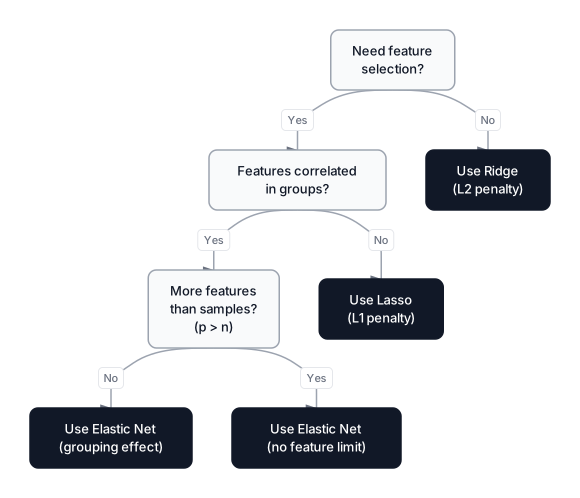 Click to expandDecision flowchart for choosing between Ridge, Lasso, and Elastic Net
| Criterion | Ridge (L2) | Lasso (L1) | Elastic Net |
|---|---|---|---|
| Penalty | Both | ||
| Zeros out coefficients | No | Yes | Yes |
| Handles multicollinearity | Strong (distributes weight) | Weak (picks one arbitrarily) | Strong (groups correlated features) |
| Feature selection | No | Built-in | Built-in |
| Computational cost | Low (closed-form) | Moderate (coordinate descent) | Moderate (coordinate descent) |
| Max features selected | All | At most | No hard limit |
| Best for | All features relevant; correlated predictors | Many irrelevant features; need sparse model | High-dimensional data with correlation; $p > n$ |
When NOT to use regularization
Regularization isn't always the answer:
- Small feature set, large dataset: With 5 features and 100,000 rows, OLS works fine. The ratio of observations to parameters is so high that overfitting is unlikely.
- Tree-based models: Random forests, gradient boosting, and XGBoost have built-in regularization (max depth, min samples, learning rate). Adding L1/L2 penalties to a tree ensemble is redundant.
- Nonlinear relationships: If the true relationship is nonlinear, no amount of regularization on a linear model will help. Consider polynomial regression or tree-based approaches instead.
Three practical guidelines
- Start with Ridge when you have no reason to believe features are irrelevant. It stabilizes coefficients and handles multicollinearity with minimal risk of discarding useful information.
- Use Lasso when you suspect many features are noise and want the model to identify the important ones automatically. The resulting sparse model is easier to explain to stakeholders.
- Choose Elastic Net when features are correlated in groups, when $p > n$, or when you need Lasso-style sparsity without its instability on correlated inputs. Genomics, NLP, and sensor-array applications default to Elastic Net for this reason.
Production considerations
Computational complexity:
- Ridge: for the closed-form solution (matrix inversion), per iteration with
SGDRegressor - Lasso: per coordinate descent iteration, converges in 100-1000 iterations typically
- Elastic Net: same as Lasso (coordinate descent)
Memory: All three store only a coefficient vector of size . Even with 100,000 features, the model footprint is negligible.
Scaling to large datasets: For datasets with millions of rows, swap Ridge/Lasso/ElasticNet for SGDRegressor with penalty='l2'/'l1'/'elasticnet'. SGD processes one mini-batch at a time and scales linearly with dataset size. As of scikit-learn 1.6, SGDRegressor supports all three penalty types with adaptive learning rate schedules.
Deployment note: Regularized models are linear combinations of features. Inference is a single dot product — per prediction — making them some of the fastest models to serve in production, handling millions of predictions per second on modest hardware.
Choosing a Regularization Penalty
Regularization transforms unconstrained linear regression into a controlled optimization that balances fit against complexity. Ridge penalizes squared coefficients, shrinking them toward zero and stabilizing models plagued by multicollinearity. Lasso penalizes absolute coefficients, pushing irrelevant ones to exactly zero and performing automatic feature selection — a property explained by the diamond-shaped L1 constraint region whose corners sit on the coordinate axes. Elastic Net combines both penalties, inheriting Lasso's sparsity and Ridge's grouping stability, making it the standard for high-dimensional datasets with correlated features.
The practical workflow is straightforward: standardize features, select a method based on your data characteristics, and use cross-validation (RidgeCV, LassoCV, ElasticNetCV) to tune the regularization strength. These three tools, layered on top of the fundamentals covered in Linear Regression, give you precise control over the bias-variance tradeoff that determines whether a model memorizes training data or generalizes to the real world.
Frequently Asked Interview Questions
Q: What is the difference between L1 and L2 regularization?
L1 (Lasso) adds the sum of absolute coefficient values as penalty, which drives some coefficients to exactly zero — performing automatic feature selection. L2 (Ridge) adds the sum of squared coefficients, which shrinks all coefficients toward zero but never eliminates them. Geometrically, L1's diamond-shaped constraint region has corners on the coordinate axes where coefficients are zero, while L2's circular constraint has no corners.
Q: When would you choose Ridge over Lasso in a production model?
Choose Ridge when most features carry some signal and you don't want to risk dropping useful predictors. Ridge is also more stable when features are correlated — it distributes weight across correlated features rather than arbitrarily picking one, which makes coefficients more reproducible across different data splits.
Q: Why is feature standardization required before applying regularization?
Regularization penalizes coefficient magnitude, but coefficient magnitude depends on feature scale. A feature ranging 1-6 (bedrooms) will have a coefficient 500x larger than a feature ranging 500-5000 (square footage), purely due to scale differences. Without standardization, the penalty suppresses large-scale features and ignores small-scale ones, which has nothing to do with feature importance.
Q: Explain geometrically why Lasso produces sparse solutions but Ridge does not.
The L1 constraint region is a diamond with sharp corners on the coordinate axes. The L2 constraint is a circle with no corners. When the elliptical RSS contours expand outward from the OLS solution, they're far more likely to first touch the diamond at a corner (where one or more coefficients are zero) than along a flat edge. The circle has no such corners, so contact almost always occurs where all coefficients are nonzero.
Q: How do you choose between Lasso and Elastic Net?
Use Lasso when features are mostly independent and you want maximum sparsity. Switch to Elastic Net when features are correlated in groups — Lasso arbitrarily picks one feature per correlated group and zeros the rest, while Elastic Net keeps the entire group with similar weights. Elastic Net also lifts Lasso's hard limit of selecting at most features when $p > n$.
Q: Your model has 500 features, low training error, but high test error. Walk through your debugging process.
This is classic overfitting. First, apply regularization — start with Lasso or Elastic Net since many of those 500 features are likely irrelevant. Use LassoCV or ElasticNetCV with 5-fold cross-validation to tune alpha. Check how many features survive with nonzero coefficients. If the gap between training and test error shrinks, regularization solved it. If not, investigate whether the relationship is nonlinear and consider tree-based models.
Q: What is the "grouping effect" in Elastic Net, and why does it matter?
The grouping effect means Elastic Net assigns similar coefficients to correlated features rather than picking one and zeroing the rest (as Lasso does). This happens because the L2 component encourages correlated features to share weight. It matters in practice because correlated features often carry complementary information — total square footage and first-floor square footage are correlated but not identical — and keeping both gives a more stable, informative model.
Hands-On Practice
Regularization techniques like Ridge, Lasso, and Elastic Net are essential tools for preventing overfitting, but understanding their impact requires seeing how they constrain model coefficients in practice. You'll transform raw sensor data into a regression problem to predict sensor values, comparing how standard Linear Regression differs from its regularized counterparts when handling noisy data. By experimenting with the Sensor Anomalies dataset, you will visualize exactly how these algorithms shrink coefficients to create more solid, generalizable models.
Dataset: Sensor Anomalies (Detection) Sensor readings with 5% labeled anomalies (extreme values). Clear separation between normal and anomalous data. Precision ≈ 94% with Isolation Forest.
Try changing the alpha parameter in the Ridge and Lasso models from 0.1 to 10.0 and observe how the coefficient plot changes; you should see the bars shrink significantly as the penalty increases. Specifically, check if Lasso aggressively sets more lag features to exactly zero at higher alpha values, effectively performing automated feature selection. This experimentation will reveal the trade-off between model simplicity (bias) and fitting the training data accuracy (variance).