
Fifty employees sit in a conference room for their annual compensation review. The median salary is $62,000, and the mean is close behind at $64,500. Then the CEO's $4.2 million package enters the spreadsheet. The mean leaps to $145,000, more than double the actual pay of 49 out of 50 people. The median barely moves. That single data point didn't change anyone's paycheck, but it destroyed the usefulness of the most common summary statistic in data science.
This is the core problem with outlier detection. Outliers warp means, inflate standard deviations, corrupt regression coefficients, and silently degrade every downstream model that trusts those numbers. Dropping them blindly is equally dangerous: a fraudulent transaction, a sensor failure, or a viral product listing might be the most valuable signal in your dataset. The discipline lies in detecting outliers mathematically and then making informed decisions about each one.
This guide walks through five detection methods (from the familiar z-score to multivariate Mahalanobis distance) using a single employee salary dataset so you can compare every technique on the same numbers.
The running example: employee salary data
Every method in this guide operates on the same 12-employee salary array. Eleven salaries cluster between $45,000 and $72,000. One outlier, $310,000, represents an executive whose compensation dwarfs the rest.
Expected output:
Mean:   $78,750
Median: $59,000
Std:    $70,167
The mean is $78,750, nearly $20,000 above the median of $59,000. The standard deviation is $70,168, larger than most individual salaries. Both figures are distorted by a single value. Every method below tries to flag that value. How well each one succeeds reveals fundamental differences in statistical robustness.
Why the mean misleads with outliers present
The arithmetic mean treats every observation equally, weighting a $310,000 salary the same as a $45,000 one. Add one extreme value, and the mean chases it, dragging the "center" of the data toward the tail. The standard deviation follows, because it squares deviations from the now-distorted mean.
This creates two cascading problems:
- Shifted center. The mean no longer represents typical values. In the salary data, no employee earns anything close to $78,750.
- Inflated spread. The standard deviation balloons to $70,168, making the true cluster of salaries ($45k—$72k) appear less tightly grouped than it actually is. Subsequent z-score calculations use this inflated denominator, which shrinks the outlier's score and can cause it to slip below the detection threshold, a phenomenon called masking.
 Click to expandHow the masking effect causes z-scores to miss outliers by inflating the standard deviation
The median and Median Absolute Deviation (MAD) resist this distortion because they depend on rank order rather than magnitude. That's why every robust detection method in this guide replaces the mean and standard deviation with their median-based counterparts.
Key Insight: Masking is the central failure mode of mean-based outlier detection. The outlier corrupts the very statistics used to detect it, making itself look less extreme. Understanding this single concept explains why robust alternatives exist and when you need them.
The z-score method
The z-score converts each observation into a number of standard deviations from the mean. It's the first outlier detection technique most practitioners learn, and for good reason: it's fast, intuitive, and works well when your data is approximately normal.
Where:
- is the individual data point (e.g., one employee's salary)
- is the sample mean ($78,750 in our salary data)
- is the sample standard deviation ($70,168 in our salary data)
In Plain English: The z-score answers "how many standard deviations is this salary from the average?" A z-score of 0 means the salary equals the mean. A z-score of 3 means it sits three standard deviations away. Under a normal distribution, that happens with roughly 0.27% probability, or about 1 in 370 observations.
The conventional threshold is $|z| > 3$. Any observation beyond three standard deviations gets flagged as a potential outlier.
Expected output:
Z-scores:  [0.48 0.44 0.41 0.38 0.34 0.3  0.27 0.24 0.2  0.15 0.1  3.3 ]
Outlier index: [11]
Outlier value: [310000]
The $310,000 salary gets a z-score of 3.30, just barely above the threshold. Had the outlier been slightly less extreme, say $280,000, the inflated standard deviation would have absorbed it entirely, and the z-score would have dropped below 3. This is masking in action.
Limitations of z-scores
- Normality assumption. The $|z| > 3$ rule assumes the data follows a Gaussian distribution. For skewed data like income, web traffic, or insurance claims, this threshold is unreliable.
- Masking. The outlier inflates both the mean and the standard deviation, reducing its own z-score. With multiple outliers, masking intensifies and can hide all of them.
- Swamping. The reverse problem: extreme outliers distort the mean enough that normal observations near the shifted mean receive artificially high z-scores and get falsely flagged.
Pro Tip: Always visualize your distribution before applying z-scores. A quick histogram or Q-Q plot reveals whether the normality assumption holds. If your data is right-skewed, skip directly to the IQR or modified z-score methods.
The modified z-score with Median Absolute Deviation
The modified z-score replaces the mean and standard deviation with the median and Median Absolute Deviation (MAD), making it robust to the very outliers it aims to detect. Boris Iglewicz and David Hoaglin proposed this approach in their 1993 monograph How to Detect and Handle Outliers, and it remains one of the most reliable univariate outlier tests available.
Where:
- is the modified z-score for observation
- is the individual data point (e.g., one employee's salary)
- is the median of the dataset ($59,000 in our salary data)
- is the Median Absolute Deviation
- is a scaling constant that makes MAD consistent with the standard deviation under normality
In Plain English: Instead of measuring how far each salary sits from the average in units of standard deviation, the modified z-score measures distance from the median in units of MAD. Because the median ignores the $310,000 value, the outlier can't inflate the yardstick used to measure it. The measurement instrument stays clean.
Why the 0.6745 constant matters
The constant 0.6745 equals the 75th percentile of the standard normal distribution. Multiplying by it makes the MAD a consistent estimator of the standard deviation when the underlying data is normally distributed. Without this scaling, the modified z-score and the standard z-score would be on different scales, and the threshold of 3.5 recommended by Iglewicz and Hoaglin would lose its statistical grounding.
Full implementation
Expected output:
Modified Z-scores: [ 1.18  0.93  0.76  0.59  0.34  0.08  0.08  0.25  0.51  0.76  1.1  21.16]
Outlier index: [11]
Outlier value: [310000]
The modified z-score for $310,000 is 21.16: six times the 3.5 threshold. Compare that to the standard z-score of 3.30, which barely cleared 3.0. The modified z-score screams "anomaly" because the outlier couldn't inflate the median or the MAD. This is the practical payoff of robust statistics: the measurement instrument is no longer corrupted by the thing it's measuring.
Common Pitfall: If all your data points are identical, the MAD is zero and the modified z-score is undefined. The implementation above handles this with an explicit zero-check, but production code should log this case rather than silently returning zeros.
The IQR method and Tukey fences
The Interquartile Range (IQR) method creates fences around the central 50% of the data. It's the logic behind boxplot whiskers and was formalized by John Tukey in his 1977 book Exploratory Data Analysis, one of the most influential statistics texts ever published.
The procedure works in three steps:
- Compute (25th percentile) and (75th percentile).
- Calculate .
- Set lower and upper fences:
Where:
- is the 25th percentile ($51,500 in our salary data)
- is the 75th percentile ($65,750 in our salary data)
- is the interquartile range ($14,250)
- is the fence multiplier (1.5 for standard outliers, 3.0 for extreme outliers)
In Plain English: The IQR measures the width of the "middle box" containing the central half of salaries. Any salary that falls more than 1.5 box-widths beyond the edge of the box is flagged as suspicious. In our data, the box spans $51,500 to $65,750 (a width of $14,250), so the upper fence sits at $65,750 + 1.5 x $14,250 = $87,125.
Why 1.5?
When asked about this choice, Tukey reportedly answered: "Because 1 is too small and 2 is too large." More precisely, for a perfectly normal distribution, the 1.5 multiplier flags roughly 0.7% of observations as outliers (about 1 in 140). This balance catches genuine anomalies without over-flagging natural variation. Using $k = 3.0$ instead catches only extreme cases (roughly 1 in 425,000 observations under normality).
Expected output:
Q1: $51,500  |  Q3: $65,750  |  IQR: $14,250
Lower fence: $30,125
Upper fence: $87,125
IQR outliers: [310000]
The upper fence sits at $87,125. The $310,000 salary exceeds it by more than $220,000, an unambiguous outlier. The IQR method makes no assumption about the shape of the distribution, which is why it works well on skewed data like income, house prices, and customer lifetime value.
Pro Tip: The IQR method and modified z-score often agree on obvious outliers, but they diverge on borderline cases. When the two methods flag different points, investigate those points individually rather than trusting either method blindly.
Grubbs' test for a single outlier
Grubbs' test is a formal hypothesis test designed to detect exactly one outlier in a univariate, normally distributed sample. Published by Frank Grubbs in Technometrics (1969), it remains a standard reference in engineering quality control and laboratory sciences where formal statistical rigor is required.
Hypotheses:
- : There are no outliers in the dataset.
- : There is exactly one outlier.
Test statistic:
Where:
- is the Grubbs test statistic
- is each observation in the dataset
- is the sample mean
- is the sample standard deviation (with Bessel's correction, )
This is simply the largest absolute z-score in the dataset. The critical value depends on the sample size and the significance level , derived from the t-distribution:
Where:
- is the sample size (12 employees)
- is the critical value from the t-distribution with degrees of freedom
- is the significance level (typically 0.05)
If , the null hypothesis is rejected and the most extreme value is declared an outlier.
In Plain English: Grubbs' test asks: "Is the single most extreme salary in this dataset too extreme to have come from the same normal distribution as the rest?" It formalizes what z-scores do informally, but attaches a proper p-value. For our salary data, it checks whether the $310,000 value is statistically incompatible with the other eleven salaries.
Expected output:
G statistic:  3.1554
G critical:   2.4116
Outlier detected: True
Suspect value: $310,000
Grubbs' test confirms the $310,000 salary as a statistically significant outlier at the 5% significance level (). To find additional outliers, you remove the flagged value and repeat the test. This iterative process works for small, well-behaved datasets but becomes cumbersome at scale.
When Grubbs' test fits and when it doesn't
Use Grubbs' test when you have a small, normally distributed sample and need a formal p-value: quality control, lab measurements, and regulatory reporting. For datasets with thousands of rows or non-normal distributions, the IQR or modified z-score methods are more practical and don't require the normality assumption.
Visual detection with box plots and scatter plots
Statistical tests produce numbers. Visualization produces understanding. The two complement each other, and skipping either one is a mistake.
Box plots encode the IQR method directly. The box spans Q1 to Q3, the line inside marks the median, whiskers extend to 1.5 times the IQR, and dots beyond the whiskers are outliers. A single box plot of our salary data immediately reveals the $310,000 value sitting far above the upper whisker.
Scatter plots expose relationships between two variables. A point that looks normal in a univariate box plot can become a clear outlier when its combination of values is implausible. Plotting employee age against salary might reveal a 22-year-old earning $310,000. That contextual information is something a univariate test misses entirely.
Expected output: Two side-by-side plots. The box plot shows 11 salaries clustered in the $45k—$72k box with a single dot at $310,000 far above the upper whisker. The scatter plot shows the same pattern with a dashed red line at the $87,125 IQR fence, and employee 11 well above it.
A box plot answers "what stands out?" A scatter plot with a reference line answers "how far out does it stand?" Use both.
Multivariate outlier detection with Mahalanobis distance
Every method above operates on a single variable. Real datasets have dozens. An employee earning $55,000 is normal. An employee who is 19 years old is normal. But a 19-year-old listed with 30 years of experience and a $55,000 salary is suspicious in a way no single-column check would catch. Univariate methods examine each column in isolation and miss these multivariate anomalies.
Mahalanobis distance solves this by measuring how far a point sits from the center of the multivariate distribution, accounting for correlations between variables.
 Click to expandEuclidean vs Mahalanobis distance showing how correlation-aware measurement catches multivariate outliers
Where:
- is the squared Mahalanobis distance
- is the observation vector (e.g., [salary, years_experience] for one employee)
- is the mean vector of the dataset
- is the inverse of the covariance matrix
In Plain English: Euclidean distance measures "how far away is this employee from the center?" Mahalanobis distance measures "how far away is this employee, given how salary and experience usually vary together?" It stretches and rotates the coordinate system so that correlated variables don't inflate the distance calculation. A 25-year-old earning $50,000 might be close in Euclidean space but far in Mahalanobis space if every other 25-year-old earns $35,000.
Under the assumption of multivariate normality, follows a chi-squared distribution with degrees of freedom, where is the number of variables. This gives a principled threshold: flag any observation whose exceeds .
Expected output:
Mahalanobis distances: [0.29 0.9  1.43 1.18 0.36 0.61 1.   0.42 1.01 2.17 0.49 3.17]
Threshold: 2.72
Outlier indices: [11]
Outlier values (salary, experience):
  Employee 11: $310,000, 2.0 years
The employee with $310,000 salary and only 2 years of experience stands out in two dimensions simultaneously. No univariate check on salary alone or experience alone would capture the full extent of this anomaly.
Pro Tip: For high-dimensional data (more than about 10 features), the sample covariance matrix can become unstable or singular. As of scikit-learn 1.8, EllipticEnvelope estimates a robust covariance matrix using the Minimum Covariance Determinant (MCD) method, making Mahalanobis-based detection more reliable with many features or moderate contamination. Keep in mind the rule of thumb: you need observations (where is the number of features) for stable covariance estimation.
Choosing the right method
Selecting an outlier detection method depends on your data's shape, size, and dimensionality. No single technique works everywhere, but the decision tree below covers most practical scenarios.
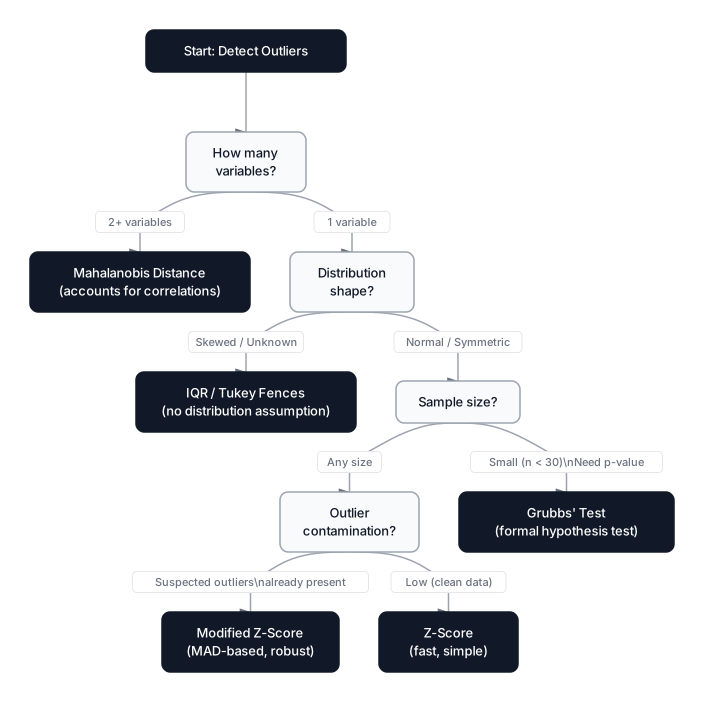 Click to expandDecision flowchart for selecting the right outlier detection method based on data characteristics
| Method | Distribution Assumption | Robustness | Complexity | Best For |
|---|---|---|---|---|
| Z-score | Normal (Gaussian) | Low; mean/std influenced by outliers | Clean, symmetric data; quick screening | |
| Modified z-score | Approximately symmetric | High; uses median and MAD | Data with suspected contamination | |
| IQR / Tukey fences | None (non-parametric) | High; based on percentiles | Skewed data; unknown distributions | |
| Grubbs' test | Strictly normal | Low; uses mean and std | Small samples needing a formal p-value | |
| Mahalanobis distance | Multivariate normal | Moderate; depends on covariance estimation | Multi-column datasets; correlated features |
For most practical data science work, start with the IQR method or the modified z-score. They require no distributional assumptions, resist masking, and scale to large datasets. Reserve z-scores for confirmed normal data, Grubbs' test for small validated samples, and Mahalanobis distance for multivariate analysis.
When NOT to use statistical outlier detection
These methods all assume you're working with continuous, roughly bell-shaped (or at least unimodal) data. They break down when:
- Your data is multimodal. A mixture of two populations (e.g., full-time and part-time employees) creates legitimate "outliers" that are actually members of a second cluster. Use Gaussian Mixture Models or clustering-based anomaly detection instead.
- You have high-dimensional sparse data. Text features, one-hot encoded categories, or image embeddings make distance-based methods unreliable. Consider Isolation Forest or autoencoder-based anomaly detection.
- Outliers are the majority class. If more than ~10-15% of your data is anomalous, these methods struggle to separate signal from noise. You need a supervised approach with labeled examples.
When to remove, keep, or transform outliers
Detection is step one. The harder decision is what to do with the flagged values. There's no universal rule, but a decision framework grounded in domain knowledge keeps you out of trouble.
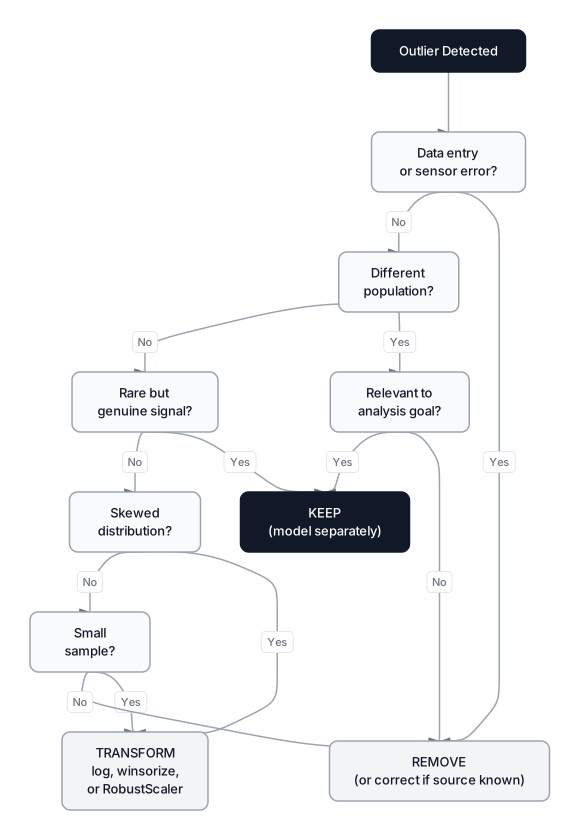 Click to expandDecision framework for handling detected outliers: remove, keep, or transform
Remove the outlier when:
- It results from a confirmed data entry error (a salary of $5.80 instead of $58,000).
- It originates from a measurement instrument malfunction (a temperature sensor that occasionally spikes to 999).
- It belongs to a different population entirely (a corporate executive mixed into a dataset of entry-level salaries).
Keep the outlier when:
- It represents genuine, rare phenomena you need to model (fraud detection, equipment failure, viral content).
- Your sample is small and removing it would distort the analysis more than keeping it.
- The variable is naturally right-skewed (income, insurance claims, page views), where extreme values are expected.
Transform instead of removing:
- Winsorization caps extreme values at a percentile boundary (e.g., replace anything above the 99th percentile with the 99th percentile value). This keeps the observation count intact while limiting influence.
- Log transformation compresses right-skewed distributions, pulling extreme values closer to the center. A salary of $310,000 becomes , while $58,000 becomes , a much smaller gap.
- Robust scaling with scikit-learn's
RobustScalercenters data on the median and scales by the IQR, reducing the influence of outliers without deleting them:
Expected output:
Original vs Scaled salaries:
  $ 45,000 ->  -0.98
  $ 48,000 ->  -0.77
  $ 50,000 ->  -0.63
  $ 52,000 ->  -0.49
  $ 55,000 ->  -0.28
  $ 58,000 ->  -0.07
  $ 60,000 ->   0.07
  $ 62,000 ->   0.21
  $ 65,000 ->   0.42
  $ 68,000 ->   0.63
  $ 72,000 ->   0.91
  $310,000 ->  17.61 <-- outlier
The 11 normal salaries scale to a tight range around 0, while the $310,000 outlier gets a scaled value of 17.61. The outlier is still present and visible, but it hasn't distorted the scaling of the other observations. Compare that to StandardScaler, which would have compressed everyone else into a narrow band near zero. For a deeper comparison of when to use which scaler, see Standardization vs Normalization.
Warning: Always run your analysis twice: once with outliers included and once with them removed or transformed. If your conclusions change dramatically, the outliers are driving your results, and you need to understand them before making any modeling decisions.
Domain-specific considerations
The same statistical flag means different things in different fields. Context is everything.
| Domain | Outlier Meaning | Typical Action |
|---|---|---|
| Finance / Fraud | Outlier transactions are the signal | Keep; model deviations from normal behavior |
| Healthcare | Rare disease or labeling error | Expert review required; never auto-remove |
| Manufacturing | Equipment degradation or sensor failure | Keep for predictive maintenance models |
| Surveys / Social Science | Extreme opinion or disengaged respondent | Check response patterns before deciding |
| E-commerce | Viral listing or bot activity | Segment separately; don't pollute aggregate metrics |
The recurring principle: never automate the removal decision. Automate the detection, then apply domain judgment to each flagged observation.
Key Insight: In fraud detection and predictive maintenance, removing outliers from your training data means your model never learns to detect the exact failures it was built to catch. These are the rare cases where outliers are more valuable than the rest of the data combined.
Production considerations
For real-world deployment, keep these operational details in mind:
- Computational cost. Z-scores and modified z-scores run in and respectively, making them feasible on millions of rows. Mahalanobis distance involves a matrix inversion ( where is the feature count), which becomes expensive beyond ~100 features.
- Streaming data. None of these methods work well out of the box on streaming data because they require the full dataset to compute statistics. For real-time anomaly detection, consider exponentially weighted moving statistics or online variants of Isolation Forest.
- Feature scaling. Before applying Mahalanobis distance, ensure your features are on comparable scales. While the covariance matrix theoretically handles scale differences, numerical instability can creep in when one feature is in millions and another is between 0 and 1.
- Contamination rate. If you know approximately what fraction of your data is anomalous, scikit-learn's
EllipticEnvelopeaccepts acontaminationparameter (default 0.1) that adjusts the decision boundary accordingly.
Conclusion
The mean is useful, but only when your data cooperates. A single extreme value can corrupt it, along with every calculation that depends on it. The five methods in this guide form a progression of increasing sophistication for catching those extreme values.
Z-scores offer the simplest approach but suffer from masking: the outlier inflates the very statistics used to detect it. The modified z-score, proposed by Iglewicz and Hoaglin, fixes this by replacing the mean and standard deviation with their robust counterparts (median and MAD), making the detection instrument immune to the thing it measures.
The IQR method and Tukey fences take a different path entirely, requiring no distributional assumptions and mapping directly to boxplot visualizations that anyone can interpret. Grubbs' test adds formal hypothesis testing for small, normally distributed samples where a p-value carries regulatory or scientific weight. And Mahalanobis distance extends the entire framework into multiple dimensions, catching anomalies that no univariate method could find, like that 19-year-old with 30 years of listed experience.
Detection, however, is only the beginning. A flagged value is a question, not an answer. Whether you remove, keep, or transform an outlier depends on domain context, sample size, and what you're trying to learn. For deeper coverage of the statistical foundations these methods rest on, explore Probability Distributions: The Hidden Framework Behind Your Data. If your outlier investigation reveals unexpected variable relationships, Correlation Analysis: Beyond Just Pearson covers the rank-based alternatives that resist outlier distortion. And for a broader view of anomaly detection beyond statistics, including tree-based and neural approaches, see Finding the Needle: A Comprehensive Guide to Anomaly Detection Algorithms.
Frequently Asked Interview Questions
Q: What is the difference between an outlier and an anomaly?
In practice, the terms are often used interchangeably, but there's a subtle distinction. An outlier is a data point that is statistically distant from the rest of the distribution; it's a purely mathematical concept. An anomaly is an outlier that is also meaningful in context: a fraudulent transaction, a sensor malfunction, or a disease indicator. Every anomaly is an outlier, but not every outlier is an anomaly. Some are just natural variation in skewed distributions.
Q: Why can't you just use z-scores for all outlier detection?
Z-scores rely on the mean and standard deviation, both of which are sensitive to the very outliers you're trying to detect. This creates the masking effect: the outlier inflates the standard deviation, which shrinks its own z-score, potentially hiding it below the detection threshold. For data that's skewed, contaminated, or non-normal, the modified z-score (using median and MAD) or the IQR method give more reliable results.
Q: How do you handle outliers in a machine learning pipeline?
It depends on the model and the domain. Tree-based models (random forests, gradient boosting) are inherently resistant to outliers because they split on rank order, not magnitude. Linear models and distance-based models (KNN, SVM, k-means) are highly sensitive and benefit from either removing outliers or using RobustScaler. In fraud detection or anomaly detection, outliers are the target class and should never be removed from training data.
Q: What is the masking effect, and how do you avoid it?
Masking occurs when outliers inflate the mean and standard deviation, causing the z-score of the outlier itself to shrink below the detection threshold. Multiple outliers amplify this effect; they can hide each other entirely. You avoid it by using robust statistics (median and MAD instead of mean and standard deviation) or non-parametric methods like the IQR. The modified z-score was specifically designed to eliminate masking.
Q: When would you use Mahalanobis distance instead of Euclidean distance for outlier detection?
Use Mahalanobis distance whenever your features are correlated or on different scales. Euclidean distance treats all directions equally, so a point that's far away in a low-variance direction gets the same weight as one far away in a high-variance direction. Mahalanobis distance accounts for the shape of the data cloud by incorporating the covariance matrix, making it the appropriate metric for multivariate outlier detection. The key requirement is having enough samples relative to the number of features, roughly .
Q: Your model performs well on the test set but poorly in production. Could outliers be the cause?
Absolutely. If your training data was cleaned of outliers but production data contains them, the model has never seen extreme values and won't handle them well. Conversely, if outliers in the training data inflated variance estimates or biased coefficients, the model learned distorted patterns. The solution is to analyze outliers during EDA, make a deliberate decision about each one, and ensure your training data reflects the distribution you'll see in production, including realistic extreme values.
Q: How do you detect outliers in time series data?
Standard statistical methods (z-score, IQR) can be applied to the residuals after decomposing the time series into trend, seasonality, and remainder components. The residual component strips away expected patterns, so any remaining extreme values are genuine anomalies. For real-time detection, exponentially weighted moving averages or online algorithms like streaming Isolation Forest are more practical than batch methods that require the full dataset.
Hands-On Practice
The following code demonstrates how to implement the three outlier detection methods discussed in the article: Z-Score, Modified Z-Score, and the Interquartile Range (IQR). We will apply these techniques to the 'income' column of our dataset, contrasting how each method handles extreme values.
Dataset: Customer Analytics (Data Analysis) Rich customer dataset with 1200 rows designed for EDA, data profiling, correlation analysis, and outlier detection. Contains intentional correlations (strong, moderate, non-linear), ~5% missing values, ~3% outliers, various distributions, and business context for storytelling.
Notice how the counts differ between methods. The IQR method typically detects the most outliers in skewed data (like income) because the upper fence is tighter than the Z-score threshold. The Z-score method may 'mask' outliers if extreme values have already inflated the standard deviation.