
A bank's credit scoring model processes thousands of loan applications daily. Income is missing for 12% of applicants, mostly self-employed workers who don't fit the standard salary field. Credit scores are absent for another 8%, concentrated among applicants with scores below 550 who never completed the verification step. Dropping these rows silently removes the exact populations the model needs to predict accurately. The resulting classifier works beautifully in validation but fails in production, approving risky loans and rejecting creditworthy applicants the training data never saw.
Missing data is one of the most common problems in applied machine learning, and one of the most mishandled. According to a 2020 survey of Kaggle competitions, over 80% of real-world datasets contain missing values. The default dropna() or fillna(0) reflexes feel safe, but they introduce bias that propagates silently through every downstream model. Choosing the right imputation strategy requires understanding why the data is gone, not just how much.
Every formula and code block in this article uses one running example: a bank loan application dataset with income, age, credit score, employment history, and loan amount. We'll watch how different imputation methods distort or preserve the relationships in this data.
Three Types of Missing Data
The mechanism behind missingness determines which imputation strategies are valid. Donald Rubin formalized this framework in 1976, and it remains the foundation for handling missing data in statistics and machine learning. Getting the mechanism wrong means your "fix" introduces the exact bias you're trying to avoid.
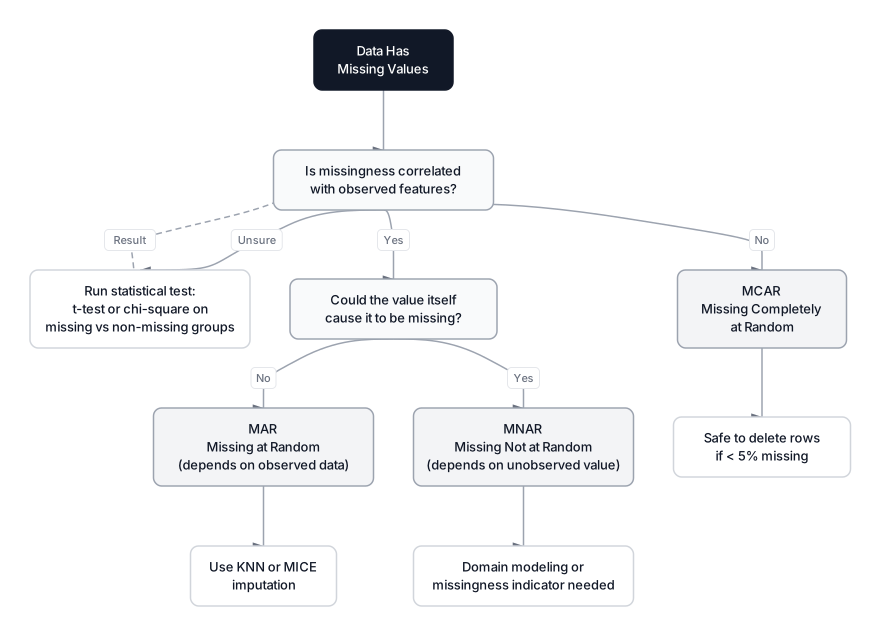 Click to expandDecision tree for identifying MCAR, MAR, and MNAR missingness mechanisms in datasets
Missing Completely at Random (MCAR)
MCAR means the probability of a value being missing is identical for every observation, regardless of observed or unobserved values. A database server crashes and loses 3% of records at random. The missingness tells you nothing about the data itself.
This is the only scenario where dropping rows is statistically safe. The remaining data is still a random sample of the original population.
Missing at Random (MAR)
MAR is the most confusingly named concept in statistics. It does not mean the data is randomly missing. It means the missingness depends on other observed variables in the dataset, but not on the missing value itself.
In our bank loan example: younger applicants (under 30) are far more likely to skip the income field on their application. The missingness depends on age, which we observe, not on the income value itself. If you have age in your dataset, you can account for this pattern.
Missing Not at Random (MNAR)
MNAR is the hardest case. The value is missing because of what it would have been. Applicants with low credit scores abandon the verification process, so their scores never get recorded. The missingness itself carries information about the unobserved value.
No imputation method can fully correct MNAR from observed data alone. You need domain knowledge, external data sources, or explicit modeling of the missingness mechanism (selection models, pattern-mixture models). In practice, adding a binary "is_missing" indicator column lets the model learn from the pattern itself.
The Formal Definition
Where:
- is the missingness indicator (1 if missing, 0 if observed)
- is the observed portion of the data
- is the unobserved (missing) portion
In Plain English: This formula asks a single question: what determines whether a value is missing? If the answer is "nothing" (pure randomness), you have MCAR. If it depends on other fields in the application (like the applicant's age), you have MAR. If it depends on the missing value itself (low credit scores cause people to quit), you have MNAR.
Detecting Missingness Patterns
Detecting the missingness mechanism requires statistical testing, not guesswork. You can't prove MNAR from observed data (by definition, you don't see the missing values), but you can distinguish MCAR from MAR by comparing groups.
The approach is straightforward: split your data into two groups (value present vs. value missing for a given column) and test whether other observed features differ significantly between them. If they do, missingness depends on those features, which rules out MCAR.
This is a natural extension of exploratory data analysis and data profiling. Before imputing anything, profile the missingness.
Missing values per column:
income              44
age                  0
credit_score        14
employment_years     0
loan_amount          9
dtype: int64

Total rows: 300
Complete rows: 240
Rows lost with listwise deletion: 60

--- Detecting MAR in income ---
Mean age (income present): 45.4
Mean age (income missing): 29.6
t-statistic: 8.625, p-value: 0.0000
Significant difference -> missingness likely depends on age (MAR)

--- Detecting MNAR in credit_score ---
Mean credit_score (present): 646
Mean credit_score (missing, actual): 532
Note: MNAR cannot be confirmed from observed data alone.
The actual missing values are systematically lower, but we only
know this because we created the data.
Listwise deletion on this dataset drops 60 of 300 rows (20%), even though no single column is missing more than 15%. That's the compound effect: missingness across multiple columns accumulates fast.
Key Insight: The t-test comparing mean age between income-present (45.4 years) and income-missing (29.6 years) groups returns a p-value near zero. This is strong evidence that income missingness depends on age, ruling out MCAR. A simple dropna() would systematically remove younger applicants, biasing the model toward older demographics.
Simple Imputation: When It Works and When It Fails
Mean and median imputation replace missing values with the column's central tendency. This is fast, requires no tuning, and ships in every ML library. It's also dangerous for any feature that matters to your model.
The core problem is variance distortion. When you replace 20% of income values with the mean, you add a spike of identical values right at the center of the distribution. The standard deviation drops, correlations between features weaken, and confidence intervals shrink. Your model becomes overconfident in a pattern that doesn't exist.
The Variance Shrinkage Formula
Where:
- is the sample variance
- is each data point (including imputed values)
- is the sample mean
- is the total number of observations (original + imputed)
In Plain English: Every imputed value equals the mean exactly, so . You're adding to the denominator (more data points) without adding to the numerator (no squared differences). The variance shrinks mechanically, making the income distribution look artificially tight. A loan officer reviewing this data would think applicants have more similar incomes than they actually do.
Missing income values: 69 / 300

Original income:
  Mean:   $76,806
  Std:    $17,383
  Median: $78,662

Mean-imputed income:
  Mean:   $76,455
  Std:    $15,474
  Median: $76,455

Variance reduction: 20.8%
Correlation (income, credit_score) original:  0.8456
Correlation (income, credit_score) imputed:   0.7576
Correlation attenuation: 10.4%
The standard deviation drops from $17,383 to $15,474, and the income-credit score correlation weakens from 0.85 to 0.76. That 10.4% correlation attenuation matters: it means the model learns a weaker relationship between income and credit score than actually exists.
Common Pitfall: Median imputation avoids sensitivity to outliers, but it creates the same variance shrinkage problem. The only difference is where the spike appears. Neither preserves the distributional shape. Use SimpleImputer(strategy='mean') or strategy='median' only for low-importance features, missingness below 5%, or as a quick baseline before trying better methods.
When Simple Imputation Is Acceptable
Despite its flaws, mean/median imputation is the right call in specific situations:
| Condition | Why It's OK |
|---|---|
| Feature has low importance | Distortion doesn't affect predictions much |
| Missingness < 5% | Variance shrinkage is negligible |
| Production latency constraint | KNN/MICE add compute overhead |
| Baseline comparison | You need a simple benchmark before testing advanced methods |
KNN Imputation
KNN imputation fills missing values using the nearest neighbors in feature space rather than a global average. If an applicant is missing their income, KNN finds the 5 most similar applicants (by age, credit score, and employment history) and averages their incomes. The result is a local estimate tailored to that specific data point.
This approach works well when similar observations cluster together, which is common in feature-engineered tabular data. The key requirement: features must be scaled first, because KNN uses distance metrics.
The Distance Metric
Where:
- is the Euclidean distance between data points and
- and are feature values for the -th feature
- is the number of features used for distance computation
In Plain English: KNN measures how "similar" two loan applicants are by computing the straight-line distance across all their features. An applicant aged 35 with 10 years of employment is "closer" to someone aged 37 with 12 years than to a 22-year-old fresh graduate. The missing income gets filled with the average income of those nearby applicants.
Pro Tip: Always scale features before KNN imputation. Income ranges from $15,000 to $200,000 while age ranges from 22 to 65. Without scaling, income dominates the distance calculation and age becomes irrelevant. StandardScaler or MinMaxScaler fixes this.
Missing income values: 41 / 300

First 8 imputed values vs actual:
     actual  knn_imputed  error_pct
9   60609.0      61354.0        1.2
10  68249.0      70199.0        2.9
18  60455.0      69304.0       14.6
23  81158.0      87697.0        8.1
27  73136.0      67744.0       -7.4
35  79360.0      82006.0        3.3
38  72347.0      76612.0        5.9
57  96710.0      95716.0       -1.0

Mean Absolute Error: $6,025
Mean income: $76,806
Error as % of mean: 7.8%
KNN recovers income with a mean absolute error of $6,025, which is 7.8% of the average income. Most imputed values land within 10% of the true value. Compare this to mean imputation, which would assign everyone the same $76,455 regardless of their age and credit profile.
Key Insight: KNN imputation shines when features are correlated. Since income correlates strongly with age and credit score in our dataset (r = 0.85), KNN can triangulate a good estimate. For uncorrelated features, KNN degrades to something close to mean imputation because the "neighbors" carry no useful information.
Multiple Imputation by Chained Equations (MICE)
MICE (available as IterativeImputer in scikit-learn) is the gold standard for tabular data imputation. Instead of using distance-based neighbors, MICE models each column with missing values as a regression target, using all other columns as predictors. It runs these regressions iteratively until the imputed values converge.
In scikit-learn 1.8, IterativeImputer remains experimental and requires an explicit import:
from sklearn.experimental import enable_iterative_imputer
from sklearn.impute import IterativeImputer
How MICE Works
- Initialize: Fill all missing values with column means (temporary placeholders).
- For each column with missing values: Set its missing entries back to NaN, then train a regression model (BayesianRidge by default) using all other columns as features. Predict the missing values and fill them in.
- Repeat this cycle across all columns for
max_iterrounds until values stabilize.
The beauty of this approach is that it preserves multivariate relationships. If income and credit score are correlated, MICE learns that correlation and uses it during imputation. Mean imputation destroys this relationship; MICE preserves it.
Missing income: 56, credit_score: 22

Variance comparison (income):
  Original:      302,180,648
  Mean imp:      254,917,022  (+15.6%)
  MICE imp:      290,305,190  (+3.9%)

Correlation preservation (income vs credit_score):
  Original:  0.8456
  Mean imp:  0.7522  (-11.0%)
  MICE imp:  0.8694  (+2.8%)

MAE on missing income values:
  Mean imp:  $13,334
  MICE imp:  $5,516
The numbers tell a clear story. MICE preserves 96% of the original variance while mean imputation loses 16%. The income-credit score correlation stays within 3% of the original with MICE but drops 11% with mean imputation. And MICE's imputation error ($5,516) is less than half of mean imputation's ($13,334).
Pro Tip: The default BayesianRidge estimator in IterativeImputer works well for continuous features with approximately linear relationships. For datasets with nonlinear patterns, try estimator=RandomForestRegressor(n_estimators=10, random_state=42) instead. This handles interactions and nonlinearities better at the cost of more compute.
Building Leakage-Free Imputation Pipelines
One of the most common mistakes in machine learning is fitting the imputer on the entire dataset before splitting into train and test sets. This is data leakage, and it inflates validation metrics while degrading production performance.
The mean (or the neighbor structure, or the regression coefficients) computed from the full dataset contains information from the test set. Your model "sees" the test data during training, producing optimistic accuracy numbers that won't hold up.
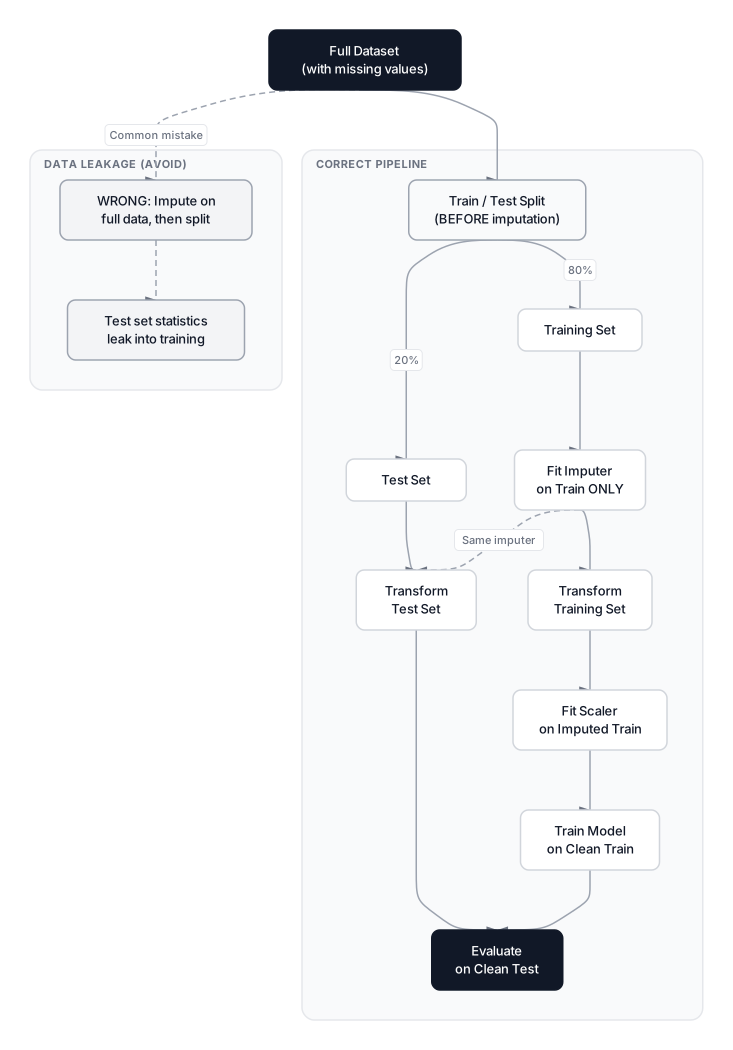 Click to expandLeakage-free imputation pipeline showing correct train/test split before imputer fitting
The correct workflow:
- Split data into train and test sets.
- Fit the imputer on the training set only.
- Transform both train and test using that fitted imputer.
- Fit the scaler on the imputed training set.
- Train the model on clean training data.
Scikit-learn's Pipeline enforces this automatically. Each step's .fit() runs only on training data during cross_val_score or .fit() calls:
Total missing values: 374 / 2500 (15.0%)

5-Fold CV Accuracy:
  No missing (baseline): 0.9840 +/- 0.0136
  Mean imputation:       0.9200 +/- 0.0179
  MICE imputation:       0.9680 +/- 0.0133
With 15% missingness across all features, mean imputation drops accuracy from 98.4% to 92.0%, a loss of 6.4 percentage points. MICE recovers most of that gap, reaching 96.8%. The difference between 92% and 96.8% on a loan approval model processing thousands of applications daily translates directly to revenue and risk exposure.
Common Pitfall: Never call imputer.fit_transform(X) on the full dataset before splitting. Even if your validation score looks great, you've contaminated the evaluation. Use Pipeline or manually fit on training data only.
Handling Categorical Missing Data
Categorical features need different treatment. You can't compute a "mean" of Red, Blue, and Green. Two practical strategies dominate.
Mode imputation replaces missing values with the most frequent category. This is the categorical equivalent of mean imputation, with the same drawback: it over-represents the dominant class if missingness is high.
Treating "Missing" as its own category is often the smarter choice. If applicants who hide their employment type are systematically different (perhaps self-employed workers avoiding the standard categories), a "Missing" label lets the model learn from the missingness pattern. This is particularly valuable when missingness is informative (MNAR).
# Mode imputation for categorical
from sklearn.impute import SimpleImputer

cat_imputer = SimpleImputer(strategy='most_frequent')

# Or: treat missingness as a category (often better)
df['employment_type'] = df['employment_type'].fillna('Unknown')
Pro Tip: Combine categorical indicator encoding with imputation. Add a binary column income_was_missing alongside your imputed income value. This gives the model two signals: the best-guess income and the fact that it was guessed. Random forests and XGBoost pick up on missingness indicators effectively.
When to Use Each Strategy
Choosing the right imputation method depends on the missingness mechanism, dataset size, and computational budget. This decision table covers the most common scenarios.
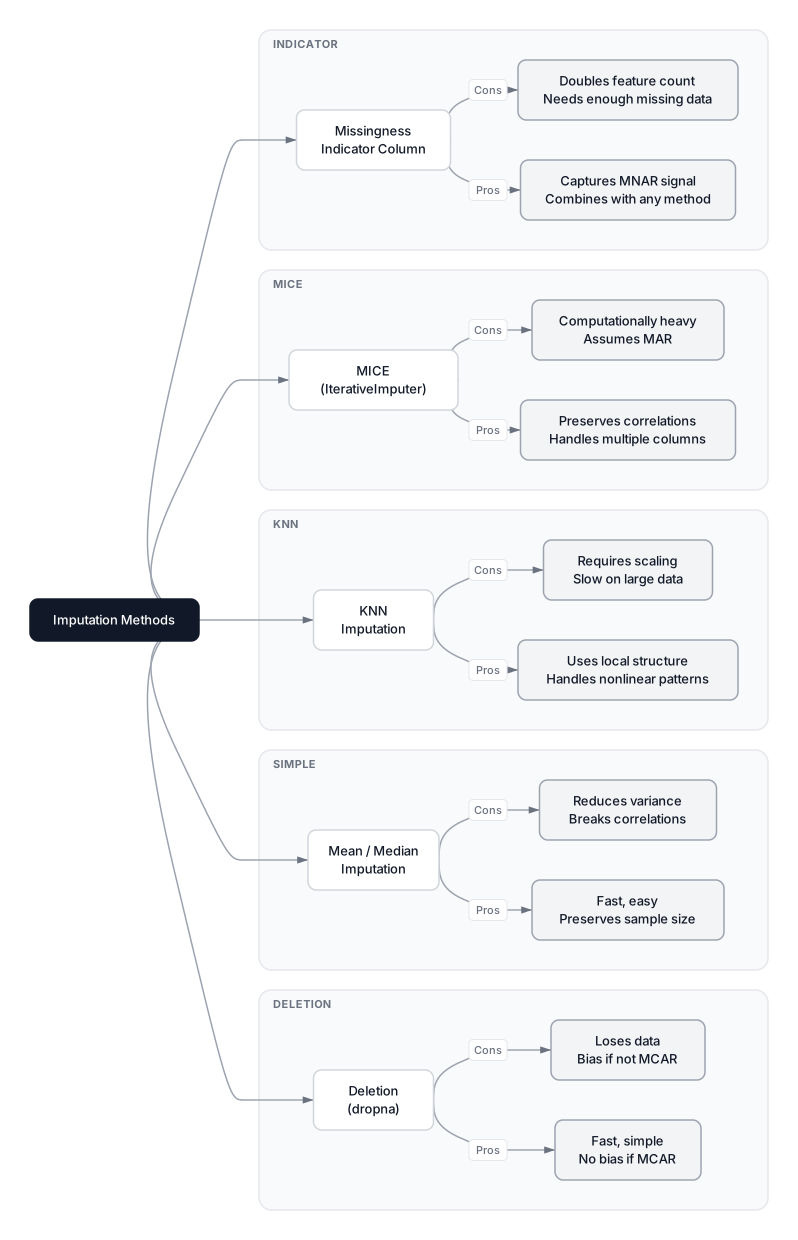 Click to expandComparison of imputation methods with pros and cons for each strategy
| Strategy | Speed | Variance Preserved | Correlations Preserved | Best For |
|---|---|---|---|---|
| Deletion | Instant | N/A (rows removed) | N/A | MCAR, < 5% missing |
| Mean/Median | Fast | Low | Low | Unimportant features, baselines |
| KNN | Medium-High | High | Small/medium data, clustered features | |
| MICE | High | High | Correlated tabular data (default choice) | |
| Missingness indicator | Fast | N/A (additive) | N/A | MNAR, combine with any method |
Decision framework:
- Is missingness < 5% and confirmed MCAR? Delete rows.
- Is the feature unimportant to the model? Use mean/median.
- Is the dataset small enough for pairwise distances (< 50K rows)? Try KNN.
- Do features have strong correlations? Use MICE.
- Is the missingness informative (MNAR)? Add indicator columns alongside imputation.
Production Considerations
Computational Complexity
Mean imputation is per column. KNN imputation is because it computes pairwise distances across samples and features. For a dataset with 100K rows and 50 features, that's 500 billion distance calculations, which can take minutes.
MICE scales as for linear estimators like BayesianRidge. With max_iter=10 and 50 features, that's 500 regression fits. Each fit is for linear regression, making the total . Still feasible for datasets under 1M rows, but switch to RandomForestRegressor with caution at scale.
Memory Requirements
KNN imputation with scikit-learn stores the full distance matrix in memory: . For 100K rows at 8 bytes per float, that's 80 GB. At this scale, switch to approximate nearest neighbor methods or chunk the computation.
Scaling Tips
- KNN at scale: Use
n_neighbors=3instead of 5 to reduce computation. Or use batch-wise imputation: fit the imputer on a representative sample, then transform the full dataset. - MICE at scale: Reduce
max_iterfrom 10 to 3. Azur et al. (2011) showed that convergence often happens within 5 iterations for most datasets. - Production inference: Fit the imputer once on training data and serialize it with
joblib.dump(). At inference time, call.transform()only, which is fast for all methods. - Monitoring: Track the percentage and pattern of missing values in incoming data. A sudden spike in missingness for a specific feature signals a data pipeline issue, not a modeling problem.
Conclusion
Missing data handling sits at the intersection of statistics and engineering. The mechanism of missingness (MCAR, MAR, or MNAR) determines which strategies are valid. Mean imputation is fast but destroys variance and correlations. KNN and MICE preserve the statistical structure of your data, with MICE being the strongest general-purpose choice for correlated tabular features.
The most critical rule is also the simplest: impute after you split. Fitting an imputer on the full dataset before train/test separation leaks test information into training. Scikit-learn's Pipeline makes this automatic and protects against a mistake that inflates accuracy by several percentage points.
For a deeper understanding of how imputation choices affect model evaluation, see our guide on cross-validation. If you're working with the bias-variance tradeoff in your models, remember that bad imputation adds bias while noisy imputation adds variance. Getting it right is the first step toward a model you can trust in production.
Frequently Asked Interview Questions
Q: Your dataset has 30% missing values in one column. Walk me through your decision process for handling it.
First, I'd diagnose the mechanism. Compare observed features between the missing and non-missing groups using a t-test or chi-square test. If there's no significant difference, it's likely MCAR and deletion is theoretically valid, but 30% deletion wastes too much data. For MAR, I'd use MICE with BayesianRidge since it preserves correlations. For MNAR, I'd add a missingness indicator column alongside the imputation. Regardless of mechanism, I'd validate by comparing model accuracy with and without imputation on a held-out test set.
Q: Why is mean imputation dangerous even though it preserves the sample mean?
Mean imputation preserves the first moment (mean) but distorts the second moment (variance) and all joint relationships. Every imputed value equals the mean exactly, creating a spike in the distribution that doesn't exist in reality. This shrinks variance, weakens correlations between features, and makes confidence intervals artificially narrow. The model becomes overconfident in predictions near the mean, which is exactly the region where most predictions land.
Q: Explain the difference between MCAR and MAR with a concrete example.
Consider a hospital survey. MCAR: the survey printer jams and loses random pages, so blood pressure readings are randomly missing. MAR: older patients skip the survey more often, so blood pressure is missing more for elderly patients. If we have age in our data, we can account for this. The critical distinction is that MAR missingness can be explained by other variables we observe, while MCAR cannot be explained by anything.
Q: How does data leakage occur during imputation, and how do you prevent it?
Leakage happens when you fit the imputer on the full dataset before train/test splitting. The imputer's learned parameters (the mean value, the neighbor structure, or the regression coefficients) contain information from the test set. For example, the column mean includes test set values, so every imputed training value is "informed" by test data. The fix is simple: fit the imputer on training data only, then call .transform() on both train and test. Use sklearn.pipeline.Pipeline to enforce this automatically.
Q: When would you choose KNN imputation over MICE?
KNN works best when features form natural clusters in the data and the relationships between features are potentially nonlinear. It requires no distributional assumptions and can capture local patterns that linear MICE misses. However, KNN scales poorly (quadratic in sample count) and requires feature scaling. I'd choose KNN for datasets under 50K rows with clear cluster structure. For larger datasets or when features have strong linear correlations, MICE with BayesianRidge is more efficient and equally accurate.
Q: Your model accuracy drops significantly when you switch from validation to production. Missing data handling is suspected. What do you investigate?
Three things. First, check if the production data has a different missingness rate or pattern than the training data. A feature that was 5% missing during training might be 40% missing in production due to a data pipeline change. Second, check if the missingness mechanism shifted. Training data might have MCAR missingness while production data has MAR or MNAR patterns. Third, verify that the imputer was fit on training data and serialized correctly, not refit on new data each time.
Q: Should you impute target values (the label column)? Why or why not?
Generally, no. Imputing the target variable and then training on those imputed labels treats your guesses as ground truth. The model learns to fit the imputer's predictions rather than real outcomes, which introduces systematic bias. Drop rows with missing targets instead. The exception is semi-supervised learning, where you explicitly model the uncertainty around missing labels, but that requires specialized algorithms, not simple imputation.
Hands-On Practice
See for yourself why mean imputation is dangerous and how MICE preserves data integrity. We'll introduce missing values into clean data and watch what happens to the distribution.
Dataset: ML Fundamentals (Loan Approval) We'll artificially introduce missing values to compare imputation strategies.
Try this: Change MISSING_RATE to 0.40 and see how the spike gets worse!