
Your model hits 95% accuracy on your test set. You deploy it on Monday. By Wednesday, performance has cratered to 62%, and your Slack channel is on fire. The algorithm wasn't the problem. The data split was.
Data splitting is the most consequential decision in any machine learning pipeline, yet most practitioners treat it as a one-liner they copy from a tutorial. How you partition your data determines whether your evaluation metrics reflect reality or a comfortable illusion. Get it wrong, and every number you compute downstream is meaningless. Get it right, and you'll catch problems before they reach production.
This guide covers the complete taxonomy of splitting strategies: three-way partitions, data leakage prevention, stratified splits for imbalanced classes, chronological splits for time series, and group-aware splits for clustered data. We'll use a single housing price dataset throughout every example, running in scikit-learn 1.8 (the current stable release as of March 2026).
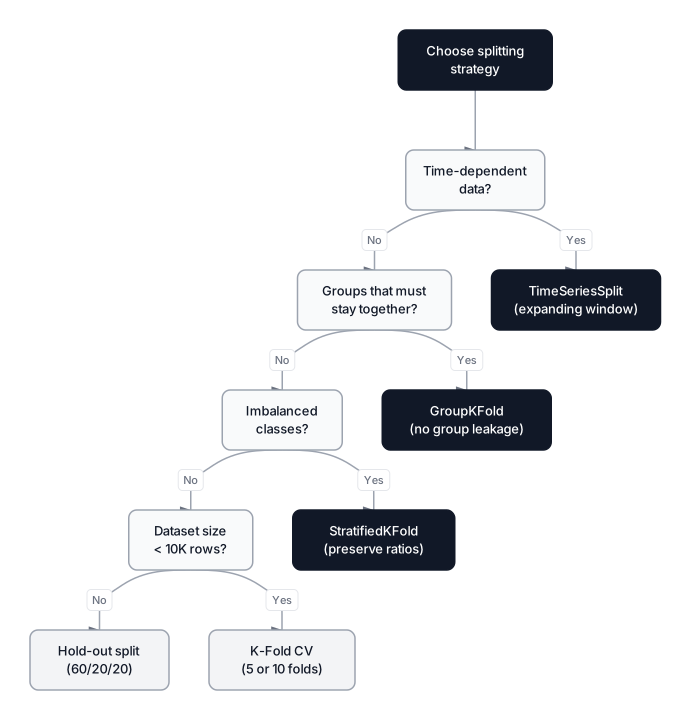 Click to expandData splitting strategies decision tree for choosing the right split method
The Three-Way Split: Train, Validation, and Test
A three-way split partitions your dataset into three non-overlapping subsets: a training set where the model learns parameters, a validation set where you tune hyperparameters, and a test set that provides a final, unbiased performance estimate.
Most tutorials show a simple 80/20 train/test split. This works for homework assignments but falls apart in practice. The moment you evaluate multiple hyperparameter configurations against that test set and pick the best one, you've optimized for that specific slice of data. Your "test" set has become a second validation set, and you no longer have a genuine estimate of out-of-sample performance.
The fix is straightforward: split three ways.
- Training set (60%) teaches model parameters (weights, coefficients, tree structures).
- Validation set (20%) provides feedback during hyperparameter tuning. You iterate here freely.
- Test set (20%) stays sealed until your final evaluation. You touch it exactly once.
Key Insight: If you look at test set results and then go back to adjust your model, the test set effectively becomes a validation set. You've lost your only honest performance estimate.
The Math Behind Generalization Error
The goal of splitting data is to approximate the generalization error , the expected error on data the model has never encountered (a concept formalized in Mosteller and Tukey's 1968 paper on cross-validation and extended by the Vapnik-Chervonenkis theory).
Where:
- is the error measured on the held-out test set
- is the true generalization error on the entire data distribution
When you select the best model $h^*$ from a set of candidates by optimizing against a validation set, the validation error becomes an optimistic estimate:
Where:
- is the validation error of the selected model
- $h^*$ is the model chosen because it scored best on the validation set
- is the full hypothesis space of candidate models
In Plain English: You're running a talent show and picking the singer who sounds best in the audition room. That audition score will almost always overestimate how well they'll perform at the actual concert, because you selected them partly based on skill and partly based on luck with that particular audience. The test set is the concert — it tells you if the talent is real.
Three-Way Split in Practice
Expected output:
Two-Way Split
  Train: 400 samples | Test: 100 samples

Three-Way Split
  Train: 300 | Val: 100 | Test: 100

Best alpha (chosen on validation): 10.0
  Validation MAE: $15,819
  Test MAE:       $17,242
Notice the test MAE is higher than the validation MAE. This is expected and healthy. The validation score guided our choice of alpha, so it's slightly optimistic. The test set gives us the honest number we'd report to stakeholders.
Choosing the Right Split Ratio
The ideal ratio depends on your dataset size. Larger datasets can afford thinner validation and test slices because even 1% of a million rows gives you 10,000 samples for stable estimates.
| Dataset Size | Recommended Ratio (Train / Val / Test) | Reasoning |
|---|---|---|
| Small (< 5,000) | 60 / 20 / 20 | Need enough val/test samples for stable metrics. Consider cross-validation instead. |
| Medium (5K — 100K) | 70 / 15 / 15 | Standard balance. Most Kaggle competitions live here. |
| Large (> 1M) | 98 / 1 / 1 | 10K test samples are plenty. Maximize training data. |
Pro Tip: For small datasets, skip the fixed validation set entirely and use k-fold cross-validation on the training portion. You'll get a much more stable performance estimate from 5 or 10 folds than from a single 20% validation slice.
Data Leakage: The Silent Model Killer
Data leakage occurs when information from the test or validation set contaminates the training process, creating artificially inflated performance metrics that evaporate in production.
The most common form is preprocessing leakage: fitting a scaler, encoder, or feature selector on the entire dataset before splitting. This leaks statistical properties of the test data (mean, variance, feature importance) into the training pipeline. The model quietly memorizes information it should never have seen.
But scaling leakage is just the mild version. Feature selection leakage is far more dangerous. When you run SelectKBest on the full dataset, you're choosing features that correlate with all labels, including test labels. This inflates accuracy dramatically, especially on high-dimensional data.
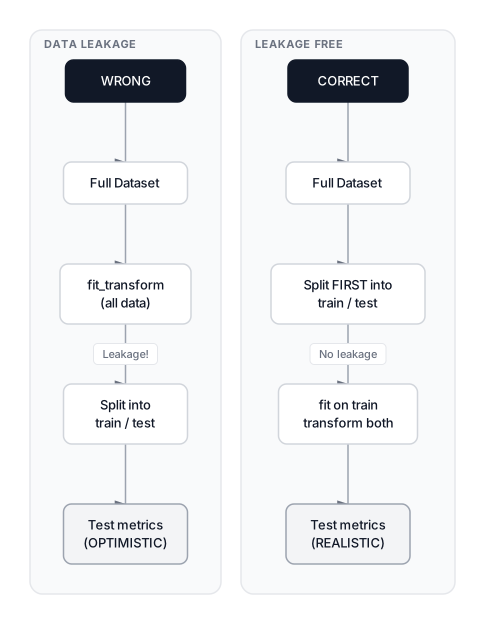 Click to expandData leakage comparison showing correct vs incorrect preprocessing pipelines
Feature Selection Leakage in Action
Expected output:
Feature Selection Leakage (200 samples, 50 features)
  Leaked pipeline accuracy:  0.800  (INFLATED)
  Clean pipeline accuracy:   0.683  (HONEST)
  Difference:                +0.117

  Selected features (leaked):  10
  Selected features (clean):   10
An 11.7 percentage point inflation. The leaked pipeline picked features that happened to correlate with test labels, giving you a model that looks much better than it actually is. In production, you'd see the honest 68.3% number and wonder what went wrong.
Common Pitfall: Leakage isn't limited to scaling and feature selection. Target encoding, oversampling (SMOTE), outlier removal, and imputation all leak if applied before splitting. The rule is absolute: split first, preprocess second. Scikit-learn's Pipeline object enforces this automatically and should be your default for any preprocessing chain. See the scikit-learn Pipeline documentation for details.
Common Leakage Sources
| Leakage Type | What Leaks | Impact |
|---|---|---|
| Scaling before split | Test set mean and variance | Low to moderate |
| Feature selection before split | Test set label correlations | High |
| SMOTE/oversampling before split | Synthetic test-like samples in train | High |
| Target encoding before split | Test set target statistics | Very high |
| Time-unaware random split | Future data used to predict past | Very high |
Stratified Splitting for Imbalanced Data
Stratified splitting forces each partition to preserve the original class distribution, preventing random chance from creating test sets with too many or too few minority-class samples.
Consider a fraud detection dataset where 5% of transactions are fraudulent. A random 80/20 split could easily produce a test set with 2% fraud or 8% fraud, depending on the random seed. With stratification, the test set always contains exactly 5% fraud, matching the real-world distribution your model will face.
This matters most for evaluation metrics. A test set with 0% fraud would show 100% accuracy for a model that never predicts fraud. Stratification eliminates this failure mode entirely.
Stratification Eliminates Split Variance
Expected output:
Original class ratio: 0.050  (50 / 1000)

Random splits (20 seeds):
  Min ratio: 0.020  Max ratio: 0.085
  Std dev:   0.0150

Stratified splits (20 seeds):
  Min ratio: 0.050  Max ratio: 0.050
  Std dev:   0.0000

Single stratified split (seed=42):
  Test ratio: 0.050  (10/200)
The random split produced test sets ranging from 2% to 8.5% positive. One seed gives you a test set with barely any positives; another gives you nearly double. Stratification locks every single split at exactly 5.0% with zero variance. For rare classes, this consistency is non-negotiable.
When to Stratify (and When Not To)
| Scenario | Stratify? | Why |
|---|---|---|
| Binary classification, < 20% minority | Yes | Random splits distort rare class evaluation |
| Multi-class with balanced classes | Optional | Small benefit, no harm |
| Regression | No (standard) | stratify only works with categorical targets. For regression, consider binning the target first. |
| Time series | No | Chronological order trumps class balance |
| Multi-label | Use iterative_stratification from skmultilearn | Standard stratify doesn't support multi-label |
Pro Tip: In scikit-learn 1.8, just pass stratify=y to train_test_split. For cross-validation, use StratifiedKFold instead of KFold. It's a one-word change that prevents an entire class of evaluation bugs.
Time Series Splitting: Respecting Temporal Order
Time series data violates the fundamental assumption behind random splitting: that observations are independent and identically distributed (i.i.d.). Stock prices, sensor readings, and monthly sales figures have temporal dependencies. Tomorrow's value depends on today's. Random shuffling destroys this structure and introduces look-ahead bias, where future data leaks into the training set.
The fix is a chronological split. Everything before a cutoff date goes into training; everything after goes into testing. No shuffling, no randomization.
Where:
- is the observation at time
- is the chronological cutoff point
In Plain English: Think of it like a weather forecast. You can only train on yesterday's weather to predict tomorrow's. If you mix in next week's temperatures into your training data, your "forecast" is just reading the answer key.
For rigorous evaluation, scikit-learn provides TimeSeriesSplit, which creates expanding training windows with forward-rolling test windows. This mimics how you'd actually deploy a time series model: retrain on all data up to today, predict next month, retrain again with the new month included, and repeat.
TimeSeriesSplit vs Random KFold
Expected output:
TimeSeriesSplit Folds
-------------------------------------------------------
  Fold 1: Train months [0- 19] -> Test months [ 20- 39]  MAE: $16,889
  Fold 2: Train months [0- 39] -> Test months [ 40- 59]  MAE: $12,232
  Fold 3: Train months [0- 59] -> Test months [ 60- 79]  MAE: $11,821
  Fold 4: Train months [0- 79] -> Test months [ 80- 99]  MAE: $10,957
  Fold 5: Train months [0- 99] -> Test months [100-119]  MAE: $8,554

Average MAE with random KFold:     $10,102  (OVEROPTIMISTIC)
Average MAE with TimeSeriesSplit:  $12,091  (HONEST)
Random KFold reports $10,102 MAE because future months leak into the training set. The model sees month 100 prices during training and "predicts" month 50 — that's not forecasting, it's cheating. TimeSeriesSplit gives the honest $12,091 figure that actually reflects how the model would perform in deployment.
Notice how MAE decreases as training windows expand. More historical data means better forecasts, which is exactly what you'd expect in production.
 Click to expandTime series splitting with expanding training windows and forward-rolling test sets
Group-Based Splitting for Clustered Data
Group-based splitting ensures that all observations belonging to the same logical entity (a patient, customer, sensor, or geographic region) stay together in the same partition. Without it, the model can memorize entity-specific patterns and appear to generalize when it's actually just recognizing familiar faces.
Consider our housing dataset. Multiple houses in the same neighborhood share characteristics: school quality, crime rates, walkability scores. If houses from the same neighborhood appear in both training and test sets, the model learns "neighborhood X has high prices" rather than learning the actual relationship between features and prices. In production, it'll face neighborhoods it's never seen and fail.
This is the same problem that plagues medical imaging studies. If a patient has 10 X-rays and 7 land in training while 3 land in testing, the model may learn to recognize the patient's rib structure rather than the pneumonia. It scores perfectly on the test set for the wrong reason.
GroupKFold: Zero Overlap Guarantee
Expected output:
Total houses: 458
Unique neighborhoods: 50
  Fold 1: 40 train neighborhoods, 10 test neighborhoods, overlap: 0, MAE: $90,330
  Fold 2: 40 train neighborhoods, 10 test neighborhoods, overlap: 0, MAE: $89,308
  Fold 3: 40 train neighborhoods, 10 test neighborhoods, overlap: 0, MAE: $92,389
  Fold 4: 40 train neighborhoods, 10 test neighborhoods, overlap: 0, MAE: $99,746
  Fold 5: 40 train neighborhoods, 10 test neighborhoods, overlap: 0, MAE: $124,728

GroupKFold average MAE: $99,300
Every fold shows zero overlap. No neighborhood appears in both training and testing. The MAE is high because the model must generalize to entirely unseen neighborhoods, each with its own base price. That's the honest metric. A random split (ignoring groups) would report lower MAE because the model would partly memorize neighborhood effects.
Common Pitfall: Group leakage is especially dangerous because it inflates metrics silently. Your accuracy looks great, your stakeholders are happy, and the model ships. It's only after deployment that you discover the model can't handle unseen groups. Always ask: "Does my data have a natural grouping structure?" If yes, split by group.
When to Use Each Splitting Strategy
Not every dataset needs the same treatment. Here's a decision framework.
| Your Data Looks Like | Strategy | scikit-learn Class |
|---|---|---|
| i.i.d., balanced classes | Random split or KFold | train_test_split, KFold |
| i.i.d., imbalanced classes | Stratified split | train_test_split(stratify=y), StratifiedKFold |
| Temporal ordering matters | Chronological split | TimeSeriesSplit |
| Multiple observations per entity | Group split | GroupKFold, GroupShuffleSplit |
| Imbalanced + grouped | Stratified group split | StratifiedGroupKFold (added in scikit-learn 1.1) |
| Small dataset (< 1,000 rows) | Cross-validation (no fixed test set) | RepeatedStratifiedKFold |
When NOT to Split This Way
Some situations require approaches beyond standard splitting:
- Online/streaming data: You don't split at all. You evaluate with prequential (test-then-train) evaluation, where each new batch is tested before being added to training.
- Geographic data: Random splits ignore spatial autocorrelation. Nearby locations are correlated, so you need spatial cross-validation (e.g., scikit-learn's spatial Group splits or the
sklearn_extralibrary). - Multi-modal data: If images and text describe the same entity, you must group-split by entity, not by modality.
The Production-Ready Splitting Pipeline
Putting it all together, here's a complete pipeline that combines stratification, proper preprocessing isolation, and cross-validation on the development set before a final test evaluation.
Expected output:
Production-Ready Pipeline
  Dataset: 800 samples, 10% positive class
  Dev set: 640 | Test set: 160

  Best C from 5-fold CV: 1.0
  Mean CV accuracy:      0.969
  Final test accuracy:   0.969

  Test set class ratio:  0.100 (matches original 0.100)
The CV accuracy and test accuracy match closely because we didn't leak and we stratified properly. The test class ratio exactly matches the original distribution. This is a pipeline you can ship to production with confidence.
 Click to expandComplete ML pipeline showing split-first preprocessing with cross-validation
Designing the Split Before Training
Data splitting is the first line of defense between your model's performance metrics and reality. Every technique covered here addresses the same core question: "Are my numbers honest?" Three-way splits prevent validation optimism. Leakage prevention stops information from flowing backward in your pipeline. Stratification keeps rare classes properly represented. Temporal splits respect the arrow of time. Group splits prevent entity memorization.
The mechanics are simple. Scikit-learn gives you train_test_split, StratifiedKFold, TimeSeriesSplit, and GroupKFold for every scenario you'll encounter. The discipline is harder: always split before preprocessing, always hold out a sealed test set, and always ask whether your data has structure that a random shuffle would destroy.
If your dataset is small, don't trust a single split. Use cross-validation to average across multiple folds and reduce variance. If your model performs brilliantly on the test set but fails in production, revisit the split. You may be facing a bias-variance tradeoff issue, or your test set may not represent the real-world distribution. And when evaluating classifiers on imbalanced data, pair proper splitting with the right metrics to avoid accuracy illusions.
The best model in the world is worthless if you can't measure it honestly. Split your data correctly, and every decision you make afterward stands on firm ground.
Frequently Asked Interview Questions
Q: Why do we need a separate validation set when we already have a test set?
The test set gives you a single, unbiased estimate of final performance. But you can't use it for tuning, because every time you evaluate against it and adjust your model, you're fitting to that specific data slice. The validation set absorbs all the "peeking" during hyperparameter search, keeping the test set clean for the one-shot final evaluation.
Q: You scale your features before splitting the data. Your model achieves 94% accuracy in development but 81% in production. What went wrong?
Scaling before splitting causes data leakage. The scaler's mean and variance include test set statistics, so the model implicitly knows the distribution of unseen data. In production, it encounters a distribution it hasn't been trained on. The fix is to fit the scaler only on training data and transform the test set with those parameters.
Q: When would you use TimeSeriesSplit instead of standard KFold?
Any time your data has temporal ordering where future values depend on past values: stock prices, weather, user activity over time, sensor data. Standard KFold shuffles observations and can place future data in training and past data in testing, creating look-ahead bias. TimeSeriesSplit enforces chronological ordering so you only ever predict forward in time.
Q: Your team trains a skin cancer classifier and reports 97% accuracy. Each patient contributed multiple images. What concern would you raise?
If patient images are split randomly across train and test sets, the model may learn patient-specific features (skin tone, mole patterns, camera angle) rather than actual cancer markers. This is group leakage. You'd recommend splitting by patient ID using GroupKFold so that all images from a given patient stay in the same partition. The honest accuracy will likely be lower but more trustworthy.
Q: How would you handle splitting for a dataset with only 300 samples?
With 300 samples, a single 80/20 split gives you only 60 test samples, which produces unstable metrics. Use repeated stratified k-fold cross-validation (e.g., RepeatedStratifiedKFold with 5 folds and 3 repeats) to get 15 different evaluation scores. Report the mean and standard deviation to quantify uncertainty, which matters far more than a single point estimate from a tiny test set.
Q: What is the difference between StratifiedKFold and StratifiedGroupKFold?
StratifiedKFold preserves class proportions across folds but ignores group structure. StratifiedGroupKFold does both: it keeps class ratios balanced while ensuring no group appears in multiple folds. Use the group variant when your data has both class imbalance and entity-level clustering, like multiple loan applications per customer where approval rates are skewed.
Q: Your model's cross-validation score is 0.92, but the held-out test score is 0.85. Is this a problem?
A gap between CV and test scores is expected, since CV selects the best hyperparameters using the same data that produced those scores. A 0.07 gap is moderate but worth investigating. Check whether the test set distribution differs from the training distribution (covariate shift), whether you have leakage in the CV loop, or whether you're simply overfitting to the validation folds by searching too many hyperparameter combinations.
Hands-On Practice
Now let's put theory into practice. You'll experiment with different data splitting strategies, see how data leakage contaminates your results, and understand why stratification matters for imbalanced datasets. By the end, you'll have built a proper leak-free ML pipeline.
Dataset: ML Fundamentals (Loan Approval) A loan approval dataset with class imbalance - perfect for demonstrating proper train/validation/test splits, data leakage prevention, and stratified splitting techniques.
Experiment with different random seeds to see how stratification keeps class ratios stable. Try removing stratification from the three-way split to see how it affects your results on imbalanced data.