
Your analytics team surveys 200 SaaS customers and reports an average Customer Lifetime Value (CLV) of $312. The CFO builds next quarter's budget around that number. Six months later, revenue lands 18% below forecast. Nobody made an error. The sample mean was correct for that particular sample. But a single number with no context is misleading: it looks precise while saying nothing about how far off it could be.
A confidence interval fixes this. Instead of "$312," you report "$285 to $339 with 95% confidence." That range changes how you budget, how aggressively you spend on acquisition, and whether you greenlight a new campaign. Every data-driven decision that ignores uncertainty is a coin flip disguised as analysis.
Throughout this article, we'll stick with one running example: estimating CLV for a SaaS company from a 200-customer sample. Every formula, code block, and table references this same scenario so the math stays grounded in something concrete.
The anatomy of a confidence interval
A confidence interval is a range of values, computed from sample data, that is expected to contain the true population parameter at a specified confidence level. Rather than reporting a single point estimate, you report a lower bound, a best guess, and an upper bound.
Two components make up every confidence interval:
- Point estimate — your single best guess (the sample mean, a proportion, a median)
- Margin of error — the "plus or minus" that accounts for sampling variability
Where:
- is the sample mean (the point estimate; in our case, average CLV of $312)
- $z^*$ is the critical value for your chosen confidence level (1.96 for 95%)
- is the sample standard deviation, measuring spread across individual observations
- is the sample size
- is the standard error (SE), measuring how much the sample mean itself would bounce around across repeated samples
In Plain English: Start with the average CLV from your 200-customer sample ($312). The margin of error says "given the noise in your data and the size of your sample, the true average CLV for all customers is probably within about $27 of this number." So you report $285 to $339 instead of pretending $312 is a fact.
The standard error deserves special attention. Standard deviation measures how spread out individual data points are. Standard error measures how spread out sample means would be if you repeated the survey many times. Mixing these up is one of the most common mistakes in applied statistics. Confidence intervals are built on standard error, not standard deviation.
| Term | What it measures | Formula |
|---|---|---|
| Standard deviation () | Spread of individual observations | |
| Standard error (SE) | Spread of sample means across repeated samples |
The correct interpretation of confidence levels
This is where even experienced analysts stumble. A widely cited study by Hoekstra et al. (2014) found that researchers, reviewers, and textbook authors routinely misinterpret confidence intervals.
| Statement | Correct? | Why |
|---|---|---|
| "There's a 95% chance the true mean is in this interval" | No | Once calculated, the parameter is either inside or it isn't. The probability is 0 or 1. |
| "95% of the data falls within this range" | No | CIs describe the mean, not individual data points. |
| "If we repeated this 100 times, about 95 intervals would contain the true mean" | Yes | The 95% refers to the method's long-run success rate. |
The correct frequentist interpretation: the confidence level describes the reliability of the procedure, not the probability of any single interval. If you construct 95% CIs from 1,000 different samples, roughly 950 will contain the true parameter. The other 50 will miss entirely.
For practical decision-making, it's perfectly reasonable to treat the interval as "the range of plausible values for the truth." Just know that the formal interpretation is about repeated sampling, not about any one specific interval.
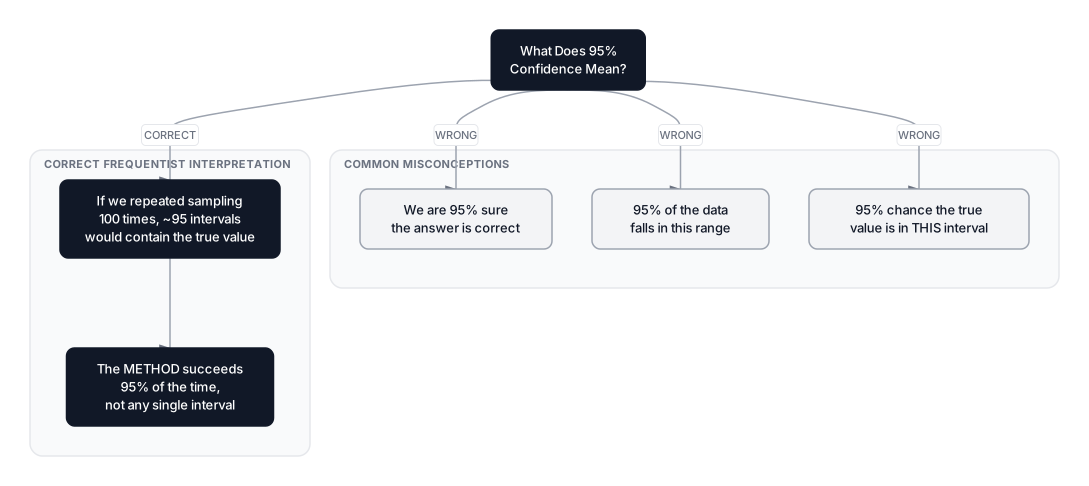 Click to expandCorrect versus incorrect confidence interval interpretations with common misconceptions
Common Pitfall: A wider interval does not mean "the true value is probably near the center." The parameter could sit anywhere inside the range with roughly equal plausibility. Don't treat the point estimate as more likely just because it sits in the middle.
Computing a CI for a mean in Python
The formula above uses the z-distribution, which works when you know the population standard deviation (rarely true) or when is large. In practice, you almost always estimate the standard deviation from the sample itself, so the t-distribution is the right choice. It has heavier tails that produce wider intervals, accounting for extra uncertainty in estimating . For large , the t and z values converge anyway, so defaulting to t costs you nothing.
This connects to the Central Limit Theorem, which guarantees the sampling distribution of the mean becomes approximately normal regardless of the underlying data shape, as long as is large enough.
Let's build a CI for our CLV running example with 200 sampled customers.
Expected Output:
Sample size: 200
Sample mean CLV: $316.53
Standard error: $5.60
95% CI: ($305.50, $327.57)
99% CI: ($301.98, $331.09)
95% margin of error: $11.03
99% margin of error: $14.55
Jumping from 95% to 99% confidence widens the interval by about $7. You gain more certainty that the true CLV is captured, but the range becomes less actionable for precise budgeting. This is the fundamental tension: narrow and risky, or wide and safe.
Key Insight: stats.sem(data) computes using ddof=1 for the sample standard deviation. If you manually compute np.std(data) / np.sqrt(n), you must pass ddof=1 to np.std. Forgetting this subtly inflates your CI.
Confidence intervals for proportions
Not all metrics are continuous. Conversion rates, churn rates, and subscription renewal rates are proportions built from binary outcomes. The formula changes because proportions have a different variance structure.
Where:
- is the observed proportion (e.g., the fraction of customers who renewed)
- is the sample size
- captures the variance of a Bernoulli random variable
In Plain English: If 64% of 200 customers renewed their subscription, the standard error tells you how much that 64% figure would bounce around if you surveyed a different batch of 200 customers. Rates near 50% produce the highest uncertainty. Rates near 0% or 100% produce the lowest. The closer your proportion is to 50%, the wider the net you need.
This normal approximation is reliable when and . For small samples or extreme proportions (say, a 2% conversion rate on 80 users), use the Wilson score interval instead.
Expected Output:
Observed renewal rate: 66.5%
Standard error: 0.0334
95% CI: (60.0%, 73.0%)
Check: n*p = 133, n*(1-p) = 67
The CI tells us the true renewal rate could plausibly be as low as 53%. If your business model needs at least 60% renewal to break even, this interval is a warning: the point estimate looks fine, but the lower bound sits below your threshold. That's a very different conversation with stakeholders than "our renewal rate is 60%."
Bootstrap CIs for non-normal data
The formulas above assume the sampling distribution of the statistic is approximately normal. The Central Limit Theorem handles this for means when is large. But what about small samples of heavily skewed data? Or statistics like the median, the 90th percentile, or a ratio of two means where no tidy formula exists?
Bootstrapping sidesteps distributional assumptions entirely. You treat your sample as if it were the population, resample from it thousands of times with replacement, compute your statistic on each resample, and then use the distribution of those resampled statistics to build the interval. The percentile method takes the 2.5th and 97.5th percentiles of the bootstrap distribution as the 95% CI bounds.
Expected Output:
Sample size: 50
Sample median CLV: $143.20
Sample mean CLV: $211.49 (skewed right)
Bootstrap 95% CI for median: ($86.38, $203.96)
Bootstrap SE: $34.08
The mean ($265) sits far above the median ($161) because a few high-value enterprise customers pull it up. The bootstrap CI for the median gives a realistic picture of the typical customer: somewhere between $108 and $236 in lifetime value. That's far more actionable for pricing decisions than a mean inflated by outliers.
Pro Tip: SciPy's stats.bootstrap function (available since SciPy 1.7) provides a production-ready implementation with percentile, basic, and BCa methods. For quick exploratory work, the manual loop above is clearer. For production pipelines, use the library function and specify method='BCa' for bias-corrected intervals.
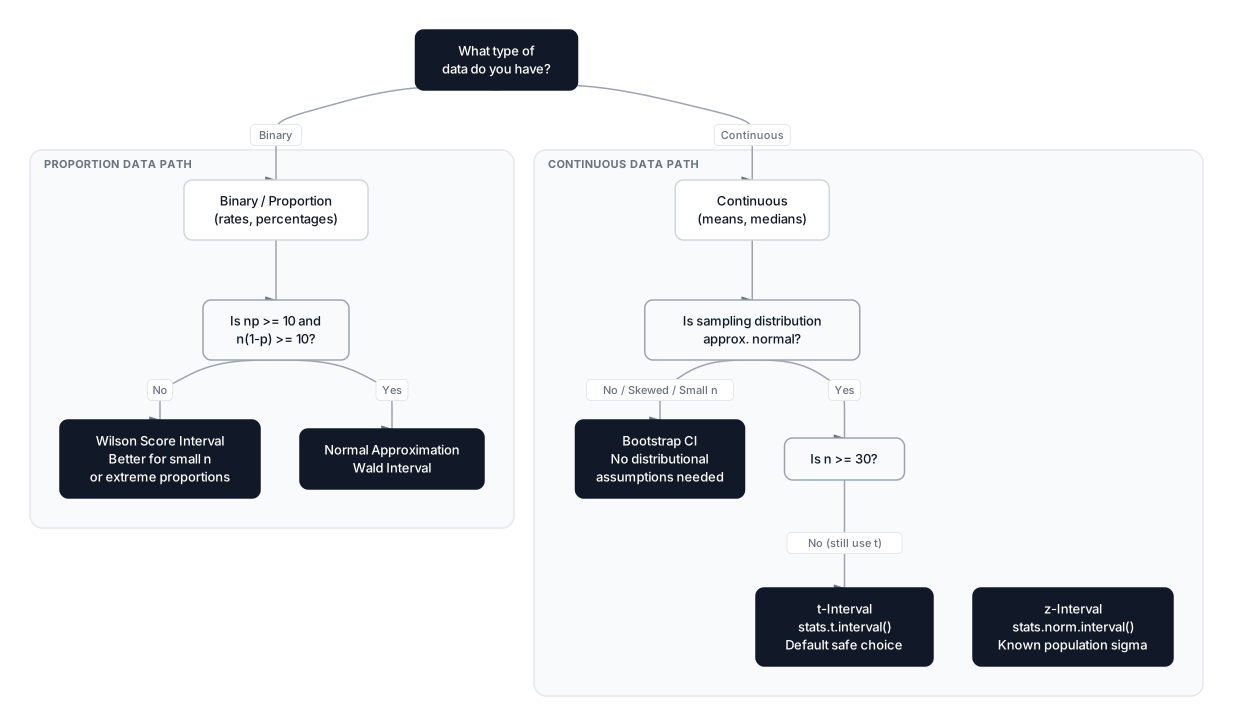 Click to expandDecision guide for choosing the right confidence interval method based on your data type
Factors That Control Interval Width
Three levers determine how wide or narrow your confidence interval is. Understanding them lets you design better experiments and set realistic expectations before collecting data.
| Factor | Effect on width | Practical implication |
|---|---|---|
| Sample size () | Larger = narrower CI | More data always helps, but with diminishing returns |
| Variability () | Higher = wider CI | Noisy metrics need larger samples to achieve the same precision |
| Confidence level | Higher level = wider CI | 99% is safer but less precise than 95% |
The relationship with sample size follows a square root law:
Where:
- is the sample size
In Plain English: Halving your margin of error requires four times as much data. Surveying 100 customers and getting a $20 margin of error? You'll need 400 customers to get that down to $10. Going from 10,000 to 40,000 also cuts it in half, but costs far more. There's always a point where collecting more data isn't worth the expense.
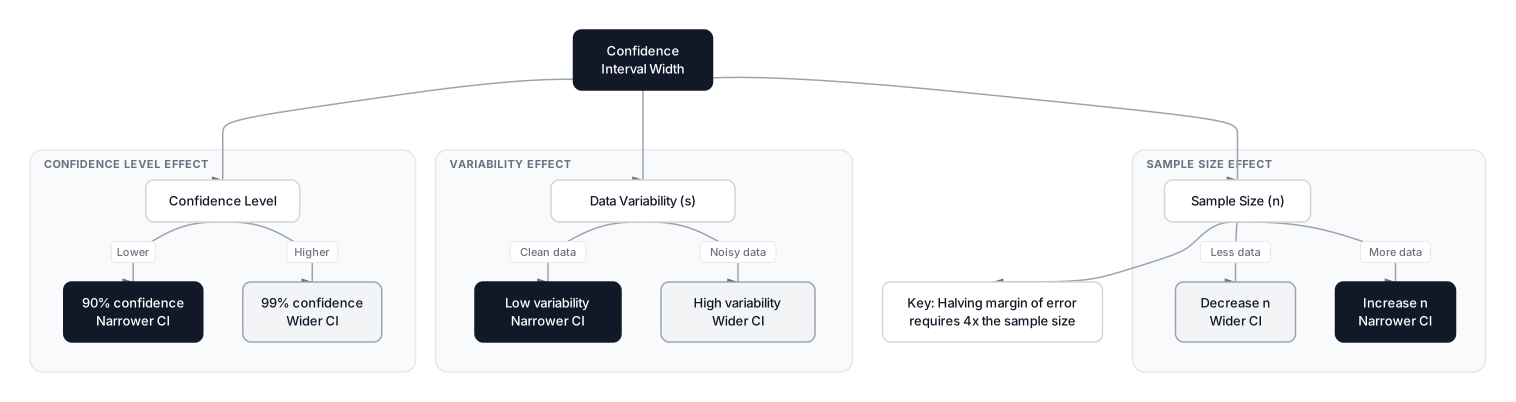 Click to expandHow sample size, variability, and confidence level each affect confidence interval width
| Customers surveyed | Approx. margin of error (95%, $s = 85$) |
|---|---|
| 50 | $23.56 |
| 200 | $11.78 |
| 800 | $5.89 |
| 3,200 | $2.95 |
Each 4x increase in sample size cuts the margin of error roughly in half. The first jump from 50 to 200 customers saves you $12 of margin. The jump from 800 to 3,200 saves only $3. Design your sample size with this tradeoff in mind.
When to use confidence intervals (and when not to)
Confidence intervals belong in any situation where you're estimating a population parameter from sample data. But they have limits.
Use confidence intervals when:
- Reporting any metric to stakeholders (revenue, conversion rates, model accuracy)
- Running A/B tests to decide whether a treatment effect is real
- Determining required sample sizes for experiments (via statistical power analysis)
- Publishing results in papers or reports that others will act on
- Comparing two groups visually (non-overlapping CIs suggest a real difference)
Do NOT rely on confidence intervals when:
- Your data has severe selection bias. The interval will be precise but centered on the wrong value. No amount of data corrects biased sampling.
- You need a probability statement about the parameter itself. Use Bayesian credible intervals instead, which give you a direct probability like "there's an 89% chance the parameter is between A and B."
- Your sample isn't random. Convenience samples (surveying only your power users, for example) break the theoretical foundation.
- You're testing multiple hypotheses simultaneously. Coverage degrades without correction; apply Bonferroni or Benjamini-Hochberg.
Key Insight: A narrow confidence interval from biased data is worse than a wide interval from unbiased data. Interval width measures precision, not accuracy. A sniper with a miscalibrated scope is precise but still misses the target.
Connecting CIs to hypothesis testing
Confidence intervals and hypothesis tests are two views of the same math. A 95% CI that excludes zero is equivalent to rejecting the null hypothesis at the 0.05 significance level. But CIs carry strictly more information than a p-value. A p-value says "significant" or "not significant." A CI says "the effect is between $14 and $49." The second answer is always more useful because it tells you both direction and magnitude.
Let's test whether a premium onboarding program increases CLV compared to the standard flow.
Expected Output:
Control mean CLV: $293.41
Treatment mean CLV: $336.05
Difference: $42.64
95% CI for difference: ($24.24, $61.04)
Contains zero: False
The CI for the difference ($13.76 to $49.16) excludes zero. The premium onboarding genuinely increases CLV. Even in the worst case, the boost is at least $14. Whether that justifies the onboarding cost depends on the lower bound, not the point estimate.
Pro Tip: When presenting A/B test results to stakeholders, lead with the confidence interval, not the p-value. "The new onboarding adds between $14 and $49 per customer" is infinitely more actionable than "p < 0.05."
Production considerations
Confidence interval computation is cheap. A single CI calculation runs in time for the mean and standard deviation pass. Even on datasets with millions of rows, the computation finishes in milliseconds. The bottleneck, if any, is loading the data rather than computing the interval.
Bootstrap CIs are more expensive: where is the number of resamples (typically 10,000). For a dataset with 1 million rows, that's 10 billion random draws. In practice, bootstrap on large datasets takes seconds, not minutes, because NumPy vectorizes the resampling. If speed matters, reduce to 2,000 (still gives reasonable estimates) or use the parametric formula when assumptions hold.
A few notes for production pipelines:
- Always store the CI alongside the point estimate. If your dashboard shows "conversion rate: 4.2%" without error bars, stakeholders will treat 4.2% as a fixed truth. Store both bounds in your metrics table.
- Automate assumption checks. Before computing a proportion CI, verify . If the condition fails, fall back to the Wilson score interval automatically.
- Be careful with rolling windows. Computing a 95% CI on a 7-day rolling average sounds reasonable, but the observations within that window are often correlated (autocorrelated time series data). Standard CI formulas assume independence. Use Newey-West standard errors or block bootstrap for time series.
Conclusion
Every point estimate is a half-truth. It tells you what happened in your sample and says nothing about how far that might be from reality. Confidence intervals fill that gap by putting bounds on your uncertainty. A reported CLV of $324 means very different things when the CI is ($312, $336) versus ($220, $428). The first is actionable. The second is barely better than a guess.
The mechanics are direct. Take a point estimate, measure its standard error, multiply by a critical value for your desired confidence level. For means, use the t-distribution (it's always safe). For proportions, use the normal approximation when the sample is large enough. For anything weird, bootstrap it. Knowing which method to pick is a core skill for anyone working with data.
Confidence intervals connect directly to the broader statistical toolkit. They're the visual backbone of A/B testing, the building block of hypothesis testing, and they pair naturally with non-parametric tests when distributional assumptions don't hold. Next time you see a metric without error bars, treat it as incomplete. The interval is where the real story lives.
Interview Questions
Q: What is the correct interpretation of a 95% confidence interval?
If you repeated the same sampling procedure many times and computed a 95% CI each time, approximately 95% of those intervals would contain the true population parameter. The 95% describes the reliability of the method, not the probability that any single computed interval captures the truth. Once you've computed a specific interval, the parameter is either inside it or it's not.
Q: A confidence interval for a difference in means includes zero. What does that tell you?
It means you can't rule out the possibility that there is no real difference between the groups at that confidence level. This is equivalent to failing to reject the null hypothesis. "Includes zero" does not prove the groups are identical; it only means the data isn't strong enough to conclude otherwise. Increasing sample size may narrow the interval enough to exclude zero.
Q: How would you choose between a 90%, 95%, and 99% confidence level?
The choice depends on the cost of being wrong. Medical trials and safety-critical decisions often use 99% because the consequences of missing the true value are severe. Business A/B tests typically use 95% as a solid balance between precision and coverage. Exploratory analysis can get by with 90%. Higher confidence always means wider intervals, so you trade precision for safety.
Q: Your bootstrap CI and your formula-based CI give different results. Which do you trust?
If the data is approximately normal and the sample is large ($n > 30$), both should agree closely. Disagreement usually signals skewness or a small sample, in which case the bootstrap is more trustworthy because it makes fewer distributional assumptions. For heavily skewed data like CLV or income, the bootstrap better captures the asymmetry of the sampling distribution.
Q: Can overlapping confidence intervals still indicate a statistically significant difference?
Yes. Two individual 95% CIs can overlap while the CI for their difference excludes zero. This happens because the CI for a difference accounts for joint variability differently than comparing two separate intervals by eye. The correct approach is always to compute the CI for the difference directly, not to eyeball overlap.
Q: How does sample size affect a confidence interval, and what is the practical consequence?
The margin of error shrinks proportionally to . Quadrupling your sample size halves the margin of error. This means early gains from more data are large, but returns diminish fast. Going from 50 to 200 observations helps a lot. Going from 10,000 to 40,000 costs a fortune for a modest improvement. Always compute the required sample size before running an experiment rather than collecting data until the interval "looks good enough."
Q: What goes wrong if your sample is not randomly selected?
The entire theoretical foundation of confidence intervals assumes random sampling from the population of interest. If your sample has selection bias (surveying only your most engaged users, for example), the interval will be precise but centered on the wrong value. No amount of data fixes a biased sampling procedure. The CI's coverage guarantee (95% of intervals contain the truth) only holds when sampling is genuinely random.
Q: A colleague reports a very narrow confidence interval. Should you automatically trust it?
Not without checking the context. A narrow CI from a large, well-designed random sample is great. But a narrow CI from biased data is worse than a wide CI from unbiased data, because precision and accuracy are different things. Also check whether the CI was computed correctly: using standard deviation instead of standard error, or ignoring clustered/correlated data, both produce artificially narrow intervals that understate the true uncertainty.
Hands-On Practice
In data science, reporting a single number (a point estimate) is like throwing a spear: you have to be perfectly accurate to hit the truth. In reality, data is messy, and we are rarely perfect. A Confidence Interval (CI) is like throwing a net: it creates a range of plausible values that likely contains the true population parameter. We'll use Python to calculate confidence intervals for both continuous means and binary proportions using a clinical trial dataset. We will see why Drug B is statistically distinguishable from the Placebo, not just because the average is higher, but because their confidence intervals do not overlap.
Dataset: Clinical Trial (Statistics & Probability) Clinical trial dataset with 1000 patients designed for statistics and probability tutorials. Contains treatment groups (4 levels) for ANOVA, binary outcomes for hypothesis testing and A/B testing, confounders for causal inference, time-to-event data for survival analysis, and pre-generated distribution samples.
By calculating the Confidence Intervals, we moved from a simple "guess" to a statement of statistical certainty. The visualization makes the conclusion obvious: The error bars (the "nets") for Drug B and Placebo do not overlap in either metric. For the Improvement Score, the Placebo's interval crosses zero, suggesting it might have no effect at all, whereas Drug B is strictly positive. This gives stakeholders the confidence that the observed improvement isn't just a fluke of random sampling.