
You're comparing four simulated clinical-trial groups: Placebo, Drug A, Drug B, and Drug C. Before testing every pair, note that the NIST handbook on multiple comparisons explains that repeated pairwise tests do not, in general, preserve the intended overall significance level. ANOVA provides an omnibus test of whether the group means differ.
A natural first instinct is to run t-tests on every pair. Placebo vs. Drug A, Placebo vs. Drug B, Drug A vs. Drug C, and so on. With four groups, that's six separate comparisons. Each test carries a 5% false positive risk, and those risks compound. By the time you finish all six, your chance of declaring a fake finding "significant" has ballooned to 26.5%. Analysis of Variance (ANOVA) solves this by testing all groups in a single step, keeping your error rate exactly at 5%.
This article uses one consistent example throughout: a clinical trial with four treatment groups measuring patient improvement scores. Every formula, every code block, and every diagram ties back to this scenario.
The Family-Wise Error Rate Problem
The family-wise error rate (FWER) measures the probability of making at least one Type I error (false positive) across a set of hypothesis tests. When you run a single test at , you accept a 5% risk of a false alarm. Run multiple tests, and those risks stack up fast.
Where:
- is the family-wise error rate
- is the significance level for a single test (typically 0.05)
- is the number of independent tests performed
In Plain English: Each t-test is like buying a lottery ticket where "winning" means a false positive. One ticket gives you a 5% chance. Six tickets give you a 26.5% chance. Run 50 tests and you're at 92%. ANOVA buys one ticket for the whole family of comparisons.
Expected Output:
  1 tests -> FWER = 5.0%
  3 tests -> FWER = 14.3%
  6 tests -> FWER = 26.5%
 10 tests -> FWER = 40.1%
 20 tests -> FWER = 64.2%
 50 tests -> FWER = 92.3%
For our clinical trial with 4 groups, there are pairwise comparisons. At , we'd have a 26.5% chance of calling at least one pair "significantly different" when no real difference exists. That's unacceptable in a medical context.
ANOVA fixes this by testing a single null hypothesis:
How ANOVA Partitions Variance
ANOVA works by splitting the total variation in your data into two components: variation between group means (the signal you care about) and variation within each group (the noise). If the between-group signal dwarfs the within-group noise, the treatment is likely real.
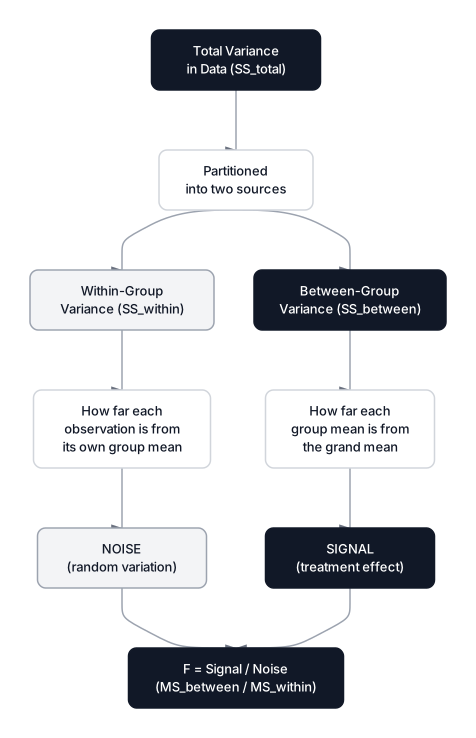 Click to expandANOVA decomposes total variance into between-group signal and within-group noise to compute the F-statistic
The Restaurant Analogy
Picture three tables at a crowded restaurant. At Table A, everyone is whispering about golf. Table B is arguing about politics at full volume. Table C is singing "Happy Birthday."
The within-group variance is how much volume fluctuates at a single table (some people louder, some quieter). The between-group variance is the volume difference across tables. If the between-table contrast is enormous compared to the chatter within each table, you can easily tell the conversations apart. If everyone is mumbling at the same volume, you can't distinguish anything.
ANOVA formalizes this intuition with the F-statistic.
The F-Statistic and ANOVA Table
The F-statistic quantifies the ratio of treatment effect to random noise. It's the core output of every ANOVA test.
Where:
- is the mean square between groups (treatment variance)
- is the mean square within groups (error variance)
- $MS = SS / df$ (sum of squares divided by degrees of freedom)
The Mean Squares are computed from the Sum of Squares:
Where:
- is the number of groups (4 in our trial)
- is the number of observations in group
- is the mean of group
- is the grand mean of all observations
- is observation in group
- is the total sample size across all groups
In Plain English: measures how spread out the four treatment group averages are from each other. If Drug B's average improvement is 8.06 while Placebo's is 1.54, that's a large between-group spread. measures how much individual patients vary within their own group. An F of 1 means the treatment effect is indistinguishable from noise. An F of 43 means the treatment signal is 43 times louder than the noise.
| ANOVA Table Component | Formula | Clinical Trial Meaning |
|---|---|---|
| Variation due to drug differences | ||
| Variation due to patient differences | ||
| $k - 1 = 3$ | Degrees of freedom for 4 groups | |
| $N - k = 216$ | Degrees of freedom for error | |
| Signal-to-noise ratio |
One-Way ANOVA in Python
One-way ANOVA tests whether the means of three or more independent groups differ on a single factor. In our clinical trial, the single factor is the treatment assignment.
Let's build the dataset from scratch and compute the F-statistic both manually and with scipy.stats.f_oneway.
Expected Output:
Group Means:
treatment
Drug_A     4.43
Drug_B     8.06
Drug_C     5.57
Placebo    1.54
Name: improvement, dtype: float64

Grand Mean: 4.75
Total patients: 220

One-Way ANOVA Results:
F-statistic: 43.568
p-value:     4.65e-22
Decision: Reject H0 (p < 0.05)
Interpreting the Results
The group means tell the story immediately. Placebo patients improved by just 1.54 points on average, while Drug B patients improved by 8.06. The F-statistic of 43.568 means the between-group variance is roughly 43 times the within-group variance. The p-value of is astronomically small, far below the 0.05 threshold.
Key Insight: A significant ANOVA result tells you "at least one group is different." It does NOT tell you which specific groups differ. That's what post-hoc tests are for.
ANOVA Assumptions and How to Check Them
ANOVA rests on three assumptions. Violating them can inflate your false positive rate or reduce statistical power. The good news: ANOVA is reasonably tolerant of mild violations when sample sizes are roughly balanced (Keppel & Wickens, 2004).
| Assumption | What It Means | How to Test | What to Do If Violated |
|---|---|---|---|
| Normality | Residuals within each group follow a normal distribution | Shapiro-Wilk test, Q-Q plot | Use Kruskal-Wallis H-test |
| Homogeneity of variance | Groups have similar spread (standard deviations) | Levene's test | Use Welch's ANOVA or Games-Howell post-hoc |
| Independence | Observations are unrelated to each other | Experimental design (not a statistical test) | Use repeated measures ANOVA |
Common Pitfall: Many practitioners skip assumption checks entirely. With small samples or wildly different group sizes, even moderate violations can produce misleading results. Always check.
Expected Output:
Levene Test for Equal Variances:
Statistic: 1.078
p-value:   0.359
Variances are roughly equal (p > 0.05)

Shapiro-Wilk Normality Test (per group):
  Placebo : W=0.988, p=0.823 -> Normal
  Drug_A  : W=0.978, p=0.398 -> Normal
  Drug_B  : W=0.963, p=0.113 -> Normal
  Drug_C  : W=0.929, p=0.003 -> Non-normal
Drug C's Shapiro-Wilk p-value (0.003) flags non-normality. In practice, with 55 observations and a W of 0.929, this is a mild departure. ANOVA is generally tolerant of this when group sizes are similar (Box, 1953). If the violation were severe (extremely skewed data), you'd switch to the Kruskal-Wallis test, the non-parametric cousin of one-way ANOVA.
Post-Hoc Tests: Finding Which Groups Differ
A significant ANOVA tells you something differs, but not where. Post-hoc tests perform pairwise comparisons while controlling the family-wise error rate. The most popular is Tukey's Honestly Significant Difference (HSD), which compares every pair of groups with corrected p-values.
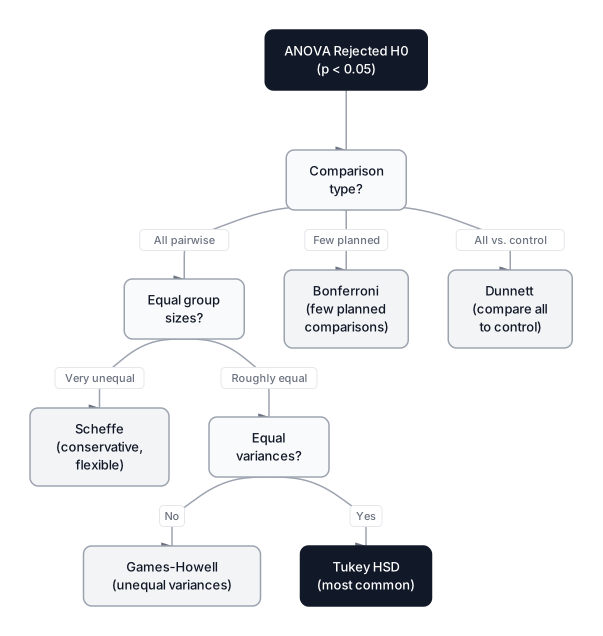 Click to expandPost-hoc test selection guide after a significant ANOVA result
Expected Output:
 Multiple Comparison of Means - Tukey HSD, FWER=0.05
=====================================================
group1  group2 meandiff p-adj   lower   upper  reject
-----------------------------------------------------
Drug_A  Drug_B    3.626    0.0  2.0878  5.1642   True
Drug_A  Drug_C   1.1358 0.2069 -0.3653  2.6369  False
Drug_A Placebo  -2.8933    0.0 -4.3629 -1.4238   True
Drug_B  Drug_C  -2.4902 0.0002 -4.0284  -0.952   True
Drug_B Placebo  -6.5193    0.0 -8.0267 -5.0119   True
Drug_C Placebo  -4.0291    0.0 -5.4987 -2.5596   True
-----------------------------------------------------
Look at the reject column. Five of six pairs show True, confirming significant differences. The exception is Drug A vs. Drug C (p-adj = 0.2069), meaning these two drugs produce statistically indistinguishable improvements. Drug B is the clear winner, outperforming every other group including a 6.52-point advantage over Placebo.
Pro Tip: If your experiment has a natural control group (like Placebo), consider Dunnett's test instead of Tukey. Dunnett compares each treatment against the control only, giving you more statistical power by skipping irrelevant pairwise comparisons like Drug A vs. Drug B.
Two-Way ANOVA: Testing Multiple Factors
Two-way ANOVA extends the analysis to two independent variables simultaneously. Beyond testing each factor's individual effect (main effects), it also tests whether the two factors interact. An interaction means the effect of one factor depends on the level of the other.
In our trial, what if Drug B works dramatically better for male patients but shows little benefit for female patients? A one-way ANOVA would average those results together and might mask the real story. Two-way ANOVA with treatment and gender reveals this hidden pattern.
Where:
- is the improvement score for patient in treatment and gender
- is the grand mean
- is the treatment effect (how much treatment shifts the score)
- is the gender effect (how much gender shifts the score)
- is the interaction term (does treatment work differently for gender ?)
- is random error for the individual patient
In Plain English: A patient's improvement score = overall average + the drug they received + their gender + whether the drug works differently for their gender + random noise unique to that patient.
Expected Output:
Two-Way ANOVA Table:
                           sum_sq     df        F  PR(>F)
C(treatment)            1273.8963    3.0  49.9620  0.0000
C(gender)                309.9131    1.0  36.4642  0.0000
C(treatment):C(gender)   112.9836    3.0   4.4312  0.0048
Residual                1801.8093  212.0      NaN     NaN
All three rows have significant p-values (all below 0.05). The treatment effect is strong (F = 49.96). Gender has a main effect (F = 36.46). Most importantly, the interaction term is significant (F = 4.43, p = 0.0048). This confirms that Drug B's effectiveness depends on the patient's gender, exactly the kind of finding that one-way ANOVA would miss entirely.
When to Use ANOVA (and When Not To)
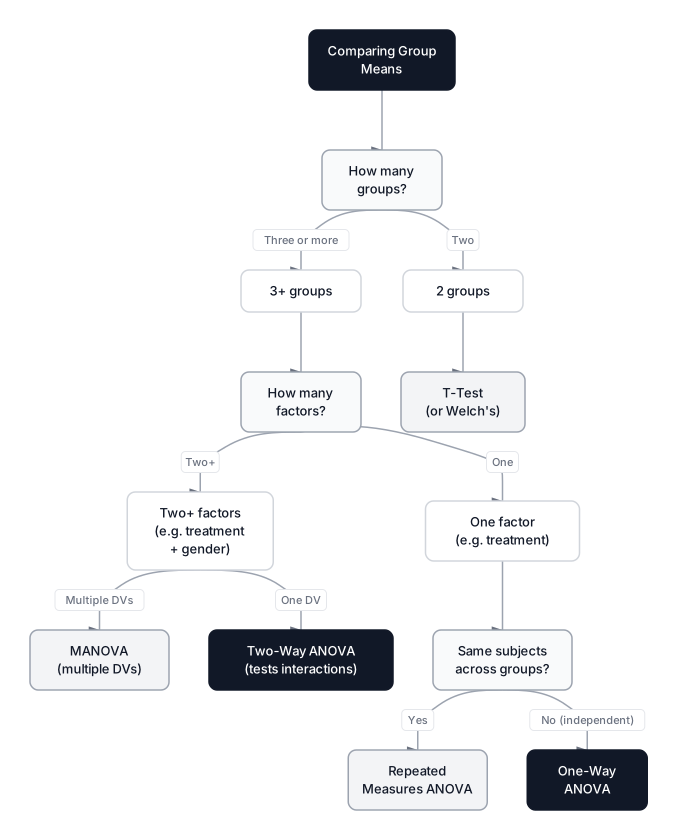 Click to expandDecision guide for selecting the right ANOVA variant
Use ANOVA when:
- You have 3+ independent groups to compare on a continuous outcome
- Your data roughly meets normality and equal variance assumptions
- You want to control the family-wise error rate (unlike multiple t-tests)
- You need to test interaction effects between two or more factors (two-way ANOVA)
Do NOT use ANOVA when:
- You have only 2 groups. Use a t-test or Welch's t-test instead. ANOVA with 2 groups gives identical results to a t-test () but is less interpretable.
- Your data is heavily skewed or ordinal. Use the Kruskal-Wallis H-test (non-parametric one-way ANOVA) or Friedman test (non-parametric repeated measures).
- Your outcome is categorical. Use a chi-square test instead. ANOVA is for continuous outcomes.
- Observations are paired or repeated. Standard one-way ANOVA assumes independence. For before/after measurements on the same subjects, use repeated measures ANOVA or a paired t-test.
- Group variances differ by more than 4:1. Welch's ANOVA (
scipy.stats.alexandergovern) handles unequal variances without assuming homoscedasticity.
Key Insight: ANOVA's computational complexity is where is the total sample size. It scales effortlessly to millions of observations. The bottleneck in practice is never ANOVA itself but rather post-hoc pairwise tests, which grow as with the number of groups .
Conclusion
ANOVA is the standard method for comparing means across three or more groups because it controls the false positive rate that would explode with multiple t-tests. The F-statistic captures a simple, powerful idea: how much of the variation in your data comes from the treatment versus random noise. When is large and the p-value is small, at least one group genuinely differs.
The workflow in practice is always the same: check assumptions first (Levene's test for equal variances, Shapiro-Wilk for normality), run the omnibus ANOVA, and then follow up with a post-hoc test like Tukey HSD to identify which specific pairs differ. Two-way ANOVA extends this to multiple factors and their interactions, revealing patterns that single-factor analysis would miss.
For the statistical foundations behind ANOVA, review our guide on hypothesis testing. If your data involves categorical outcomes rather than continuous measurements, explore chi-square tests. And for understanding the probability distributions that underpin the F-test, that guide covers the full landscape from normal to F to chi-square.
Frequently Asked Interview Questions
Q: Why can't you just run multiple t-tests instead of ANOVA?
Multiple t-tests inflate the family-wise error rate. With 4 groups and 6 pairwise comparisons at , you have a 26.5% chance of at least one false positive. ANOVA tests all groups simultaneously with a single F-test, keeping the error rate at exactly 5%.
Q: What does a significant ANOVA result actually tell you?
It tells you that at least one group mean is significantly different from the others. It does NOT tell you which specific groups differ. You need post-hoc tests (Tukey HSD, Bonferroni, Dunnett) to identify the specific pairwise differences.
Q: How do you decide between Tukey HSD, Bonferroni, and Dunnett post-hoc tests?
Use Tukey HSD for all pairwise comparisons with balanced groups. Use Bonferroni when you have a small number of planned comparisons (it's too conservative for many pairs). Use Dunnett when you're comparing multiple treatments against a single control group, which is common in clinical trials and A/B testing with a baseline.
Q: What happens if the homogeneity of variance assumption is violated?
Use Welch's ANOVA instead, which doesn't assume equal variances. For post-hoc tests, Games-Howell handles unequal variances. In scipy, scipy.stats.alexandergovern provides a Welch-type ANOVA alternative.
Q: Explain the relationship between ANOVA and regression.
One-way ANOVA is mathematically equivalent to linear regression with dummy-coded categorical predictors. The F-statistic from ANOVA equals the F-statistic from the overall regression significance test. Two-way ANOVA extends this to include interaction terms. This connection means you can run ANOVA using statsmodels.formula.api.ols and then apply anova_lm, which is exactly how Type II and Type III sums of squares are computed.
Q: When would you choose Kruskal-Wallis over one-way ANOVA?
Kruskal-Wallis is the non-parametric alternative when your data violates normality assumptions (heavily skewed distributions, ordinal data, or small samples where the central limit theorem doesn't help). It tests whether group medians differ rather than means. The trade-off is lower statistical power compared to ANOVA when assumptions are actually met.
Q: What is an interaction effect in two-way ANOVA, and why does it matter?
An interaction effect means the impact of one factor depends on the level of another factor. In a drug trial, Drug B might improve male patients by 10 points but female patients by only 3 points. If you only run a one-way ANOVA on treatment, you'd see Drug B's average as 6.5 and miss the gender-dependent pattern entirely. Checking for interactions prevents you from making blanket treatment recommendations that only apply to a subset of your population.
Hands-On Practice
When comparing multiple experimental groups, a beginner's instinct is often to run separate t-tests for every pair (A vs. B, B vs. C, A vs. C). However, this approach dramatically inflates the risk of a false positive, known as the 'Family-Wise Error Rate.' We'll use Python and Scipy to perform a One-Way ANOVA on clinical trial data. This method allows us to compare all treatment groups simultaneously to determine if at least one treatment has a statistically significant effect, while keeping our error rate controlled.
Dataset: Clinical Trial (Statistics & Probability) Clinical trial dataset with 1000 patients designed for statistics and probability tutorials. Contains treatment groups (4 levels) for ANOVA, binary outcomes for hypothesis testing and A/B testing, confounders for causal inference, time-to-event data for survival analysis, and pre-generated distribution samples.
The ANOVA results provided a massive F-statistic (~71.55) and a p-value far below 0.05, confirming that the medication groups differ significantly from the placebo and each other. By using ANOVA instead of multiple t-tests, we maintained a 5% error rate for the entire experiment. The next logical step in a real-world scenario would be to perform a 'Post-Hoc' test (like Tukey's HSD) to pinpoint exactly which specific pairs of drugs differ, now that we know there is a difference somewhere in the family.