
You've collected customer satisfaction scores from an A/B test, plotted the histogram, and instead of the tidy bell curve your statistics textbook promised, you're staring at a lopsided blob with a long right tail. The Shapiro-Wilk p-value is 0.0001. Running a t-test on this data would be like measuring wind speed with a bathroom scale: the tool isn't designed for the job.
Non-parametric tests solve this problem. They compare the rank order of observations rather than the raw values, which means they don't need your data to follow a normal probability distribution. Skewed data, ordinal ratings, heavy outliers, tiny samples where the Central Limit Theorem can't help — non-parametric methods handle all of it. Throughout this article, we'll use one running example: an e-commerce company testing three checkout page designs and measuring completion times in seconds.
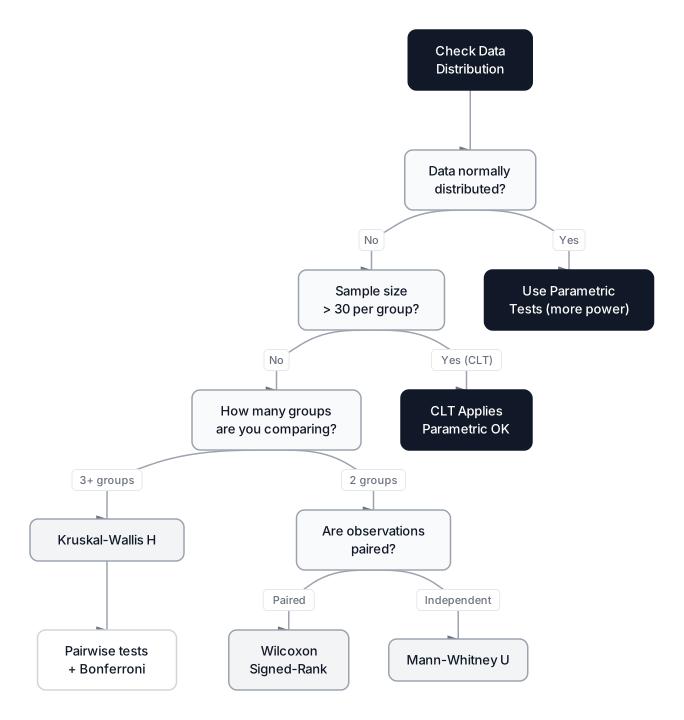 Click to expandDecision flowchart for choosing the right non-parametric statistical test
Parametric vs Non-Parametric Tests
Parametric tests (t-test, ANOVA, Pearson correlation) estimate population parameters like the mean and standard deviation. They assume the underlying data is roughly normally distributed and that groups share similar variances. When those assumptions hold, parametric tests squeeze every drop of information from the raw values and deliver the highest statistical power available.
Non-parametric tests take a different approach. They convert raw values into ranks (1st, 2nd, 3rd, ...) and analyze those ranks instead. This conversion makes them immune to skewness and outliers, because the largest outlier simply becomes the highest rank — it doesn't distort any calculation.
| Parametric Test | Non-Parametric Alternative | When to Switch |
|---|---|---|
| Independent t-test | Mann-Whitney U | Two independent groups, non-normal data |
| Paired t-test | Wilcoxon Signed-Rank | Matched before/after pairs, skewed differences |
| One-way ANOVA | Kruskal-Wallis H | Three or more groups, violated normality |
| Pearson correlation () | Spearman's rank () | Monotonic but non-linear relationships |
Key Insight: Parametric tests ask "are these means different?" Non-parametric tests ask "does one group tend to produce larger values than the other?" The second question is more general and often more useful when distributions are asymmetric.
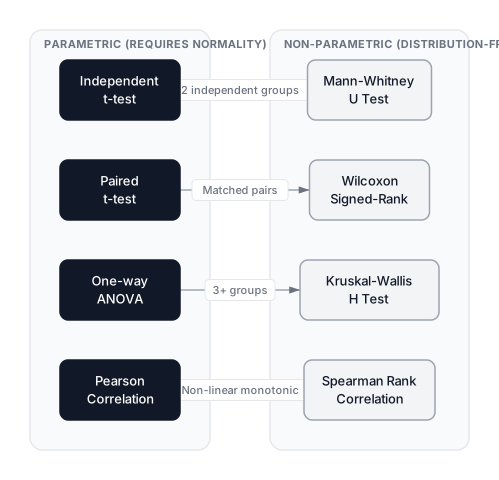 Click to expandMapping between parametric tests and their non-parametric equivalents
When to Use Non-Parametric Tests (and When Not To)
The choice between parametric and non-parametric isn't subjective. It follows directly from your data's properties.
Reach for non-parametric tests when:
- Shapiro-Wilk rejects normality (p < 0.05) and your sample is small (n < 30 per group)
- Your outcome is ordinal (satisfaction ratings, Likert scales, rankings)
- Heavy outliers pull the mean far from the median
- Sample sizes are very small (n < 15) where normality is impossible to confirm
- Your data is bounded or heavily censored (e.g., response times capped at a maximum)
Stick with parametric tests when:
- Data passes normality checks, or samples are large enough for the CLT (n > 30 per group)
- You need maximum statistical power to detect a real effect
- You specifically need to compare means, not just distributional shifts
Research comparing the two families shows that on large normally distributed samples, parametric tests achieve roughly 80.6% power versus 77.7% for non-parametric alternatives (Bridge & Sawilowsky, 2024). That 3-point gap can matter when effects are subtle. But here's the flip side: on skewed data with outliers, the violated assumptions hurt a t-test more than the rank conversion hurts a Mann-Whitney. In practice, non-parametric tests often outperform parametric ones on real-world data precisely because real-world data is messy.
Pro Tip: With very large samples (n > 1,000 per group), parametric tests become resistant to non-normality thanks to the CLT. Non-parametric methods matter most for small-to-medium datasets where the distribution shape directly affects your p-value's reliability.
The Mann-Whitney U Test for Two Independent Groups
The Mann-Whitney U test (also known as the Wilcoxon rank-sum test) compares two independent groups by pooling all observations, ranking them from smallest to largest regardless of group membership, and checking whether one group's ranks cluster systematically higher or lower than expected under random mixing.
The Ranking Intuition
Imagine two teams competing in a relay race. You don't care about exact finish times — you only record the finishing order: 1st, 2nd, 3rd, and so on. If Team A takes positions 1, 2, and 3 while Team B takes 4, 5, and 6, Team A is obviously faster. But what if the ranks are mixed? Team A at positions 1, 3, 5 and Team B at 2, 4, 6? That's roughly even. The Mann-Whitney U test mathematically quantifies how much one group's ranks deviate from this "evenly mixed" baseline.
The U Statistic
Where:
- is the test statistic for group 1
- is the sum of all ranks assigned to group 1 after pooling both groups
- is the number of observations in group 1
- is the minimum possible rank sum (when group 1 holds all the lowest ranks)
In Plain English: We rank every checkout completion time across both the Control and Redesigned page groups. Then we sum the ranks that belong to Control. If Control users are genuinely slower, their rank sum will be inflated well above what random chance would produce. The further sits from its expected value of , the stronger the evidence that the groups differ.
Mann-Whitney U in Python
Our e-commerce company tested two checkout designs. The Control group uses the original page; the Variant uses a streamlined redesign. Both distributions are right-skewed because a handful of users wander off mid-purchase and take unusually long.
Expected Output:
=== Data Summary ===
Control: n=50, median=43.9s, mean=73.2s
Variant: n=50, median=26.4s, mean=32.5s

Shapiro-Wilk (Control): W=0.7348, p=0.000000
Shapiro-Wilk (Variant): W=0.8754, p=0.000081
Both groups non-normal: True

=== Mann-Whitney U Test ===
U statistic: 1663.0
p-value: 0.0045
Rank-biserial r: -0.3304
Result: Significant difference between Control and Variant.
The p-value of 0.0045 sits well below 0.05, so we reject the null hypothesis that both groups come from the same distribution. The rank-biserial correlation of -0.33 indicates a medium effect size: Control users systematically rank higher (slower checkout) than Variant users. Notice how the mean diverges far more than the median (73.2 vs 32.5 for means, 43.9 vs 26.4 for medians). That's the right skew at work, and exactly why a t-test comparing means would give misleading results here.
Common Pitfall: Always report an effect size alongside the p-value. A tiny p-value with a near-zero effect size means the difference is statistically detectable but practically meaningless. For Mann-Whitney U, the rank-biserial correlation () is standard: values near 0.1, 0.3, and 0.5 correspond to small, medium, and large effects (SciPy 1.17 docs).
The Kruskal-Wallis H Test for Three or More Groups
The Kruskal-Wallis H test extends rank-based comparison logic to three or more independent groups. It answers the same question as one-way ANOVA but without assuming normality or equal variances: does at least one group's distribution differ from the rest?
The H Statistic
Where:
- is the test statistic, approximately chi-squared distributed with degrees of freedom
- is the total number of observations across all groups
- is the number of groups
- is the sum of ranks for group
- is the sample size of group
In Plain English: We rank all checkout completion times across the three page designs (Control, Variant A, Variant B), then check whether each group's average rank differs from the overall average rank. If all three designs performed equally, their average ranks would cluster near the same value. A large means at least one design stands apart.
Kruskal-Wallis in Python
The product team now has three checkout variants. Let's test whether any design produces a meaningfully different distribution of completion times.
Expected Output:
=== Group Medians ===
Control:   43.9s
Variant A: 26.4s
Variant B: 30.1s

=== Kruskal-Wallis H Test ===
H statistic: 8.0288
p-value: 0.018054
Result: At least one group differs significantly.
With p = 0.018, we know something differs across groups, but not which pair. The standard follow-up is pairwise Mann-Whitney U tests with a Bonferroni correction: divide your significance threshold by the number of comparisons. For three groups, that's three pairwise tests at .
Common Pitfall: Running multiple pairwise tests without correction inflates your false positive rate. Three pairs push the family-wise error rate from 5% to roughly 14%. Always apply Bonferroni or Holm corrections. This is the exact same problem that makes running multiple t-tests unreliable in the parametric world.
The Wilcoxon Signed-Rank Test for Paired Samples
The Wilcoxon signed-rank test replaces the paired t-test for before/after designs, crossover experiments, or any study where each subject serves as their own control. Instead of assuming the differences between pairs follow a normal distribution, it ranks the absolute differences and tests whether positive and negative ranks balance out.
How Signed-Rank Works
- Compute the difference for each pair:
- Drop any zero differences (no change detected)
- Rank the absolute values from smallest to largest
- Restore the original sign (+ or -) to each rank
- Sum positive ranks ($W^+$) and negative ranks ($W^-$) separately
- The test statistic is the smaller of the two sums
If the treatment has no effect, roughly half the differences should be positive and half negative, so $W^+$ and $W^-$ should be close. A very lopsided split produces a small , which signals a significant shift.
Wilcoxon Signed-Rank in Python
Thirty users tested both the original and redesigned checkout in a within-subjects design. We want to know if the new design genuinely reduces completion times for the same people.
Expected Output:
=== Paired Data Summary ===
Before: median=38.5s, mean=54.3s
After:  median=32.4s, mean=42.5s
Median difference: -3.9s

Shapiro-Wilk on differences: W=0.7402, p=0.0000

=== Wilcoxon Signed-Rank Test ===
W statistic: 66.0
p-value: 0.000313
Result: Significant difference between Before and After.
The differences are clearly non-normal (Shapiro-Wilk p essentially zero), which rules out a paired t-test. The Wilcoxon test confirms a significant reduction in checkout time after the redesign (p = 0.0003). The median dropped from 38.5s to 32.4s, but the mean dropped more dramatically (54.3s to 42.5s) because the redesign especially helped the slowest users who were dragging the tail of the distribution. This is a case where reporting medians alongside means tells a richer story.
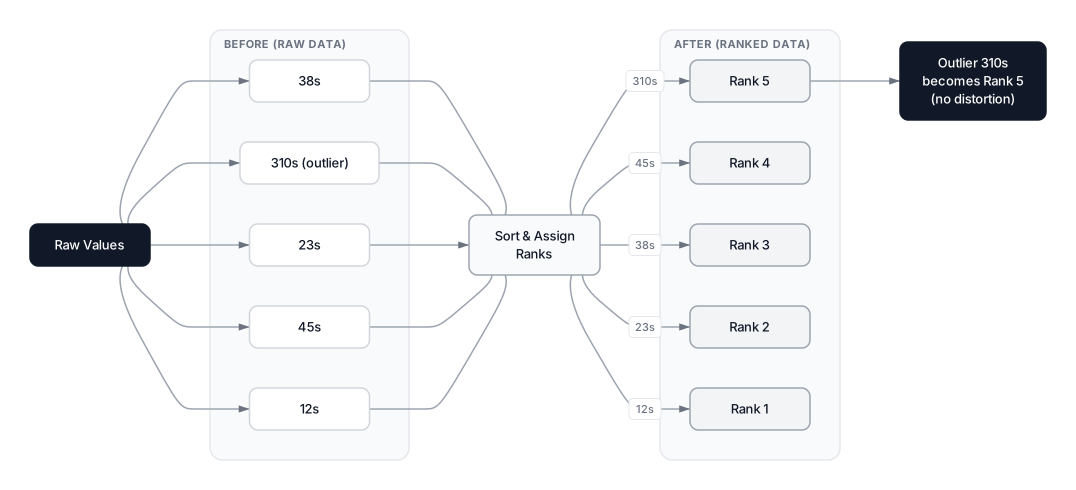 Click to expandHow raw data values are converted to ranks for non-parametric analysis
Spearman's Rank Correlation for Non-Linear Relationships
Spearman's rank correlation coefficient () measures monotonic relationships between two variables. Where Pearson's only captures linear associations and crumbles in the presence of outliers, Spearman converts both variables to ranks first. This makes it capable of detecting curved-but-consistent patterns that Pearson underestimates.
| Property | Pearson | Spearman |
|---|---|---|
| Assumption | Linear relationship | Monotonic relationship |
| Outlier sensitivity | High | Low |
| Perfect score means | Perfect straight line | Perfect increasing order |
| Best for | Continuous, normal data | Ordinal or skewed data |
In our checkout context, consider pages visited versus completion time. The relationship is logarithmic: going from 1 to 3 pages adds significant time, but going from 30 to 33 pages barely registers. Perfectly monotonic, far from linear.
Expected Output:
Pearson r:  0.8419  (p = 0.000083)
Spearman r: 0.9893  (p = 0.000000)

Spearman captures the monotonic pattern (0.99)
Pearson underestimates because the curve is not linear (0.84)
Both reach statistical significance, but Spearman (0.99) correctly reflects the near-perfect monotonic trend. Pearson (0.84) gets pulled down by the curvature. If you stopped at Pearson, you'd underestimate how tightly these variables are connected.
Key Insight: A relationship can be perfectly monotonic (Spearman ) while having a modest Pearson . Think of an exponential curve: as X goes up, Y always goes up, but the rate keeps changing. Spearman captures this; Pearson doesn't.
Production Considerations and Edge Cases
Computational complexity. All rank-based tests run in time, dominated by the sorting step. For datasets under 100K rows, they finish in milliseconds with scipy.stats. On very large datasets (1M+ rows), SciPy automatically switches to a normal approximation for the p-value, which is fast and accurate for large .
Ties handling. Real data always contains ties (identical values). SciPy uses midrank averaging for tied observations and applies a continuity correction by default. For heavily tied ordinal data like 5-point Likert scales, the chi-squared approximation in Kruskal-Wallis can become unreliable. The SciPy 1.17 documentation recommends permutation-based tests for such cases.
Multiple comparisons. When Kruskal-Wallis rejects the null, post-hoc pairwise Mann-Whitney tests need correction. Use Bonferroni (multiply each p-value by the number of comparisons) or scipy.stats.false_discovery_control for Benjamini-Hochberg FDR control. Without correction, testing pairs at yields a family-wise error rate of approximately .
Effect sizes matter. For Mann-Whitney U, report the rank-biserial correlation . For Wilcoxon signed-rank, use where is the standardized statistic and is the number of pairs. Values near 0.1, 0.3, and 0.5 map to small, medium, and large effects. Stakeholders care about how much groups differ, not just whether they do.
The asymptotic relative efficiency of Mann-Whitney U compared to the t-test on normal data is . This means even in the worst case (perfectly normal data), you lose only about 4.5% efficiency by choosing Mann-Whitney. On non-normal data, the efficiency can exceed 1.0, meaning Mann-Whitney actually outperforms the t-test.
Conclusion
Non-parametric tests give you valid hypothesis testing results when your data breaks parametric assumptions. The decision process is direct: two independent groups with non-normal data calls for Mann-Whitney U; paired measurements with skewed differences calls for Wilcoxon Signed-Rank; three or more groups means Kruskal-Wallis followed by corrected pairwise comparisons.
The power tradeoff is real but frequently overstated. On truly normal data, parametric tests hold about a 5% edge. On skewed data with outliers — which describes most real-world checkout times, revenue figures, and session durations — non-parametric tests actually outperform their parametric counterparts because violated assumptions damage the t-test more than rank conversion damages the Mann-Whitney.
If you want a thorough treatment of the parametric side, see Why Multiple T-Tests Fail: A Practical Guide to ANOVA. When your data is categorical rather than ordinal, reach for the Chi-Square test instead. And for designing experiments with enough power to actually detect the effects you care about, the statistical power guide covers sample size calculations for both parametric and non-parametric families.
Interview Questions
Q: When would you choose a Mann-Whitney U test over an independent t-test?
When the data violates normality and the sample is too small for the Central Limit Theorem to apply. Classic examples include right-skewed metrics like revenue or session duration, ordinal data like Likert-scale ratings, and datasets with extreme outliers that distort the mean. If each group has n > 30 and the distribution is roughly symmetric, the t-test works fine.
Q: Does the Mann-Whitney U test compare medians?
Not exactly. It tests whether one group is stochastically dominant over the other, meaning whether a randomly chosen observation from group A is more likely to exceed one from group B. It only simplifies to a median comparison when both distributions have the same shape and differ only in location. Two distributions can share the same median but differ in spread, and the test would still reject the null.
Q: A Kruskal-Wallis test returns p < 0.05. What do you do next?
Run pairwise post-hoc comparisons to identify which specific groups differ. The two standard approaches are Dunn's test or pairwise Mann-Whitney U tests with a Bonferroni correction (divide by the number of pairwise comparisons). Without this step, you only know "at least one group differs" but not which pair is responsible.
Q: Why do non-parametric tests have lower statistical power?
They discard magnitude information when converting values to ranks. The difference between 10 and 100 gets the same rank gap as 10 and 11. Parametric tests use actual values, giving them more information when assumptions hold. On normal data, Mann-Whitney achieves about 95.5% of the t-test's power (asymptotic relative efficiency of ).
Q: Your A/B test has 500K users per group. Should you still use non-parametric tests?
Probably not. At that scale, the Central Limit Theorem guarantees the sampling distribution of the mean is approximately normal regardless of the underlying data distribution. A Welch's t-test is perfectly reliable. Non-parametric tests matter most for small-to-medium samples (n < 30 per group) where the CLT hasn't kicked in.
Q: How do you report effect size for non-parametric tests in a paper or presentation?
For Mann-Whitney U, report the rank-biserial correlation , which ranges from -1 to 1. Apply Cohen's benchmarks: 0.1 small, 0.3 medium, 0.5 large. For Wilcoxon signed-rank, use . Always pair the effect size with the p-value so the audience understands both whether and how much groups differ.
Q: Can you use non-parametric tests on purely categorical data?
No. Mann-Whitney, Wilcoxon, and Kruskal-Wallis all require at least ordinal data that can be meaningfully ranked. For nominal categorical data (browser type, color preference), use a chi-square test or Fisher's exact test.
Q: What happens if you run a t-test on heavily skewed data with a small sample?
The p-value becomes unreliable. The t-test assumes the sampling distribution of the mean is normal, which needs either normal data or a large sample. On a sample of 15 drawn from an exponential distribution, the actual Type I error rate can exceed the nominal 5% by a wide margin, producing false positives you'd incorrectly treat as real findings.
<!— HANDS_ON_START —>
Hands-On Practice
In this specific example, we'll apply non-parametric tests to a messy Customer Data dataset. We often assume data like purchase amounts or customer satisfaction follows a normal distribution, but in reality, high-spending outliers and polarized satisfaction scores create skewed distributions. We will use the Mann-Whitney U test to check if 'total_purchases' differs between churned and active customers, and the Kruskal-Wallis test to see if 'satisfaction_score' varies across different product categories.
Dataset: Customer Data (Data Wrangling) Intentionally messy customer dataset with 1050 rows designed for data wrangling tutorials. Contains missing values (MCAR, MAR, MNAR patterns), exact/near duplicates, messy date formats, inconsistent categories with typos, mixed data types, and outliers. Includes clean reference columns for validation.
The Mann-Whitney U and Kruskal-Wallis tests let this example compare groups without assuming normally distributed outcomes. The histograms confirmed that 'total_purchases' was not bell-shaped, justifying our choice of non-parametric methods. These tests are solid tools for any data scientist dealing with real-world user behavior data, which rarely follows a perfect normal distribution.
<!— HANDS_ON_END —>