
Most real-world data looks nothing like a bell curve. Household incomes pile up at the left with a long tail of high earners stretching right. Insurance claims cluster near zero with occasional six-figure outliers. Customer session durations spike at a few seconds and trail off for hours. None of these follow a normal distribution, yet statisticians confidently apply tools that assume normality every single day.
The Central Limit Theorem (CLT) is the reason that works. It states that the distribution of sample means converges to a normal distribution as sample size grows, regardless of the population's original shape. That single guarantee is what makes hypothesis testing, confidence intervals, and A/B testing possible on messy, skewed, real-world data.
Throughout this article, we'll use a single running example: estimating average household income from a population of 10,000 earners whose incomes follow a right-skewed Gamma distribution.
The Core Idea Behind CLT
The Central Limit Theorem says: if you draw repeated random samples of size from any population with a finite mean and finite variance, the distribution of sample means approaches a normal distribution as increases. The original data can be skewed, bimodal, uniform, or shaped like anything at all. The means of those samples will still form a bell curve.
This distinction trips up a lot of people. The CLT doesn't claim your data becomes normal. Your data stays exactly as messy as it was. What becomes normal is the distribution of averages computed from repeated samples.
Key Insight: The CLT is about averages, not individual data points. One household might earn $12k while another earns $400k. But the average of 50 randomly chosen households will land remarkably close to the population mean, and those averages across many samples form a bell curve.
Think about it with dice. Roll a single die and every outcome (1 through 6) has equal probability. The distribution is flat. Now roll 30 dice and compute the average. Getting an average of 1.0 requires all thirty dice to land on 1, which is astronomically unlikely. Getting an average near 3.5 is easy because thousands of combinations produce values in that range. The result: averages cluster in the middle and form a bell-shaped curve. More dice (larger ) means a tighter cluster.
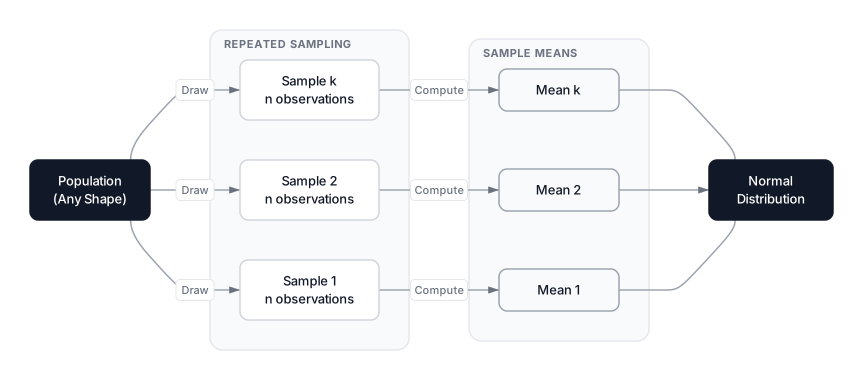 Click to expandHow the Central Limit Theorem transforms any population distribution into a normal sampling distribution
The Standard Error Formula
The CLT provides a precise mathematical statement about how sample means behave. If a population has mean and standard deviation , the sampling distribution of the mean for samples of size follows:
Where:
- is the sample mean (the average you compute from one sample)
- is the true population mean (the value you're trying to estimate)
- is the population variance
- is the number of observations in each sample
- denotes a normal distribution with specified mean and variance
The standard deviation of this sampling distribution has its own name: the Standard Error (SE).
Where:
- is the standard error of the mean
- is the population standard deviation
- is the square root of the sample size
In Plain English: In our income example, the population standard deviation is about $7.04k. If you take samples of 50 households each, the standard error is k. That means most sample averages will land within $1k of the true population mean. Double the sample size to 100, and the standard error drops to $0.70k. Quadrupling the data only halves the uncertainty.
This square-root relationship matters in practice. Going from $n = 100$ to $n = 400$ cuts your standard error in half. Going from $n = 400$ to $n = 1600$ cuts it in half again. Each incremental gain in precision costs four times the data. That's why sample size planning is critical in experiment design.
CLT Demonstrated in Python
Let's prove the CLT with code. We'll generate a heavily right-skewed population (Gamma-distributed household incomes), draw 1,000 random samples of size 50, compute each sample mean, and show that those means form a normal distribution even though the original data is far from normal.
Expected Output:
The left plot shows the original right-skewed income distribution. The right plot shows the sampling distribution of means, which is clearly bell-shaped and centered on the population mean.
--- Original Population (10,000 household incomes) ---
Mean:     10.07k
Std Dev:  7.04k
Skewness: 1.37 (heavily right-skewed)

--- Sampling Distribution (1000 sample means, n=50) ---
Mean of sample means: 10.11k
Std Error (observed):  1.0276k
Std Error (theory):    0.9957k
Skewness of means:     0.0951 (near zero = symmetric)
Three things happened here. The skewness dropped from 1.37 to 0.10, near-perfect symmetry. The mean of sample means (10.11k) landed almost exactly on the true population mean (10.07k). And the spread collapsed from a standard deviation of 7.04k down to about 1.03k, matching the theoretical standard error of 0.9957k. That's the CLT in action.
Sample Size and the Speed of Convergence
The "magic number" you'll see everywhere is . That's a useful rule of thumb, but it misses the real story. How quickly the CLT kicks in depends entirely on how non-normal the original population is.
| Population Shape | CLT Works Well At | Why |
|---|---|---|
| Normal or near-normal | $n = 5$ | Already normal, CLT adds nothing |
| Symmetric but non-normal (uniform, triangular) | No skew to overcome | |
| Moderately skewed (exponential, chi-square) | The classic rule of thumb | |
| Heavily skewed (Pareto, log-normal with high sigma) | $n = 100+$ | Extreme tails need more averaging |
| Infinite variance (Cauchy) | Never | CLT does not apply |
Let's verify this with our income data by comparing sample sizes of 5, 30, and 100.
Expected Output:
    n   SE(observed)    SE(theory)   Skewness
----------------------------------------------
    5         3.3198        3.1486     0.5900
   30         1.2654        1.2854     0.3384
  100         0.7125        0.7040    -0.0232
At $n = 5$, the skewness is still 0.59, far from the zero you'd expect from a normal distribution. By $n = 30$, it drops to 0.34. At $n = 100$, the skewness hits -0.02, practically zero. The observed standard errors closely track the theoretical values at all sample sizes, confirming the formula works even when the sampling distribution isn't perfectly normal yet.
Pro Tip: The "" rule is fine for moderately skewed data. For income distributions, insurance claims, or anything with extreme right tails, push to $n = 50$ or $n = 100$ before trusting normality-based inference. Always check the skewness of your sampling distribution if you're unsure.
 Click to expandHow standard error decreases with increasing sample size, showing diminishing returns
When CLT Applies and When It Fails
The CLT is not a universal pass. It requires three conditions, and violating any of them can produce misleading results.
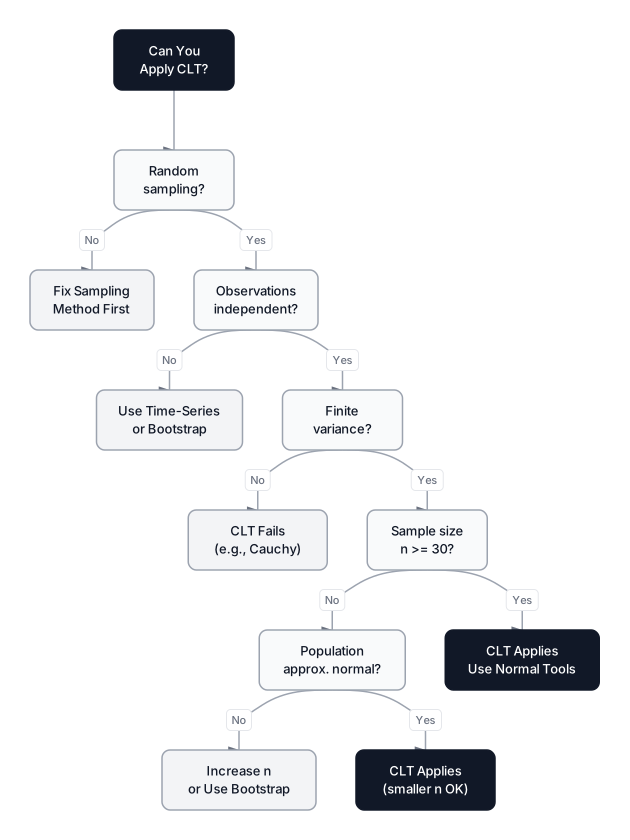 Click to expandDecision tree for checking whether CLT conditions are satisfied
Condition 1: Random Sampling
Every observation must have a known, non-zero probability of being selected. Convenience samples (surveying only your coworkers, scraping only English-language tweets, measuring only patients who visit your clinic) violate this condition. The sample mean will converge, but to the biased mean of whatever subpopulation you accidentally selected, not the true population mean.
Condition 2: Independence
Each observation must be independent of the others. In practice, this means sampling with replacement from a large population, or sampling without replacement when the sample is less than 10% of the population (the "10% rule"). Time-series data violates independence because today's value correlates with yesterday's. Clustered data (students within schools, patients within hospitals) also breaks independence without proper adjustment.
Condition 3: Finite Variance
This is the condition most people forget, and it's the one that can truly break the CLT. Probability distributions with infinite variance, like the Cauchy distribution, produce sample means that never settle down. No matter how large gets, the sampling distribution stays heavy-tailed and unstable.
The Cauchy distribution appears more often than you'd expect: ratios of independent normals, certain financial return models, and resonance curves in physics all follow Cauchy-like behavior.
Expected Output:
--- Cauchy Distribution: CLT Failure ---
Mean of sample means: 2.96
Std of sample means:  33.49
Skewness of means:    6.77
Min mean: -108.41, Max mean: 269.28

--- Gamma Distribution: CLT Works ---
Mean of sample means: 10.13
Std of sample means:  0.72
Skewness of means:    0.05
Min mean: 8.05, Max mean: 12.30
The contrast is dramatic. With the Gamma distribution (finite variance), sample means cluster tightly between 8.05 and 12.30, with a skewness of 0.05. With the Cauchy (infinite variance), the means range from -108 to 269, the standard deviation is 33.49, and the skewness is 6.77. Even at $n = 100$, the Cauchy sampling distribution shows no sign of converging to normality.
Common Pitfall: If your data contains ratios (conversion rate per user, price-to-earnings ratios), check whether the denominator can be zero or near-zero. Ratios with near-zero denominators can behave like Cauchy distributions, breaking CLT-based inference. Consider log-transforming or using non-parametric tests instead.
Connection to Confidence Intervals and Hypothesis Testing
The CLT is the engine behind every confidence interval and most hypothesis tests. Here's why.
A confidence interval for the population mean takes this form:
Where:
- is the observed sample mean
- $z^*$ is the critical value for the desired confidence level (1.96 for 95%)
- is the population standard deviation (often estimated by )
- is the sample size
In Plain English: Using our income example, if one sample of 50 households produces a mean of $10.11k and the standard error is about $1.0k, a 95% confidence interval would be roughly $10.11k 1.96 $1.0k, or [$8.15k, $12.07k]. The CLT is what allows us to use 1.96 as the multiplier, because it guarantees the sampling distribution is normal. Without that guarantee, we wouldn't know the right multiplier to use.
Hypothesis testing works the same way. A Z-test computes:
Where:
- is the observed sample mean
- is the hypothesized population mean (under the null hypothesis)
- is the standard error
This Z-score tells you how many standard errors the sample mean sits from the null hypothesis value. Because the CLT guarantees the sampling distribution is normal, you can look up in a standard normal table to get a p-value. Without CLT, that lookup wouldn't be valid.
The same logic extends to A/B tests: comparing two sample means is just computing how far apart they are in units of standard error, then using the normal distribution to assess whether the gap is statistically significant.
When to Use CLT and When NOT to Use It
Use CLT-Based Methods When:
- You have from a population with finite variance. This is the bread-and-butter case. Z-tests, t-tests, and confidence intervals all rest on CLT.
- You're comparing group means in an A/B test. As long as each group has enough observations (typically per group), CLT justifies normal approximation.
- You need a quick, interpretable result. CLT-based methods are fast ( computation), easy to explain to stakeholders, and produce confidence intervals that decision-makers understand.
- You're building monitoring dashboards. Rolling averages of metrics (latency, error rates, revenue per user) converge to normality quickly, making CLT-based control charts practical at scale.
Do NOT Use CLT-Based Methods When:
- Your data has infinite variance. Cauchy-like distributions, heavy-tailed financial returns, or ratio metrics with near-zero denominators. Use non-parametric methods or bootstrap confidence intervals instead.
- Your sample is small and the population is heavily skewed. With $n < 30$ and a right-skewed income distribution, the sampling distribution hasn't converged yet. The bootstrap or permutation tests are safer choices.
- Your observations are dependent. Time-series data, clustered observations, or repeated measures on the same subjects violate CLT's independence assumption. Use methods designed for dependent data (ARIMA, mixed-effects models, cluster-robust standard errors).
- You're working with medians or proportions at extreme values. CLT applies to means specifically. The median doesn't benefit from CLT in the same way. For proportions near 0 or 1, use exact binomial methods or Wilson intervals rather than normal approximation.
Production Considerations
Computational cost: Computing a sample mean is . CLT-based inference (Z-tests, t-tests, confidence intervals) runs in constant time once you have the mean and standard error. This makes CLT methods extremely efficient compared to bootstrap ( for resamples) or permutation tests ( for permutations).
Memory: A single pass through the data gives you and . You don't need to store the entire dataset, just running sums. Welford's online algorithm computes mean and variance in one pass with memory, which matters when processing billions of events in streaming pipelines.
Scaling to production A/B testing: Companies like Google, Netflix, and Booking.com run thousands of simultaneous experiments. CLT-based Z-tests are the workhorse because they're fast, statistically sound for large , and easy to automate. According to Kohavi, Tang, and Xu (2020), normal approximation via CLT is the default approach in all major experimentation platforms.
The bootstrap alternative: When you're unsure whether CLT conditions hold, the bootstrap provides a non-parametric fallback. It resamples your data with replacement to empirically build the sampling distribution, requiring no normality assumption. The tradeoff is computational cost: a bootstrap with 10,000 resamples on 1 million rows takes meaningful time, while CLT-based inference is instant.
Pro Tip: In production, start with CLT-based tests for speed. Spot-check a random subset of experiments with bootstrap confidence intervals. If they disagree meaningfully, investigate the underlying distribution before trusting either result. According to research from Efron and Tibshirani (1993), the bootstrap and CLT produce nearly identical results when CLT conditions are satisfied, making the CLT the efficient default.
Conclusion
The Central Limit Theorem reduces the complexity of statistical inference to one clean guarantee: sample means are normally distributed, regardless of the population shape, as long as you have random samples, independence, and finite variance. That guarantee is the foundation of confidence intervals, hypothesis tests, and every A/B test running in production today.
The practical takeaway is that you don't need to understand the full distribution of your data to make rigorous inferences about its mean. You need a large enough random sample and a finite variance, and the CLT handles the rest. The standard error formula, , tells you exactly how much precision any given sample size buys you, and the square-root relationship explains why doubling precision requires quadrupling data.
For deeper coverage of how CLT powers real-world decisions, explore our guides on A/B testing design, confidence intervals, and statistical power. Understanding CLT deeply is what separates someone who runs statistical tests from someone who knows why those tests work.
Frequently Asked Interview Questions
Q: Explain the Central Limit Theorem in one sentence. Why does it matter?
The CLT states that the sampling distribution of the mean approaches a normal distribution as sample size increases, regardless of the population's shape. It matters because it lets us apply normal-distribution-based tools (Z-tests, t-tests, confidence intervals) to data from any distribution, which is the foundation of practically all frequentist inference.
Q: Does the CLT say that data becomes normally distributed with large samples?
No. The CLT applies to the distribution of sample means, not to the raw data. If you collect 10,000 income observations, the data will still be right-skewed. What the CLT guarantees is that the average computed from repeated samples of that data will be normally distributed. Confusing these two is one of the most common mistakes in data science interviews.
Q: Why is often cited as the minimum sample size for CLT?
It's a convenient rule of thumb that works well for moderately skewed populations. For symmetric distributions, CLT can kick in at $n = 10$ or fewer. For heavily skewed distributions (Pareto, extreme log-normal), you might need $n = 100$ or more. The right answer depends on the degree of skewness and kurtosis in the original data.
Q: Your A/B test has 15 users per group. Can you rely on the CLT for your analysis?
With only 15 users per group, CLT-based inference is risky unless you have strong reason to believe the metric is approximately normally distributed. For skewed metrics like revenue per user or session duration, 15 is likely too small. Use a bootstrap confidence interval, a permutation test, or collect more data before drawing conclusions.
Q: Name a distribution where the CLT does not apply, and explain why.
The Cauchy distribution has undefined mean and infinite variance, which violates CLT's finite-variance requirement. No matter how many Cauchy observations you average, the sampling distribution remains heavy-tailed and never converges to normality. This matters in finance where certain return ratios can exhibit Cauchy-like behavior.
Q: How does the Central Limit Theorem relate to the standard error formula?
The CLT tells us the sampling distribution is normal; the standard error formula tells us its spread. Together, they fully specify the sampling distribution: . The standard error quantifies the precision of a sample mean as an estimator of the population mean.
Q: In a production A/B testing platform, why do teams typically use CLT-based Z-tests instead of bootstrap methods?
Speed and scalability. A Z-test requires only the mean, variance, and sample size, all computable in a single pass over the data. Bootstrap methods require thousands of resamples, making them orders of magnitude slower. When a platform runs thousands of simultaneous experiments on millions of users, CLT-based tests are the only practical choice at scale.
Q: You run a Z-test on revenue data that is heavily right-skewed with $n = 500$ per group. Should you trust the result?
At $n = 500$, the CLT provides a strong normal approximation for the sampling distribution of the mean, even with heavy skew. The Z-test result is likely trustworthy for the mean comparison. However, if you care about medians or if there are extreme outliers driving the mean, consider a trimmed mean or Mann-Whitney U test as a sensitivity check.
Hands-On Practice
The Central Limit Theorem (CLT) is often called the "magic trick" of statistics because it allows us to apply normal distribution tools (like t-tests) to non-normal data.
This simulation illustrates the CLT with the sample_skewed column from the Clinical Trial dataset. Although the observations are right-skewed, the distribution of repeated sample means becomes increasingly bell-shaped as sample size grows.
Dataset: Clinical Trial (Statistics & Probability) Clinical trial dataset with 1000 patients designed for statistics and probability tutorials. Contains treatment groups (4 levels) for ANOVA, binary outcomes for hypothesis testing and A/B testing, confounders for causal inference, time-to-event data for survival analysis, and pre-generated distribution samples.
In this simulation, the source data is strongly right-skewed, while the distribution of sample means is more symmetric. The standard deviation of those means falls from about 6.99 to 0.96 as sample size increases, illustrating the reduction in standard error under this setup.