
Every time you open your inbox and find it free of "Congratulations! You've won a lottery!" scams, a Naive Bayes classifier probably did the heavy lifting. Naive Bayes has long served as a fast baseline for spam filtering and other high-volume text-classification tasks. The reason is simple: Naive Bayes is absurdly fast, works with tiny training sets, and punches well above its weight on text data.
This guide walks through the probability math from scratch, builds a working spam classifier in Python, and covers the practical decisions you'll face when deploying Naive Bayes in real systems.
Bayes Theorem: The Foundation
Bayes' theorem describes how to update your belief about a hypothesis when you observe new evidence. Published posthumously in 1763 by Thomas Bayes, this single equation powers everything from medical diagnosis to search engines.
Where:
- $P(y|X)$ is the posterior probability: the chance that class is correct given the observed features
- $P(X|y)$ is the likelihood: how probable these features are if the class really is
- is the prior: the baseline probability of class before seeing any features
- is the evidence: the total probability of observing features across all classes
In Plain English: Suppose 40% of your inbox is spam (the prior). If the word "free" shows up in 82% of spam emails but only 5% of legitimate ones (the likelihood), seeing "free" in a new message should heavily shift your belief toward spam. Bayes' theorem is the formula that calculates exactly how much to shift.
Since stays constant across all classes, we can drop it when comparing class scores and work with the proportional form:
The class with the highest score wins. That proportionality shortcut is why Naive Bayes classifiers never need to compute the full denominator during prediction.
The "Naive" Independence Assumption
Naive Bayes earns its name from a single, deliberately unrealistic assumption: every feature is conditionally independent of every other feature given the class label.
If an email contains the words , the joint likelihood would normally require estimating , a combinatorial nightmare. With the independence assumption, that collapses into a product of individual word probabilities:
Where:
- is the prior probability of class (e.g., what fraction of training emails are spam)
- means "multiply together for every feature from 1 to "
- is the probability of seeing word in emails of class
In Plain English: To score an email as spam, multiply the base spam rate by the probability of each word appearing in spam. "Free" pushes the score up. "Meeting" pushes it down. Multiply all those individual nudges together and you get the final verdict.
Is this assumption realistic? Almost never. The words "San" and "Francisco" are obviously correlated. Yet in practice, the independence assumption rarely changes which class wins; it just makes the probability magnitudes unreliable. The ranking stays correct even when the exact numbers are off, which is why Naive Bayes classifies accurately despite its flawed math. A 2004 paper by Zhang showed that Naive Bayes is optimal even when dependencies exist, as long as they distribute evenly across classes.
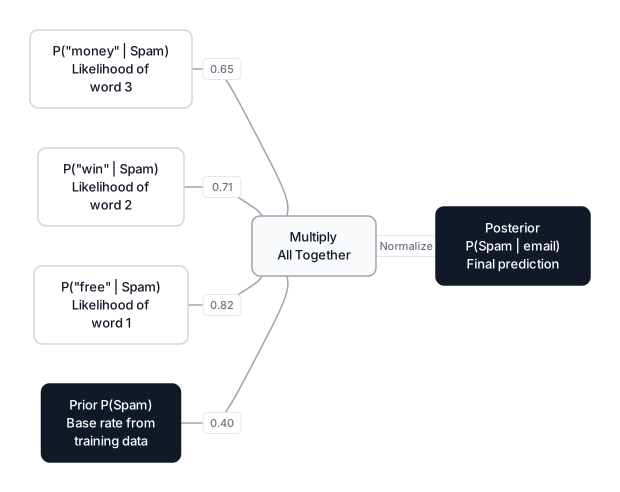 Click to expandBayes theorem posterior calculation showing how prior and word likelihoods combine for spam classification
Naive Bayes Variants
Not all features are word counts. Depending on your data type, scikit-learn (as of version 1.6+) offers four Naive Bayes variants, each with a different likelihood model.
| Variant | Feature Type | Likelihood Model | Best For |
|---|---|---|---|
| MultinomialNB | Discrete counts | Multinomial distribution | Document classification, word frequencies |
| BernoulliNB | Binary (0/1) | Bernoulli distribution | Short text, binary feature vectors |
| GaussianNB | Continuous | Normal (Gaussian) distribution | Numeric datasets, sensor readings |
| ComplementNB | Discrete counts | Complement of other classes | Imbalanced text datasets |
Multinomial Naive Bayes
MultinomialNB is the workhorse for text classification. It models the probability of observing a particular word count in documents of a given class. If "money" appears five times in an email, MultinomialNB accounts for that intensity rather than just presence.
Bernoulli Naive Bayes
BernoulliNB cares only about whether a word is present or absent, ignoring frequency entirely. This makes it effective for short texts like tweets or SMS messages where seeing a word once is already a strong signal. It also explicitly penalizes the absence of features, which MultinomialNB does not.
Gaussian Naive Bayes
When features are continuous numbers (age, salary, sensor voltage), GaussianNB assumes each feature follows a normal distribution within each class. The likelihood becomes the Gaussian probability density function:
Where:
- is the observed feature value (e.g., the dollar amount in a transaction)
- is the mean of feature for class
- is the variance of feature for class
- is the exponential function
In Plain English: GaussianNB asks "how far is this value from the typical value for each class?" If spam emails have an average message length of 45 words with a standard deviation of 12, and this email is 200 words, GaussianNB says that's extremely unlikely for spam. The bell curve math quantifies that intuition.
For a deeper look at the normal distribution and other probability models, see our guide on Probability Distributions.
Complement Naive Bayes
ComplementNB estimates parameters using data from the complement of each class (all classes except the target). When training data is imbalanced, say 95% ham and 5% spam, MultinomialNB's estimates for the minority class are noisy. ComplementNB sidesteps this by learning from the majority class instead. According to the original paper by Rennie et al. (2003), it consistently outperforms standard MultinomialNB on imbalanced text benchmarks.
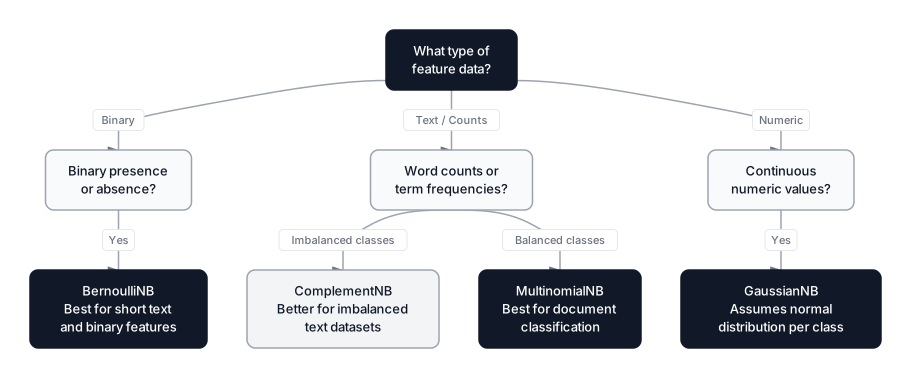 Click to expandNaive Bayes variant selection guide based on feature data type
Laplace Smoothing: Fixing the Zero Problem
Here's a catastrophic edge case. Your spam filter encounters the word "cryptocurrency" in a new email, but that word never appeared in training data. The likelihood becomes , and because Naive Bayes multiplies all likelihoods together, one zero wipes out every other signal:
The fix is Laplace smoothing (additive smoothing). Add a small constant to every word count so nothing is ever zero:
Where:
- is the count of word in class 's training documents
- is the total count of all words in class
- is the vocabulary size (number of distinct words)
- is the smoothing parameter (1.0 by default in scikit-learn)
In Plain English: Laplace smoothing pretends every word was seen at least once in every class. "Cryptocurrency" gets a tiny probability instead of zero, preserving the other 49 words' evidence. Setting is called Laplace smoothing; smaller values like 0.1 (Lidstone smoothing) give less artificial boost.
Pro Tip: Tuning alpha between 0.01 and 10.0 is the single most impactful hyperparameter for MultinomialNB. Lower values work better when your vocabulary is large and sparse. Use GridSearchCV to find the sweet spot.
Building a Spam Classifier in Python
Let's bring the theory together with a complete spam classifier using scikit-learn's MultinomialNB. This example mirrors the real pipeline: raw text in, class predictions out.
 Click to expandNaive Bayes text classification pipeline from raw emails to spam or ham prediction
Expected Output:
Vocabulary size: 76 unique words
Feature matrix:  16 emails x 76 features (sparse)

What the model learned (log-probabilities):
      Word | log P(w|Ham) | log P(w|Spam) | Favors
------------------------------------------------------------
      free |      -4.8363 |       -3.2347 | Spam
     money |      -4.8363 |       -3.7456 | Spam
       win |      -4.8363 |       -3.7456 | Spam
   meeting |      -3.7377 |       -4.8442 | Ham
   project |      -4.1431 |       -4.8442 | Ham
      team |      -3.7377 |       -4.8442 | Ham

"Hey are we still meeting for lunch today"
  -> Ham (Ham: 0.9264, Spam: 0.0736)
"You won a free lottery prize claim now"
  -> Spam (Ham: 0.0015, Spam: 0.9985)
The log-probability table reveals exactly what the model learned. Words like "free" and "win" have higher log-probabilities under the Spam class, while "meeting" and "team" are strong Ham indicators. The CountVectorizer handled tokenization, and Laplace smoothing (alpha=1.0) ensured no word gets a zero probability. For more on how text gets converted to features, see our Text Preprocessing guide.
Comparing Naive Bayes Against Other Classifiers
A natural question: when should you pick Naive Bayes over logistic regression or a decision tree? The answer depends on your dataset size, feature types, and whether you need calibrated probabilities.
Expected Output:
Model Comparison (2000 samples, 20 features, 5-fold CV)
==================================================
Model                  Accuracy      Std
--------------------------------------------------
GaussianNB               0.7985   0.0195
MultinomialNB            0.7520   0.0121
BernoulliNB              0.7515   0.0181
LogisticRegression       0.8360   0.0217
Logistic regression wins on this continuous dataset because it directly models the decision boundary. But look at Naive Bayes's 79.8% accuracy: it's within 4 percentage points with zero hyperparameter tuning, and it trains in a fraction of the time. On text data, MultinomialNB often closes that gap or pulls ahead.
Key Insight: Naive Bayes is a generative classifier (it models $P(X|y)$), while logistic regression is discriminative (it models $P(y|X)$ directly). The generative approach needs fewer samples to converge but loses accuracy when the assumed distribution is wrong. With under 100 training examples, Naive Bayes typically outperforms logistic regression.
When to Use Naive Bayes (and When Not To)
After working with Naive Bayes across dozens of projects, here's the decision framework I've settled on.
Reach for Naive Bayes when:
- You're classifying text (spam, sentiment, topic categorization). MultinomialNB is the default starting point.
- Training data is small (under a few thousand samples). Naive Bayes estimates parameters from simple counts, so it converges fast.
- You need sub-millisecond predictions. Both training and inference are where is samples, is features, and is classes.
- You're building a baseline. Naive Bayes sets an honest floor. If a complex model can't beat it, your features probably need work.
- You need incremental learning.
partial_fit()lets you update the model without retraining from scratch, ideal for streaming data.
Avoid Naive Bayes when:
- Features are heavily correlated. Naive Bayes double-counts correlated evidence, leading to overconfident wrong predictions. Consider feature engineering to reduce redundancy first.
- You need calibrated probabilities. The probabilities from
predict_proba()are often far from the true likelihood. If you need reliable probabilities (risk scoring, medical diagnosis), useCalibratedClassifierCVas a wrapper or switch to logistic regression. - Feature interactions matter. Naive Bayes ignores all interactions by design. If "age > 50 AND income > $100K" predicts differently than either feature alone, a decision tree or random forest will capture that.
- Your dataset is large with complex patterns. With tens of thousands of labeled samples, gradient boosting or neural networks will usually learn a better boundary.
Production Considerations
Computational Complexity
| Operation | Time Complexity | Space Complexity |
|---|---|---|
| Training | ||
| Prediction | per sample | |
partial_fit | Same model |
Training is a single pass through the data: count occurrences and compute probabilities. There's no iterative optimization, no gradient computation. This is why a MultinomialNB model trains in under 1 millisecond on thousands of documents while logistic regression needs multiple passes.
Memory and Scaling
For text classification with a vocabulary of 100K words and 10 classes, the model stores roughly parameters (one log-probability per word per class). That's about 8 MB in float64. Compare that to a BERT model at 440 MB.
The sparse matrix representation from CountVectorizer keeps memory efficient during training. Documents with 50K unique tokens across millions of emails? Still fits comfortably in RAM because most entries are zero.
Common Production Patterns
- Pipeline construction: Always wrap
CountVectorizerandMultinomialNBin aPipelineto prevent data leakage during cross-validation. The vectorizer must fit only on training data. - TF-IDF vs raw counts:
TfidfTransformercan improve MultinomialNB by downweighting common words, but in practice the gains are often marginal since Naive Bayes already handles frequency differences through its class-conditional probabilities. - Online learning: Use
partial_fit()for streaming data. Pre-specify all classes in the first call:clf.partial_fit(X_batch, y_batch, classes=[0, 1]). - Probability calibration: Wrap with
CalibratedClassifierCV(clf, method='isotonic')if downstream systems rely on probability scores.
Common Pitfall: Never call fit() again after using partial_fit(). It resets the model. If you need to retrain from scratch, create a new instance.
When Naive Bayes Is the Right Baseline
Naive Bayes remains one of the most practical classification algorithms 260 years after Bayes first described the theorem. Its power comes from a deliberate tradeoff: sacrifice modeling accuracy for computational speed and data efficiency. On text classification tasks, particularly with small to medium datasets, it regularly matches models that take 100x longer to train.
Use MultinomialNB as a baseline for count-based or sparse text features, and GaussianNB as a quick baseline when continuous features are plausibly class-conditionally Gaussian. The probability-based reasoning carries into more sophisticated classifiers.
If you want to move beyond Naive Bayes, explore how random forests handle feature interactions that Naive Bayes misses. For understanding how different categorical encoding strategies affect classifier performance, that guide covers the complete picture. And for the statistical foundations behind hypothesis testing and confidence in your model's results, see our Hypothesis Testing guide.
Frequently Asked Interview Questions
Q: Why does Naive Bayes work well despite the clearly wrong independence assumption?
The independence assumption affects the magnitude of predicted probabilities but rarely changes their ranking. As long as the most probable class stays on top, classification accuracy is preserved. Zhang (2004) proved that Naive Bayes is optimal when dependencies distribute evenly across classes, which happens more often than you'd expect in practice.
Q: When would you choose Naive Bayes over logistic regression?
Choose Naive Bayes when you have very few training samples (under 1,000), when features are high-dimensional and sparse (text data), or when you need extremely fast training and inference. Logistic regression generally wins when you have enough data and need calibrated probability estimates.
Q: What is Laplace smoothing and why is it necessary?
Laplace smoothing adds a small constant (typically 1) to every feature count before computing probabilities. Without it, any unseen word in test data produces a zero probability, which zeroes out the entire class prediction regardless of other evidence. It's controlled by the alpha parameter in scikit-learn.
Q: How would you handle a highly imbalanced dataset with Naive Bayes?
Three approaches work well together. First, use ComplementNB instead of MultinomialNB, since it estimates parameters from the complement of each class and handles imbalance naturally. Second, adjust class priors manually using the class_prior parameter. Third, combine Naive Bayes with CalibratedClassifierCV to correct the distorted probability estimates.
Q: What's the difference between MultinomialNB and BernoulliNB for text classification?
MultinomialNB uses word frequencies (how many times a word appears), while BernoulliNB uses only binary presence/absence. BernoulliNB also explicitly penalizes the absence of a word, which MultinomialNB does not. For longer documents, MultinomialNB typically performs better because frequency carries useful signal. For short texts like tweets, BernoulliNB can be more effective.
Q: Can Naive Bayes be used for multi-class classification?
Yes. Naive Bayes naturally extends to any number of classes. It computes a posterior score for each class and picks the highest. The computational cost scales linearly with the number of classes, making it practical even with hundreds of categories (e.g., classifying news articles into 50+ topics).
Q: Your Naive Bayes spam filter suddenly starts missing obvious spam after deployment. What happened?
This is likely vocabulary drift. New spam vocabulary (e.g., "crypto", "NFT") has zero probability in the model because those words weren't in training data. Even with Laplace smoothing, their contribution is minimal. The fix is retraining periodically or using partial_fit() for online updates. Also check whether the class distribution has shifted; if spam volume increased, the prior needs updating.
Q: How does Naive Bayes compare to deep learning models for text classification?
On small datasets (under 10K samples), Naive Bayes often matches or beats fine-tuned transformer models because it doesn't overfit. On large datasets (100K+ samples), deep learning pulls ahead significantly because it captures word order, context, and semantic meaning that bag-of-words Naive Bayes ignores entirely. The training cost difference is massive: milliseconds for Naive Bayes versus hours for BERT.
Hands-On Practice
In this hands-on tutorial, we will apply the concepts of Probabilistic Classification using the Naive Bayes algorithm. While often famous for text analysis, Naive Bayes is also a powerful baseline for structured tabular data. You will build a Gaussian Naive Bayes model to predict passenger survival, allowing you to visualize exactly how the algorithm calculates probabilities based on feature distributions like age and fare.
Dataset: Passenger Survival (Binary) Titanic-style survival prediction with clear class patterns. Women and first-class passengers have higher survival rates. Expected accuracy ≈ 78-85% depending on model.
Experiment with the var_smoothing parameter in GaussianNB(var_smoothing=1e-9). Increasing this value adds stability to the calculation and can help when the bell-curve assumption isn't perfect. Also, try removing the 'fare' feature and observe how the accuracy changes; Naive Bayes assumes features are independent, but Fare and Class are highly correlated, which can sometimes confuse the model.