
A clothing store manager stares at twelve months of sales data and needs next quarter's forecast by Friday. The yearly average is useless because it ignores the upward trend from a recent marketing push. Yesterday's number alone is too noisy to trust. What she needs is a model that remembers the past but trusts the present more, one that adapts its memory as new receipts come in. Exponential-smoothing models remain useful for level, trend, and seasonal forecasting when the data fits their assumptions.
Exponential smoothing assigns exponentially decreasing weights to past observations, so recent data dominates the forecast while older data fades out gradually. Originally proposed by Robert G. Brown in 1956 for Navy inventory control, the framework was extended by Charles Holt (1957) to handle trends and by Peter Winters (1960) to capture seasonality. Decades later, Hyndman et al.'s Forecasting with Exponential Smoothing: The State Space Approach unified the entire family under the ETS (Error-Trend-Seasonality) state-space framework, giving each model a proper statistical foundation with maximum likelihood estimation and prediction intervals.
We will build the full ETS family from the ground up using one running example: monthly retail sales for a clothing store with a clear upward trend and repeating seasonal peaks every December. Simple Exponential Smoothing handles the baseline level. Holt's method adds trend. Holt-Winters brings in seasonality. By the end, you will know exactly which variant to pick and how to fit it in Python.
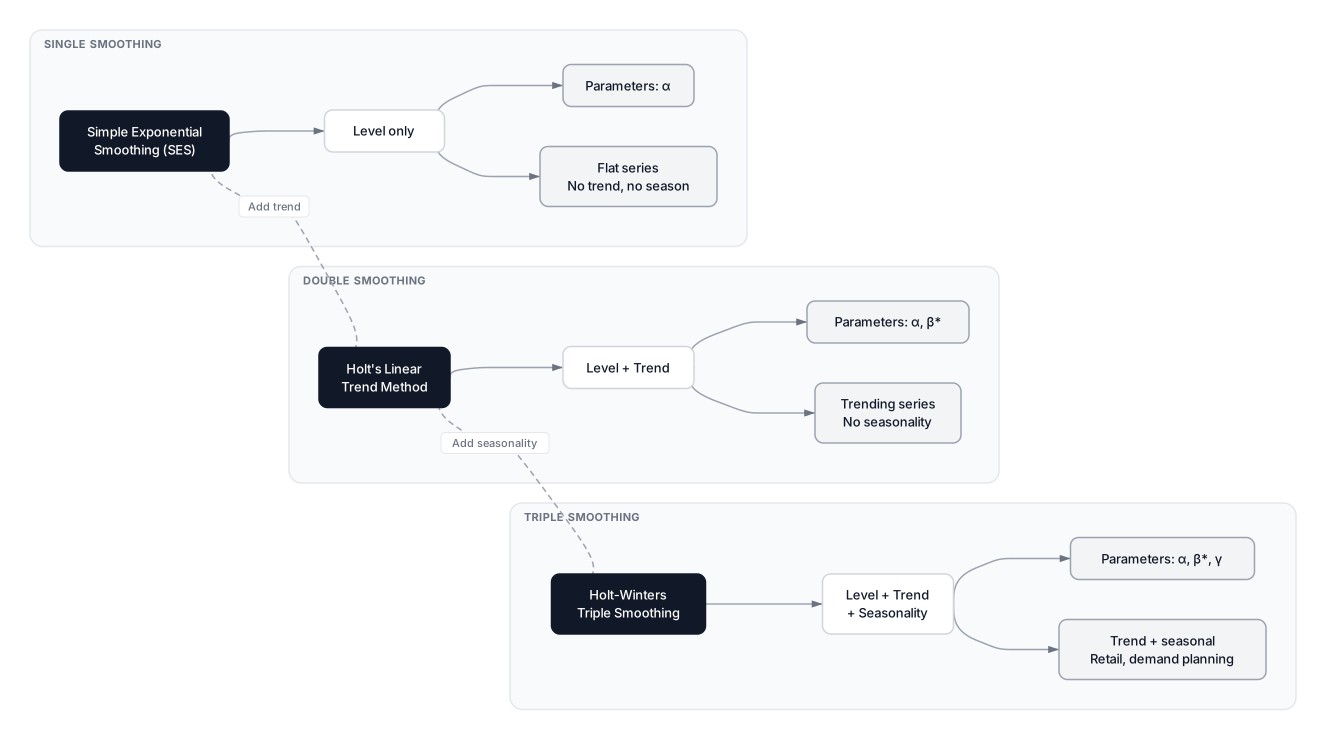 Click to expandProgressive complexity of ETS models from SES through Holt's to Holt-Winters
Simple Exponential Smoothing Tracks the Level
Simple Exponential Smoothing (SES) is a forecasting method for univariate time series that have no trend and no seasonality. It produces forecasts as weighted averages of all past observations, where the weights decay exponentially as data gets older.
A single parameter, (alpha), controls how fast that decay happens:
- High (close to 1): The model forgets quickly. It reacts fast to recent shifts but jitters with every noisy observation.
- Low (close to 0): The model remembers a long history. Forecasts are smooth and stable but slow to respond to genuine changes.
The SES update equation
Where:
- is the smoothed level estimate at time
- is the actual observed value at time (this month's clothing sales)
- is the previous level estimate
- is the smoothing parameter,
In Plain English: Each month, the store's "baseline sales" estimate is a blend: of what actually sold this month, plus of the old estimate. If , the new baseline is 30% today's number and 70% yesterday's belief.
Why the name "exponential"
Unrolling the recursion reveals the weight structure:
The weight on the observation steps back is . Because , raising it to higher powers makes the weight shrink exponentially. An observation from six months ago carries far less influence than last month's number.
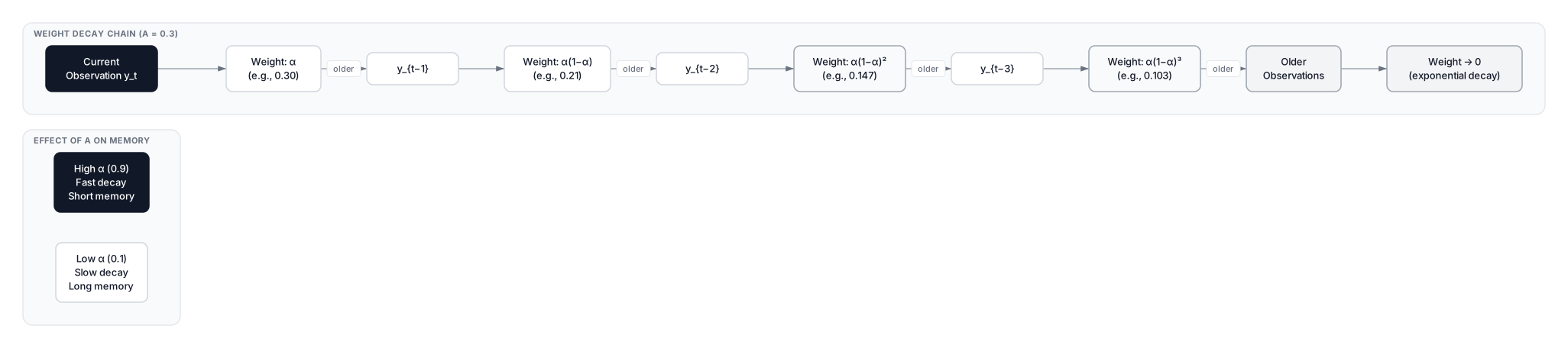 Click to expandHow alpha controls the exponential decay of weights on past observations in SES
Key Insight: A moving average of window size gives equal weight to the last points and zero weight to everything before. SES never fully ignores any past observation; it just makes old data matter less and less. This smooth weighting avoids the "cliff" where a data point suddenly drops out of the window and the forecast jumps.
SES on our clothing store data
The store's monthly sales have been hovering around $50,000 with no clear growth or seasonal pattern (imagine a quiet period before any marketing push). SES fits this flat-signal scenario well.
Expected Output:
Optimal alpha: 0.0000

Last 3 fitted values:
  2025-10: $49,511
  2025-11: $49,511
  2025-12: $49,511

Forecast (next 6 months): $49,511 (flat line)
SES forecasts a flat line because it has no concept of trend or seasonality. Every future month gets the same value: the final level estimate. If your data slopes upward (as our store's sales eventually do), SES will perpetually under-forecast. That is the signal to upgrade to Holt's method.
Common Pitfall: If your SES forecast drifts badly from actuals, the most likely cause is an underlying trend. Adding the trend component (Holt's method) fixes this immediately.
Holt's Method Adds Trend
Holt's Linear Trend method extends SES by decomposing the series into two quantities updated at every time step: a level (where the series is now) and a trend (how fast it is moving). Think of tracking both the position and velocity of a car.
Two smoothing parameters govern the updates:
| Parameter | Controls | Range |
|---|---|---|
| How quickly the level adapts | ||
| How quickly the trend adapts |
Holt's update equations
Level:
Trend:
Forecast steps ahead:
Where:
- is the level at time
- is the trend (slope) at time
- is the observed value (monthly clothing sales)
- is where the model expected the series to be this month
- controls how quickly the trend estimate reacts to apparent changes in slope
- is the forecast horizon (number of months ahead)
In Plain English: The level update blends this month's actual sales with where the model expected sales to land (last month's level plus last month's trend). The trend update blends the recently observed change in level with the previous trend estimate. To forecast our clothing store 6 months out, just extrapolate: if the current level is $75,000 and the monthly trend is $800, the 6-month forecast is $75,000 + 6 x $800 = $79,800.
Holt's method works well when data has a clear directional drift but no repeating seasonal pattern. If you plot the forecast and see a straight line continuing the slope, that is Holt's doing its job. But real retail data is not just a line going up; it spikes in December and dips in February. For that, we need the final piece.
Holt-Winters Captures Seasonality
The Holt-Winters method (Triple Exponential Smoothing) adds a third component, seasonality, to the level and trend. It is the go-to model for data exhibiting both directional drift and repeating periodic patterns, like monthly clothing store sales that spike every holiday season. A third parameter (gamma) controls how quickly the seasonal indices update.
Additive vs. multiplicative seasonality
This choice is the single most consequential modeling decision in Holt-Winters:
| Characteristic | Additive | Multiplicative |
|---|---|---|
| Seasonal amplitude | Constant regardless of level | Grows proportional to level |
| Formula structure | Level + Trend + Season | (Level + Trend) x Season |
| Visual signature | Parallel peaks and troughs | Funnel shape (wider swings as values rise) |
| Typical use | Stable-volume business, temperature | Growing retail, e-commerce revenue |
Common Pitfall: If your store's December spike was $10,000 above average when monthly sales were $50K and is now $20,000 above average at $100K, the seasonal swing is proportional to the level. Using additive seasonality here will underestimate future peaks and overestimate slow months. Choose multiplicative, or apply a log transform first.
Holt-Winters additive equations
Where:
- , are the level and trend at time
- is the seasonal component at time
- is the seasonal period (12 for monthly data with yearly cycles)
- is the seasonal smoothing parameter,
- is the seasonal index from the same month one full cycle ago
- ensures the forecast picks the correct seasonal index for horizon
In Plain English: Before updating the level, we strip out this month's seasonal effect () so the level captures only the de-seasonalized signal. The seasonal component updates by comparing today's observation to what the non-seasonal model expected. To forecast, we add the appropriate seasonal index from the last completed cycle back onto the projected trend line. For our clothing store, December's seasonal index might be +$15,000 while February's might be -$8,000.
Damped trend prevents runaway forecasts
Projecting a linear trend forever is dangerous: no store's sales grow at $800/month indefinitely. A damped trend adds a parameter (phi), , that gradually flattens the slope:
When , the trend contribution decays by 5% each step. In the M4 forecasting competition (100,000 real time series across multiple domains), damped trend models consistently outperformed their undamped counterparts, especially at longer horizons. Use damped_trend=True as your default.
Full Holt-Winters on our clothing store
Our store now has 4 years of monthly sales with an upward trend and a clear December peak that grows proportionally with overall revenue. This is textbook multiplicative seasonality.
Expected Output:
Alpha (level):    0.1365
Beta* (trend):    0.1365
Gamma (seasonal): 0.0000
Phi (damping):    0.9950

12-month forecast:
  2026-01: $66,606
  2026-02: $60,277
  2026-03: $69,000
  2026-04: $76,920
  2026-05: $80,104
  2026-06: $85,352
  2026-07: $81,694
  2026-08: $78,904
  2026-09: $86,690
  2026-10: $90,956
  2026-11: $96,920
  2026-12: $117,794
The December forecast shows the highest value, exactly as expected. The trend projects growth but the damping parameter prevents it from shooting upward indefinitely.
Choosing the Right ETS Variant
The ETS framework names each model with a three-letter code: (Error, Trend, Seasonality). Each letter is one of N (none), A (additive), M (multiplicative), or Ad (additive damped). That gives 30 possible combinations, though about 15 see regular use.
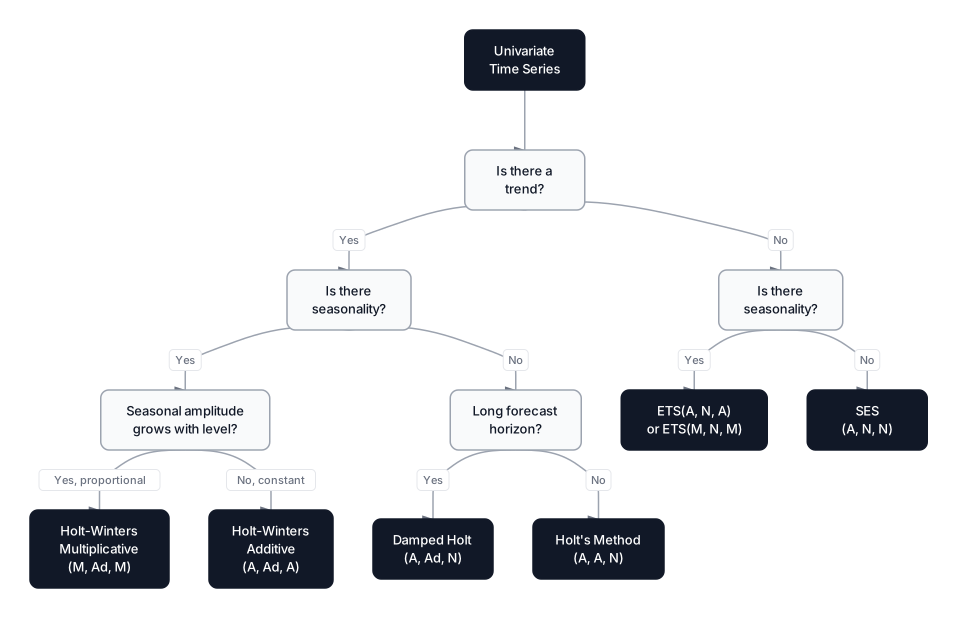 Click to expandDecision guide for selecting the right ETS variant based on data characteristics
| Data Pattern | Recommended Model | statsmodels Parameters |
|---|---|---|
| No trend, no seasonality | SES (A,N,N) | SimpleExpSmoothing |
| Trend, no seasonality | Holt's (A,A,N) or (A,Ad,N) | Holt(damped_trend=True) |
| No trend, constant seasonality | (A,N,A) | seasonal="add", no trend |
| Trend + constant seasonality | (A,A,A) or (A,Ad,A) | trend="add", seasonal="add" |
| Trend + growing seasonality | (A,A,M) or (A,Ad,M) | trend="add", seasonal="mul" |
Pro Tip: When in doubt, fit several variants and compare their AIC (Akaike Information Criterion). The statsmodels .fit() method stores it as model.aic. Lower AIC means a better balance of fit and complexity. In practice, (A,Ad,M) wins more often than you might expect because real-world seasonal amplitudes usually scale with the level and trends rarely stay linear forever.
ETS vs. ARIMA
Both ETS and ARIMA are univariate statistical methods, but they approach the problem from opposite directions.
| Criterion | ETS | ARIMA |
|---|---|---|
| Core idea | Decompose into level, trend, seasonal components | Model autocorrelations and differenced errors |
| Stationarity | Not required; handles trend and seasonality natively | Must difference the series to stationarity |
| Seasonality | Explicit seasonal component; easy to specify | SARIMA requires (P,D,Q,m) order selection |
| Interpretability | High: you can inspect , , directly | Moderate: AR and MA coefficients are less intuitive |
| External regressors | Not natively supported | ARIMAX / SARIMAX supports regressors |
| Best for | Clear trend + seasonal decomposition (retail, demand) | Complex short-lag dependencies, regression effects |
When your series has a clean decomposable structure, start with ETS. When you need external variables like price or temperature, or when the autocorrelation structure is complex, reach for ARIMA. Many practitioners fit both and pick the lower AIC. For richer decomposition with holidays and multiple seasonalities, Prophet is worth a look.
When to Use Exponential Smoothing (and When Not To)
Use ETS when:
- You have a single univariate time series with identifiable trend and/or seasonality
- Speed matters: ETS fits in milliseconds, even on daily data spanning years
- You need interpretable components that business stakeholders can inspect
- Your series is relatively "well-behaved" with no sudden structural breaks
- You want a strong baseline before trying anything more complex
Do NOT use ETS when:
- You have multiple exogenous regressors that drive the target (use SARIMAX or gradient boosting)
- Your data has multiple overlapping seasonal periods, for example daily + weekly + yearly (use Prophet or multi-step forecasting strategies)
- You need to capture long-range nonlinear dependencies across hundreds of time steps (consider LSTMs)
- Your series has irregular timestamps or heavy missing data
- You need probabilistic forecasts with complex distributional assumptions
Pro Tip: In production, always fit ETS as a baseline. It takes seconds, costs nothing, and provides a hard floor that fancier models must beat. If your deep learning forecast cannot outperform Holt-Winters, something is wrong with the pipeline, not with ETS.
Production Considerations
Computational complexity: Fitting ETS is where is the series length and is the number of parameters to optimize (3-4 for Holt-Winters). This is orders of magnitude cheaper than training an LSTM or even running ARIMA's auto-order selection.
Memory: The state-space representation stores only the latest level, trend, and one full cycle of seasonal indices. For monthly data with yearly seasonality, that is just 14 numbers regardless of how long the historical series is.
Scaling to many series: Retail companies forecast millions of SKUs. ETS's speed makes it practical to fit one model per SKU with automatic parameter optimization. The statsmodels implementation handles a 10-year monthly series in under 50ms.
Warm-start requirements: ETS needs at least two full seasonal cycles of data to estimate seasonal indices reliably. With monthly data and yearly seasonality, that means 24 observations minimum. Fewer than that and you should fall back to SES or Holt's method.
Re-estimation frequency: Re-fit the model whenever you have meaningful new data (weekly for daily series, monthly for weekly series). The optimized parameters shift slowly, so you do not need to re-fit after every single observation.
Choosing an Exponential Smoothing Model
Exponential smoothing earns its place in every forecaster's toolkit by turning one elegant idea into a production-grade system. Weight recent data more heavily, decompose the signal into level, trend, and seasonality, and let maximum likelihood find the best smoothing parameters. SES handles flat series. Holt's method adds slope. Holt-Winters captures repeating cycles. The damped trend variant prevents runaway projections and has been the quiet champion of forecasting competitions since the M3 competition in 2000.
The ETS family pairs naturally with other time series techniques. If your data needs stationarity testing or differencing, ARIMA provides a complementary perspective. For business-facing forecasts with holiday effects and changepoints, Prophet extends many of the same ideas. And when you have enough data and complex nonlinear patterns that ETS simply cannot capture, LSTMs are worth exploring, though only after ETS sets the baseline.
Start with the simplest model that could possibly work. For most univariate time series, that model is Holt-Winters with a damped trend.
Interview Questions
Q: What happens when you set alpha to 0 or 1 in Simple Exponential Smoothing?
At , the forecast equals the most recent observation (a naive random walk with no smoothing at all). At , the forecast never updates from the initial level and ignores all new data entirely. Neither extreme is useful in practice. Optimized alphas typically fall between 0.05 and 0.5 for most business time series.
Q: How does Holt-Winters decide between additive and multiplicative seasonality?
Look at the raw plot. If seasonal swings stay constant as the level rises, use additive. If they grow proportionally (the December spike gets bigger as overall sales increase), use multiplicative. Quantitatively, fit both variants and compare AIC or out-of-sample RMSE. A log-transform on the target converts multiplicative seasonality into additive, which is another common approach.
Q: Why does damped trend often outperform linear trend in forecasting competitions?
Linear trend extrapolates the current slope indefinitely, which is unrealistic for most real-world series. Sales do not grow at the same rate forever. The damping parameter gradually attenuates the trend contribution, so longer-horizon forecasts converge toward a constant level. This conservative behavior reduces catastrophic overforecasting, especially beyond one or two seasonal cycles.
Q: Can exponential smoothing handle multiple seasonalities?
Standard Holt-Winters supports exactly one seasonal period. If your daily data has both weekly and yearly patterns, you need extensions like Double Seasonal Holt-Winters (Taylor, 2003), TBATS, or switch to Prophet, which natively handles multiple Fourier-based seasonalities.
Q: An interviewer asks you to fit forecast models on 100,000 time series in under an hour. What do you choose?
ETS is the answer. It fits a single series in under 50ms, so 100,000 series take roughly 80 minutes in serial and just minutes with basic parallelization. ARIMA's auto-order selection is 10-100x slower per series. Deep learning requires GPU infrastructure that is impractical at this scale for most teams.
Q: Your Holt-Winters forecast works well for 3 months but deteriorates badly at 12 months. What do you check?
Three things, in order. First, verify the seasonal period is correct ($m = 12$ for yearly cycles, not $m = 4$). Second, check additive vs. multiplicative by plotting residuals against the fitted level. Third, look for structural breaks or regime changes that violate the assumption of stable patterns. ETS assumes the underlying structure is consistent; a sudden shock like a pandemic will break that assumption.
Q: What is the ETS state-space framework and why does it matter?
Hyndman et al. reformulated exponential smoothing as state-space models where each variant has explicit observation and state equations. This provides proper likelihood functions for AIC-based model selection, valid prediction intervals, and a principled way to compare all 30 ETS variants automatically. Without the state-space formulation, exponential smoothing was just a collection of recursive formulas with no statistical foundation for inference.
Hands-On Practice
In this hands-on tutorial, we will master the art of Exponential Smoothing, the engine behind many industrial forecasting systems. Moving beyond simple averages, you will implement Simple Exponential Smoothing (SES) to grasp the concept of weighted memory, and advance to Triple Exponential Smoothing (Holt-Winters) to capture trends and seasonality. We will use a realistic retail sales dataset that exhibits clear seasonal patterns, making it the perfect playground to see how these algorithms separate signal from noise.
Dataset: Retail Sales (Time Series) 3 years of daily retail sales data with clear trend, weekly/yearly seasonality, and related features. Includes sales, visitors, marketing spend, and temperature. Perfect for ARIMA, Exponential Smoothing, and Time Series Forecasting.
Try modifying the seasonal_periods parameter to 30 or 365 to see if capturing monthly or yearly seasonality improves the forecast further. You can also experiment with trend='mul' (multiplicative) to see how the model behaves if the sales growth accelerates over time rather than growing linearly. Observing how the Alpha, Beta, and Gamma parameters change with different configurations provides deep insight into how the model 'views' the stability of your data.