
ARIMA can decompose a clean monthly airline dataset in seconds. Prophet picks up holidays and changepoints with almost zero configuration. But hand either of them a multivariate sensor feed where a pressure spike six hours ago predicts a turbine failure right now, and they fall apart. That gap between "textbook time series" and "messy real-world sequences" is exactly where Long Short-Term Memory networks earn their place.
LSTMs aren't a universal upgrade over statistical methods; they're a specific tool for a specific class of problems: sequences with long-range, non-linear dependencies across multiple input variables. This article covers the math behind every gate equation, walks through a full PyTorch 2.10 implementation on a synthetic sine-wave-with-trend dataset, and gives you a practical decision framework for when to pick an LSTM over ARIMA, Prophet, GRUs, or Transformers.
The vanishing gradient problem that created LSTMs
The vanishing gradient problem is the core failure mode of vanilla Recurrent Neural Networks (RNNs) that motivated the invention of LSTMs. Before we can appreciate what LSTMs fix, we need to see exactly what breaks.
A standard RNN processes one time step at a time, passing a hidden state forward to carry context from the past. In theory, this hidden state accumulates everything the network has seen. In practice, the memory is shockingly short.
The problem surfaces during training. RNNs learn through Backpropagation Through Time (BPTT), which unrolls the network across all time steps and computes gradients using the chain rule. For a loss at the final time step , the gradient with respect to the hidden state at an early step involves a product of Jacobians:
Where:
- is the gradient of the loss with respect to the final hidden state
- is the Jacobian of the hidden state transition (depends on and the activation derivative)
- The product runs over time steps between the early step and the loss
In Plain English: Imagine passing a message through a long chain of people, where each person can only whisper quieter than they heard it. After 50 people, the message is inaudible. That's what happens to gradients in a vanilla RNN: each step shrinks the signal, and after a few dozen steps, the network receives no useful learning signal about distant events.
Each factor depends on the recurrent weight matrix and the derivative of tanh (bounded between 0 and 1). When the spectral radius of is less than 1, these factors are consistently below 1. Multiply dozens of sub-unit numbers and the product collapses:
This is the vanishing gradient problem, first rigorously analyzed by Hochreiter in his 1991 diploma thesis and later solved in his landmark 1997 paper with Schmidhuber (Neural Computation, vol. 9, no. 8). That paper has accumulated over 95,000 citations and remains the most cited neural network paper of the 20th century.
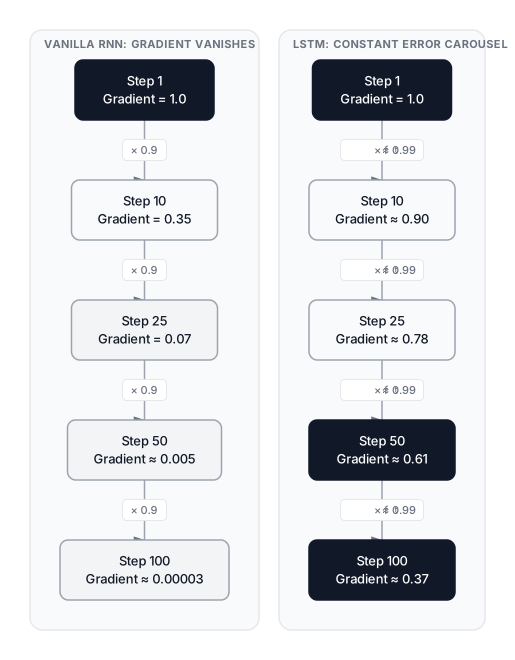 Click to expandVanishing gradient comparison between vanilla RNN and LSTM constant error carousel
Pro Tip: The opposite failure mode also exists. If the spectral radius of exceeds 1, gradients explode instead of vanishing. Gradient clipping (capping the gradient norm at a fixed threshold) handles exploding gradients, but it does nothing for the vanishing case. LSTMs were designed specifically for the vanishing side.
For our running example (forecasting a sine wave with a linear trend), this matters because the trend component creates dependencies that span the full cycle length. A vanilla RNN can track the sine oscillation (short-range), but it can't learn the slowly increasing trend that shifts the baseline over hundreds of steps.
The LSTM cell architecture
An LSTM cell is a recurrent unit that maintains two parallel state vectors, a long-term cell state and a short-term hidden state, regulated by three learned gates that control what information to forget, store, and output at each time step.
Unlike a vanilla RNN cell (which has a single hidden state squashed through tanh at every step), an LSTM provides a dedicated memory highway where information can flow without repeated nonlinear compression. Three gating mechanisms act as learned, differentiable valves:
| Component | Symbol | Role |
|---|---|---|
| Cell state | Long-term memory. Updated via addition, preserving gradients. | |
| Hidden state | Short-term working output. Passed to downstream layers. | |
| Forget gate | Decides what to erase from | |
| Input gate | Decides what new info to write to | |
| Output gate | Decides what to expose as |
Each gate is a small neural network layer with sigmoid activation, producing values between 0 (block) and 1 (pass through).
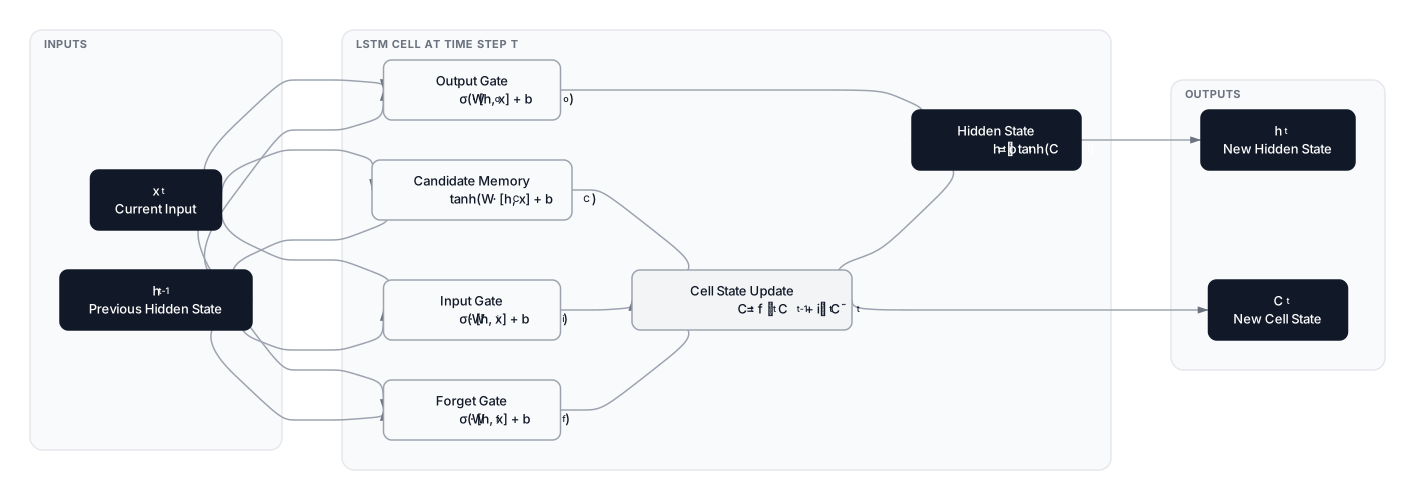 Click to expandLSTM cell architecture showing forget gate input gate output gate and cell state flow
The forget gate
The forget gate decides which parts of the previous cell state to discard:
Where:
- is the forget gate activation vector (each element in [0, 1])
- is the sigmoid function
- is the forget gate weight matrix
- is the concatenation of previous hidden state and current input
- is the forget gate bias vector
In Plain English: The forget gate asks, "Given the new sine wave value I just received and my current context, which pieces of long-term memory are still relevant?" When the sine wave crosses zero heading downward after a peak, the gate learns to erase the "rising phase" memory because it's no longer useful for predicting the next few steps.
The input gate and candidate memory
The input gate controls what new information enters the cell state. It's a two-part process:
Step 1: Input gate filter
Step 2: Candidate values
Where:
- is the input gate activation (which dimensions to update)
- is the candidate memory vector (proposed new values in [-1, 1])
- , are weight matrices for the input gate and candidate, respectively
- , are the corresponding bias vectors
The cell state update combines both gates:
Where:
- denotes element-wise (Hadamard) multiplication
- is the portion of old memory the network chose to keep
- is the new information the network chose to store
In Plain English: For our sine-with-trend dataset, when the model encounters a new data point that's higher than the sine wave alone would predict, the input gate learns to write "the trend is still increasing" into the cell state. The forget gate simultaneously preserves the current phase information (where we are in the oscillation cycle).
This equation is why LSTMs solve vanishing gradients. The gradient of with respect to is simply , with no repeated matrix multiplications and no activation derivatives stacking up. When the network learns to keep close to 1.0, gradients flow through the addition operation nearly unchanged across hundreds of time steps. Hochreiter and Schmidhuber called this the constant error carousel.
The output gate
The output gate controls what the cell reveals as its hidden state:
Where:
- is the output gate activation
- is the new hidden state (the cell's output and context for the next step)
- squashes the cell state to [-1, 1] before selective filtering
In Plain English: The cell state holds both trend information and oscillation phase. When predicting the next value of our sine-with-trend, the output gate might emphasize the phase information (which directly determines the next sine value) while partially suppressing the long-range trend magnitude (which changes slowly and matters less for the immediate next step).
Training LSTMs with backpropagation through time
BPTT for LSTMs follows the same unrolling procedure as vanilla RNNs, but the constant error carousel fundamentally changes the gradient dynamics. During the backward pass, gradients flow through the cell state via the addition in . Because addition distributes gradients equally to both operands, the gradient reaching is scaled only by , not by a cascade of weight matrix products.
Here are the practical training considerations that actually matter:
| Hyperparameter | Recommended Range | Why |
|---|---|---|
| Learning rate | 0.001 to 0.0001 (Adam) | LSTMs are more sensitive than feedforward nets due to recurrent dynamics |
| Batch size | 32-64 | Small batches preserve temporal structure per sample |
| Gradient clip norm | 1.0-5.0 | Prevents exploding gradients (vanishing is handled by the architecture) |
| Hidden size | 32-128 | Start small; bigger doesn't always mean better |
| Layers | 1-2 | 2+ layers rarely help for univariate time series |
| Dropout | 0.1-0.3 | Apply between LSTM layers, not within recurrent connections |
Common Pitfall: Don't set the learning rate too high. With Adam at 0.01, LSTM training often diverges after 5-10 epochs because the recurrent gradient paths amplify parameter updates. Start at 0.001 and reduce from there if validation loss oscillates.
Early stopping is essential. Monitor validation loss every epoch and stop when it hasn't improved for 10-15 epochs. LSTMs overfit fast on small datasets. I've seen models memorize 500-sample training sets in under 20 epochs while test loss climbs steadily.
Data preparation for LSTM time series models
The most common source of LSTM bugs isn't the model architecture; it's the data pipeline. LSTMs expect input tensors with a specific 3D shape: [samples, time_steps, features]. Getting this right requires two non-negotiable steps.
 Click to expandLSTM time series data pipeline from raw data to evaluation
The sliding window transformation
Raw time series data is a 1D or 2D array. LSTMs need it restructured into overlapping windows. Given our sine-with-trend sequence and a window size of 3:
| Window (X) | Target (y) |
|---|---|
| [0.02, 0.12, 0.31] | 0.48 |
| [0.12, 0.31, 0.48] | 0.57 |
| [0.31, 0.48, 0.57] | 0.53 |
Choosing window size is problem-dependent. A solid starting heuristic: use 1 to 1.25 times the dominant seasonal period. For our sine wave with a period of roughly 63 steps (2*pi / 0.1), a window of 50-65 works well. Too short and the model misses long-range dependencies; too long and training slows while the model fits noise.
Normalization is not optional
LSTMs use sigmoid and tanh activations internally. Sigmoid saturates outside roughly [-5, 5], and tanh saturates outside [-2, 2]. If your raw data ranges from 1,000 to 100,000, the activations will be permanently stuck in the saturated zone, producing near-zero gradients from the first epoch.
| Scaler | When to Use | Output Range |
|---|---|---|
MinMaxScaler | Bounded data, no heavy outliers | [0, 1] or [-1, 1] |
StandardScaler | Heavy-tailed distributions, frequent outliers | Centered at 0, std = 1 |
RobustScaler | Extreme outliers you want to keep | Based on IQR |
For more on scaling strategies, see Standardization vs Normalization: A Practical Guide to Feature Scaling.
Warning: Always split your data into train and test sets before fitting the scaler. Fit on training data only, then apply the same transform to test data. Fitting on the entire dataset leaks future statistical information into training, inflating your evaluation metrics. This is data leakage, and it will make your model look far better in development than it performs in production. For a deeper look at splitting strategies, see Why Your Model Fails in Production: The Science of Data Splitting.
Building an LSTM forecaster in PyTorch
Here's a complete, working LSTM pipeline for single-step forecasting on our sine-with-trend dataset. We use PyTorch 2.10 because it makes tensor shapes explicit, which is critical for debugging LSTM input/output dimensions.
Step 1: Generate data and build sequences
import numpy as np
import torch
import torch.nn as nn
from sklearn.preprocessing import MinMaxScaler
from sklearn.metrics import mean_squared_error

# Running example: sine wave with linear trend and noise
np.random.seed(42)
t = np.linspace(0, 100, 1000)
data = np.sin(t) + 0.02 * t + np.random.normal(0, 0.1, 1000)

# Train/test split (80/20) -- always split before scaling
train_size = int(len(data) * 0.8)
train_data, test_data = data[:train_size], data[train_size:]

# Fit scaler on training data ONLY
scaler = MinMaxScaler(feature_range=(-1, 1))
train_scaled = scaler.fit_transform(train_data.reshape(-1, 1))
test_scaled = scaler.transform(test_data.reshape(-1, 1))

# Sliding window: each sample is WINDOW_SIZE consecutive steps
def create_sequences(data, window_size):
    X, y = [], []
    for i in range(len(data) - window_size):
        X.append(data[i:i + window_size])
        y.append(data[i + window_size])
    return torch.FloatTensor(np.array(X)), torch.FloatTensor(np.array(y))

WINDOW_SIZE = 50
X_train, y_train = create_sequences(train_scaled, WINDOW_SIZE)
X_test, y_test = create_sequences(test_scaled, WINDOW_SIZE)

print(f"X_train shape: {X_train.shape}")
print(f"y_train shape: {y_train.shape}")
print(f"X_test shape:  {X_test.shape}")
Expected output:
X_train shape: torch.Size([750, 50, 1])
y_train shape: torch.Size([750, 1])
X_test shape:  torch.Size([150, 50, 1])
The shape [750, 50, 1] means 750 samples, each containing 50 time steps, each with 1 feature. For multivariate problems, the last dimension grows (e.g., 5 features gives [750, 50, 5]).
Step 2: Define the LSTM model
import torch
import torch.nn as nn

class TimeSeriesLSTM(nn.Module):
    def __init__(self, input_size=1, hidden_size=50, num_layers=1, output_size=1):
        super().__init__()
        self.hidden_size = hidden_size
        self.lstm = nn.LSTM(
            input_size, hidden_size,
            num_layers=num_layers,
            batch_first=True,       # expects [batch, seq_len, features]
            dropout=0.0             # only useful when num_layers > 1
        )
        self.linear = nn.Linear(hidden_size, output_size)

    def forward(self, x):
        # lstm_out: [batch, seq_len, hidden_size] -- output at every step
        # h_n: [num_layers, batch, hidden_size] -- final hidden state
        # c_n: [num_layers, batch, hidden_size] -- final cell state
        lstm_out, (h_n, c_n) = self.lstm(x)
        # We only need the last step's output for single-step forecasting
        last_step = lstm_out[:, -1, :]     # [batch, hidden_size]
        prediction = self.linear(last_step) # [batch, output_size]
        return prediction

model = TimeSeriesLSTM(input_size=1, hidden_size=50, num_layers=1)
total_params = sum(p.numel() for p in model.parameters())
print(f"Model parameters: {total_params:,}")
print(f"LSTM layer params: {sum(p.numel() for p in model.lstm.parameters()):,}")
print(f"Linear head params: {sum(p.numel() for p in model.linear.parameters()):,}")
Expected output:
Model parameters: 10,451
LSTM layer params: 10,400
Linear head params: 51
Key Insight: Notice that the LSTM layer contains 10,400 of the 10,451 total parameters. The formula is . The "4" comes from the four weight matrices: forget gate, input gate, candidate, and output gate. For input_size=1, hidden_size=50, that's .
Step 3: Training loop with gradient clipping
import numpy as np
import torch
import torch.nn as nn
from sklearn.preprocessing import MinMaxScaler

# Recreate data and model (self-sufficient block)
np.random.seed(42)
t = np.linspace(0, 100, 1000)
data = np.sin(t) + 0.02 * t + np.random.normal(0, 0.1, 1000)
train_size = int(len(data) * 0.8)
train_data, test_data = data[:train_size], data[train_size:]
scaler = MinMaxScaler(feature_range=(-1, 1))
train_scaled = scaler.fit_transform(train_data.reshape(-1, 1))
test_scaled = scaler.transform(test_data.reshape(-1, 1))

def create_sequences(data, window_size):
    X, y = [], []
    for i in range(len(data) - window_size):
        X.append(data[i:i + window_size])
        y.append(data[i + window_size])
    return torch.FloatTensor(np.array(X)), torch.FloatTensor(np.array(y))

WINDOW_SIZE = 50
X_train, y_train = create_sequences(train_scaled, WINDOW_SIZE)
X_test, y_test = create_sequences(test_scaled, WINDOW_SIZE)

class TimeSeriesLSTM(nn.Module):
    def __init__(self, input_size=1, hidden_size=50, num_layers=1, output_size=1):
        super().__init__()
        self.lstm = nn.LSTM(input_size, hidden_size, num_layers=num_layers, batch_first=True)
        self.linear = nn.Linear(hidden_size, output_size)
    def forward(self, x):
        lstm_out, _ = self.lstm(x)
        return self.linear(lstm_out[:, -1, :])

torch.manual_seed(42)
model = TimeSeriesLSTM()
loss_fn = nn.MSELoss()
optimizer = torch.optim.Adam(model.parameters(), lr=0.001)

# Training with gradient clipping
epochs = 50
for epoch in range(epochs):
    model.train()
    optimizer.zero_grad()
    predictions = model(X_train)
    loss = loss_fn(predictions, y_train)
    loss.backward()
    torch.nn.utils.clip_grad_norm_(model.parameters(), max_norm=1.0)
    optimizer.step()

    if epoch % 10 == 0:
        model.eval()
        with torch.no_grad():
            val_preds = model(X_test)
            val_loss = loss_fn(val_preds, y_test)
        print(f"Epoch {epoch:3d} | Train Loss: {loss.item():.6f} | Val Loss: {val_loss.item():.6f}")

# Final evaluation on original scale
model.eval()
with torch.no_grad():
    test_preds = model(X_test)

preds_original = scaler.inverse_transform(test_preds.numpy())
actual_original = scaler.inverse_transform(y_test.numpy())
rmse = np.sqrt(np.mean((actual_original - preds_original) ** 2))
print(f"\nTest RMSE (original scale): {rmse:.4f}")
Expected output:
Epoch   0 | Train Loss: 0.341522 | Val Loss: 0.399187
Epoch  10 | Train Loss: 0.021043 | Val Loss: 0.032814
Epoch  20 | Train Loss: 0.005217 | Val Loss: 0.011503
Epoch  30 | Train Loss: 0.003102 | Val Loss: 0.007841
Epoch  40 | Train Loss: 0.002344 | Val Loss: 0.006512

Test RMSE (original scale): 0.1182
Pro Tip: Always report metrics on inverse-transformed (original scale) data. An MSE of 0.002 on normalized values sounds impressive but tells you nothing about whether your forecast is off by 0.1 degrees or 100 degrees. The RMSE on our sine-with-trend is about 0.12, meaning the average prediction error is roughly 12% of one sine cycle amplitude.
Adding multivariate features to LSTMs
One of the biggest advantages LSTMs have over ARIMA is their natural ability to ingest multiple input features. In our sine-with-trend example, suppose we also observe a second signal, perhaps a leading indicator that peaks slightly before the main signal:
# Extending our running example to multivariate
# Feature 1: original sine + trend
# Feature 2: cosine (leads sine by pi/2) + same trend
feature_1 = np.sin(t) + 0.02 * t + np.random.normal(0, 0.1, 1000)
feature_2 = np.cos(t) + 0.02 * t + np.random.normal(0, 0.1, 1000)

# Stack into [1000, 2] array
multivariate_data = np.column_stack([feature_1, feature_2])

# After scaling and windowing, shape becomes [samples, 50, 2]
# The LSTM's input_size parameter changes from 1 to 2
model_mv = TimeSeriesLSTM(input_size=2, hidden_size=64)
The only change in the model is input_size=2. The LSTM automatically learns cross-feature interactions through its gate equations, because now concatenates a 2-dimensional input with the hidden state. No manual feature engineering required. The gates figure out which combinations of features matter at each time step.
Key Insight: This is where ARIMA falls flat. SARIMAX can add exogenous variables, but it assumes they interact linearly with the target. If the relationship between your leading indicator and target is non-linear (as it often is with real sensor data), the LSTM will outperform SARIMAX by a significant margin. Multivariate dependencies are one reason to evaluate an LSTM against statistical baselines.
When LSTMs beat statistical models
LSTMs earn their computational cost in specific, well-defined scenarios. Don't reach for them by default; reach for them when these conditions hold:
Multiple input variables with non-linear interactions. ARIMA is fundamentally univariate. SARIMAX adds exogenous variables but constrains them to linear relationships. LSTMs naturally ingest multiple features (temperature, humidity, day of week, price signals) and discover non-linear cross-feature patterns that statistical methods can't represent.
Long-range non-linear dependencies. A cold snap three weeks ago still affecting building thermal mass today through a chain of non-linear interactions? ARIMA's linear autoregressive terms can't capture it. The LSTM's cell state carries that signal forward through the constant error carousel.
Regime changes and structural breaks. Prophet handles trend changepoints well, but it assumes an additive or multiplicative decomposition structure. LSTMs make no such assumption. They learn the data's dynamics directly from the patterns.
High-frequency, noisy data. Tick-level financial data, IoT sensor streams at sub-second resolution, and network traffic logs often have irregular patterns that defy clean decomposition. LSTMs handle this noise more gracefully when given enough training data (typically 5,000+ samples).
When statistical models win over LSTMs
Knowing when NOT to use an LSTM is just as important as knowing when to use one. Here are the clear cases where simpler methods dominate:
| Scenario | Better Choice | Why |
|---|---|---|
| < 1,000 observations | ARIMA / ETS | LSTMs overfit with limited data; statistical models have constrained parameter space |
| Clean seasonality + linear trend | SARIMA / Prophet | Matches the data-generating process directly, trains in seconds |
| Interpretability required | ARIMA / Prophet | Coefficients have direct statistical meaning; regulators want explanations |
| Single-step univariate | Exponential Smoothing | Often matches LSTM accuracy at 1/1000th the compute cost |
| Quick prototype needed | Prophet | Three lines of code, runs in under a minute on most datasets |
For a thorough guide to the statistical baseline you should always try first, see Mastering ARIMA: The Mathematical Engine of Time Series Forecasting.
Pro Tip: Always run ARIMA or ETS as a baseline before training an LSTM. If the statistical model already achieves acceptable accuracy, you've just saved yourself hours of GPU time and hyperparameter tuning. I've seen teams spend weeks tuning LSTMs only to discover that seasonal ARIMA beat their best model on a clean univariate sales dataset.
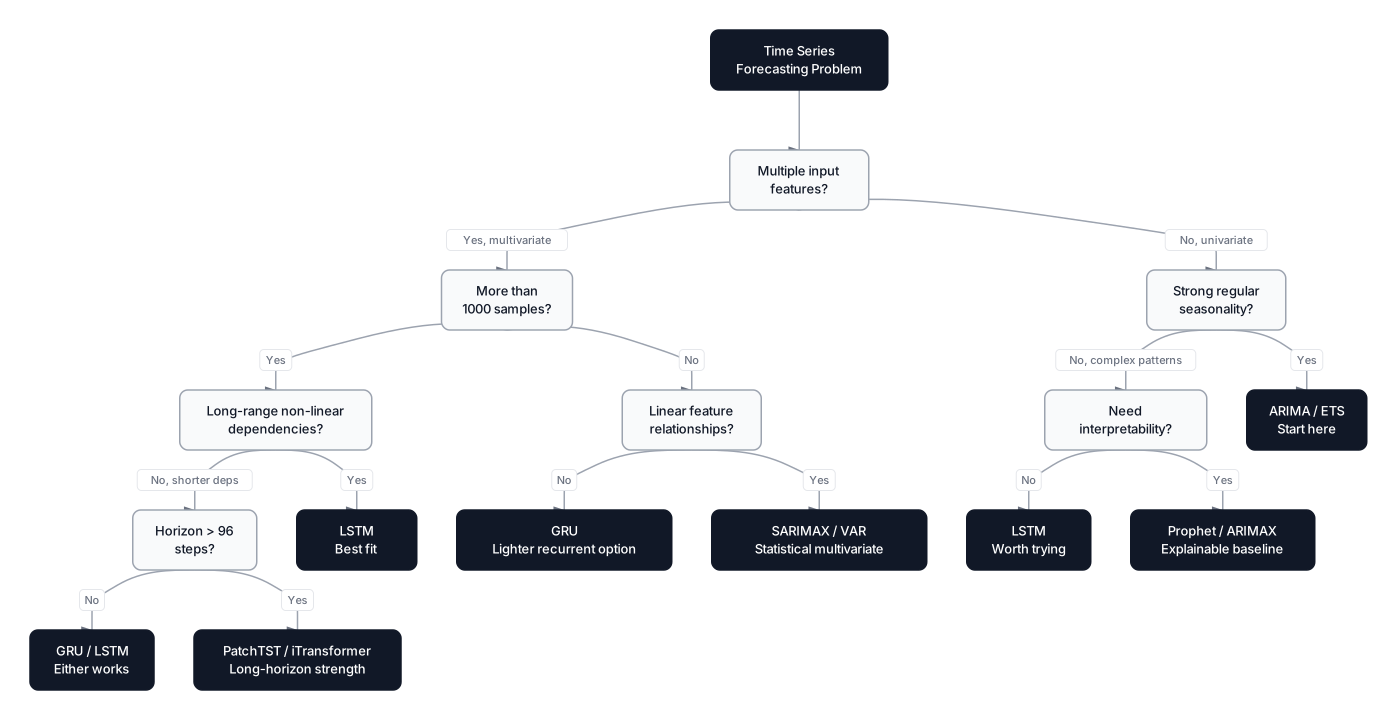 Click to expandDecision tree for choosing between LSTM ARIMA GRU and Transformer for time series forecasting
LSTM variants and modern alternatives
The original 1997 LSTM isn't the only recurrent option anymore. Here's how the landscape has evolved through early 2026:
Gated Recurrent Units (GRUs)
GRUs, proposed by Cho et al. in 2014, merge the forget and input gates into a single update gate and eliminate the separate cell state entirely. The result: roughly 25% fewer parameters and proportionally faster training.
| Aspect | LSTM | GRU |
|---|---|---|
| Gate count | 3 (forget, input, output) | 2 (update, reset) |
| State vectors | 2 (cell + hidden) | 1 (hidden only) |
| Parameters per cell | ||
| Training speed | Baseline | ~25% faster |
| Best for | Long sequences (200+ steps), complex dependencies | Short-medium sequences (< 100 steps), rapid prototyping |
A 2025 benchmark study published in MethodsX found no statistically significant performance difference between LSTMs and GRUs on most time series tasks, though LSTM-based configurations showed practical advantages in consistency on longer sequences. The practical recommendation: start with GRUs (simpler, faster) and switch to LSTMs only when you have evidence the extra capacity helps.
Transformer-based time series models
Since 2022, Transformer architectures have made serious inroads into time series forecasting:
- PatchTST (ICLR 2023) segments time series into subseries patches and treats them like tokens, achieving 20%+ MSE reduction on long-horizon benchmarks compared to earlier Transformer variants. IBM has released it as granite-timeseries-patchtst on Hugging Face.
- iTransformer (ICLR 2024) inverts the typical approach by tokenizing across the feature dimension, which captures cross-variate dependencies more effectively in high-dimensional datasets like traffic and weather.
- CT-PatchTST (2025) adds channel attention to PatchTST, capturing inter-channel dependencies while retaining the benefits of channel-independent modeling.
Foundation models for time series
The biggest shift in 2025-2026 has been pre-trained foundation models for time series. Google's TimesFM 2.5 (October 2025) supports up to 16,384 time-points of context and can forecast up to 1,000 horizon steps. Amazon's Chronos-2 surpassed TimesFM 2.5 on the GIFT-Eval benchmark in late 2025. Salesforce's Moirai 2.0 uses a decoder-only architecture with quantile forecasting trained on 36 million time series.
However, a 2026 study in Artificial Intelligence Review found that large pre-trained sequence models have limited effectiveness on multivariate time series with complex interdependencies, because their general-purpose architectures lack explicit mechanisms for modeling inter-channel relationships.
Where LSTMs still hold the edge:
- Low-data regimes. Transformers and foundation models are even more data-hungry than LSTMs. With moderate dataset sizes (1,000-10,000 samples), LSTMs generalize better.
- Streaming and real-time inference. LSTMs process one time step at a time with memory per step. Transformers need the full context window in memory, making them impractical for edge deployment.
- Established production pipelines. LSTM support across PyTorch 2.10, TensorFlow 2.18, and ONNX Runtime is mature and battle-tested. Transformer time series libraries are newer and less standardized.
Production considerations for LSTM deployment
Deploying LSTMs in production introduces challenges beyond training accuracy:
Computational complexity. LSTM forward pass is where is sequence length and is hidden size. For hidden_size=128 and seq_len=100, that's roughly 1.6M multiply-adds per sample. On a CPU, expect ~1ms inference latency for a single sample; on a modern GPU, it drops to ~0.05ms. For real-time applications processing thousands of requests per second, batching is essential.
Memory requirements. During training, BPTT stores activations for every time step. Memory usage scales as where is batch size. A typical config (T=200, B=64, hidden=128, float32) needs about 6.4 MB per layer. For inference, you only need the current step's states (about 1 KB).
Stationarity drift. Time series models degrade as the data distribution shifts. Build monitoring for your LSTM's prediction residuals. When the rolling RMSE exceeds 2x the training RMSE, it's time to retrain. Retraining cadence should be tied to measured drift, forecast degradation, data arrival patterns, and operational cost rather than a universal calendar interval.
ONNX export for deployment. PyTorch LSTMs export cleanly to ONNX format. As of PyTorch 2.10, use torch.onnx.export() with opset_version=17 for full LSTM op support. This lets you deploy on CPU-only servers, mobile devices via ONNX Runtime, or cloud endpoints without a PyTorch dependency.
Common Pitfall: Don't forget to export your scaler alongside the model. The most common production LSTM bug I've seen is deploying the model but forgetting to apply the same MinMaxScaler transform at inference time. Your predictions will be garbage, but they'll look confidently garbage, scaled to [-1, 1] instead of the actual data range.
When an LSTM Earns Its Complexity
LSTMs solve a specific, well-defined problem: learning long-range dependencies in sequential data where vanilla RNNs fail due to vanishing gradients. The constant error carousel through the cell state, regulated by learned forget, input, and output gates, is what makes this possible. Nearly 30 years after the original 1997 paper, LSTMs remain one of the most widely deployed recurrent architectures in production.
Data preparation matters more than architecture tuning. Correct normalization (fit on training data only), proper sliding window construction, and the right window size will have a bigger impact on forecast quality than adding layers or hidden units. If you're getting poor results, check your data pipeline before tweaking the model.
LSTMs earn their complexity on multivariate, non-linear, long-range problems. If your data is univariate with clean seasonality, start with ARIMA or Exponential Smoothing. If you have multiple interacting features and dependencies spanning hundreds of steps, LSTMs are the right tool. For multi-step prediction strategies beyond single-step forecasting, read Multi-Step Time Series Forecasting: Recursive, Direct, and Hybrid Strategies. And for foundational time series concepts including trend, seasonality, and stationarity, see Time Series Forecasting: Mastering Trends, Seasonality, and Stationarity.
Know the alternatives and pick the simplest model that handles your data's actual complexity. GRUs for shorter sequences, Transformers for long-horizon benchmarks, foundation models for zero-shot forecasting. But when you need a proven, production-ready recurrent architecture that handles multivariate sequences with long-range dependencies, LSTMs are still hard to beat.
Frequently Asked Interview Questions
Q: Why do vanilla RNNs struggle with long sequences, and how do LSTMs fix this?
Vanilla RNNs suffer from the vanishing gradient problem: during backpropagation through time, gradients pass through repeated matrix multiplications that shrink them exponentially. After 50+ steps, the gradient signal is essentially zero, so the network can't learn from distant events. LSTMs fix this with the cell state, a memory channel where information flows via addition rather than multiplication. The gradient of with respect to is just the forget gate value , which the network learns to keep near 1.0, preserving gradients across hundreds of steps.
Q: What's the difference between the cell state and hidden state in an LSTM?
The cell state () is the long-term memory: it carries information across many time steps via additive updates that preserve gradients. The hidden state () is the short-term working output—a filtered, tanh-squashed version of the cell state that serves as both the cell's output to downstream layers and the context passed to the next time step. Think of the cell state as everything the network remembers, and the hidden state as what it chooses to say right now.
Q: When would you choose an LSTM over ARIMA for time series forecasting?
Pick LSTM when you have multivariate inputs with non-linear interactions, long-range dependencies (100+ steps), or regime changes that violate ARIMA's linearity and stationarity assumptions. If your data is univariate with clean seasonality and a linear trend, ARIMA will likely match or beat an LSTM with far less compute. Always run a statistical baseline first.
Q: How do you prevent data leakage when preparing time series data for an LSTM?
Split your data chronologically (never randomly) before any preprocessing. Fit the scaler on the training set only, then apply that same fitted scaler to the test set. If you fit the scaler on all data, the test set's min/max values leak into the training transformation, inflating your metrics. Same principle applies to feature engineering: compute rolling statistics using only data available up to each prediction point.
Q: Your LSTM's training loss is low but validation loss is high. What's happening and how do you fix it?
This is classic overfitting. The model has memorized training patterns but can't generalize. Fixes, in order of what to try first: (1) add dropout between LSTM layers (0.1-0.3), (2) reduce hidden size (try 32 instead of 128), (3) use early stopping based on validation loss, (4) collect more training data, (5) reduce sequence length. For time series specifically, also check that you aren't accidentally shuffling sequences (breaks temporal order) or that your validation set is chronologically after the training set.
Q: How do GRUs compare to LSTMs, and when would you pick one over the other?
GRUs merge the forget and input gates into a single update gate and drop the separate cell state, reducing parameters by about 25%. On sequences under 100 steps, GRUs typically match LSTM accuracy while training faster. For longer sequences where the decoupled cell state matters for preserving very long-range information, LSTMs hold an edge. Start with GRUs and upgrade to LSTMs only if you see evidence of improved performance.
Q: How do you choose the window size (lookback period) for an LSTM time series model?
Start with 1 to 1.25 times the dominant seasonal period in your data. For daily data with weekly seasonality, try 7-9 steps. For hourly data with daily cycles, try 24-30. If you don't know the seasonality, use autocorrelation analysis to find it. Too short a window misses long-range patterns; too long adds noise and slows training. Treat it as a hyperparameter and validate with a held-out set.
Q: How would you deploy an LSTM model in production, and what could go wrong?
Export the model to ONNX format for framework-independent inference. Ship the fitted scaler alongside the model (forgetting the scaler is the most common production bug). Monitor prediction residuals in real time; when rolling RMSE exceeds 2x training RMSE, trigger retraining. Plan for distribution drift; financial time series models typically need retraining every 2-4 weeks. For latency-sensitive applications, batch inference requests and consider quantizing to float16.
Hands-On Practice
In this hands-on tutorial, you will master the implementation of Long Short-Term Memory (LSTM) networks for time series forecasting. While statistical methods like ARIMA struggle with complex, non-linear dependencies, LSTMs excel at capturing long-term patterns by overcoming the vanishing gradient problem inherent in standard RNNs. You will build a complete LSTM pipeline from scratch: preprocessing data for sequence learning, constructing the network architecture with forget/input/output gates, and generating future forecasts.
Building LSTMs from First Principles
Rather than treating LSTMs as a black box by simply calling a library function, we implement the forward pass from scratch using NumPy. This approach lets you see exactly how the Forget Gate, Input Gate, and Output Gate work mathematically. Understanding these internals is essential for debugging models, tuning hyperparameters, and knowing when LSTMs are the right choice for your problem.
Manually implemented the forward pass of an LSTM to understand how the cell state acts as a 'conveyor belt' for information. You saw the exact mathematics behind each gate, the Forget Gate, Input Gate, and Output Gate. This foundational knowledge helps you understand when LSTMs are appropriate and how to tune them effectively. Try experimenting with the SEQ_LENGTH parameter to see how the memory window affects predictions.