
A commercial building's energy bill jumped 40% last quarter, and the facilities team wants to know: is next month going to be worse? They have three years of monthly kWh readings sitting in a spreadsheet. No external weather API, no GPU cluster, just a single time series and a question about the future. ARIMA was built for exactly this problem.
ARIMA (AutoRegressive Integrated Moving Average) remains the most widely taught and deployed statistical forecasting method, more than five decades after Box and Jenkins first formalized it in 1970. It works by decomposing a time series into three learnable components: the momentum of past values, the stabilization of trends through differencing, and the correction of past forecast errors. If you've worked with time series fundamentals before, ARIMA is the natural next step toward building transparent, interpretable forecasts.
Throughout this article, we'll use a single running example: forecasting monthly energy consumption (kWh) for a commercial building. Every formula, code block, and diagram ties back to this scenario.
The Three Components of ARIMA
ARIMA stands for AutoRegressive Integrated Moving Average. It combines three distinct mechanisms into a single model, each controlled by one hyperparameter:
| Component | Parameter | Role |
|---|---|---|
| AR (AutoRegressive) | Uses past values to predict the current value | |
| I (Integrated) | Differences the series to remove trends | |
| MA (Moving Average) | Uses past forecast errors to correct predictions |
We write the model as ARIMA(p, d, q). Setting any parameter to zero turns off that component. An ARIMA(1, 0, 0) is just an AR(1) model. An ARIMA(0, 1, 1) applies one round of differencing and then fits a single MA term.
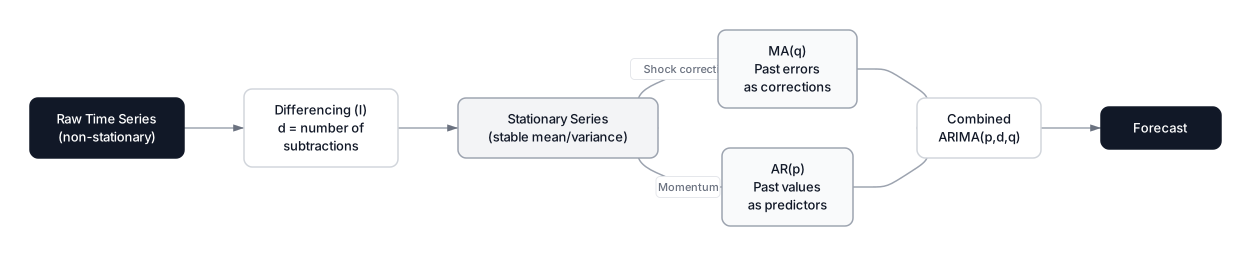 Click to expandHow AR, I, and MA components combine into the full ARIMA model
Key Insight: Think of ARIMA as a recipe with three ingredients you mix in different proportions. AR captures momentum ("last month's kWh predicts this month"), I removes the upward drift in consumption over time, and MA absorbs one-off shocks like a broken HVAC unit that spiked usage for a single month.
Stationarity and the Integrated Term
Stationarity is the statistical property where a time series has a constant mean, constant variance, and consistent autocorrelation structure over time. Every ARIMA model assumes stationarity after differencing. If the data's mean is drifting upward (like our building's energy consumption growing year over year), the AR and MA components can't extract stable patterns from it.
The I term fixes this. Differencing subtracts each observation from the one before it:
Where:
- is the differenced value at time
- is the original observation at time
- is the previous observation
In Plain English: Instead of predicting the building's total energy consumption (which trends upward each year), we predict the change in consumption from one month to the next. If the change is roughly stable around zero, we've achieved stationarity with $d = 1$.
Second-order differencing ($d = 2$) differences the already-differenced series. You rarely need $d > 2$ in practice. Hyndman and Khandakar's 2008 algorithm for automatic ARIMA modeling recommends capping at $d = 2$; if that's not enough, the data likely needs a log transform or a different model entirely.
Common Pitfall: Over-differencing introduces artificial structure into the data, creating moving-average patterns in what was originally white noise. If the variance of the differenced series is higher than the original, you've gone too far. Use the minimum that achieves stationarity.
The Augmented Dickey-Fuller (ADF) test is the standard tool for checking stationarity. It tests the null hypothesis that a unit root is present (non-stationary). A p-value below 0.05 rejects the null and confirms stationarity.
The AutoRegressive Component
An AutoRegressive model of order predicts the current value as a linear combination of the previous values. It captures the "memory" in the system: if last month's energy usage was high, this month's probably will be too.
Where:
- is the value at time (this month's kWh)
- is a constant (baseline consumption level)
- are lag coefficients (how much each past month matters)
- is white noise (random, unpredictable variation)
In Plain English: This formula says "this month's energy usage is roughly a fraction of last month's, plus a smaller fraction of two months ago, plus random noise." If , the building's consumption is sticky: a high month tends to be followed by another high month. If is near zero, each month is basically independent.
For the AR process to remain stationary, the roots of the characteristic polynomial must lie outside the unit circle. In practice, statsmodels checks this automatically and warns you if estimated coefficients imply instability.
The Moving Average Component
The Moving Average component of order predicts the current value based on past forecast errors, not past values. This naming trips up a lot of people. It has nothing to do with a rolling average (like a 7-day moving average). It's a regression on past surprises.
Where:
- is the current shock (unpredictable component)
- are past forecast errors
- are weights on those past errors
In Plain English: Suppose a pipe burst in January and the building's energy consumption spiked far above what the AR term predicted. That surprise is the error term . The MA component asks: "Does that January surprise still ripple into February's prediction?" If , half the surprise carries over. By March ($q = 1$), it's fully absorbed. Think of it like a car's suspension: the pothole was one month, but the bounce lingers.
The Full ARIMA Equation
Combining all three components, we first difference the series times to get stationary data , then model it with both AR and MA terms:
Where:
- is the differenced series at time
- are the AR coefficients (influence of past changes)
- are the MA coefficients (influence of past shocks)
- is white noise
- is a constant (drift term)
In Plain English: The change in our building's energy consumption this month depends on (1) how consumption changed in recent months (AR terms) and (2) how badly our recent forecasts missed the mark (MA terms). We tune the and weights to fit the specific rhythm of this building's data.
Selecting p, d, and q with ACF and PACF
Choosing the right ARIMA order is where the statistical art meets science. The Box-Jenkins methodology prescribes a four-step workflow: identify, estimate, diagnose, forecast.
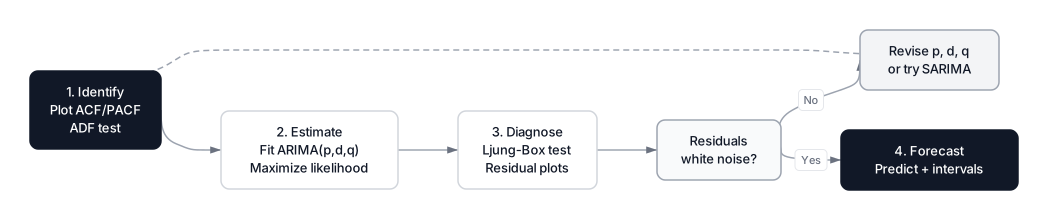 Click to expandThe Box-Jenkins workflow for ARIMA modeling
Determining d
Apply the ADF test to the raw series. If the p-value exceeds 0.05, difference once ($d = 1$) and test again. Repeat until stationary. Most real-world series need $d = 0$ or $d = 1$.
Reading ACF and PACF Plots
Once the series is stationary, two diagnostic plots reveal the AR and MA orders:
- PACF (Partial Autocorrelation Function) measures the direct correlation between and , stripping out the influence of intermediate lags. A sharp cutoff at lag suggests $p = k$.
- ACF (Autocorrelation Function) measures the total correlation between and . A sharp cutoff at lag suggests $q = k$.
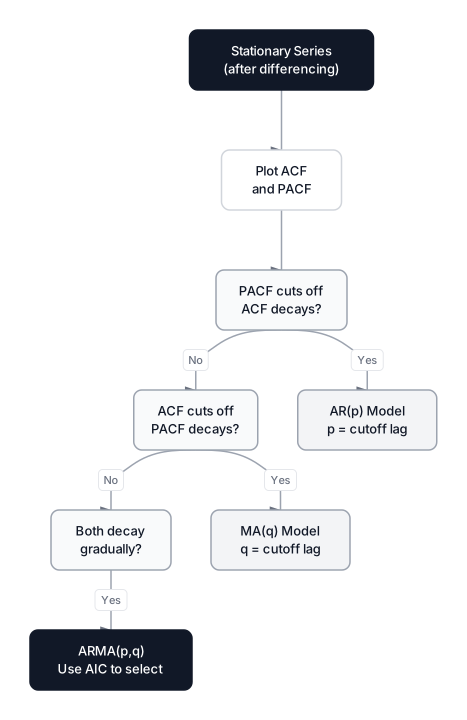 Click to expandHow to read ACF and PACF plots to determine p and q values
| ACF Pattern | PACF Pattern | Suggested Model |
|---|---|---|
| Gradual decay | Sharp cutoff at lag | AR() |
| Sharp cutoff at lag | Gradual decay | MA() |
| Both decay gradually | Both decay gradually | ARMA(, ); use AIC |
Automatic Selection with AIC
Visual interpretation gets ambiguous when both ACF and PACF decay. In practice, you grid-search over candidate $(p, d, q)$ combinations and pick the model with the lowest Akaike Information Criterion:
Where:
- is the number of estimated parameters
- is the maximized likelihood of the model
In Plain English: AIC balances fit against complexity. A model with more parameters () gets penalized, even if it fits the training data better (). It finds the simplest ARIMA order that still captures the building's energy patterns without overfitting to noise.
The pmdarima library automates this search with auto_arima, implementing the Hyndman-Khandakar stepwise algorithm that's far faster than brute-force grid search.
Building an ARIMA Forecast in Python
Let's put everything together. We'll generate synthetic monthly energy data for a commercial building, check stationarity, fit the model, and forecast.
Stationarity Testing and Differencing
Expected Output:
Raw series ADF statistic: 1.2602
Raw series p-value:       0.9964
Stationary? No

Differenced ADF statistic: -5.3891
Differenced p-value:       0.0000
Stationary? Yes

Conclusion: d = 1
The raw series has a p-value of 0.99, well above the 0.05 threshold, confirming the upward trend makes it non-stationary. After one round of differencing, the ADF statistic drops to -5.39 with a p-value of essentially zero. One difference is enough.
Fitting and Evaluating the Model
Expected Output:
ARIMA(1,1,1) coefficients:
  AR(1) coeff (phi):  0.7140
  MA(1) coeff (theta): -0.8303
  AIC: 748.1

Forecast evaluation (12-month horizon):
  MAE:  188.2 kWh
  RMSE: 221.6 kWh
  Mean actual: 5732.5 kWh
  MAPE: 3.3%
A MAPE around 3.3% is solid for a univariate model with no weather or occupancy features. The AR(1) coefficient of 0.71 tells us strong month-to-month persistence, and the MA(1) coefficient near -0.83 means forecast errors get substantially corrected in the next period.
Pro Tip: If both AR and MA coefficients are near the boundary of invertibility (close to 1 or -1), the model may be over-parameterized. Try reducing or by one and compare AIC values.
Residual Diagnostics
A well-fit ARIMA model leaves residuals that look like white noise: no significant autocorrelation, roughly constant variance, and ideally close to a normal distribution. If residuals show patterns, the model is missing signal.
Expected Output:
Residual diagnostics:
  Mean: 29.43 (should be near 0)
  Std:  128.12
  Ljung-Box p-value (lag 10): 0.6661
  Residuals are white noise? Yes
The Ljung-Box test passes (p = 0.67), confirming no significant autocorrelation remains. However, the residual standard deviation of 128 kWh and the non-zero mean hint that the model is missing systematic structure. That elevated residual spread is the seasonal component we haven't modeled. This is our cue to try SARIMA.
Extending to SARIMA for Seasonal Data
When data shows repeating patterns at fixed intervals (monthly energy consumption peaking every summer), standard ARIMA falls short. SARIMA adds a second set of parameters that operate at the seasonal lag . The notation becomes SARIMA(p, d, q)(P, D, Q), where is the seasonal period (12 for monthly data, 4 for quarterly).
Expected Output:
SARIMA(1,1,1)(1,1,1)_12 results:
  AIC:  605.8
  MAE:  70.5 kWh
  RMSE: 95.1 kWh
  MAPE: 1.2%

Improvement over ARIMA(1,1,1):
  ARIMA MAE:  188.2 kWh
  SARIMA MAE: 70.5 kWh
  Reduction:  62.5%
SARIMA cuts the MAE by 62.5% because it explicitly models the 12-month seasonal cycle. The AIC drops from 748 to 606, confirming the seasonal terms are capturing real structure, not just adding parameters. For a deeper comparison of forecasting methods beyond ARIMA, see our guide on exponential smoothing and Holt-Winters.
When to Use ARIMA (and When Not To)
| Scenario | ARIMA? | Better Alternative |
|---|---|---|
| Univariate series, no seasonality | Yes | This is ARIMA's sweet spot |
| Clear seasonal patterns | SARIMA | Prophet for fast baselines |
| Multiple external features (weather, price) | No | SARIMAX, XGBoost, or TFT |
| Non-linear dynamics, regime changes | No | LSTMs or gradient boosting |
| Very long forecast horizons (50+ steps) | Weak | Multi-step strategies |
| Small data (<100 observations) | Yes | Exponential smoothing also works well |
| Need uncertainty intervals | Yes | Built-in confidence intervals |
| Real-time, high-frequency retraining | Slow to refit | Online learning models |
Pro Tip: Always start with ARIMA as a baseline, even if you plan to use deep learning. If an LSTM can't beat SARIMA on your dataset, the extra complexity isn't worth it. ARIMA can be a strong baseline for clean univariate series, particularly when interpretability and limited data matter.
Production Considerations
- Training complexity: Fitting ARIMA is for observations and order . Fast enough for virtually any business time series.
- Grid search cost: Testing all $(p, d, q)$ up to (5, 2, 5) means 180 fits.
pmdarima.auto_arimauses stepwise search to cut this to roughly 15-30 fits. - Retraining: ARIMA coefficients are static. Retrain monthly or whenever a structural break occurs (new building tenant, HVAC replacement, pandemic).
- Forecast horizon: Predictions revert to the mean as the horizon extends. Beyond 2-3 seasonal cycles, prediction intervals become so wide they're uninformative.
- Memory: Negligible. The model stores a handful of coefficients, not the entire training set.
When ARIMA Is the Right Baseline
ARIMA decomposes time series forecasting into three clearly interpretable mechanisms: autoregressive momentum, trend-removing differencing, and error-correcting moving averages. That transparency is its greatest strength. When a forecast goes wrong, you can trace the issue to a specific component rather than staring at a black-box neural network.
The Box-Jenkins workflow of identify, estimate, diagnose, and forecast provides a disciplined approach that prevents the common mistake of fitting a model before understanding your data. If the residual diagnostics fail (as they hinted with our seasonal energy data), the framework tells you exactly what's missing and points you toward SARIMA or beyond.
For readers looking to go deeper, exponential smoothing methods offer a complementary statistical approach, while Prophet provides a more accessible interface for business teams. And when the data genuinely demands non-linear modeling, our guide on LSTMs for time series covers the transition from statistics to deep learning.
The best forecasters don't pick one method and stick with it. They build an ARIMA baseline first, check the residuals, and only reach for more complexity when the data demands it.
Interview Questions
Q: What does each letter in ARIMA stand for, and what does each component do?
AR (AutoRegressive) uses past values of the series to predict the current value, capturing momentum. I (Integrated) refers to differencing the data to remove trends and achieve stationarity. MA (Moving Average) uses past forecast errors to correct predictions, absorbing short-term shocks. Together, ARIMA(p, d, q) gives you three knobs to control how the model learns from history.
Q: Why is stationarity required for ARIMA, and how do you test for it?
ARIMA assumes the statistical properties of the series (mean, variance, autocorrelation) don't change over time. If the mean is drifting upward, patterns learned from early data won't apply to later data. The Augmented Dickey-Fuller test checks for a unit root: a p-value below 0.05 confirms stationarity. If non-stationary, difference the series ($d = 1$ or $d = 2$) and test again.
Q: How do you decide the values of p and q?
Plot the PACF and ACF of the stationary series. If the PACF cuts off sharply at lag while the ACF decays gradually, set $p = k$. If the ACF cuts off at lag while the PACF decays, set $q = k$. When both decay, use AIC-based grid search (or auto_arima) to find the best combination. Always validate with residual diagnostics afterward.
Q: What's the difference between ARIMA and SARIMA?
Standard ARIMA can't model repeating seasonal patterns (like summer energy spikes every 12 months). SARIMA adds a second set of parameters that operate at the seasonal lag . It runs ARIMA at two scales simultaneously: one for short-term dynamics and one for seasonal cycles. Use SARIMA whenever your data has a fixed-period repeating pattern.
Q: Your ARIMA model's residuals show significant autocorrelation at lag 12. What do you do?
This strongly suggests the model is missing a seasonal component with period 12. Switch to SARIMA with $m = 12$ and add seasonal AR and MA terms. After refitting, recheck the residuals with the Ljung-Box test. If autocorrelation persists at other lags, increase or as well.
Q: When would you choose ARIMA over a deep learning model like LSTM?
ARIMA is preferable when you have a small to medium univariate dataset (under 10,000 points), need interpretable coefficients, require confidence intervals, or want a fast baseline. LSTMs need thousands of samples to train well and are harder to diagnose when they fail. In practice, SARIMA often matches or beats LSTMs on clean univariate data with moderate length.
Q: What happens if you over-difference a time series?
Over-differencing introduces artificial structure, creating moving-average patterns in what was originally white noise. The ADF test will still show stationarity, but the model will fit phantom patterns and produce wider confidence intervals. Always use the minimum that achieves stationarity, and check whether the variance of the differenced series is lower than the original.
Q: How does ARIMA handle a structural break like a new building tenant changing energy patterns?
It doesn't, not automatically. ARIMA assumes the data-generating process is stable. Options include: training only on post-break data if you have enough observations, adding an intervention variable via ARIMAX (a binary regressor indicating pre/post break), or using a regime-switching model. The simplest fix is truncating the training window to the most recent stable period.
Hands-On Practice
We will strip away the complexity of time series forecasting by building an ARIMA model from scratch using Python. Rather than treating forecasting as a black box, we will manually inspect the components of ARIMA, Autoregression (AR), Integration (I), and Moving Average (MA), to understand how they capture trends and seasonality. You will learn to diagnose stationarity, determine the correct differencing order, and fit a model to predict retail sales data effectively.
Dataset: Retail Sales (Time Series) 3 years of daily retail sales data with clear trend, weekly/yearly seasonality, and related features. Includes sales, visitors, marketing spend, and temperature. Perfect for ARIMA, Exponential Smoothing, and Time Series Forecasting.
We manually built an ARIMA model by inspecting stationarity and autocorrelation plots. Try changing the arima_order tuple to (7, 1, 1) to account for weekly seasonality, does the RMSE improve? You can also experiment with the differencing parameter d to see how under-differencing (leaving trends) or over-differencing (adding noise) affects your forecast accuracy.