
Electricity grid operators face a brutal prediction problem every single day. They need to forecast demand across hundreds of substations, 48 hours into the future, while accounting for weather forecasts, holiday schedules, time-of-day patterns, and building types that never change. Standard time series models treat all inputs as a single stream. LSTMs forget what happened 100 steps ago. And nobody in operations trusts a model that can't explain why it predicted a spike.
The Temporal Fusion Transformer (TFT) solves all three problems at once. Developed by Google Cloud AI and published by Lim et al. in the International Journal of Forecasting (2021), TFT combines LSTM-based local processing with multi-head attention for long-range dependencies, wraps both in a gating architecture that suppresses irrelevant features, and produces interpretable quantile forecasts out of the box. With over 2,000 citations and implementations across energy, retail, finance, and healthcare, it remains one of the most practical deep learning architectures for production forecasting in 2026.
Throughout this article, we'll use electricity demand forecasting as our running example. Every formula, every code block, and every diagram ties back to predicting megawatt-hours across a grid of substations.
TFT Architecture at a Glance
The Temporal Fusion Transformer is a hybrid deep learning architecture purpose-built for multi-horizon time series forecasting. It explicitly separates three categories of input data, processes them through specialized layers, and outputs prediction intervals rather than single-point estimates.
Here is what makes TFT different from a generic Transformer or a plain LSTM:
| Component | Purpose | Analogy |
|---|---|---|
| Variable Selection Networks | Suppress irrelevant features before processing | Hiring a competent analyst who ignores noise |
| Gated Residual Networks (GRN) | Control information flow at every layer | A volume knob that can mute entire channels |
| LSTM Encoder-Decoder | Capture local temporal patterns | Short-term memory for recent trends |
| Multi-Head Attention | Detect long-range dependencies | Looking back months to find recurring patterns |
| Quantile Outputs | Produce prediction intervals (P10, P50, P90) | Giving operations a worst-case and best-case bound |
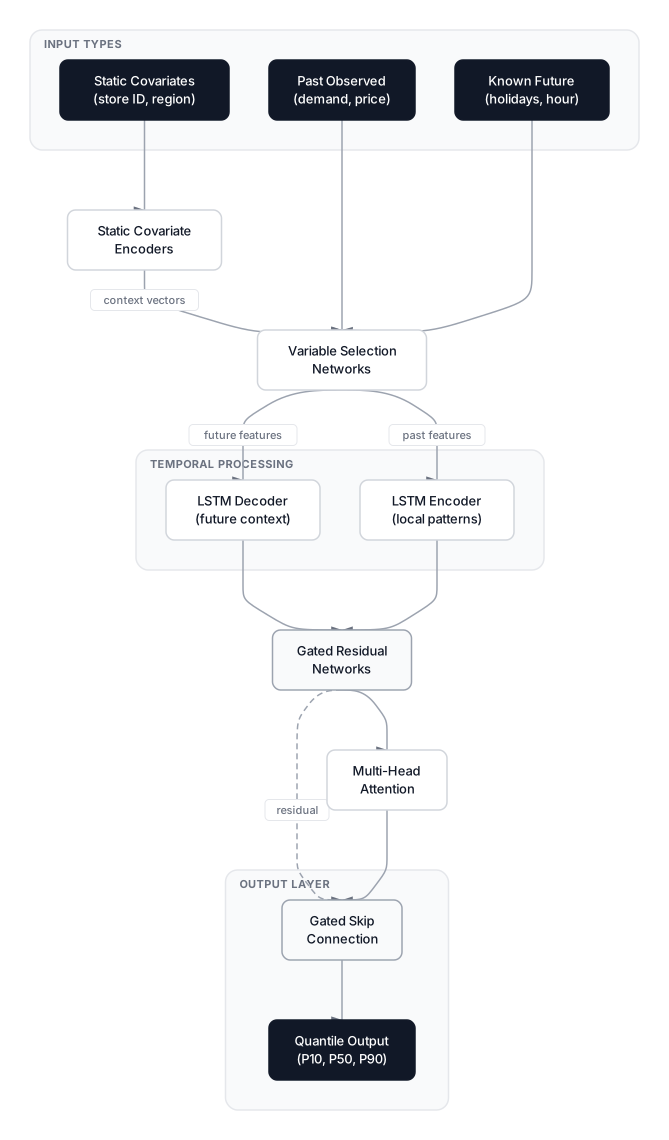 Click to expandTFT architecture showing input types flowing through variable selection, LSTM processing, multi-head attention, and quantile outputs
The architecture processes data in a strict pipeline: inputs get filtered by Variable Selection Networks, then flow through an LSTM encoder-decoder for temporal context, pass through interpretable multi-head attention, and finally produce quantile predictions through dense output layers. Gated Residual Networks appear at every junction, acting as learned switches that can bypass processing entirely when the raw input is already informative.
Three Input Types That Change Everything
Traditional forecasting models treat every input column the same way. TFT takes a fundamentally different approach by categorizing inputs into three distinct types, each processed through its own pathway.
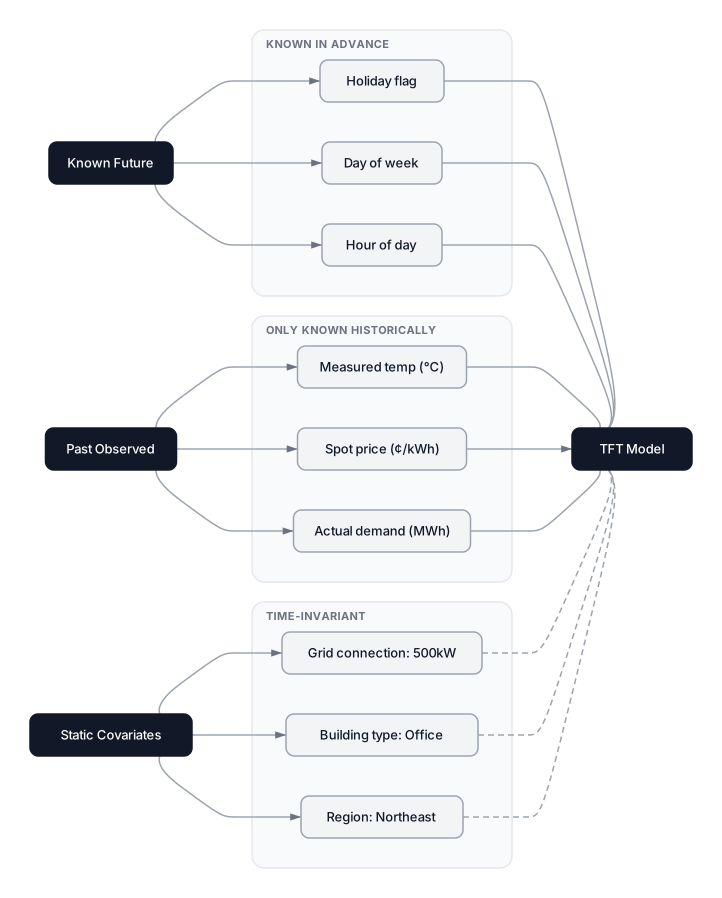 Click to expandThree input types for electricity demand forecasting showing static, past observed, and known future features flowing into the TFT model
Static covariates are features that never change across time for a given entity. In our electricity demand scenario, these include the substation's geographic region, building type (residential vs. commercial), and maximum grid connection capacity. TFT learns how these static attributes should influence the forecast through dedicated static covariate encoders.
Past observed inputs are features we only know historically. Actual electricity demand, real-time spot price, and measured temperature fall into this category. We know yesterday's demand, but we don't know tomorrow's. TFT processes these through the LSTM encoder, creating a compressed representation of recent history.
Known future inputs are features we can predict with certainty (or near-certainty) into the future. Hour of day, day of week, holiday indicators, and scheduled maintenance windows belong here. These feed into the LSTM decoder, giving the model explicit knowledge about the forecast horizon.
Common Pitfall: The single most destructive mistake when setting up TFT is misclassifying an input. Putting actual temperature (which you only know historically) into the "known future" bucket means the model sees the answer during training but gets nothing at inference time. Performance collapses in production. If you want to use temperature as a future input, you must use the weather forecast, not the observed reading.
Why Standard Transformers Fail at Time Series
Standard Transformer architectures (BERT, GPT, Vision Transformers) were designed for sequences where almost every token carries meaning. A sentence like "the cat sat on the mat" has six meaningful tokens. Time series data is different in two critical ways.
First, positional encoding breaks down. In NLP, relative position matters ("the cat sat" vs. "sat the cat"), but distance between tokens is uniform. In time series, the gap between and (one hour ago) carries different information than the gap between and (same hour last week). Standard sinusoidal positional encodings don't capture this distinction.
Second, most features are noise. A standard Transformer attends to everything with equal initial capacity. In a time series with 30 input features, perhaps 5 actually drive the target. A vanilla Transformer overfits to random fluctuations in the other 25, especially with limited training data. TFT addresses this directly through Variable Selection Networks, which assign learned importance weights to each feature before the heavy computation begins.
Key Insight: TFT doesn't just add attention to time series. It solves the two specific failure modes that make generic Transformers unreliable for forecasting: positional encoding that respects temporal distance, and feature gating that prevents attention from wasting capacity on noise.
Gated Linear Units and Gated Residual Networks
The Gated Linear Unit (GLU) is the atomic building block of TFT's information filtering. Every major component in the architecture uses some form of gating to control what information flows forward and what gets suppressed.
Given an input vector , the GLU computes:
Where:
- is the input vector (e.g., a feature embedding at a specific time step)
- is the sigmoid activation function, producing values between 0 and 1
- are the learnable weights and bias of the gate pathway
- are the learnable weights and bias of the value pathway
- is element-wise (Hadamard) multiplication
In Plain English: Picture two parallel wires. One wire carries the actual electricity demand signal (the value pathway, ). The other wire passes through a sigmoid that outputs a number between 0 and 1 (the gate pathway). These two wires get multiplied together element-wise. When the gate outputs 0, the demand signal is completely silenced. When it outputs 1, the signal passes through untouched. The network learns which parts of each feature vector matter for prediction, and it can shut off entire dimensions that carry noise.
The following code demonstrates how the gate selectively passes or suppresses signals at different input magnitudes.
Expected output:
Gated Linear Unit (GLU) — How the Gate Works
==================================================
At x = -3.0: gate = 0.0025, output = -0.0074  (suppressed)
At x =  0.0: gate = 0.5000, output = 0.0000  (half-open)
At x =  3.0: gate = 0.9975, output = 2.9926  (passes through)

Variable Selection Network — Learned Feature Weights
==================================================
    Temperature: 0.519  #########################
    Hour of Day: 0.348  #################
   Price Signal: 0.095  ####
     Wind Speed: 0.032  #
   Random Noise: 0.006
          Total: 1.000
Notice how the gate at $x = -3$ outputs just 0.0025, effectively killing that signal. At $x = 3$, the gate is 0.9975 and the signal passes through almost perfectly. This is exactly how TFT decides, at every layer, which information matters and which to discard.
TFT wraps the GLU into a Gated Residual Network (GRN), which adds two important features: a nonlinear processing step (Dense + ELU activation) before the gate, and a skip connection that lets the original input bypass the entire block if the gating decides the raw input is already sufficient.
 Click to expandGated Residual Network showing input flowing through dense layers, GLU gating, and a skip connection that bypasses the block
The GRN's skip connection is crucial. During early training, the gates often start near zero, which means the GRN initially acts like an identity function (just passing input through). As training progresses, the model gradually opens gates for useful transformations. This makes optimization much more stable than architectures that force every input through heavy nonlinear processing from the start.
Variable Selection Networks
Variable Selection Networks (VSNs) are what make TFT genuinely practical for messy real-world datasets. Instead of manually selecting features or hoping the model figures it out, VSNs learn a soft weighting over all input features at every time step.
For a set of input features at time step , the VSN produces:
Where:
- is the final weighted feature representation at time
- is the total number of input features
- is the learned importance weight for feature at time , computed via softmax so all weights sum to 1
- is the transformed (GRN-processed) representation of feature at time
In Plain English: At each hour of the day, the VSN asks: "Which of these 15 features actually matter for predicting electricity demand right now?" During a summer heatwave, temperature might get 45% of the weight while holiday indicators get 2%. During Christmas week, those weights flip. The model dynamically reallocates attention to whichever features are most predictive in the current context.
The weights come from passing all features (plus static context from the covariate encoders) through a GRN followed by a softmax. This means static covariates directly influence which temporal features the model pays attention to. A residential substation might learn to weight temperature heavily, while an industrial substation focuses on day-of-week patterns.
Pro Tip: After training, you can extract and plot the VSN weights directly. This gives you a feature importance ranking that's more reliable than permutation importance or SHAP values for time series, because the weights reflect what the model actually used during prediction rather than post-hoc perturbation analysis.
Temporal Self-Attention for Long-Range Dependencies
While the LSTM encoder-decoder captures local sequential patterns (yesterday's demand predicts today's demand), it struggles with dependencies that span weeks or months. This is where TFT's modified self-attention mechanism takes over.
TFT applies multi-head attention after the LSTM layers, operating on the encoder-decoder output. The standard scaled dot-product attention computes:
Where:
- (Query) is the set of future time steps we want to predict (e.g., "What will demand be at 3 PM tomorrow?")
- (Key) is the set of all past time steps available for comparison (e.g., every hour from the past 7 days)
- (Value) contains the actual LSTM-processed representations at each past time step
- is the dimension of the key vectors, used for numerical stability
- computes a similarity score between each future query and every past key
In Plain English: Imagine you're predicting electricity demand for 3 PM next Tuesday. The Query is "3 PM Tuesday." The model compares this query against every past hour (the Keys). It discovers that 3 PM last Tuesday had a very high similarity score, so the attention weight is large. It also finds that 3 PM during last month's heatwave scored high. The Values (actual processed demand data at those time steps) from these high-attention hours get pulled forward and combined to form the prediction. Hours where nothing interesting happened contribute almost nothing.
TFT makes one critical modification to standard attention: it applies a gated skip connection after the attention layer. This means the model can learn to bypass attention entirely for short-horizon predictions where the LSTM output is already sufficient, and only engage attention for longer horizons where historical patterns matter more.
The following simulation shows how attention weights shift depending on the forecasting context.
Expected output:
Self-Attention Weights Over 24-Hour Lookback
============================================================
  Hour    Normal Day    Post-Holiday
------------------------------------------------------------
  t-24         0.200*          0.019
  t-23         0.050          0.019
  t-19         0.014          0.019
  t-14         0.014          0.112*
  t-13         0.014          0.112*
  t-12         0.014          0.112*
  t-11         0.014          0.112*
  t- 6         0.014          0.019
  t- 3         0.080          0.019
  t- 2         0.150*          0.075
  t- 1         0.250*          0.140*

* = high attention weight (>0.10)

Normal day: model attends to same hour yesterday (t-24)
and most recent hours (t-1, t-2).
Post-holiday: attention spikes on hours 10-13 (the holiday
disruption), showing TFT learned to track regime shifts.
This is the kind of interpretability that makes TFT valuable to operations teams. When the model predicts a demand spike, you can inspect the attention weights and explain exactly which historical hours drove that prediction. No SHAP values, no post-hoc approximations: the attention weights are the model's actual reasoning.
Quantile Forecasting and Uncertainty Estimation
Point forecasts are dangerous in production. If you tell a grid operator "demand will be 920 MWh at 3 PM" and actual demand is 1,050 MWh, you've caused a shortage. TFT addresses this by producing quantile forecasts: instead of a single number, it outputs an entire prediction interval.
TFT trains with the quantile loss function, which penalizes errors asymmetrically depending on the target quantile:
Where:
- is the actual observed value (true electricity demand)
- is the model's prediction for quantile
- is the target quantile (e.g., 0.1, 0.5, or 0.9)
- When $q = 0.9$, under-predictions are penalized 9x more than over-predictions
- When $q = 0.1$, over-predictions are penalized 9x more than under-predictions
In Plain English: Think of it this way: if you're forecasting the 90th percentile of electricity demand (an upper safety bound), and the actual demand exceeds your forecast, that's a serious underestimate. The quantile loss punishes you 9 times harder for that miss compared to an equivalent overestimate. This forces the P90 model to predict conservatively high, giving operators a reliable safety margin.
The total TFT loss sums quantile losses across all time steps and all target quantiles:
Where:
- is the set of all prediction time steps across all training samples
- is the model's prediction at time for quantile
The following code shows exactly how quantile loss behaves differently for symmetric versus conservative models.
Expected output:
Quantile Loss for Electricity Demand Forecasting
=======================================================
  Quantile   Symmetric Model  Conservative Model
-------------------------------------------------------
       0.1              5.50               45.00
       0.5              7.50               25.00
       0.9              9.50                5.00

Key observation:
At q=0.9, the conservative model (over-predicts) has LOWER loss
because 90th percentile forecasts SHOULD be above the actual value.
Symmetric model q=0.9 loss:    9.50
Conservative model q=0.9 loss: 5.00
The table shows the core tradeoff. The symmetric model is better at the median (q=0.5, loss 7.50 vs 25.00). But the conservative model wins at q=0.9 (loss 5.00 vs 9.50) because its systematic over-prediction aligns with what the 90th percentile should be. TFT learns separate internal pathways for each quantile, producing a coherent prediction band where P10 < P50 < P90.
Implementing TFT with pytorch-forecasting
The most mature implementation of TFT lives in the pytorch-forecasting library, now maintained by the sktime organization. As of March 2026, the latest release is version 1.6.1, which requires Python 3.10+ and is built on PyTorch Lightning.
Installation
pip install pytorch-forecasting==1.6.1 lightning
Data Preparation
TFT requires a specific dataset format through the TimeSeriesDataSet class. This is where you explicitly declare which columns are static, known future, or past observed. Getting this wrong ruins everything.
import pandas as pd
from pytorch_forecasting import TimeSeriesDataSet, TemporalFusionTransformer
from pytorch_forecasting.data import GroupNormalizer

# Load electricity demand data
# Required columns: time_idx (integer), group_id, target, plus covariates
data = pd.read_csv("electricity_demand.csv")

max_encoder_length = 168   # Look back 7 days (168 hours)
max_prediction_length = 48 # Predict 48 hours into the future

training_cutoff = data["time_idx"].max() - max_prediction_length

training_dataset = TimeSeriesDataSet(
    data[lambda x: x.time_idx <= training_cutoff],
    time_idx="time_idx",
    target="demand_mwh",
    group_ids=["substation_id"],
    min_encoder_length=max_encoder_length // 2,
    max_encoder_length=max_encoder_length,
    min_prediction_length=1,
    max_prediction_length=max_prediction_length,

    # STATIC covariates (never change for a given substation)
    static_categoricals=["substation_id", "region", "building_type"],

    # KNOWN FUTURE covariates (calendar features we know in advance)
    time_varying_known_categoricals=["hour_of_day", "day_of_week", "is_holiday"],
    time_varying_known_reals=["time_idx", "scheduled_maintenance"],

    # PAST OBSERVED covariates (unknown during forecast horizon)
    time_varying_unknown_reals=["demand_mwh", "spot_price", "temperature"],

    # Normalize targets per substation (critical for convergence)
    target_normalizer=GroupNormalizer(
        groups=["substation_id"], transformation="softplus"
    ),
    add_relative_time_idx=True,
    add_target_scales=True,
    add_encoder_length=True,
)

# Create dataloaders
batch_size = 64
train_dataloader = training_dataset.to_dataloader(
    train=True, batch_size=batch_size, num_workers=4
)
Warning: The time_idx column must be an integer that increases monotonically within each group. Gaps are allowed (the model handles missing time steps), but the index must be sorted. Many first-time users pass a datetime column here and get cryptic errors.
Model Configuration and Training
import lightning.pytorch as pl
from pytorch_forecasting.metrics import QuantileLoss

# Configure TFT with reasonable defaults for electricity data
tft = TemporalFusionTransformer.from_dataset(
    training_dataset,
    learning_rate=0.001,
    hidden_size=64,            # Internal embedding dimension
    attention_head_size=4,     # Multi-head attention heads
    dropout=0.1,               # Regularization
    hidden_continuous_size=32, # Continuous variable embedding size
    loss=QuantileLoss(quantiles=[0.1, 0.5, 0.9]),
    optimizer="Adam",
)

# Print parameter count — useful for sizing GPU memory
print(f"Number of parameters: {tft.size() / 1e3:.1f}K")

# Initialize trainer with gradient clipping (essential for LSTM stability)
trainer = pl.Trainer(
    max_epochs=50,
    accelerator="gpu",
    gradient_clip_val=0.1,
    enable_progress_bar=True,
)

# Train
trainer.fit(tft, train_dataloaders=train_dataloader)
Pro Tip: Start with hidden_size=16 and attention_head_size=1 for a quick sanity check (trains in minutes on CPU). Once you confirm the pipeline works end-to-end, scale up to hidden_size=64 or 128 with attention_head_size=4 for production quality. Training a full model on 10,000 time series with 168-step encoder and 48-step decoder takes roughly 2 hours on a single V100 GPU.
Extracting Interpretability
After training, TFT provides three types of interpretation that no other architecture matches:
# Generate predictions with full interpretation data
raw_predictions, x = tft.predict(
    val_dataloader, mode="raw", return_x=True
)
interpretation = tft.interpret_output(raw_predictions, reduction="sum")

# 1. Variable importance — which features drive predictions
tft.plot_interpretation(interpretation)
# Shows bar chart: e.g., temperature=38%, hour_of_day=25%, spot_price=18%...

# 2. Attention patterns — which past time steps the model focused on
# Extract per-sample attention weights
attention_weights = raw_predictions["attention"]  # shape: (batch, heads, pred_len, enc_len)

# 3. Quantile predictions — prediction intervals
predictions = tft.predict(val_dataloader, mode="quantiles")
# Returns P10, P50, P90 for every forecast horizon
The variable importance output isn't a post-hoc explanation; it comes directly from the Variable Selection Network weights. When you tell an operations manager "temperature accounts for 38% of this prediction," that's the literal truth about what the model computed, not an approximation.
Production Considerations
Computational Complexity
TFT's training complexity is per sample, where is the sequence length (encoder + decoder) and is the hidden dimension. This quadratic scaling in sequence length comes from the self-attention mechanism. For a 168-hour encoder and 48-hour decoder:
| Hidden Size | Parameters | GPU Memory (batch=64) | Train Time (10K series, 50 epochs) |
|---|---|---|---|
| 16 | ~15K | ~2 GB | ~15 min (V100) |
| 64 | ~200K | ~6 GB | ~2 hr (V100) |
| 128 | ~700K | ~14 GB | ~6 hr (V100) |
| 256 | ~2.5M | ~32 GB | ~18 hr (V100) |
Memory Management
For datasets with 100K+ time series, the TimeSeriesDataSet object itself can consume significant RAM. Two practical mitigations:
- Use
num_workers > 0in the dataloader to overlap data loading with GPU computation. - Set
min_encoder_lengthto half ofmax_encoder_length. This allows the model to train on shorter sequences when full history isn't available, reducing memory by 30-40%.
Inference Latency
A trained TFT model generates 48-step quantile forecasts in roughly 5-15ms per batch on GPU, which is fast enough for most hourly or daily forecasting pipelines. For real-time applications requiring sub-millisecond latency, consider exporting to ONNX or using TorchScript tracing.
Pro Tip: If your dataset has fewer than 50 unique time series and fewer than 500 data points per series, TFT is overkill. An XGBoost model with lag features will train 100x faster and often match TFT's accuracy on small datasets. TFT's advantage only emerges with scale.
When to Use TFT (and When Not To)
TFT excels in a specific regime. Knowing when it's the wrong tool saves weeks of wasted engineering.
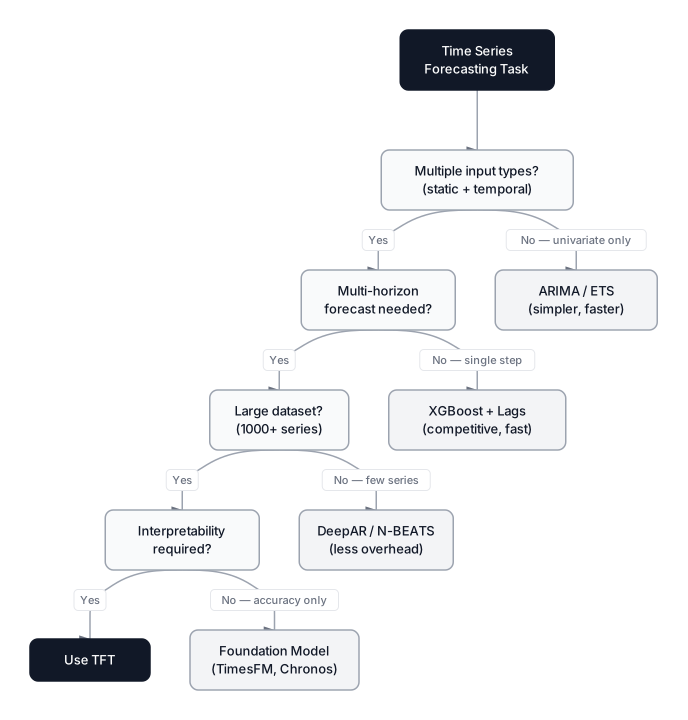 Click to expandDecision guide for choosing TFT versus simpler models based on input types, forecast horizon, dataset size, and interpretability needs
| Scenario | Best Choice | Why |
|---|---|---|
| Thousands of time series, mixed input types, 48-step horizon, need to explain predictions | TFT | This is its sweet spot |
| Single univariate series, 100 data points | ARIMA / ETS | Not enough data for deep learning |
| Multi-step forecast, no static covariates, speed matters | N-BEATS or DeepAR | Less architectural overhead |
| Single-step forecast with tabular features | XGBoost + lag features | Faster training, competitive accuracy |
| Zero-shot forecast on new domain, no training data | TimesFM 2.5 / Chronos-2 | Foundation models that generalize without training |
| Any forecasting task, no interpretability needed | Foundation models | As of early 2026, models like Amazon Chronos-2 and Google TimesFM 2.5 match or beat TFT on many benchmarks without domain-specific training |
Key Insight: The competitive field has shifted significantly since TFT's publication in 2021. Foundation models for time series (TimesFM, Chronos-2, MOIRAI-2) now offer strong zero-shot performance. TFT's remaining advantage is interpretability: no foundation model gives you variable importance weights and attention patterns out of the box. If you need to explain your forecasts to stakeholders, TFT is still the best option. If you just need accuracy, test a foundation model first.
Common Mistakes and How to Avoid Them
Data Leakage Through Misclassified Inputs
The most frequent error. If actual temperature goes into time_varying_known_reals instead of time_varying_unknown_reals, the model learns to cheat during training. Validation metrics look incredible, but production performance collapses because the model expects future temperature readings that don't exist yet.
Fix: Create a strict data dictionary before writing any code. For each feature, ask: "Can I know this value with certainty at the time I need to make the forecast?" If the answer involves any uncertainty, it belongs in time_varying_unknown.
Skipping Group Normalization
Neural networks are sensitive to magnitude. If one substation's demand ranges from 200 to 500 MWh and another ranges from 5,000 to 15,000 MWh, the model will primarily optimize for the high-magnitude group. GroupNormalizer normalizes each series independently, ensuring equal learning across all groups.
Fix: Always use GroupNormalizer with groups matching your group_ids. For heavily skewed targets (like demand that's always positive), set transformation="softplus" or "log".
Ignoring Static Variables for Multi-Series Forecasting
When forecasting demand across 500 substations, failing to include static_categoricals (like substation_id, region, building_type) forces the model to learn a single "average" behavior across all substations. An office building in Phoenix and a factory in Seattle have fundamentally different demand profiles.
Fix: Always include entity identifiers and any time-invariant metadata as static categoricals. TFT's static covariate encoders will learn how these attributes should modulate the temporal processing.
Training on Too-Short History
TFT needs sufficient history to learn seasonal patterns. If you set max_encoder_length=24 (one day) but your data has strong weekly seasonality, the model can't see a full week and misses the pattern.
Fix: Set max_encoder_length to at least 2x the longest seasonal cycle you expect. For data with weekly patterns, use 336 (two weeks). For annual patterns, you'll need a much longer encoder or explicit seasonal features.
TFT in the 2026 Forecasting Ecosystem
TFT was published in late 2019 (arXiv) and formally in the International Journal of Forecasting in 2021. Since then, the time series forecasting field has evolved considerably.
Architectures that built on TFT's ideas:
- PatchTST (ICLR 2023) treats time series as patches (like image patches in Vision Transformers), achieving strong results with simpler architecture
- iTransformer (2024) inverts the standard Transformer by applying attention across variates instead of time steps
- ElasTST (NeurIPS 2024) extends PatchTST with variable-horizon forecasting
Foundation models (the new frontier):
- TimesFM 2.5 (Google, September 2025) provides zero-shot forecasting with just 200M parameters
- Chronos-2 (Amazon, October 2025) uses T5-based tokenization and leads the GIFT-Eval benchmark
- MOIRAI-2 (Salesforce, 2025) specializes in multivariate scenarios
TFT's unique position in 2026 is interpretable production forecasting. Foundation models may match its accuracy, but none offer the same level of built-in explainability. For regulated industries (energy, healthcare, finance) where you must justify every prediction, TFT remains the standard choice.
When TFT Is Worth the Complexity
Temporal Fusion Transformers bring together three capabilities that are rarely found in a single architecture: multi-horizon forecasting across thousands of heterogeneous time series, built-in interpretability through variable importance and attention weights, and calibrated uncertainty estimation through quantile outputs. For our electricity demand example, this means operators get a 48-hour forecast with confidence bands, an explanation of which features drove the prediction, and a list of which historical hours the model focused on.
The practical recipe is straightforward. Classify your inputs into the three categories (static, past observed, known future), set up TimeSeriesDataSet with the correct column mappings, and let the Variable Selection Networks and Gated Residual Networks handle the feature engineering automatically. The biggest risk isn't in the model itself but in data leakage from misclassified inputs.
If you're new to time series prediction, start with Time Series Fundamentals to build your foundation, then explore Multi-Step Forecasting Strategies to understand the recursive vs. direct tradeoffs that TFT handles internally. For simpler datasets where TFT is overkill, Facebook Prophet offers a fast, interpretable alternative that requires minimal setup.
Whether you adopt TFT directly or use it as a conceptual framework for thinking about input types and feature gating, the architecture's core ideas will improve how you approach any forecasting problem.
Frequently Asked Interview Questions
Q: What makes TFT different from a standard Transformer applied to time series data?
TFT addresses two specific failure modes of vanilla Transformers: it uses Variable Selection Networks to suppress irrelevant features before they reach the attention mechanism (preventing overfitting to noise), and it processes three distinct input types (static, past observed, known future) through separate pathways. A standard Transformer treats all inputs uniformly, which wastes capacity on noisy features and can't distinguish between data you know about the future and data you don't.
Q: Explain the role of Gated Residual Networks in TFT.
GRNs appear at every processing junction in TFT and serve two purposes. First, the GLU component acts as a learned gate that can completely suppress uninformative signals (gate output near 0) or pass them through unchanged (gate output near 1). Second, the skip connection lets the network bypass the entire nonlinear transformation when the raw input is already sufficient. This stabilizes training and allows the model to default to identity mappings early in optimization.
Q: A colleague puts actual weather readings into the "known future" inputs. What goes wrong?
This causes data leakage. During training, the model sees actual future weather and learns to rely on it heavily. Validation metrics look excellent because the model is essentially cheating. In production, actual future weather isn't available, so the model receives weather forecasts (which have their own errors) or nothing at all. Prediction quality drops dramatically. The fix is to either use weather forecasts as the known future input or move actual weather into the past observed category.
Q: When would you choose TFT over a foundation model like TimesFM or Chronos-2?
TFT is the better choice when interpretability is a requirement, when you have ample domain-specific training data, and when you need to explain which features and which historical time steps drove each prediction. Foundation models are preferable for zero-shot forecasting on new domains without training data, rapid prototyping, or situations where accuracy matters more than explainability. In regulated industries like energy grid management, TFT's built-in interpretability often makes it the only acceptable option.
Q: How does quantile loss differ from MSE, and why does TFT use it?
MSE penalizes all errors symmetrically: being 50 MWh above actual is the same as 50 MWh below. Quantile loss is deliberately asymmetric. For the 90th percentile, under-predicting is penalized 9x more than over-predicting, which forces the model to produce a conservative upper bound. TFT outputs predictions for multiple quantiles simultaneously (typically P10, P50, P90), giving users both a point estimate and calibrated confidence intervals. This is essential for operational decisions where the cost of under-predicting demand is far higher than over-predicting.
Q: What is the computational bottleneck of TFT, and how can you mitigate it?
The self-attention mechanism scales quadratically with sequence length: . For a 168-hour encoder and 48-hour decoder, this means computing attention over 216 time steps. Mitigation strategies include reducing max_encoder_length to the minimum needed for your longest seasonal cycle, starting with small hidden_size (16 or 32) during hyperparameter search, and using mixed-precision training (fp16) to cut GPU memory in half without meaningful accuracy loss.
Q: You're forecasting demand across 10,000 retail stores. How do you set up the static covariates?
Each store has time-invariant attributes like store_id, city, store_format (supermarket vs. convenience), and floor_area_sqm. These go into static_categoricals (for IDs and labels) or static_reals (for numerical attributes like floor area). TFT's static covariate encoders produce context vectors that modulate how the Variable Selection Networks and temporal layers process each store's data. Without these, the model learns one averaged behavior across all 10,000 stores and loses the ability to capture store-specific patterns.
Hands-On Practice
Temporal Fusion Transformers (TFT) have redefined time series forecasting by combining the power of deep learning with the interpretability of statistical models. You'll decompose the architecture's core innovation, the Gated Linear Unit (GLU), and implement it from scratch to understand how it filters 'noise' from your data. Using the Retail Sales dataset, we will apply these concepts of distinguishing 'Known Future Inputs' from 'Past Observed Inputs' to build a solid forecasting pipeline that mirrors the structural logic of a TFT.
Dataset: Retail Sales (Time Series) 3 years of daily retail sales data with clear trend, weekly/yearly seasonality, and related features. Includes sales, visitors, marketing spend, and temperature. Perfect for ARIMA, Exponential Smoothing, and Time Series Forecasting.
By manually implementing the Gated Linear Unit (GLU), you've seen the mathematical core of how Temporal Fusion Transformers filter noise. While we used XGBoost for the final prediction step due to environment constraints, the data structure, separating Past Observed from Known Future inputs, is identical to preparing data for a deep learning TFT. Try adjusting the w_gate parameter in the GLU function to see how strictly or loosely the gate filters information.