Random Forest Ranks Earthlike Exoplanet Targets
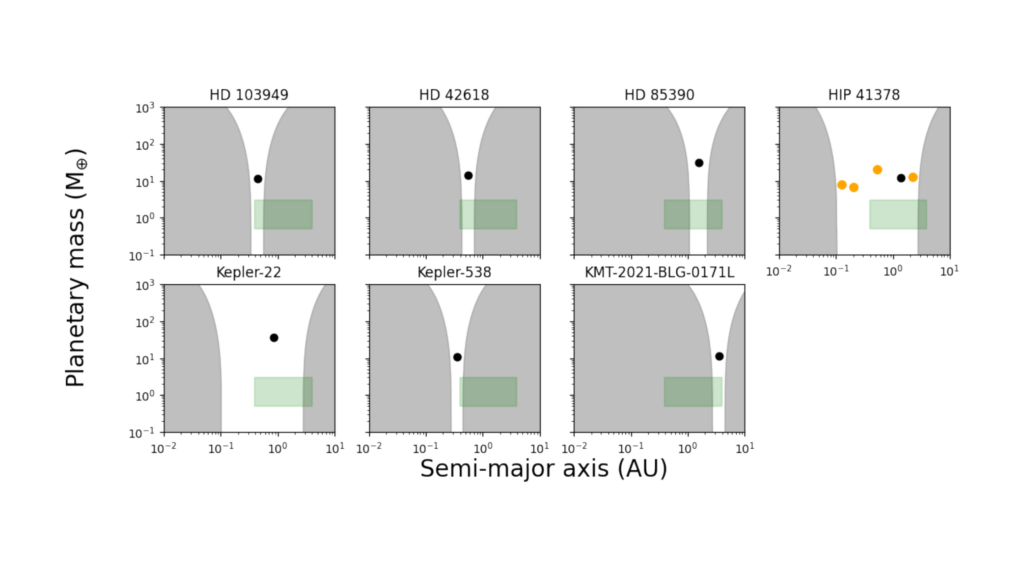
On April 9, 2025, astronomers published a study applying a random-forest classifier to 1,567 observed planetary systems, producing a 44-system shortlist for possible Earth-like planet follow-up. The model reached up to 99% precision on simulated test systems, while its broad target definition covered 0.5-3 Earth masses and 160-510 K.
Researchers have used a random-forest classifier trained on simulated planetary systems to rank 44 observed exoplanet systems as follow-up targets for possible Earth-like planets. Space Daily reports that the team applied the model to 1,567 real systems after measuring up to 99% precision on simulated test data.
The reported result is a candidate-selection method, not a catalogue of newly discovered planets. Space Daily explicitly notes that the high precision was measured within the synthetic population used for model development, rather than against real planetary systems with independently established unseen Earth-mass planets.
How the training data was constructed
Sciworthy identifies Jeanne Davoult, Romain Eltschinger, and Yann Alibert as the study's authors, with work conducted at the German Aerospace Center and the University of Bern. Sciworthy lists the original study as published on April 9, 2025; Space Daily published its synopsis on August 28, 2026.
According to Sciworthy, the researchers generated three sets of synthetic planetary systems with the Bern planet-formation model because the observed exoplanet sample was too small for this training task. The classifier learned to distinguish simulated systems containing an Earth-like planet from systems without one.
The input features were system-level properties that can be measured or inferred from known planets. Sciworthy reports that these included the arrangement of known planets and the mass, radius, and orbital distance of the planet nearest its host star. Forbes reports that the authors' stated objective was to predict which stars are more likely to host an Earth-like planet, reducing blind-search time and directing telescope observations toward higher-ranked systems.
The study uses an operational definition rather than a claim that a candidate is an Earth twin. Space Daily describes its broad Earth-like planet range as 0.5-3 Earth masses and 160-510 K. As Forbes notes, an Earth-mass planet in a habitable-zone-like orbit is not evidence of oceans, life, or other Earth surface conditions.
The validation limit
Space Daily reports that seven of the 44 targets exceeded a 90% tree-vote threshold and that all seven orbit G-type stars. Sciworthy separately characterizes eight targets as highly probable. The supplied coverage does not establish whether those descriptions use the same probability cutoff, so the two counts should not be treated as interchangeable.
The central technical question is transfer from a simulator to telescope-derived data. Machine-learning systems validated on simulated data commonly face distribution shift when the simulator omits physical processes, measurement noise, selection effects, or population characteristics present in observations. In this case, follow-up observations are needed to determine whether the simulated-data precision is predictive in the real sky.
For astronomy and scientific-ML practitioners, the work illustrates a practical use of supervised learning where labels for the desired real-world outcome are scarce or unavailable. The model's immediate value is prioritization: it can narrow a large observation set into a smaller list for more expensive follow-up observations. Its scientific utility, however, depends on prospective validation against later observations rather than performance on synthetic holdout data alone.
Key Points
- 1Space Daily reports the random forest turns planetary-system features into a 44-target follow-up list, concentrating telescope time without confirming new exoplanets.
- 2The reported 99% precision comes from held-out synthetic systems, so practical value depends on performance under simulation-to-observation distribution shift.
- 3Space Daily describes a broad 0.5-3 Earth-mass and 160-510 K target definition, which is not evidence of habitability.
Scoring Rationale
The study presents a useful scientific-ML application for prioritizing scarce telescope observations, but it does not report a new exoplanet detection or validated real-world model performance. Its key methodological lesson for ML practitioners is the gap between synthetic holdout metrics and deployment on observational data.
Sources
Primary source and supporting public references used for this report.
Practice interview problems based on real data
1,625 SQL & Python problems across 15 industry datasets — the exact type of data you work with.
Try 250 free problems