London Surgeons Complete AI-Assisted Brain Tumour Removal
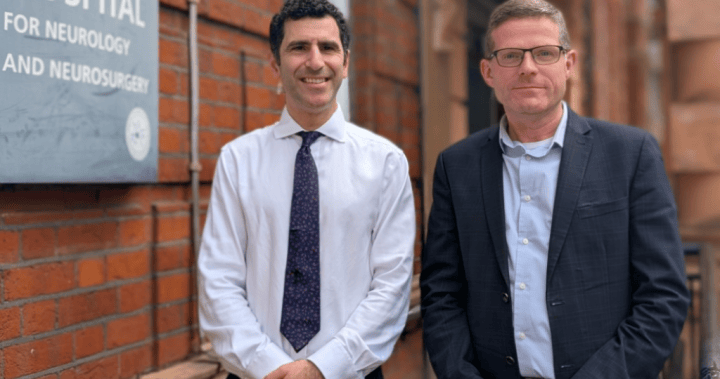
Surgeons at London's National Hospital for Neurology and Neurosurgery used real-time AI assistance to remove an 11 mm pituitary tumour from Rhys Hibbert in May, according to UCL Hospitals reporting cited by multiple outlets. Health officials described the operation as the first successful live-patient use of the technology. The system color-coded critical anatomy in the surgical video feed while the surgical team retained control.
Surgeons at the National Hospital for Neurology and Neurosurgery in London removed an 11 mm pituitary tumour from 48-year-old Rhys Hibbert using an AI system that analyzed live surgical camera footage, according to UCL Hospitals reporting cited by The Guardian, The Independent, The Telegraph, and Global News. Health officials described the May procedure as the first successful AI-assisted brain-tumour removal performed on a live patient.
The operation protected Hibbert's sight, according to UCL Hospitals as quoted by Global News. The hospital released details after Hibbert recovered; The Guardian reported that he returned to work after the procedure.
Real-time anatomical guidance
The AI system processed a live surgical video feed and color-coded structures including nerves and blood vessels near the tumour, according to The Guardian and The Independent. This provided visual guidance on anatomy that surgeons needed to avoid, while the surgical team remained in control of the operation, The Guardian reported.
The tumour was located on Hibbert's pituitary gland. Global News reported that the gland is surrounded by tightly packed blood vessels and vision-related nerves, leaving little margin for error. The Guardian, citing health officials, reported that an error of a millimetre can have serious consequences, including blindness, stroke, or death.
Professor Hani Marcus, a consultant neurosurgeon at the hospital and a University College London professor of neurosurgery, performed the operation, according to The Telegraph. The hospital had previously used the AI technology as a research tool, but this was its first use during surgery on a patient, The Guardian and The Independent reported.
What the case does and does not show
This is a reported clinical milestone rather than evidence of comparative clinical performance. The available reporting describes one operation and does not provide accuracy metrics, false-positive rates, workflow latency, or outcomes compared with conventional image-guided surgery.
For clinical AI teams, real-time intraoperative systems introduce requirements beyond model development. Comparable systems generally require reliable video capture, low enough inference latency to fit surgical workflow, intelligible visualization, and validation across changing lighting, anatomy, instruments, and camera angles. They also require clear human oversight, particularly when an overlay can influence decisions in anatomy with limited tolerance for error.
The reported workflow used AI as decision support, not autonomous control. That distinction is material: the system highlighted anatomical structures, while surgeons made operative decisions. The reporting does not identify the model architecture, training dataset, regulatory status, or the broader study protocol.
Hibbert told The Guardian that he could see the room clearly when he awoke after surgery and was able to walk independently without glasses or sticks within a week. His experience is a positive individual outcome, but broader assessment of the technology will depend on results from additional patients and on transparent reporting of safety, usability, and clinical endpoints.
Key Points
- 1London surgeons used live video AI overlays to identify anatomy during an 11 mm pituitary tumour removal, while retaining human control.
- 2The reported single-patient outcome protected vision, but published coverage provides no comparative accuracy, latency, or safety-performance metrics.
- 3Comparable intraoperative AI deployments depend on robust video pipelines, low-latency inference, interpretable overlays, and rigorous prospective clinical validation.
Scoring Rationale
The reported first live-patient use of real-time AI assistance in brain tumour surgery is a notable clinical-AI milestone. It is directly relevant to teams building computer vision and decision-support systems for high-risk workflows, although evidence currently consists of a single reported case without technical performance data.
Sources
Primary source and supporting public references used for this report.
View 4 more sources
- London neurosurgeons perform first successful AI-assisted operation to remove brain tumour | AI (artificial intelligence)theguardian.com
- UK patient first ever to have brain tumour removed through AI-assisted surgeryindependent.co.uk
- World-first surgery uses AI to help remove brain tumourtelegraph.co.uk
- Surgeons successfully complete 1st-ever AI-assisted brain tumour removal - Nationalglobalnews.ca
Practice with real Health & Insurance data
90 SQL & Python problems · 15 industry datasets
250 free problems · No credit card
See all Health & Insurance problems