AI Demand Lifts Foundry Market 29% in Q2
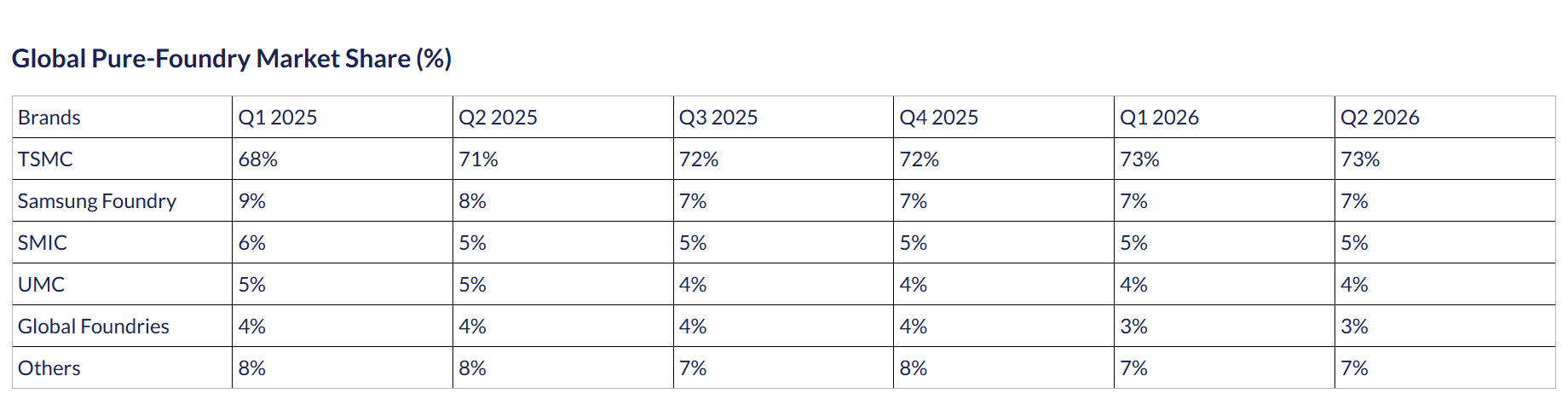
The global pure-play foundry market grew 29% year over year in Q2 2026, driven by AI-related orders and capacity reallocation, according to Counterpoint Research. TSMC held a 73% market share for a second consecutive quarter, while Samsung held 7% and SMIC 5%, reporting by Asia Business Daily and Mark LaPedus shows. Counterpoint also reported supply-demand imbalances in advanced and mature processes alongside tight advanced-packaging supply.
The global pure-play foundry market grew 29% year over year in Q2 2026, with AI semiconductor orders and capacity reallocation contributing to supply-demand imbalances across advanced and mature manufacturing processes, according to Counterpoint Research.
TSMC accounted for 73% of the market for the second consecutive quarter, according to Counterpoint figures reported by Asia Business Daily and semiconductor journalist Mark LaPedus. Samsung Foundry remained second with 7% share, followed by China's SMIC at 5%, Taiwan's UMC at 4%, and GlobalFoundries at 3%, LaPedus reported.
TSMC extends its lead
Asia Business Daily reported that TSMC's share put it 66 percentage points ahead of Samsung in Q2. Counterpoint attributed TSMC's position to 2nm mass production, expansion of 3nm processes, shortages in 8-inch and 12-inch mature-node capacity, and tight supply of advanced packaging.
The reported mix matters because advanced AI accelerators depend on more than leading-edge logic fabrication. They also require packaging capacity to integrate high-bandwidth memory and compute dies. Across the sector, constraints at either the wafer-fabrication or packaging stage can limit delivered accelerator volume even when demand for chips remains high.
Counterpoint reported that surging AI-related orders and capacity reallocation remained key drivers of supply-demand imbalances in both advanced and mature nodes. Mature-node demand remains relevant to AI infrastructure because power-management ICs, connectivity components, controllers, and other supporting silicon typically do not require the newest process technologies.
Rivals retain smaller shares
Samsung's Q2 share was unchanged from Q1 2026, according to both reports. Counterpoint identified demand for Samsung's SF4 and SF5 processes, along with foundry wafer price increases in the first half of 2026, as drivers of revenue growth. The research firm also reported that Samsung's principal target remained yield improvement for its SF2 process.
SMIC recorded record Q2 revenue and retained third place, supported by domestic Chinese demand and increased overseas orders, according to Counterpoint as cited by Asia Business Daily. The report did not provide revenue figures in the material reviewed.
Intel did not appear in Counterpoint's top-10 pure-play foundry ranking, LaPedus reported. That ranking is specifically about pure-play foundry share and does not measure every semiconductor manufacturer's total chip revenue or internal manufacturing output.
Pricing and utilization outlook
Counterpoint forecast that foundry wafer average selling prices would continue rising in the second half of 2026 and that pure-play foundry utilization would remain relatively high. That is a forecast from the research firm, not an announced pricing policy by individual foundries.
For ML infrastructure teams, the market data is a reminder that AI system availability can be shaped by a multistage hardware supply chain, not solely by GPU architecture or cloud procurement. Wafer fabrication, packaging capacity, and total system availability can all affect large-scale training and inference deployments.
Key Points
- 1Counterpoint reports 29% Q2 foundry growth, showing that AI demand is affecting both leading-edge logic fabrication and mature-node supply.
- 2TSMC held 73% of pure-play foundry market share, leaving Samsung 66 percentage points behind and highlighting the market's concentration.
- 3High utilization and rising wafer-price forecasts indicate that infrastructure buyers can face supply-chain constraints beyond accelerator chip design.
Scoring Rationale
The report documents substantial AI-driven growth in the contract chip-manufacturing market and an unusually concentrated share position for TSMC. It is directly relevant to practitioners building or procuring AI infrastructure because fabrication and packaging capacity affect accelerator availability and pricing.
Sources
Public references used for this report.
Practice with real Ad Tech data
90 SQL & Python problems · 15 industry datasets
250 free problems · No credit card
See all Ad Tech problems