
The title "AI Engineer" barely existed as a job category in 2022. By 2026, it tops LinkedIn's fastest-growing roles list for the US, with over 1.3 million new AI-enabled jobs created globally in the past year. Companies aren't just hiring data scientists to build models anymore — they need engineers who can ship AI-powered products to production, wire LLMs into real systems, and keep them running reliably at scale.
Median total compensation for AI engineers at major tech companies sits around $245,000 according to Levels.fyi data. Senior roles at companies like Google, Meta, and OpenAI clear $350,000–550,000 in total comp. Entry-level roles at non-FAANG companies start around $130,000–160,000 — still well above the software engineer median.
This guide maps out exactly what the role requires in 2026, how it differs from adjacent roles, and the concrete sequence to build these skills whether you're coming from software engineering, data science, or ML engineering.
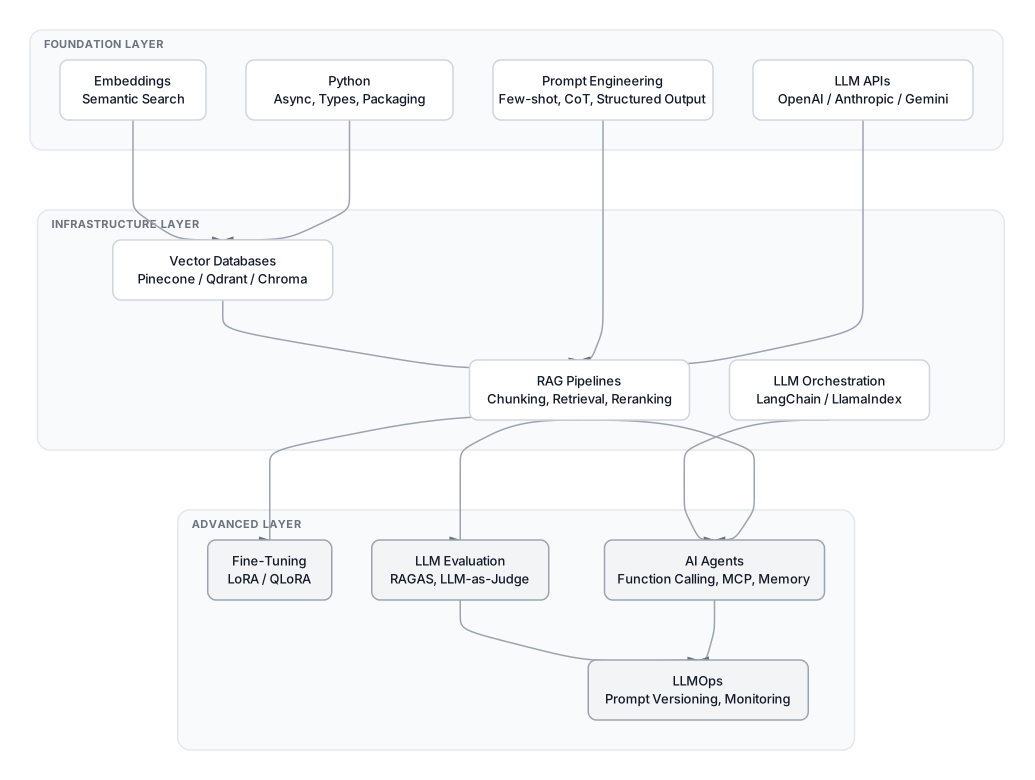 Click to expandAI engineer competency map showing Foundation, Infrastructure, and Advanced skill layers
What an AI Engineer Actually Does
An AI engineer builds systems that use large language models and foundation models as components. The definition that works best in practice: if a software engineer builds software, and a data scientist derives insights, an AI engineer ships AI features.
On a given day, an AI engineer might debug why a RAG pipeline is returning irrelevant chunks, A/B test two different system prompts to see which produces more accurate outputs, integrate a new model API into an existing service, or write evaluation harnesses that automatically grade 500 model responses. The work is closer to backend engineering than research.
This is a genuinely different job from the adjacent roles that came before it:
| Dimension | Data Scientist | ML Engineer | AI Engineer |
|---|---|---|---|
| Primary focus | Insight and analysis | Model building and training | LLM-powered product features |
| Core skills | Statistics, SQL, visualization | Training pipelines, MLOps, model optimization | Prompt engineering, RAG, agents, LLM APIs |
| Primary tools | Jupyter, pandas, matplotlib | PyTorch, Kubeflow, MLflow | LangChain/LlamaIndex, vector DBs, API SDKs |
| Output | Reports, dashboards, models | Trained models, serving infrastructure | Deployed AI features, pipelines |
| Typical background | Stats, math, domain expertise | CS, software engineering | Software engineering, ML engineering |
| 2026 median US salary | $130,000 | $155,000 | $175,000+ base |
The distinction matters because each role optimizes for different things. Data scientists optimize for analytical accuracy. ML engineers optimize for training efficiency and model performance. AI engineers optimize for end-user experience with AI features — which means reliability, latency, cost per call, and output quality all matter equally.
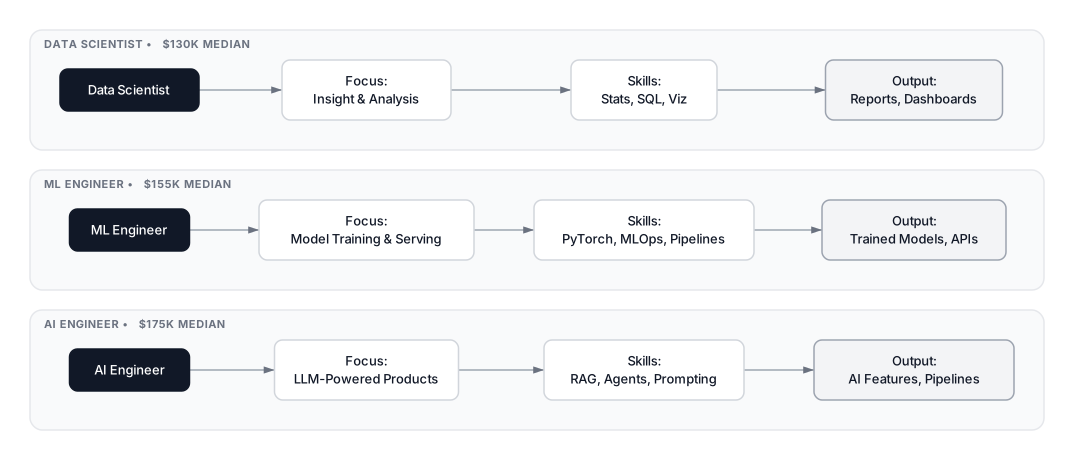 Click to expandRole comparison between Data Scientist, ML Engineer, and AI Engineer
Key Insight: AI engineering is primarily a software engineering discipline applied to LLM-based systems. The mental model that helps most: treat the LLM as an API call that returns probabilistic text, and your job is to engineer everything around it to make that probabilistic text reliably useful.
The Core Competency Map
The skills stack naturally into three layers. You can't skip layers — infrastructure skills without a solid foundation produce brittle systems, and advanced techniques without solid infrastructure skills will never make it to production.
Foundation Layer
Python beyond the basics. Data science Python (numpy, pandas, Jupyter) is the starting point, not the destination. Production AI engineering needs asyncio for handling concurrent LLM calls, proper type hints and pydantic models for validating structured outputs from LLMs, packaging skills to build reusable internal libraries, and strong understanding of environment management. If you've been doing data science Python, spend two weeks specifically on async patterns — most modern LLM frameworks are async-first.
LLM APIs. Genuine fluency with at least the OpenAI, Anthropic, and Google Gemini APIs is non-negotiable. This means synchronous and streaming calls, understanding token counting and context windows, function calling (structured tool use where the model returns JSON specifying which tool to invoke), system prompts, and the differences in how each model handles multi-turn conversation. The OpenAI API reference and Anthropic API documentation are the primary sources — read them cover to cover.
Prompt engineering. Not "tricks" — actual systematic approaches. Few-shot prompting (including how many examples is enough and how order affects performance), chain-of-thought for complex reasoning tasks, structured output prompting with JSON schema enforcement, and system prompt design that constrains model behavior reliably. The most important skill is knowing when the prompt is the problem vs. when the model is the problem vs. when the data is the problem.
Embeddings and semantic search. Understanding how text embedding models work, what cosine similarity means in practice, why you'd choose a 1536-dimension embedding vs. a 384-dimension one, and how to build a basic semantic search system from scratch. Most RAG systems live or die on embedding quality. Our Text Embeddings guide covers the mechanics in depth.
Infrastructure Layer
Vector databases. Pinecone, Qdrant, and Chroma are the three you'll encounter most often. The core skill is understanding the tradeoffs: Pinecone for fully-managed production, Qdrant for self-hosted with excellent filtering, Chroma for local development. You need to understand indexes (HNSW vs. IVF), filtering on metadata alongside vector similarity, and how to think about collection design. Our Vector Databases Compared guide covers these tradeoffs in depth.
RAG pipelines. Retrieval-Augmented Generation is the most-used production pattern in AI engineering today. Building a RAG system that actually works at production quality means going well beyond the tutorial version. Chunking strategy (fixed-size vs. semantic vs. hierarchical), overlap settings, embedding model choice, retrieval (dense, sparse, hybrid), and reranking with a cross-encoder before passing context to the LLM. The gap between a 10-minute tutorial RAG and a production RAG that users trust is enormous. Our RAG vs Fine-Tuning deep-dive covers when to use each approach.
LLM orchestration. LangChain (now v0.9.3) and LlamaIndex (now v1.2.0) are the dominant frameworks. The honest take: learn LangChain Expression Language (LCEL) for its composability, but also practice building simple pipelines directly against the model APIs. Over-relying on frameworks before understanding the primitives leads to debugging nightmares in production. Many production stacks in 2026 use LlamaIndex as the knowledge/retrieval layer and LangChain as the orchestration layer — the two are no longer direct competitors.
Model Context Protocol (MCP). MCP has become the de facto standard for connecting AI agents to external tools and data sources. Introduced by Anthropic in November 2024 and donated to the Linux Foundation in December 2025, the protocol hit 97 million monthly SDK downloads by February 2026 and is now supported by every major AI provider: Anthropic, OpenAI, Google, and Microsoft. Understanding how to build and consume MCP servers is no longer optional — it's the plumbing of modern agent systems. Our MCP deep-dive covers the full architecture.
Advanced Layer
AI agents with LangGraph, CrewAI, and PydanticAI. Agents are LLM-powered systems that take sequences of actions — call APIs, run code, search the web, write files — to complete multi-step tasks. The agent framework landscape has clarified significantly in 2026:
| Framework | Best for | Why |
|---|---|---|
| LangGraph | Enterprise/production stateful agents | Fine-grained control, durable workflows, human-in-the-loop |
| CrewAI | Business workflow automation | 40% faster time-to-production, role-based teams |
| PydanticAI | Type-safe production agents | V1 stable March 2026, 15M+ downloads, strong validation |
| AutoGen | Avoid for new projects | Shifted to maintenance mode; Microsoft moved to other tooling |
LangGraph wins for production systems where a failure costs money or reputation. CrewAI wins for quickly automating business workflows. PydanticAI is the emerging choice for teams who want strong type guarantees and production-grade reliability. Our AI Agent Frameworks Compared article benchmarks these in detail.
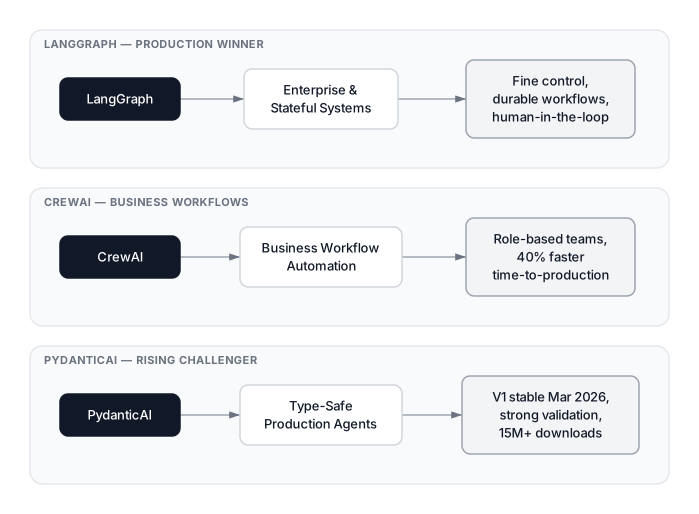 Click to expandAI agent framework comparison showing LangGraph, CrewAI, and PydanticAI use cases in 2026
Fine-tuning with LoRA/QLoRA. Full fine-tuning of large models is prohibitively expensive for most teams. Parameter-Efficient Fine-Tuning (PEFT) methods — specifically LoRA and QLoRA — let you adapt a 7B or 13B model to specialized tasks on a single GPU. The key skills: understanding when fine-tuning actually beats well-engineered prompting (less often than you'd think), dataset curation for instruction fine-tuning, and the Hugging Face transformers + peft + trl stack. Our Fine-Tuning LLMs with LoRA and QLoRA article is the best starting point.
LLM evaluation. You cannot improve what you don't measure. Automated evaluation for LLM outputs uses three approaches: rule-based checks (JSON validity, length constraints, keyword presence), model-graded scoring where another LLM judges the output quality ("LLM-as-judge"), and framework-based evaluation with tools like RAGAS specifically for RAG pipelines. RAGAS measures context relevancy, faithfulness, and answer relevance. Learning to design eval sets that catch real failure modes — not just happy-path examples — is one of the most underrated skills in this field. Our LLM Evaluation with RAGAS and LLM-as-Judge guide covers the full evaluation toolkit.
LLMOps. This is MLOps applied to LLM-based systems, with some important differences. You're not versioning model weights as often — you're versioning prompts, which change frequently. The tool landscape has matured:
| Tool | Type | Best for |
|---|---|---|
| LangSmith | Commercial | Tracing, prompt registry, A/B tests — most popular |
| Langfuse | Open source (MIT) | Self-hosted observability, generous free tier |
| Helicone | Commercial/OSS | Fastest setup, automatic cost tracking |
| Braintrust | Commercial | Enterprise eval management |
| Arize Phoenix | OSS | Model performance + evaluation focus |
| Weave (W&B) | Commercial | Teams already using Weights & Biases |
A common production setup: Helicone or Langfuse for logging and cost tracking, RAGAS + a golden test set for quality measurement. LangSmith if you need prompt registry and team collaboration on evals.
Vercel AI SDK (for full-stack AI). If you're building AI features in Next.js or React, the Vercel AI SDK v6 (20 million monthly downloads as of March 2026) is the TypeScript standard. It provides streaming, tool calling, and multi-provider support in a unified API. Not every AI engineer needs it, but it's essential for full-stack roles.
The Six-Month Learning Sequence
The mistake most people make is trying to learn everything in parallel. The competency layers exist because skills in later layers make no sense without earlier ones.
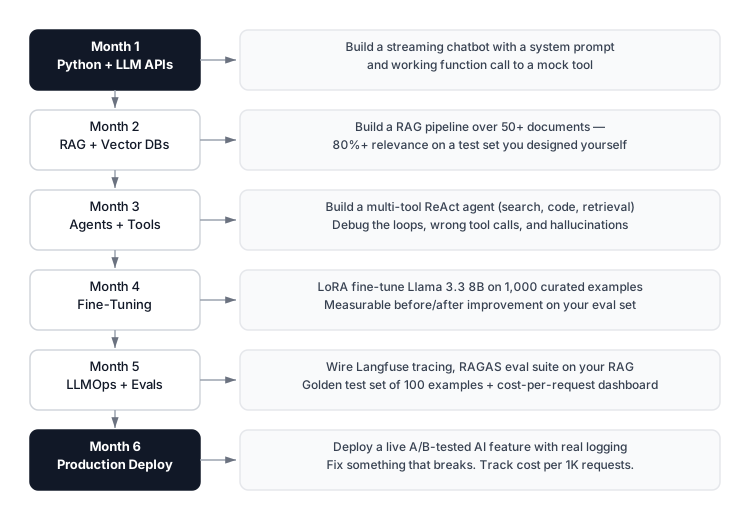 Click to expandAI engineer learning path from Month 1 through Month 6
Month 1: Foundation. Pure foundation work. Python proficiency at the async and type-hint level, plus hands-on time with at least two LLM APIs. Milestone: build a CLI chatbot that streams responses, uses a system prompt to maintain a persona, and implements function calling to query a mock database. If you can build that cleanly, the foundation is solid.
Month 2: RAG and Vector Databases. Build a RAG pipeline from scratch — directly against the embedding API and a vector database, not with a framework. Index 50+ documents, implement chunking, add reranking. Milestone: a system that answers questions about a document corpus and achieves 80%+ relevant answers on a test set you designed yourself. Now you understand what a framework like LlamaIndex is actually abstracting.
Month 3: Agents. Take your RAG pipeline and give the model tools: web search, document retrieval, a calculator, a code executor. Implement the ReAct loop manually. Hit the point where the model breaks in interesting ways — it loops, it hallucinates tool names, it calls the wrong tool. Debugging agents teaches more than tutorials.
Month 4: Fine-tuning. Take a base model (Llama 3.3 8B is the 2026 choice), curate 1,000 instruction-response pairs on a task you care about, run LoRA fine-tuning with the trl library. Evaluate before and after. Milestone: a demonstrable improvement on your task with a model that fits in GPU memory.
Month 5: LLMOps and Evaluation. Wire everything together with observability. Set up Langfuse or LangSmith tracing, write a golden test set of 100 examples, implement RAGAS metrics for your RAG system, and build a cost-per-request dashboard. This is where you go from "it works on my machine" to "I can prove it works in production."
Month 6: Production Deployment. Deploy something real. A/B test two prompts. Fix something that broke. Track cost per 1,000 requests. One production system teaches more about the job than any course.
Pro Tip: Build one project per phase that you can actually show someone. Four production-quality projects beat 40 tutorial completions every time in interviews. The projects compound — your month-six deployment should sit on top of everything you built in months one through five.
Essential Tools Reference
| Category | Tool | Purpose | Priority |
|---|---|---|---|
| LLM APIs | OpenAI, Anthropic, Gemini | Primary model access | Learn all three |
| LLM Frameworks | LangChain v0.9 (LCEL), LlamaIndex v1.2 | Orchestration, pipelines | Learn one deeply |
| Agent Frameworks | LangGraph, CrewAI, PydanticAI | Multi-step agents | LangGraph for production |
| Agent Protocol | MCP (Model Context Protocol) | Tool/data connectivity | Essential for agents |
| Vector DBs | Qdrant, Pinecone | Similarity search, RAG | Learn Qdrant first |
| Local dev DB | Chroma | Fast prototyping | Useful early |
| Embeddings | OpenAI text-embedding-3-large, BGE-M3 | Text vectorization | Use both |
| Reranking | Cohere Rerank, BGE Reranker | RAG quality | Learn after basic RAG |
| PEFT | Hugging Face peft, trl | Fine-tuning LoRA/QLoRA | Month 4+ |
| Model hub | Hugging Face Hub | Open weights models | Ongoing |
| Observability | LangSmith, Langfuse, Helicone | Tracing, cost, evals | Once you have a system |
| Eval frameworks | RAGAS, deepeval | LLM output quality | Alongside any system |
| Full-stack AI | Vercel AI SDK v6 | Next.js/React AI features | If doing full-stack |
| Hosting | Modal, Replicate, HF Inference Endpoints | Model serving | Production phase |
| Container | Docker | Packaging and deployment | Required throughout |
Portfolio Projects That Actually Get You Hired
A stronger portfolio demonstrates production-quality work beyond a basic chatbot: evaluation, failure handling, observability, and clear evidence that the system works outside the happy path.
Three projects cover the full skills spectrum and compound well together:
Project 1 — Production RAG system. Pick a domain with real documents (legal filings, scientific papers, company docs, API documentation). Build a system that supports hybrid retrieval, has a proper evaluation harness with RAGAS metrics, and is deployed somewhere users can try it. Document the chunking decisions you made and why. Show the before/after on your eval set when you changed the strategy.
Project 2 — Multi-step agent with MCP. Build an agent that uses at least three MCP-connected tools to complete a real workflow — not a toy. Code review agent, research assistant, document processing pipeline. The important thing is showing that you've handled tool-call failures, implemented a retry mechanism, and added observability. A working LangGraph or PydanticAI state machine with clear decision points shows production thinking.
Project 3 — Fine-tuned model with measured improvement. Take a base model, fine-tune it on a specific task, and present a before/after evaluation showing the improvement. This doesn't need to be dramatic — a consistent 15% accuracy gain on a specific task, measured properly, is more impressive than vague claims about "improved performance." Include the dataset curation decisions.
Key Insight: Production deployment is the differentiator. A project hosted on a public URL with real logging, a cost dashboard, and an evaluation report puts you in the top 5% of AI engineer candidates. Most candidates stop at the GitHub repo.
Red Flags in AI Engineer Resumes and Interviews
These patterns signal to interviewers that a candidate has surface-level knowledge rather than production experience:
"I've used ChatGPT to build..." as the lead. Using ChatGPT as an end-user isn't AI engineering. Interviewers want to hear about systems you built on top of APIs, not demos you created through a web interface.
Can only talk in terms of frameworks. "I built this with LangChain" without being able to explain what LangChain is doing under the hood is a red flag. The question "how would you build this without LangChain?" should not produce a blank stare.
No evaluation numbers. Claiming a system "works well" or "performs accurately" without any eval methodology is an instant downgrade. Any system you've built in 2026 should have a test set and measurable quality metrics attached to it.
Resume says "fine-tuned a model" but can't discuss the dataset. Dataset curation is half of fine-tuning. Candidates who claim fine-tuning experience but can't describe how they curated and cleaned training data either copied a tutorial or are exaggerating the scope.
Only lists framework names as skills. LangChain, LlamaIndex, CrewAI as bullet points under Skills signals someone who has done tutorials. What interviewers want to see: "Built production RAG pipeline handling 10,000 daily queries with sub-200ms p95 latency" — outcomes and scale.
No GitHub, or GitHub with only notebooks. For an engineering role, the portfolio should show production code: proper Python packages, Dockerfiles, CI configuration, README that explains how to run it. Notebooks show data science thinking; Python packages show engineering thinking.
Career Transition Paths
From software engineering. This is the fastest path. Your production mindset, API design instincts, and debugging skills are directly transferable. The gaps are usually prompt engineering intuition, evaluation methodology, and RAG architecture. A software engineer who spends 60 days building the month-by-month project sequence above and can discuss LLM system design is competitive for junior AI engineer roles at most companies.
From data science. You have Python and statistical thinking covered. The significant gaps are: async programming patterns, API-first thinking (vs. notebook-first), system design, and DevOps basics (Docker, deployment). Data scientists often over-index on model accuracy and under-index on system reliability — the mental model shift from "model quality" to "system quality including the model" is the key adjustment.
From ML engineering. You have the strongest foundation because you understand training pipelines, model serving, and production ML. The additional skills needed are mostly LLM-specific: prompt engineering (genuinely different from feature engineering), RAG patterns, and agent architectures. ML engineers transitioning to AI engineering typically do so within 2 to 3 months of deliberate upskilling.
Common Pitfall: Don't wait until you've "mastered" everything before applying. Most AI engineer roles in 2026 don't require all advanced skills simultaneously — they require strong foundations plus one or two advanced areas. Apply when you have solid foundation plus one full infrastructure skill (usually RAG).
What Not to Waste Time On
Math-heavy ML theory before touching LLMs. If your goal is AI engineering, spending six months on backpropagation calculus and linear algebra proofs before touching an LLM API is the wrong order. Get productive first, go deep on theory where it actually connects to problems you're solving.
Mastering LangChain before understanding primitives. Many engineers reach for LangChain on day one. The problem: when your LangChain chain returns garbage, you won't know why. Build at least two systems directly against the raw API first. Then frameworks become tools that save time, not black boxes you can't debug.
Chasing every new model release. A new model drops every few weeks. Spending time benchmarking every release is not engineering work — it's procrastination. Follow the major architectural changes (new context lengths, native function calling improvements, multimodal capabilities), but stay focused on building.
Completing every course. Online courses are a starting point. The first 20% of a well-chosen course gives you 80% of the orientation you need. The remaining 80% of course content is better replaced with building something real.
AutoGen for new projects. Microsoft has shifted AutoGen to maintenance mode in favor of a broader agent framework strategy. Teams starting new agent projects in 2026 are choosing LangGraph, CrewAI, or PydanticAI. AutoGen tutorials still dominate search results — don't confuse search visibility with production adoption.
What Companies Ask in AI Engineer Interviews
Based on what engineering teams at FAANG and AI-native companies are actually testing in 2026:
System design for LLM systems. "Design a document Q&A system for 10 million documents." Interviewers want to hear you think about chunking strategy, embedding model tradeoffs, vector index design, query routing, latency budgets, and cost. They're checking whether you understand RAG as a system, not just a library call.
Debugging prompts. You'll get a bad prompt and a set of failure cases and be asked to fix it. This tests systematic thinking: can you identify whether the failure is a prompt issue, a context issue, a model capability issue, or a retrieval issue? Most candidates fail this because they only know happy-path prompting.
Evaluation design. "How would you measure whether your RAG system got better after you changed the chunking strategy?" Interviewers want RAGAS metrics, LLM-as-judge setups, and ideally a golden test set methodology. Vague answers about "testing" don't pass here.
Agents and tool calling. How does function calling work at the API level? What happens when the model calls a function with wrong arguments? How do you prevent infinite loops in an agent? These are operational questions, not conceptual ones.
Fine-tuning vs. prompting tradeoffs. When would you fine-tune a model instead of improving the prompt? Correct answer: when you need consistent format/style at scale, when the task is highly specialized with lots of training examples, or when latency/cost of long prompts is a business constraint. Wrong answer: "whenever the prompt isn't working."
Conclusion
The AI engineer role rewards people who combine production engineering instincts with genuine curiosity about how LLMs actually behave. The best AI engineers aren't those who've read the most papers — they're the ones who've shipped AI features, debugged them in production, and built intuition for how probabilistic systems fail in ways deterministic code doesn't.
The foundation-infrastructure-advanced sequence exists for a reason. Every senior AI engineer who appears to "know everything" got there by building on solid primitives. Start with Python fluency and LLM APIs, build your first RAG pipeline without frameworks, then layer in agents, fine-tuning, and evaluation. The six-month path isn't a sprint — it's the minimum viable sequence that produces candidates who can hold their own in a technical interview.
For deeper study, our Building AI Agents with ReAct, Planning, and Tool Use and Fine-Tuning LLMs with LoRA and QLoRA articles cover two of the most critical advanced skill areas. If you're building RAG systems, Agentic RAG: Self-Correcting Retrieval shows where the state of the art is heading in 2026.
Start with a production-grade Python service that calls an LLM API, measures latency and cost, and includes a small evaluation set. Add retrieval and agent workflows after those fundamentals are reliable.