
Picture a junior paralegal researching case law. They search a database once, grab the first five results, and write a memo. No quality check, no follow-up queries, no verification that the cases actually apply. That's standard RAG.
Now picture a senior attorney. They search, scan results, toss out irrelevant ones, reformulate their search terms, and cross-reference findings before writing a single word. That's agentic RAG: retrieval-augmented generation where the LLM acts as the researcher, not just the writer.
By early 2026, most enterprise RAG teams have learned the hard way that retrieval quality matters far more than generation quality. Poor chunking strategies and weak relevance filtering cause more failures than the LLM itself. The fix isn't a better model. It's closed-loop retrieval: retrieve, evaluate, and try again until the evidence supports a good answer.
Why Single-Shot Retrieval Breaks Down
Standard RAG follows a rigid three-step pipeline: embed the query, retrieve the top-K nearest documents, and generate an answer from whatever comes back. This works for simple factual lookups. It falls apart the moment queries get complex.
Consider our legal research assistant. A lawyer asks: "Find precedents where courts ruled on AI-generated evidence in contract disputes." Naive retrieval returns one relevant case, a landlord-tenant dispute mentioning "contract" but nothing about AI, and two traffic court cases that happened to mention "evidence." The system passes everything to the LLM, which hallucinates connections or hedges so heavily the output is useless.
Three failure modes plague naive RAG:
| Failure Mode | What Happens | Example |
|---|---|---|
| Semantic mismatch | Query and relevant docs use different terminology | "AI evidence" vs. "algorithmic testimony" |
| Missing context | Relevant information spans multiple documents | Ruling in one case, reasoning in another |
| Ambiguous queries | Query could mean several different things | "AI contracts" = AI-generated contracts? Contracts about AI? |
The fundamental problem: the system can't recognize when retrieval has failed and has no way to recover. The Meta CRAG Benchmark (not to be confused with the Corrective RAG method discussed later) showed that even state-of-the-art RAG solutions only answer 63% of questions without hallucination, with the best LLM-only solutions reaching just 34% overall accuracy without retrieval augmentation.
What Makes RAG "Agentic"
Agentic RAG wraps the retrieval pipeline in a decision-making loop. The LLM stops being a passive consumer of retrieved documents and starts acting as a research agent. A 2025 survey from Singh et al. (arXiv:2501.09136) formalized the taxonomy across single-agent, multi-agent, hierarchical, corrective, adaptive, and graph-based architectures.
Four capabilities separate agentic RAG from its naive predecessor:
Retrieval decisions. The agent decides when to retrieve. Some questions can be answered from parametric knowledge; complex ones need multiple rounds.
Relevance evaluation. After retrieval, the agent scores each document. Documents below a threshold get discarded, and if too few pass, the agent triggers a new cycle with a reformulated query.
Query rewriting. When initial retrieval fails, the agent generates a better search query. Our legal assistant might rewrite "AI-generated evidence in contract disputes" to "algorithmic testimony admissibility commercial litigation" to capture cases using different terminology.
Self-verification. Before returning an answer, the agent checks whether its response is supported by retrieved evidence. Unsupported claims get flagged as hallucinations.
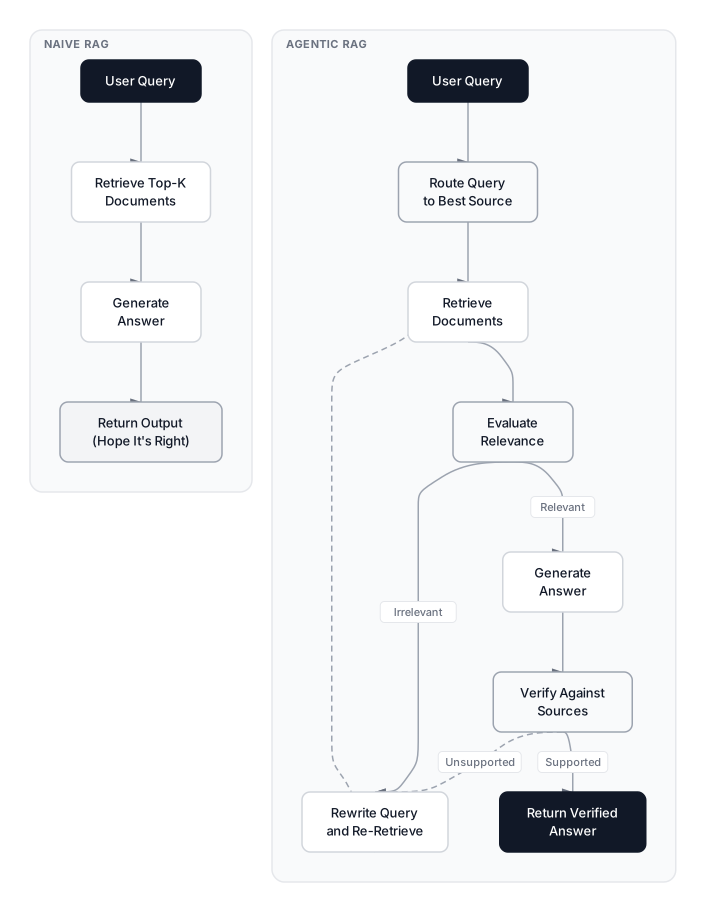 Click to expandNaive RAG retrieves once and generates. Agentic RAG adds evaluation, query rewriting, and verification loops.
Key Insight: The "agentic" part isn't about adding more models. It's about giving the LLM the ability to judge its own intermediate results and act on that judgment. A single LLM can handle retrieval evaluation, query rewriting, and answer verification if you structure the prompts correctly. In production, frameworks like LangGraph model this as a state machine with conditional edges between router, grader, rewriter, and generator nodes.
Self-RAG: Teaching Models to Critique Themselves
Self-RAG (Asai et al., ICLR 2024 Oral, top 1% of submissions) trains the language model itself to decide when retrieval is needed and to critique its own outputs. Instead of relying on external components to evaluate relevance, the model generates special reflection tokens inline with its response.
Four reflection token types control the process:
| Token | Purpose | Values |
|---|---|---|
[Retrieve] | Should I search for more information? | Yes / No / Continue |
[ISREL] | Is this retrieved document relevant? | Relevant / Irrelevant |
[ISSUP] | Is my generation supported by the evidence? | Fully / Partially / None |
[ISUSE] | Is my overall response useful? | 5 / 4 / 3 / 2 / 1 |
At inference time, these tokens act as control signals: [Retrieve=Yes] triggers a retrieval step, [ISREL=Irrelevant] discards a document. For our legal assistant, the model emits [Retrieve=Yes] when it needs case citations, retrieves five documents, marks three as [ISREL=Relevant], and self-scores [ISSUP=Fully] because every claim traces to a source. The key advantage: retrieval and quality decisions happen in a single forward pass rather than requiring separate LLM calls.
Self-RAG's approach has spawned important follow-on work. RAG-EVO (EPIA 2025) extended the concept with evolutionary learning and persistent vector memory, achieving 92.6% composite accuracy against Self-RAG, HyDE, and ReAct baselines. The A-RAG framework (February 2026, arXiv:2602.03442) exposes keyword, semantic, and chunk-level retrieval tools directly to the agent, improving QA accuracy by 5 to 13% over flat retrieval.
Pro Tip: Self-RAG works best when you can fine-tune the base model. If you're locked into a proprietary API, you can approximate the behavior with structured prompting that asks the model to explicitly score relevance and support before generating. Not as clean, but it captures 80% of the benefit.
Corrective RAG: The Three-Action Framework
Corrective RAG (Yan et al., 2024) takes a different approach: rather than training the generator to self-critique, it adds a lightweight retrieval evaluator that scores documents and triggers one of three corrective actions.
Correct. High confidence. Refines documents by stripping irrelevant sentences, keeping only knowledge strips that address the query.
Incorrect. Low confidence. Discards retrieved documents entirely and falls back to web search.
Ambiguous. Medium confidence. Refines local documents and runs web search, blending results before generation.
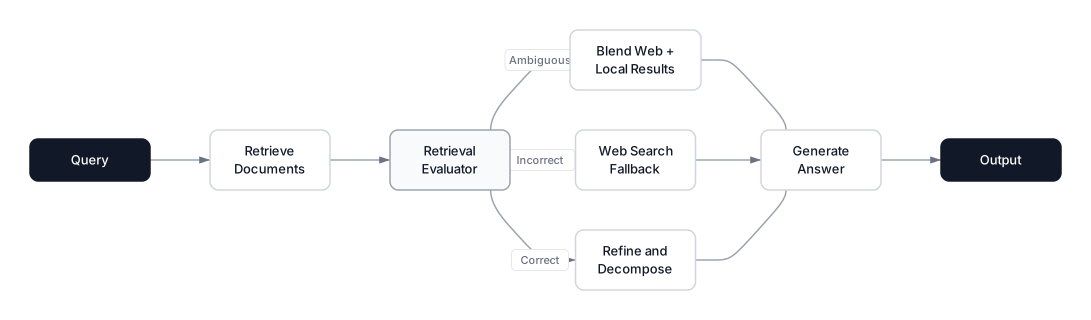 Click to expandThe CRAG pipeline evaluates retrieval quality and routes to three corrective actions based on confidence
Back to our legal assistant. A lawyer asks about a specific 2024 ruling on AI-generated contracts. If the database contains the exact ruling, Corrective RAG strips boilerplate and passes the holding to the generator (correct path). If the ruling is too recent, it discards stale results and searches legal news sites (incorrect path). If the database has related but not exact rulings, it keeps those while also searching externally (ambiguous path). The evaluator uses a fine-tuned T5-large; in practice, the full corrective loop adds 100 to 800ms of latency depending on whether web search is triggered.
The Higress-RAG framework (February 2026, arXiv:2602.23374) builds on this corrective approach for enterprise deployments, combining adaptive routing, semantic caching, and dual hybrid retrieval (dense + sparse with BGE-M3), achieving over 90% recall on enterprise datasets.
Query Routing and Decomposition
Not every query deserves the same retrieval strategy. "What is contract law" needs a fundamentally different approach than a multi-hop question spanning five years of Ninth Circuit rulings.
Adaptive RAG (Jeong et al., 2024) formalizes query routing with a trained T5-large classifier that categorizes queries into three tiers based on complexity.
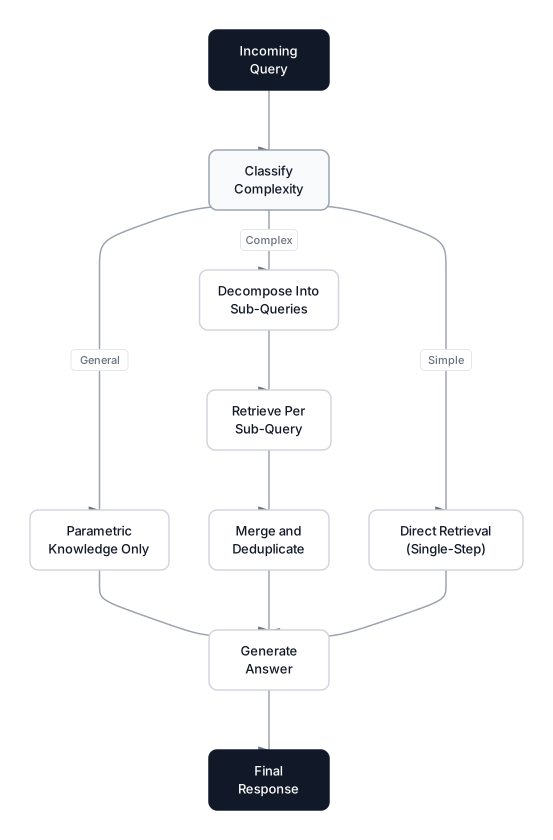 Click to expandQuery routing classifies complexity and dispatches to direct retrieval, decomposition, or parametric knowledge paths
Simple queries go to single-step retrieval. "What is the Daubert standard?" needs one pass through the knowledge base.
Complex queries get decomposed into sub-queries. Our Ninth Circuit AI evidence question becomes three targeted searches: "AI evidence admissibility federal courts," "Ninth Circuit algorithmic evidence 2020-2024," and "commercial arbitration AI evidence precedents." Results are merged, deduplicated, and fed to the generator as unified context.
General knowledge queries skip retrieval entirely. The model's parametric knowledge handles them.
By 2026, this Router Pattern has become table stakes. Enterprises report 30 to 40% latency reductions on common queries while improving accuracy on complex reasoning tasks.
Common Pitfall: Don't decompose queries without a merge step. If you concatenate results from three sub-queries, you'll have duplicates, contradictions, and a context window stuffed with redundancy. Always deduplicate and reconcile before generation.
Multi-Step Retrieval in Practice
Some questions can't be answered in a single retrieval round. Multi-step retrieval builds answers iteratively, where each step informs the next.
Our legal assistant gets asked: "Has AI evidence admissibility evolved differently in state versus federal courts?" Step 1 retrieves federal rulings and extracts key patterns. Step 2 uses those patterns to formulate a targeted state court query: "state court rulings departing from federal Daubert standard for algorithmic evidence" is far more precise than a generic search because step 1 revealed Daubert as the central framework. Step 3 retrieves comparative analyses.
Each step narrows the search space. The agent maintains a working memory and generates increasingly specific queries. Hierarchical variants organize agents into planner, orchestrator, and executor roles, coordinating retrieval across structured databases, unstructured text, and knowledge graphs simultaneously.
Microsoft's GraphRAG takes this further by building a knowledge graph from the corpus before query time. Rather than relying purely on vector similarity, GraphRAG extracts entities and relationships, groups them into hierarchical communities, and generates community summaries. At query time, the system retrieves subgraph neighborhoods and their summaries, giving the LLM structural context that flat chunk retrieval misses entirely. This is especially powerful for multi-hop questions where the answer depends on connections between documents, not just what's inside any single one. For our legal assistant, a knowledge graph linking judges to rulings to statutes would surface precedent chains that no amount of embedding similarity could reconstruct.
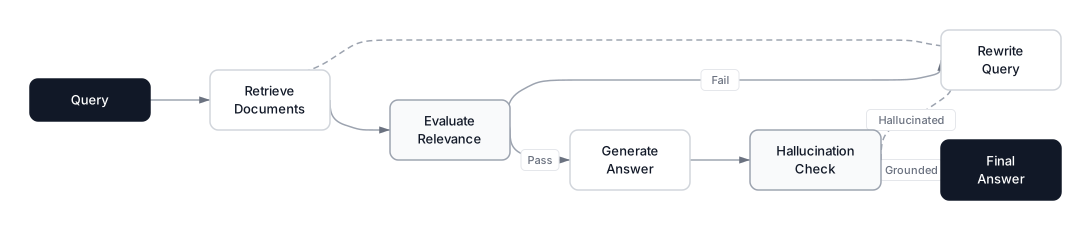 Click to expandThe self-correction loop shows how retrieval, evaluation, query rewriting, and hallucination checking form a closed-loop system
Measuring Retrieval Quality with TF-IDF Similarity
Before building correction loops, you need a way to measure retrieval quality. Here's TF-IDF cosine similarity scoring document relevance for our legal assistant.
Query: "Find cases where courts ruled on AI-generated evidence in contract disputes"

Document Rankings by TF-IDF Cosine Similarity:
----------------------------------------------------------------------
  #1  Score: 0.364  [Relevant]
       Court ruled AI-generated contract clauses are enforceable under UCC Ar

  #2  Score: 0.210  [Relevant]
       Judge excluded AI-generated evidence citing lack of established Dauber

  #3  Score: 0.187  [Relevant]
       Precedent established for admissibility of machine learning evidence i

  #4  Score: 0.080  [Irrelevant]
       Traffic violation case with standard breathalyzer evidence

  #5  Score: 0.072  [Irrelevant]
       Appeals court upheld lower court ruling on automated contract generati

  #6  Score: 0.072  [Irrelevant]
       Landlord tenant dispute over lease terms has no AI component

  #7  Score: 0.000  [Irrelevant]
       Employment discrimination case involving algorithmic hiring bias

  #8  Score: 0.000  [Irrelevant]
       Defendant argued digital signature was forged using deepfake technology
In Plain English: Cosine similarity measures how closely a document's vocabulary overlaps with the query. A score of 1.0 means perfect alignment; 0.0 means zero overlap. In our legal assistant example, Document #1 scores highest (0.364) because it shares the exact terms "AI-generated," "contract," and "ruled" with the query. Document #5 discusses the same topic but scores only 0.072 because it uses "automated" instead of "AI-generated." This is exactly the kind of semantic gap that an agentic system catches and fixes through query rewriting.
Building a Relevance Evaluation Gate
The relevance evaluator is the most critical component: it decides whether retrieved documents are good enough to generate from, or whether the system needs to try again.
Retrieval Relevance Evaluation
=======================================================
Threshold: 0.3

  Doc 1: 0.977  [PASS]  AI contract enforceability ruling (2024)
  Doc 2: 0.626  [PASS]  Deepfake evidence admissibility hearing
  Doc 3: 0.442  [PASS]  ML-based fraud detection testimony
  Doc 4: 0.182  [FAIL]  Standard lease agreement dispute
  Doc 5: 0.118  [FAIL]  Traffic court breathalyzer case

Result: 3/5 documents pass relevance threshold
Action: Proceed to generation
In production, you'd replace this cosine similarity check with an LLM-based evaluator or a fine-tuned cross-encoder (like the T5-large model Corrective RAG uses). For a deeper look at how text embeddings drive semantic retrieval beyond TF-IDF, see our dedicated guide. The threshold-based gate remains the same: enough relevant documents means proceed; too few means rewrite and retry.
Evaluation Metrics for Agentic RAG
How do you know your agentic system actually outperforms naive retrieval? The RAGAS framework provides four core metrics designed specifically for RAG evaluation.
| Metric | What It Measures | Why It Matters |
|---|---|---|
| Faithfulness | Fraction of generated claims supported by retrieved context | Catches hallucinations |
| Answer Relevancy | How well the answer addresses the original query | Catches off-topic responses |
| Context Precision | Proportion of retrieved chunks actually used in the answer | Measures retrieval efficiency |
| Context Recall | Whether all information needed to answer appears in retrieved context | Catches retrieval gaps |
Beyond RAGAS, track retrieval-specific metrics (precision@k, MRR, nDCG) plus two agentic-specific ones:
Correction rate. How often does the system trigger a query rewrite? A healthy system corrects 15 to 30% of queries. If it's correcting 80%, your initial retrieval is broken. If it never corrects, your threshold is too low.
Convergence speed. How many cycles before the system generates? Most queries should converge in 1 to 2 cycles. If you're routinely hitting 5+, your query rewriting strategy needs work.
Pro Tip: Track correction rate per query category. Factual lookups may rarely need correction while multi-hop reasoning queries correct 60% of the time. This tells you where to invest in better retrieval.
Production Architecture Considerations
Agentic RAG trades latency and cost for accuracy. Every evaluation step is an LLM call, every query rewrite triggers a new retrieval round. You need guardrails.
Retry budgets. Cap retrieval cycles at three. After three failed attempts, return a low-confidence answer with a disclaimer rather than looping forever.
Tiered evaluation. Route simple queries through standard RAG and reserve the full correction loop for complex ones. This cuts costs 40 to 60% without meaningfully impacting quality.
Hybrid retrieval with reranking. Combine BM25 (sparse) with dense vector search and a cross-encoder reranker. For vague queries, HyDE generates a hypothetical answer to guide retrieval before grounding on real documents.
Caching and access control. Cache results keyed by query embedding similarity (cosine distance < 0.05 reuses cached documents). Enforce document-level permissions at query time.
Cost tracking. A full agentic RAG query costs roughly 5 to 8x a naive RAG query. Monitor per-query cost distributions and route extreme outliers to human review. For deeper coverage of how agents manage state, see AI Agent Memory Architecture.
When to Use Agentic RAG
Use it when:
- Queries are complex, multi-hop, or ambiguous
- Accuracy matters more than latency (legal, medical, financial domains)
- Your knowledge base is large enough that single-shot retrieval regularly returns irrelevant results
- Users ask questions that span multiple documents or topics
- Hallucination risk is unacceptable in your domain
Skip it when:
- Queries are simple factual lookups ("what is our refund policy")
- Latency requirements are under 500ms
- Your knowledge base is small and well-curated (under 1,000 documents)
- The cost of 5 to 8x more LLM calls per query isn't justified
- You're building a chatbot for casual conversation, not research
- Models with 1M+ token context windows can ingest your entire knowledge base directly
The decision comes down to one question: what's the cost of a wrong answer? For a legal assistant, a hallucinated citation could lead to sanctions. For a recipe chatbot, too much salt is a minor inconvenience. One nuance for 2026: context windows now exceed 1M tokens, so smaller knowledge bases can skip retrieval entirely. The sweet spot for agentic RAG is large, dynamic knowledge bases where context stuffing isn't feasible.
Conclusion
Agentic RAG represents a genuine shift in how we build retrieval systems. The core insight: treat the LLM as a researcher that evaluates its own intermediate results, not a generator that blindly consumes whatever the retrieval step provides. Self-RAG bakes evaluation into the model through reflection tokens. Corrective RAG adds an external evaluator with three corrective paths. Adaptive RAG routes queries to the right pipeline based on complexity. Production systems increasingly combine all three.
If 20 to 30% of your RAG queries return poor answers, adding a relevance evaluation gate and query rewriting loop will likely cut that failure rate in half.
To go deeper, explore how text embeddings power the retrieval layer, read about building AI agents with ReAct planning for broader agent patterns, or see our guide to how RAG actually works for the foundations.
The best retrieval systems don't just search. They research.
Frequently Asked Interview Questions
Q: What is the difference between naive RAG and agentic RAG?
Naive RAG follows a fixed retrieve-then-generate pipeline with no quality feedback. Agentic RAG adds decision-making loops where the LLM evaluates retrieval quality, rewrites queries when results are poor, and verifies answers against source documents. Industry benchmarks show single-shot RAG only avoids hallucination on about 63% of queries; the agentic correction loop closes that gap.
Q: How does Self-RAG decide when to retrieve, and what are its limitations?
Self-RAG generates special reflection tokens ([Retrieve], [ISREL], [ISSUP], [ISUSE]) learned during fine-tuning that signal retrieval needs, score relevance, and evaluate factual support in a single forward pass. The main limitation is that it requires fine-tuning the base model; with proprietary APIs you can only approximate this through structured prompting.
Q: Explain the three corrective actions in Corrective RAG.
"Correct" triggers on high evaluator confidence and refines documents by stripping irrelevant sentences. "Incorrect" triggers on low confidence and discards local results in favor of web search. "Ambiguous" fires on medium confidence, blending refined local documents with web search results before generation.
Q: How would you design a query routing system for enterprise RAG?
Use a lightweight classifier that categorizes queries into simple (single-step retrieval), complex (decompose into sub-queries), and general knowledge (skip retrieval entirely). Route each tier to a different retrieval strategy. Enterprise deployments report 30 to 40% latency reductions on common queries while improving accuracy on complex reasoning tasks.
Q: Your agentic RAG system occasionally loops and never returns an answer. How do you fix it?
The system is caught in a correction loop where the evaluator keeps rejecting results. Fix it with a hard retry budget (max 3 cycles), a graceful degradation path that returns a low-confidence answer after the limit, and query diversity enforcement that prevents the rewriter from repeating similar searches.
Q: What metrics would you track for an agentic RAG system beyond standard accuracy?
Use the four RAGAS metrics (faithfulness, answer relevancy, context precision, context recall) plus retrieval-specific measures like MRR and nDCG. For agentic behavior specifically, track correction rate (healthy range: 15 to 30%) and convergence speed (most queries should resolve in 1 to 2 cycles).
Q: When would you choose agentic RAG over fine-tuning or long-context stuffing?
If the knowledge base fits within a model's context window (under 500K tokens), context stuffing is simpler and often sufficient. Agentic RAG is the right choice for large, frequently updated knowledge bases where accuracy is critical and you need auditability through source citations. Most production systems in 2026 combine approaches: fine-tuned embeddings for retrieval, agentic loops for quality, and context window management for synthesis.