
Someone is about to spend $15,000 on a data science bootcamp. The school's website says 89% of graduates get hired within six months. What the website doesn't say is that this number comes from the school's own marketing team, not an independent auditor — and that when a third party actually checks, the number drops to somewhere between 64% and 78%.
That gap matters when you're making a $15,000 decision. Or a $60,000 one.
This article covers what the evidence actually says about each path into data science: the traditional degree, the affordable online master's, the bootcamp, and the self-taught route. Not what the bootcamp's sales team says. Not what a YouTube motivator says. What the data shows.
The Bootcamp Promise vs. What CIRR Actually Finds
The Council on Integrity in Results Reporting (CIRR) is an independent nonprofit that audits coding bootcamp outcomes using standardized definitions. "Employed" means full-time, in-field work within 180 days of graduation. Part-time jobs, internships, and unrelated work don't count. A third-party auditor reviews every number.
Real Numbers: CIRR-audited placement rates for member schools range from 64% to 78% for full-time, in-field employment within 180 days (CIRR, 2024 cohort data). The industry average self-reported rate from bootcamp marketing materials is 85% to 93% — the same schools, different methodology.
Flatiron School's CIRR-reported rate is around 76%. Springboard self-reports above 85%, but its CIRR-eligible figures are more conservative. The math here isn't surprising: when "employed" includes anyone who took a freelance gig or a job tangentially related to tech, the numbers look a lot better.
The median first salary for CIRR-verified bootcamp graduates is approximately $70,698, according to Course Report's 2025 analysis — which represents a significant income jump for career changers coming from lower-paying fields, but falls short of what a fresh CS graduate typically earns.
Common Mistake: Before you enroll in any bootcamp, ask specifically for their CIRR report or an equivalent independently audited outcomes document. If they redirect you to their website's testimonials page, that tells you everything you need to know.
The ISA question compounds this. Income Share Agreements sound appealing: pay nothing upfront, then share a percentage of your salary after you're hired. The catch is in the math. At a $75,000 starting salary with a 15% ISA rate over three years, you end up paying $33,750 — more than double the cost of the same bootcamp at upfront pricing (typically $10,900 to $16,500). ISAs are best understood as high-interest financing products, not employer confidence signals.
The average data science bootcamp costs between $10,000 and $17,000. Springboard's Data Science Career Track lists at $10,900 upfront (discount codes can bring it to $9,900). General Assembly's Data Science Immersive runs $16,450. There are cheaper programs, but below $7,000 you are generally looking at lighter curricula with less career support.
The Traditional Degree: Real Costs and Where It Wins
A four-year CS or statistics degree from a state university typically runs $40,000 to $80,000 for in-state students (tuition only). Private universities range from $80,000 to $220,000. The entry-level salary for degree-holders in data science roles is around $85,000 to $105,000, according to Glassdoor (Q1 2026), with a BLS-reported national median for all data scientists of $112,590 as of May 2024.
The degree earns its price in two places: the credential gate and the senior ceiling.
Many data science job postings at established companies still list "Bachelor's degree in Computer Science, Statistics, or related field" as a requirement. A 2024 TripleTen survey of over 1,000 hiring decision-makers found 79% are open to candidates from non-traditional backgrounds including bootcamps — but that still leaves a meaningful share who aren't, and those tend to be the more established companies with formal HR processes. In research roles, government positions, and financial services, the degree requirement is near-universal.
The senior ceiling is where degrees diverge most sharply from alternative paths. Staff-level and principal data scientist roles at FAANG-adjacent companies almost universally require at minimum a master's degree, with many holding PhDs. The math, statistics, and algorithms depth that a four-year degree builds is tested in senior technical interviews. Total compensation for senior data scientists at top companies frequently exceeds $220,000, while the director-level path goes well above $250,000 (Levels.fyi, 2026).
Worth Knowing: Recent CS graduates face a real challenge in 2026. The unemployment rate for new CS graduates is approximately 6.1% (Federal Reserve Bank of New York data, cited in Cengage Group 2025 Employability Report), above the overall graduate unemployment rate of 4.8%. Entry-level tech roles have contracted meaningfully since 2022, partly due to AI tool adoption and partly due to broader tech sector correction. A degree is necessary but no longer sufficient.
The Degree You Might Be Ignoring: GT OMSA and UT MSCS
Here is the comparison most articles miss. Georgia Tech's Online Master of Science in Analytics (OMSA) currently costs approximately $11,800 to $13,500 all-in for the full 36-credit-hour degree (tuition plus per-semester technology fees), depending on enrollment pace and academic year. The University of Texas at Austin's Online Master of Science in Computer Science (MSCS) costs $10,000 total — $1,000 per course, 10 courses. Both confer the exact same accredited degree as their on-campus programs.
This is not a certificate or a credential from an alternative institution. Georgia Tech's OMSA diploma says "Georgia Tech." The on-campus MSA costs roughly $45,000. The online version costs a fraction of that.
Real Numbers: Georgia Tech OMSA tuition was $275 per credit hour as of 2023, rising to $327 per credit hour for Spring 2026 (confirmed via GT Bursar). At $327 × 36 credits, tuition alone is approximately $11,772. Technology fees add roughly $176 per semester; over 8–10 semesters of part-time enrollment, total fees run $1,400–$1,800. All-in cost: approximately $13,000–$13,600. UT Austin MSCS is $10,000 flat for the 30-credit-hour program ($1,000 per course, 10 courses) per UT Austin Computer & Data Science Online (2025–2026).
The catch is that these are not easy admissions targets. Georgia Tech OMSA is competitive: applicants need a quantitative undergraduate degree or strong quantitative coursework, programming experience, and typically professional work history. UT Austin MSCS has similar prerequisites and is designed for students with CS backgrounds looking to go online. Neither is a path for someone with no quantitative background who wants to transition in six months.
But for someone who already has a quantitative degree — say, a mechanical engineer, a finance analyst, or a biologist with statistics coursework — these programs offer a legitimate master's credential at bootcamp prices. The employer perception is full master's-level credibility. Multiple reviewers on Blind and in career forums note that the Georgia Tech name on a resume opens doors that a bootcamp certificate doesn't.
If you're choosing between a $15,000 bootcamp and a Georgia Tech master's degree in the same price range, and you qualify for the latter, the decision is straightforward.
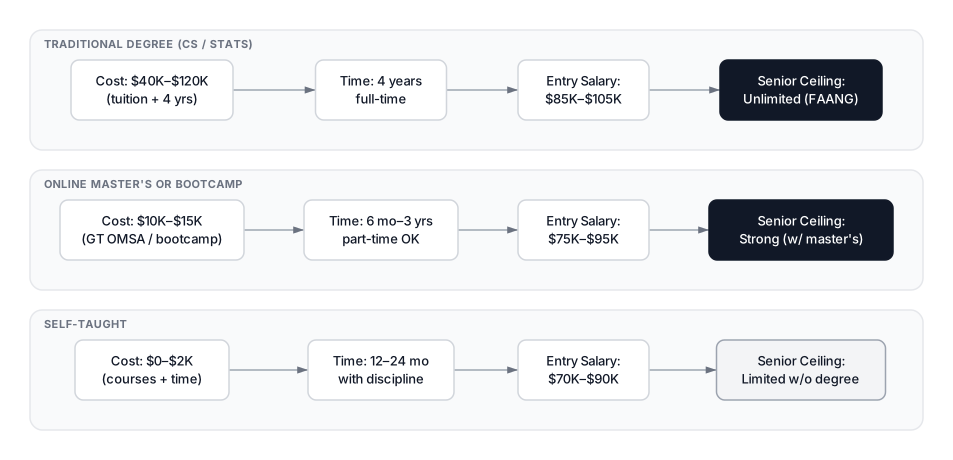 Click to expandThree paths into data science compared by cost, time, entry outcomes, and senior ceiling
What "Self-Taught" Actually Requires
Self-taught doesn't mean watching YouTube. The practitioners who succeed on the self-taught path typically spend 12 to 24 months in a structured learning sequence, build 4 to 6 end-to-end projects (not tutorials), compete on Kaggle to benchmark their skills against real practitioners, and develop a network through writing, open-source contributions, or community engagement.
The resources that produce employable practitioners:
- DeepLearning.AI / Andrew Ng Specializations (Machine Learning Specialization, Deep Learning Specialization): The most credible starting point. These are not easy courses. The ML Specialization requires linear algebra and Python. They take 3 to 4 months of focused study.
- fast.ai Practical Deep Learning: Teaches practitioners to use modern frameworks before explaining all the theory. Controversial pedagogically, but produces people who can actually build things quickly.
- Kaggle Learn and Competitions: Free, structured micro-courses followed by real competition work. Top 10% performance in two or three Kaggle competitions is a meaningful credential that shows up in conversations.
- Statistics: The most neglected part of self-taught paths. Probability, hypothesis testing, and regression theory are tested in nearly every DS interview. StatQuest with Josh Starmer on YouTube covers this better than most textbooks.
The honest timeline: with 2 to 3 hours per day of focused study (not passive watching), a career changer can reach a competitive portfolio in 18 months. Shorter timelines are possible but they depend heavily on prior quantitative background. A person with a business degree is looking at the long end; a person with an engineering degree might get there in 12 months.
Common Mistake: Completing Andrew Ng's Machine Learning Specialization and listing it on a resume without building projects is the self-taught version of a degree without internships. The certificate is table stakes. The projects are the actual credential.
The self-taught path has one structural disadvantage that no amount of self-study fixes: the lack of a verifiable credential. Employers cannot quickly assess a self-taught candidate's depth in the way they can assess a Georgia Tech graduate's. That means self-taught candidates need a portfolio that does the heavy lifting — and the portfolio quality bar is meaningfully higher than for degree or even bootcamp candidates.
The Head-to-Head Comparison
| Dimension | Traditional Degree | Online Master's (GT/UT) | Bootcamp | Self-Taught |
|---|---|---|---|---|
| Total cost | $40K–$120K | $10K–$14K | $10K–$17K | $0–$2K |
| Time to job-ready | 4 years | 1.5–3 years (part-time) | 3–9 months | 12–24 months |
| Entry-level salary | $85K–$105K | $85K–$105K | $70K–$85K | $70K–$90K |
| Senior ceiling | Highest (FAANG open) | High (MS credential) | Limited | Limited |
| Employer perception | Gold standard | Near-gold (GT/UT brand) | Acceptable (varies) | Portfolio-dependent |
| Flexibility | Low (full-time only) | High (part-time) | Medium | High |
| Audited outcomes | Graduation rates | Graduation rates | CIRR: 64–78% | N/A |
Salary data: Glassdoor Q1 2026, BLS OES 2024, Levels.fyi 2026. Bootcamp placement rates: CIRR 2024 cohort data.
What Actually Predicts Whether You Get Hired
The most common mistake in evaluating education paths is treating the path itself as the predictor. It isn't. The actual predictors are:
Portfolio quality. Every hiring manager who has spoken publicly about this process says the same thing: a single end-to-end project that demonstrates problem framing, data cleaning, modeling, evaluation, and clear communication is worth more than 10 tutorial reproductions. The project should solve a problem the interviewer finds interesting, not just demonstrate that you followed a course.
Prior domain expertise. Someone with five years in healthcare finance who learns data science has an enormous advantage over a career changer with no domain knowledge. They can walk into healthcare DS roles where their domain fluency is the differentiation. This advantage applies regardless of which education path was taken.
Network. The data science job market in 2026 is genuinely competitive. Entry-level roles at desirable companies receive hundreds of applications. The candidates who get past resume screens are overwhelmingly people who got a warm introduction — from a former colleague, a bootcamp cohort member, a Kaggle connection, or a LinkedIn conversation that turned into a referral. Building a network is not optional; it's a first-order factor.
Geographic market. San Francisco, New York, and Seattle have meaningfully denser DS hiring markets than most cities. Remote-first hiring has improved access, but elite remote roles are even more competitive than in-person ones at the same companies.
Key Insight: Two people with identical portfolios, one with a GT OMSA and one with a bootcamp certificate, will get different response rates from automated resume screening systems and different first impressions from hiring managers who haven't read the portfolio yet. The credential opens the door. The portfolio is what closes the offer.
Who Each Path Is Actually Right For
Traditional Degree (CS/Stats): Best for people who are early in their education timeline, 18 to 22 years old, have the time and financial access to attend full-time, and want the maximum optionality including research roles, PhD programs, and FAANG. Not right for career changers who already have substantial professional experience — the opportunity cost is too high and an online master's delivers comparable credentialing for a fraction of the cost and time.
Online Master's (GT OMSA / UT MSCS): Best for employed professionals with a quantitative undergraduate background who want a legitimate credential without quitting their jobs. The ROI is exceptional: spend $10,000 to $14,000 over 2 to 3 years of evenings and weekends, come out with a Georgia Tech or UT Austin degree, and watch your total compensation trajectory change. Also the right path for anyone who has been self-studying and keeps hitting the credential wall.
Bootcamp: Best for career changers without strong quantitative backgrounds who need structure, accountability, and a cohort to motivate them. The key qualifier: choose only CIRR-verified programs, and understand that the 64% to 78% placement rate means roughly one in three graduates will still be looking for work six months after finishing. A bootcamp is not a guarantee. It's a structured learning environment with career support. If you are a self-directed person with strong quantitative skills, you are paying $15,000 for structure you don't need.
Self-Taught: Best for people with strong quantitative backgrounds (engineering, science, math, finance) who can build and demonstrate real projects, have the discipline to stick with a 12 to 24 month learning plan, and are in a position to network actively. This path has the highest failure rate simply because most people underestimate how long it takes and overestimate their ability to stay structured without external accountability.
The ISA Trap: Financing That Sounds Better Than It Is
Income Share Agreements have declined significantly since their 2019 to 2021 peak, partly because the Consumer Financial Protection Bureau began scrutinizing them as consumer lending products. Several bootcamps quietly moved away from ISAs after regulatory pressure.
The remaining ISAs typically look like this: pay 10% to 17% of your pre-tax income for 24 to 48 months once you're earning above a threshold (usually $50,000). Apply the math:
- Starting salary: $72,000
- ISA rate: 15% for 36 months
- Total paid: $32,400
The upfront tuition for the same program: $14,000. You would pay more than twice the cost of the bootcamp.
Common Mistake: ISA providers market the "no upfront cost" as risk reduction for you. It is actually profit optimization for them. They are betting that you'll get hired quickly and earn well — in which case you pay far more than tuition. If you're confident you'll get hired (because you have the right background and a good portfolio), paying upfront is almost always cheaper.
The one scenario where an ISA makes sense: you genuinely cannot afford upfront tuition, you cannot get a loan, and you have exhausted employer tuition reimbursement options. Even then, compare the ISA's total cost against a personal loan at current interest rates. The personal loan is often cheaper.
The Already-Employed Transition: A Different Calculus
If you currently have a job and are transitioning into data science, the entire framework changes. You are not choosing between paths based on time-to-first-job. You're choosing based on how to invest your evenings and weekends over the next one to three years.
In this scenario, the GT OMSA is difficult to beat. You stay employed (no income gap), you earn a legitimate master's credential, your employer may reimburse some or all of the cost, and you graduate into the DS job market without the financial stress of having been out of income for six months. Many employers explicitly fund OMSA since the total cost is roughly $13,000 to $14,000 — often within or just above standard corporate tuition reimbursement limits, especially when spread over multiple reimbursement years.
The bootcamp route for an employed person is almost never optimal. Most intensive bootcamps require quitting your job. Part-time bootcamps exist but cover less ground. At $15,000, you'd be better served putting that same money toward the OMSA (if you qualify) or investing it in good courses and saving the rest for the networking and conference costs that actually move the needle.
The self-taught route while employed is viable but slow. Two to three hours per night, after a full workday, produces fatigue. Many people start strong and stall around month six. This path works best for people who genuinely enjoy studying and have a structured plan written down, not just a vague intention.
Pro Tip: If you're currently employed and your company offers tuition reimbursement — even a few thousand dollars per year — stack that benefit over two or three years toward an online master's. Under IRS Section 127, employers can reimburse up to $5,250 per year in educational assistance tax-free. Even at $3,000–$4,000 per year, two to three years of reimbursement covers a substantial portion of OMSA's $13,000–$14,000 all-in cost. Check your HR policy before spending anything.
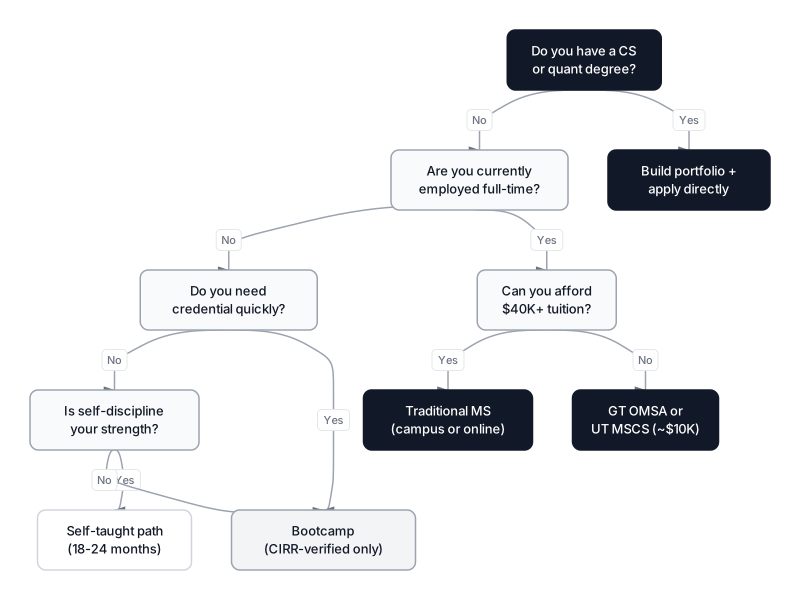 Click to expandDecision tree for choosing the right data science education path
Conclusion
The bootcamp industry's marketing problem is not that their programs are bad. Some of them deliver genuine value for the right candidate. The problem is that the advertised 85% to 93% placement rates are constructed to maximize impressiveness, not accuracy. When CIRR audits the same schools with the same cohorts and uses a consistent definition of "employed," the numbers drop to 64% to 78%. One in three graduates is still looking six months after finishing. That's the number you're betting your $15,000 on.
The biggest revelation in this comparison is that Georgia Tech and UT Austin offer legitimate, accredited master's degrees at roughly bootcamp prices. UT Austin's MSCS is $10,000 flat. Georgia Tech's OMSA runs $13,000 to $14,000 all-in (tuition plus per-semester fees at current 2025–2026 rates) — squarely in the range of a mid-tier to upper bootcamp ($10,000 to $17,000), and a fraction of a traditional on-campus master's. For anyone with a quantitative undergraduate background who is already working, the OMSA is a near-obvious choice: superior credential, better senior ceiling, similar cost, no gap in employment.
The self-taught path remains viable but requires more than courses. It requires projects that demonstrate real capability, a network that opens doors, and honest self-assessment about whether you're making progress or just accumulating certificates. For more on building the portfolio that actually gets callbacks, see How to Build a Data Science Portfolio That Gets You Hired on LDS.
Whatever path you choose, remember that the education decision is only the first move. The job market for entry-level data scientists in 2026 is more competitive than it was in 2021. CS graduates face a 6.1% unemployment rate. Bootcamp graduates face a meaningful non-hire probability. Degrees are necessary but no longer sufficient. The candidates who get hired are the ones who combine a credible background with strong projects, a warm network, and genuine domain expertise. The path matters less than what you do with it — but the path you choose determines how hard you're working against the current. For a broader view of the skills that matter most right now, see the Data Science Career Roadmap 2026 on LDS.
Career Q&A
Is my bootcamp certificate enough to get a data science job in 2026?
It depends heavily on your portfolio and your target companies. A bootcamp certificate alone is not enough — no credential is, in this market. What gets you hired is a combination of the certificate, a portfolio of 3 to 5 real projects with documented outcomes, and a warm introduction from someone inside the company. Bootcamp graduates who get hired quickly are usually the ones who networked actively during the program and had a strong project to demo by week eight. The ones who struggle finished the program and then started thinking about the job search.
Should I get a master's degree after working as a data scientist for two years?
If you're at a company where a master's degree would unlock a promotion, change your comp band, or give you access to roles you're currently screened out of, then yes. If you're already getting interviews and offers at the level you want, spending two years on a master's has a much lower marginal return. The GT OMSA's value is highest before you land your first DS role, not after you're already established. One exception: if you're targeting a transition to research, academia, or ML engineering at a top-tier lab, a master's is genuinely gating.
Do employers treat online degrees differently from on-campus ones?
For GT OMSA and UT MSCS, no — the diploma is identical to the on-campus version. For lower-tier online programs, perception varies. The honest answer is that "online master's" is a spectrum. A Georgia Tech online degree is treated as a Georgia Tech degree. A degree from a for-profit online school is treated very differently. The brand and the academic institution behind the credential matter far more than the delivery format.
How do I know if a bootcamp's job placement stats are reliable?
Ask them directly for their CIRR report. CIRR uses a standardized definition: full-time, in-field employment within 180 days, verified by a third-party auditor. If the school is not a CIRR member or cannot produce an independently audited outcomes document, their self-reported numbers should be treated as marketing, not evidence. Most reputable bootcamps are now CIRR members; check cirr.org/schooldata for verified reports.
Is the self-taught path harder in 2026 than it was a few years ago?
Yes, in terms of getting hired, though the resources available for learning are dramatically better. The job market is more competitive at entry level, so self-taught candidates need a portfolio that is visibly stronger to overcome the lack of institutional credential. That said, the ceiling for what a self-taught person can demonstrate has risen too — tools like GitHub, Hugging Face Spaces, and Streamlit make it straightforward to publish professional-looking work. The bar is higher but so is the toolkit.
Can I negotiate salary after a bootcamp the same way a degree-holder can?
Yes, with one important nuance. Your market data comes from the same places — Glassdoor, Levels.fyi, LinkedIn Salary — and negotiation technique works the same way. The difference is that bootcamp graduates have a narrower "expected range" in a recruiter's head at the start. Counter this by leading with your portfolio and the outcomes of specific projects, not your educational background. If you can walk through a project that generated measurable business impact, the conversation shifts from "what credential do you have" to "what can you actually do."
What is the actual ROI of a $15,000 bootcamp at current placement rates?
At a 70% CIRR placement rate, 70 out of 100 graduates get a qualifying job. The median first salary is approximately $70,698. Assuming an average pre-bootcamp salary of $47,000, the income lift is roughly $24,000 per year. Recouping $15,000 tuition at that lift takes about 7.5 months of employment. The math works, but only if you're in the 70% who gets the qualifying job. For the other 30%, the ROI calculation looks completely different.
Sources
- CIRR — Explore Verified Coding Bootcamp Outcomes (2024 cohort data)
- CIRR Reporting Standards (2025)
- Course Report — Data Science Bootcamp Cost Comparison (2025)
- Course Report — Are Employers Hiring Bootcamp Grads in 2024? (TripleTen Survey) (2024)
- Georgia Tech OMSA Tuition and Funding (2025–2026)
- Georgia Tech Bursar — Tuition and Fee Rates (Fall 2025, Spring 2026)
- UT Austin Computer & Data Science Online — MSCS Program (2025–2026)
- Bureau of Labor Statistics — Data Scientists Occupational Outlook (May 2024)
- Glassdoor — Entry Level Data Scientist Salary (February 2026)
- Cengage Group — Computer Science Grads Facing Lack of Entry-Level Jobs (2025)
- NACE — Facing a Tough Job Market, Class of 2025 Responded Accordingly (2025)
- Levels.fyi — Data Science Compensation Data (Q1 2026)
- Metana — ROI of Coding Bootcamps 2026 (2026)
- ComputerScience.org — CIRR-Verified Bootcamps (2024)
- Career Karma — Flatiron School Reviews and Outcomes (2024)
- IRS — Employers May Help With College Expenses Through Educational Assistance Programs (IRS Section 127, $5,250 annual tax-free limit)