
At $1,000 per billable day and 180 days of actual client work per year, you gross 180 thousand dollars. That's exactly what a senior ML engineer earns as a full-time employee at a solid tech company. On paper, it sounds like a wash — until you remember that the employed engineer also gets health insurance, a 401(k) match, paid vacation, and zero business development overhead. The freelance number is gross. The employed number is net of almost everything.
That gap is where most "go freelance" calculations fall apart. And yet, plenty of senior ICs are making the jump in 2026, and some of them are genuinely doing better than they would have as employees. This article does the full calculation — both directions — so you can decide with actual numbers instead of vibes.
What AI Consultants Actually Charge
The market has two tiers, and they're farther apart than most job boards suggest.
Independent AI consultants working directly with clients in the US charge $150 to 400 per hour — which translates to 1,200 to 3,200 dollars per day. The most commonly cited range for "senior independent" practitioners in 2025-2026 is 1,200 to 2,000 dollars per day, with the Nicola Lazzari AI Consulting Pricing Guide (2025) pegging the starting point for established consultants at $600–$1,200 per day as newer entrants build their client base before commanding premium rates. Agency-sourced consultants, where a staffing firm places you at a client, typically clear 20% to 50% less because the agency takes a margin, but you get consistent deal flow.
International rates are meaningfully lower. A strong ML practitioner in Eastern Europe or Southeast Asia is billing $50 to 150 per hour on platforms like Toptal. That's the competitive context for any US-based consultant positioning on price alone, which is why specialization matters so much.
Real Numbers: Upwork's 2026 In-Demand Skills report found demand for top AI skills more than doubled year-over-year. AI integration roles grew 178% and AI chatbot development grew 71%. A separate Upwork analysis found freelancers working on AI-related projects earn 40% more per hour than those working on non-AI projects (Upwork, 2025).
Retainers are where the real money compounds. A client paying $8,000 per month for two hours of advisory time per week is effectively paying 1,000 dollars per hour. These relationships take 6 to 18 months to build but dramatically reduce business development overhead once established. High-earning consultants typically aim for 30 to 50% of income coming from retainer arrangements.
The Math Most People Don't Do
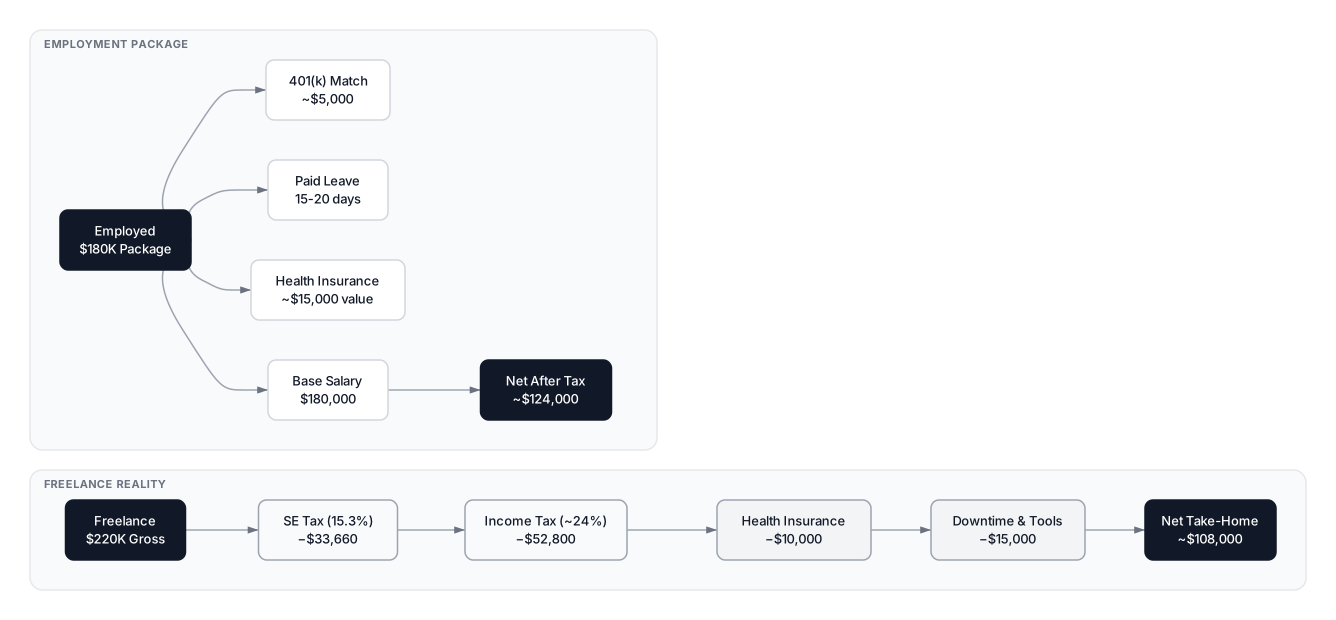
Let's use $220,000 gross as the freelance target — a number that sounds great until you run the actual deductions.
Freelance: $220,000 gross revenue
| Deduction | Amount | Notes |
|---|---|---|
| Self-employment tax | −$28,770 | 12.4% SS on first $184,500 + 2.9% Medicare on all net SE income (92.35% of gross) |
| Federal income tax (~24% bracket) | −$38,880 | Approximate; varies by deductions, state, filing status |
| Health insurance (self-funded) | −$9,000 | ACA marketplace silver plan for a single person in 2026; benchmark silver averages ~$625–$752/month before subsidies |
| Business software and tools | −$4,800 | Claude Pro, Cursor, GitHub Copilot, Notion, accounting software |
| Professional liability insurance | −$1,200 | E&O insurance; national average is $384–$1,020/year (MoneyGeek 2026); $1,200 used here reflects higher-cost states (NY/CA) and broader coverage |
| Downtime (unbillable time) | −$18,333 | Assumes ~8.3% of gross (approximately one month) for business development, admin, and vacation |
| Net take-home | ~$119,000 | Before state income tax |
Source: IRS self-employment tax rates 2026; MoneyGeek E&O insurance cost data 2026
Employed: $180,000 total compensation package
| Component | Amount | Notes |
|---|---|---|
| Base salary | $180,000 | Pre-tax |
| Federal income tax (~24%) | −$43,200 | Approximate |
| Employer-paid health insurance | +$8,000 | Hidden compensation you don't pay; average employer contribution for single coverage is ~$7,885/year (KFF 2025 Employer Health Benefits Survey) |
| 401(k) match (4% typical) | +$7,200 | Real money you'd otherwise pay yourself |
| Paid vacation (15 days) | +$10,385 | 15/260 working days × $180K |
| Net effective take-home | ~$144,000 | After income tax plus employer health value; 401(k) match and vacation shown above for total comp context but stay invested/embedded in salary |
The gap is roughly $25,000 per year in favor of employment, at these specific numbers.
To break even with a $180,000 employed package on a like-for-like basis, you need gross freelance revenue of approximately 250,000 dollars — that's 250 billable days at 1,000 per day, or 125 days at 2,000 per day. The first number is very hard to hit in year one. The second is achievable by year two or three for a focused practitioner.
Common Mistake: Most "freelance math" articles compare gross freelance revenue directly to employed salary. That's comparing apples to airport sandwiches. The correct comparison is: what is the actual cost to replace every benefit, and what rate do you need to clear after all of them?
The SE tax hit is the biggest surprise for new independents. Because you're both the employer and employee, you pay the full 15.3% FICA contribution (Social Security at 12.4% up to a $184,500 income cap in 2026, plus Medicare at 2.9% on all earnings with no cap). You can deduct the employer half from your adjusted gross income, but you still write the check. The IRS recommends setting aside 30% of gross for federal taxes alone — that doesn't include state income tax if you're in California, New York, or another high-tax state.
The AI Tools Multiplier
The economics have shifted significantly in the last two years. Not because rates went up, but because one consultant can now do what a team of three did in 2022.
Concretely: a senior ML consultant in 2023 needed a data engineer to build pipelines, a DevOps resource to handle infrastructure, and a junior DS to handle EDA and report generation. In 2026, that same consultant uses Claude for architecture documentation and code review, Cursor for writing and testing the pipeline code, GitHub Copilot for boilerplate, and a combination of AI agent frameworks to automate the monitoring layer. The junior DS tasks — data exploration, summarization, first-draft reports — are now largely handled by AI.
The productivity gain is real but requires investment. You need to become genuinely fluent with these tools, not just aware of them. Consultants who've done that report handling three to four concurrent client engagements at a level of quality that would have required a team. This is what makes the freelance economics work: you're not competing on headcount, you're competing on judgment + tools.
Key Insight: The AI tools multiplier doesn't reduce the per-day rate you charge — it increases the number of clients you can serve simultaneously and reduces the non-billable hours each project consumes. A consultant who would have needed 30 days to complete a RAG implementation scoping exercise in 2023 might now need 12 days. They can charge the same total project price, deliver faster, and take on the next client sooner.
Specific tools that matter for AI consultants in 2026:
- Claude (Anthropic): Long-context document analysis, architecture proposals, client-ready writeups. Particularly useful for AI governance frameworks and readiness assessments, which are heavily document-based.
- Cursor + Claude Code: Writing and refactoring production Python. Dramatically cuts implementation time for MLOps setup and RAG builds.
- GitHub Copilot: Inline suggestions during active coding sessions; complements Cursor.
- Notion AI / linear: Project management and client communication. A solo consultant running three client engagements simultaneously needs structured async communication.
- Perplexity / web-connected AI: Real-time research for client industry context, which matters enormously when doing AI readiness assessments for industries you're not native to.
What Enterprise Clients Actually Pay For
The range "$10,000 to 40,000 for a small AI project" is real but requires context on what that scope covers.
| Project Type | Typical Scope | Fee Range | Timeline |
|---|---|---|---|
| AI Readiness Assessment | Audit of data infrastructure, use case prioritization, roadmap document | $12,000–$25,000 | 3–5 weeks |
| RAG Proof of Concept | Single-domain RAG build, internal document Q&A, evaluation report | $20,000–$50,000 | 4–8 weeks |
| MLOps Setup | CI/CD for ML models, monitoring, deployment pipeline on AWS/GCP/Azure | $25,000–$60,000 | 6–10 weeks |
| LLM Fine-Tuning Project | Dataset prep, supervised fine-tuning, evaluation, deployment | $30,000–$80,000 | 8–14 weeks |
| AI Governance Framework | Risk assessment, policy documentation, compliance mapping | $15,000–$35,000 | 4–6 weeks |
| Ongoing Advisory Retainer | Weekly calls, architecture review, team guidance | $6,000–$12,000/month | Ongoing |
Source: Leanware AI Consulting 2026; OrientSoftware AI Consulting Rate Analysis; practitioner-reported ranges
Projects in the $10,000–$25,000 range are often "land and expand" engagements. A readiness assessment that goes well frequently converts to a larger implementation project. Clients who paid $15,000 for a focused assessment are much easier to sell a 60,000 dollar implementation than cold prospects.
Enterprise clients also care about who takes the legal risk. An LLC operating as a named vendor provides more comfort than a sole proprietor's personal name on the contract. This matters for projects with sensitive data access or custom model IP.
Where Work Actually Comes From
Not Upwork. That needs to be stated plainly.
Upwork works for some project types (short-term, well-defined tasks, lower-price-point clients), but enterprise AI consulting engagements don't get sourced through open bid platforms. The economics don't work — you'd spend more on Upwork's service fees and competitive bidding time than the margin justifies.
The actual pipeline for senior consultants looks like this, roughly in order of reliability:
1. Former employers and colleagues. The highest-converting source. You already have trust, you know the problems, and you're low-risk. Many consultants get their first 2-3 clients from companies they used to work for. Before leaving a full-time role, think carefully about whether your current employer might become a client — many do.
2. LinkedIn visibility. Not direct outreach spam. Genuine content: posts about specific technical problems you've solved, short case studies (anonymized), honest takes on tools. Consistency over 3 to 6 months builds an inbound lead flow. The goal isn't follower count — it's ensuring that when someone in your professional network has an AI problem, you're the name they think of.
3. Direct outreach to warm connections. Personalized messages to people you've worked with previously who are now at companies with obvious AI problems. Not mass email. One or two messages per week, tailored. This is the highest effort per lead but often the highest conversion.
4. Referrals from existing clients. Once you have two or three satisfied clients, referrals become self-sustaining. The pipeline diagram reflects this — a completed project with an explicit "do you know anyone else with similar challenges?" conversation at the close is the most reliable new-business mechanism once you're established.
5. Speaking and writing. Conference talks, blog posts, technical teardowns. These take months to pay off but compound indefinitely. A well-ranking article or a talk at a relevant AI conference positions you as the expert in a specific domain.
Common Mistake: "I'll build my presence first, then reach out to clients." This gets the order backwards. Outreach to your existing network should start on day one. Content builds future inbound. Your former colleagues and managers are ready to hear from you now.
 Click to expandFreelance consulting pipeline cycle
The Feast-or-Famine Problem
Nearly every independent consultant hits this. You spend three months deep in a large project, do zero business development because you're slammed, and then you emerge to an empty pipeline. You spend the next six weeks finding work, close a new engagement, disappear again.
The cycle is predictable and preventable, but prevention requires discipline when you're busy — which is exactly when it feels unnecessary.
The structural fix has three parts:
1. Protect two hours per week for business development regardless of workload. LinkedIn content, one or two outreach messages, a follow-up to a past client. Two hours is not enough to derail a project. It is enough to prevent the pipeline from drying out.
2. Build milestone overlap into every project. Structure proposals so that the final delivery milestone — and your formal off-boarding — lands four to six weeks before your billing runs out. Use that buffer to convert to a retainer or open the next conversation.
3. Keep one retainer slot. One client paying a modest monthly retainer (even $3,000 to 5,000 per month) provides the financial floor that lets you be selective about project work rather than accepting anything that comes along. It also gives you something to say when you're between projects: "I'm fully available for project work — I have one retainer client but no active project engagements."
The first six to eighteen months is typically the period of highest variability. Most practitioners who've built stable independent consulting businesses report that things stabilize meaningfully around month 12 to 18, once the referral network activates. Getting through that window without burning savings requires cash reserves of at least six months of living expenses before going independent.
Legal and Financial Setup
LLC vs. Sole Proprietor: For most US-based AI consultants, an LLC is worth the 100 to 500 dollar annual filing fee once you're consistently earning above 50,000 per year. It separates your personal assets from business liability — meaningful for consultants who handle sensitive client data or make technical recommendations that could go wrong. The default LLC is taxed identically to a sole proprietor (Schedule C), but once your net business income consistently exceeds 60,000 annually, an S-Corp election on your LLC can reduce SE tax meaningfully. At 120,000 in net profit, the S-Corp election saves approximately $8,000 to $9,000 per year in self-employment taxes, depending on how you structure the salary/distribution split.
Contracts: A standard consulting agreement should cover scope of work (very specifically), payment terms, IP ownership (who owns the work product), confidentiality, and limitation of liability. The IP clause matters most. Clients default to "we own everything you produce." Consultants should push for: clients own deliverables produced specifically for them, but you retain ownership of general methodologies, reusable frameworks, and anything that isn't specific to their business. Get a lawyer to draft your template once. It's a $500 to 1,500 dollar investment that protects you indefinitely.
Invoice to payment gap: Enterprise clients run on net-30 to net-60 payment terms. You send an invoice, and a check arrives six to eight weeks later. This means you can deliver a project in March and not see money until May. Budget for this gap. The standard mitigation is milestone billing: 25% upfront, 25% at mid-project, 50% at delivery. Many clients will accept this. Some won't, but it's always worth asking.
Insurance: Professional liability (E&O) insurance costs $384 to 1,020 per year for most solo consultants, with higher rates in New York and California (MoneyGeek 2026). Some enterprise clients require it. Even if they don't, it covers you if a client claims your recommendation caused measurable business harm. General liability is usually optional unless you're doing on-site work.
Worth Knowing: Self-employment opens significant tax deductions that employees don't have: home office, equipment, software, professional development, health insurance premiums (deductible above the line), and retirement accounts. A SEP-IRA or Solo 401(k) lets you shelter up to $72,000 annually from income tax in 2026. This meaningfully changes the after-tax math in your favor.
 Click to expandEmployed vs freelance financial comparison
Who Should Not Go Freelance
The answer is more people than the internet suggests. Specific profiles that consistently struggle:
People without an existing professional network. If you've been in ML for two years and most of your professional relationships are classmates rather than industry colleagues who've seen your work, you're starting with a near-empty pipeline. The first six months of consulting will be spent almost entirely on business development with low conversion rates. This isn't a reason never to go independent, but it's a reason to wait until you've built more relationships and credibility.
Anyone on visa sponsorship. H-1B holders need employer sponsorship. Starting an LLC while on H-1B is technically possible in limited circumstances but practically complex. An O-1 visa is the route for independent consulting, but it requires demonstrated extraordinary ability and significant professional track record. If visa status is a constraint, this path has real legal complexity that requires immigration counsel — not just financial planning.
People who need external structure to do their best work. Some people genuinely produce better work inside a team, with a manager who sets priorities, in a company with a clear roadmap. There is nothing wrong with this. Consulting requires you to set your own priorities, manage your own time, handle ambiguous client relationships on your own judgment, and maintain your own quality bar with no one checking your work. If honest self-assessment says you need that external accountability, employment is the right choice.
People with household financial obligations and no savings cushion. Mortgage payments, dependents, and a six-month pipeline gap are a combination that creates destructive financial pressure. Decisions made under that pressure — accepting bad-fit clients, undercharging, overcommitting — compound the problem. The standard advice is six months of living expenses in savings before going independent. In practice, twelve months is more comfortable.
People whose primary appeal is domain knowledge in one specific company. Some practitioners are valuable because they know a specific company's data infrastructure deeply. That knowledge transfers less than it appears. Consulting clients want practitioners who have solved the class of problem they have, not just people who've worked at one well-known company.
The 12-Month Transition Plan
Going freelance while employed is usually better than leaving a job and hoping clients appear. Here's a realistic sequencing:
Months 1-3 (while employed): Identify the specific niche you'll target. "AI consulting" is too broad to position effectively. "MLOps for mid-market e-commerce companies" or "LLM implementation for legal technology firms" is a specific enough domain to build a reputation. Set up the LLC, open a business bank account, get the contract template drafted.
Months 3-6 (while employed): Start the side work. One or two small engagements from your existing network, done carefully with your employer's knowledge (check your employment contract for moonlighting clauses — most have them). The goal isn't income yet. It's proof that you can find clients and deliver work that gets referrals.
Months 6-9 (while employed): Build the pipeline to the point where you have one confirmed project ready to start on day one of going independent, plus one or two leads in proposal stage. Leaving with zero pipeline is a leap of faith. Leaving with a confirmed first engagement and active conversations is a calculated decision.
Month 9-12 (transition): Give notice when the pipeline justifies it. Not when you've had enough of your current job — when the business makes financial sense to operate at full time. Set a cash runway target before you go: at minimum, enough to cover six months of personal expenses plus three months of business expenses (insurance, software, LLC fees).
Year 1 reality: Most practitioners report that year one gross revenue is $60,000 to 120,000 — not the 200,000+ headline. This is fine if you've budgeted for it. The business compounds in year two and three as referrals activate and you learn which client types and project scopes you work best with.
For context on what skills to develop during this transition, the AI engineer roadmap for 2026 covers the specific technical domains with highest client demand right now.
Conclusion
The honest answer to "should I go freelance?" is that it depends on one variable more than any other: the strength of your professional network. The math can work — but only after the pipeline is built, which takes 12 to 18 months and requires an existing set of professional relationships that trust your judgment enough to pay for it.
The AI tools multiplier is real. One experienced practitioner with deep fluency in Claude, Cursor, and modern MLOps tooling can genuinely do the work that required a small team three years ago. That changes the unit economics meaningfully and makes solo consulting viable at revenue levels that would have required multiple employees in 2022.
But the SE tax hit, the health insurance cost, the unbillable time, and the income variability in year one are all real too. The break-even point with a $180,000 employed package is closer to 250,000 in gross freelance revenue than most "go freelance" content admits.
The 12-month transition plan exists because leaving without a pipeline is the most preventable mistake. Build the business while you're still employed. Confirm the first client before you give notice. Then make the jump with data, not just frustration with your current situation.
For a deeper read on where AI skills create the largest salary premiums in 2026 — both employed and independent — see our AI skills salary premium guide. And if you're evaluating which technical foundation to prioritize before making the jump, the guide on RAG systems and retrieval-augmented generation covers the implementation patterns that clients pay the most for right now.
Career Q&A
How do I get the first client if I have no freelance track record?
Start with your former employer or a company where you have a strong internal advocate. These are the highest-conversion prospects because the trust barrier is already cleared. Frame it explicitly: "I'm building an independent practice and I'd like Company X to be my first client — I'll price this first engagement below market to make the decision easy." A below-market first engagement that produces a strong reference is worth more than waiting for a market-rate lead that never comes.
What if I don't have a strong network?
Then the timeline needs to extend. Spend six to twelve months deliberately building relationships before going independent: contribute to open-source AI projects that attract enterprise attention, speak at local meetups, publish technical content, and take on visible roles in the ML community. Consulting is a trust business. You can't shortcut the trust — but you can build it systematically.
Should I register an LLC before I start or wait until I have revenue?
Register it early, but not before you've confirmed you're actually going to pursue this. The filing takes two to three weeks and costs 100 to 500 dollars depending on your state. Once you have even one prospective client conversation happening, the LLC should exist. Enterprise clients are more comfortable signing contracts with "Prateek Consulting LLC" than with your personal name, and the liability protection matters from the first project.
What's the most common way first-year consultants undercharge?
By pricing based on their employed hourly rate, not market consulting rates. If you earned $180,000 employed (roughly 87 dollars per hour), you might price yourself at 100 per hour thinking you're being fair. That's a 200/day rate when the market supports 800 to 1,200 per day for someone with your experience. The employed rate doesn't account for benefits, overhead, or the value of your independent judgment. Price from market rates down, not from your salary up.
How long does it realistically take before income stabilizes?
Most practitioners report meaningful income stability beginning around month 12 to 18. The pattern is almost always the same: dry start, first client from the existing network, slow growth through referrals, then a compounding phase once you've completed four to six projects and the referral chain is active. If you're at month 18 and still in feast-or-famine, the root cause is almost always insufficient business development during busy periods, not lack of skill.
What tax mistakes do new freelancers make most often?
Two big ones. First, not making quarterly estimated tax payments — you owe estimates by April 15, June 15, September 15, and January 15 for the prior year. Missing these triggers penalties. Second, not running payroll through the S-Corp election until it's too late to save the current year's SE tax. Get an accountant who works specifically with independent consultants in year one. The cost (1,500 to 3,000 per year) pays for itself within the first few months.
Should I specialize or stay a generalist?
Specialize. Not permanently — your positioning can evolve as the market does — but the consultants who build the fastest pipelines are those who have a clear, specific answer to "what do you do?" Generalists compete on availability. Specialists compete on expertise. "I help mid-market companies implement production RAG systems on their internal document repositories" is a positioning statement that clients can remember and refer to others. "I do AI consulting" is not.
Sources
- Upwork In-Demand Skills 2026: AI Skills Demand More Than Doubles (Feb 4, 2026)
- Nicola Lazzari: AI Consultant Pricing US 2025 — $600-$1,200/day Complete Guide (2025)
- Leanware: How Much Does an AI Consultant Cost in 2026? (2026)
- OrientSoftware: AI Consulting Rates — Hourly, Project, and Retainer Models (2025)
- IRS: Self-Employment Tax — Social Security and Medicare Taxes (2026)
- OnPay: Self-Employment Tax Calculation, Rates, and Tips for 2026 (2026)
- MoneyGeek: Average Errors and Omissions Insurance Cost 2026 (2026)
- Collective: S Corp vs LLC — Tax Benefits for Freelancers (2025)
- Upwork Investor Relations: Study Finds 1 in 4 US Skilled Knowledge Workers Now Work Independently (2025)
- Slashdot: Freelancers Using AI Tools Earn 40% More Per Hour Than Peers (2025)
- Craft of Consulting: How to Avoid the Feast-or-Famine Trap (2024)
- Leanware: Enterprise RAG Consulting Services (2026)
- Future Market Insights: AI Consulting Services Market Size and Forecast 2025 to 2035 (2025)
- KFF: 2025 Employer Health Benefits Survey — Average Employer Contribution for Single Coverage (2025)
- IRS: 401(k) Limit Increases to $24,500 for 2026, IRA Limit Increases to $7,500 (2025)