Guide Distinguishes AI From Generative AI
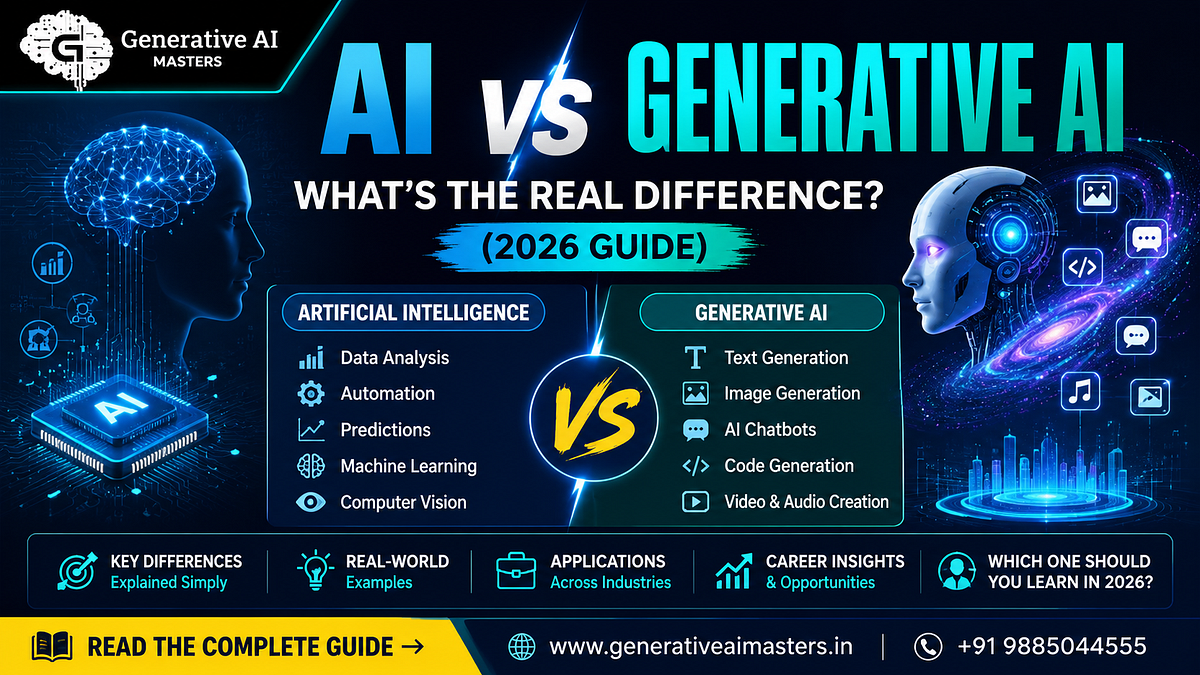
For practitioners, precise terminology helps separate prediction, classification, and optimization workloads from content-generation workloads, which have different model, evaluation, and risk requirements. The Generative AI Masters guide describes generative AI as a subset of artificial intelligence that creates text, images, audio, code, and video, while broader AI also includes systems for recognition, ranking, fraud detection, recommendations, and prediction. Microsoft similarly distinguishes predictive AI, which forecasts outcomes from historical data, from generative AI, which produces novel output. Toloka identifies large language models as one category within generative AI, rather than a synonym for the broader field.
Why the distinction matters
Predicting versus generating
Microsoft draws a functional distinction between predictive AI, which forecasts outcomes using historical data, and generative AI, which produces novel content. Salesforce describes predictive AI as learning patterns from data to anticipate outcomes, citing techniques such as clustering, decision trees, regression, and time series. Its examples include credit-risk assessment, fraud detection, and patient-readmission forecasting.
Microsoft lists text, images, audio, product designs, and code as examples of generative output. The original guide similarly contrasts analytical AI, which makes a decision, prediction, or classification from existing data, with systems that generate content.
Toloka separates several related terms: ML is a subset of AI in which systems learn patterns from data; deep learning is a subset of ML using neural networks; and LLMs are language-focused deep-learning models. According to Toloka, LLMs are one category of generative AI, alongside systems that generate images and other media.
Practical framing
Editorial analysis
the useful boundary is usually not whether a system carries an AI label, but what it is intended to output and how its output is consumed. A fraud model can produce a risk score, a recommender can order candidate items, and an LLM can draft a response. These systems may share data-engineering, governance, and monitoring needs, but their failure modes differ materially.
For practitioners
predictive and generative systems commonly require different definitions of success. Industry-pattern observations: forecasting, ranking, and classification workloads are typically assessed with task metrics such as error, calibration, recall, and ranking quality, while generative workloads also require evaluation of usefulness, faithfulness, safety, style, and output variability. Treating all AI work as "generative AI" can obscure those operational differences.
The Generative AI Masters guide defines artificial intelligence as the broader field of systems performing tasks associated with intelligence, including recognition, ranking, fraud detection, recommendations, and prediction. It defines generative AI as a type of AI that creates new content, including text, images, audio, code, and video. The guide presents the relationship as generative AI being a subset of AI.
a combined workflow often contains both categories. Industry-pattern observations: a predictive model may select an audience, estimate demand, or detect a high-risk case, while a generative model may draft content, summarize evidence, or create a human-facing explanation. That division makes it important to evaluate the decision component separately from the generated artifact, especially where generated text could be mistaken for a verified prediction or factual record.
Key Points
- 1Generative AI is presented as a subset of AI that creates content, while broader AI includes prediction, classification, ranking, and decision systems.
- 2Microsoft distinguishes predictive AI from generative AI by output type: historical-data forecasts versus novel text, images, audio, designs, or code.
- 3For practitioners, different output types generally require distinct evaluation methods, combining predictive performance measures with quality, safety, and faithfulness checks.
Scoring Rationale
This is a useful terminology explainer for practitioners and newcomers, not a new model, product, research result, or policy development. Its distinction between predictive and generative workloads has practical relevance for system design and evaluation, but it adds limited novel technical information.
Sources
Public references used for this report.
Practice interview problems based on real data
1,625 SQL & Python problems across 15 industry datasets — the exact type of data you work with.
Try 250 free problems