AMD Launches Instinct Coder for Local AI Coding
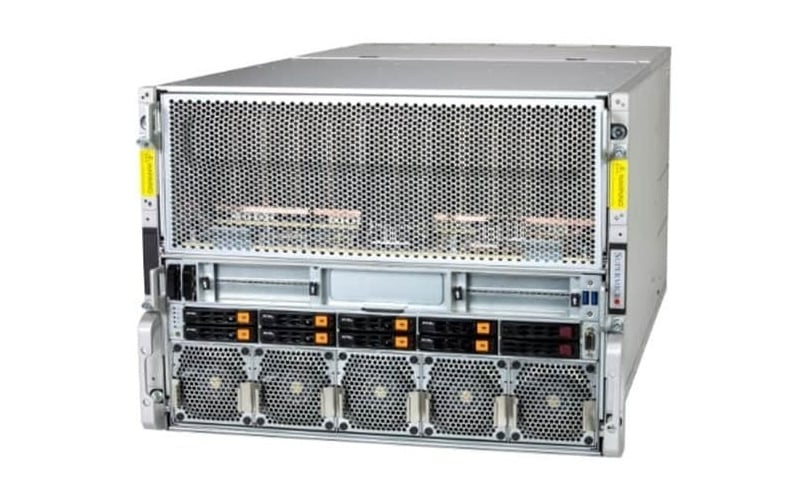
AMD, Spectro Cloud, and Supermicro announced AMD Instinct Coder on August 5, a turnkey on-premises and hybrid inference system for enterprise AI coding. The configuration pairs eight AMD MI325X GPUs in a Supermicro server with Spectro Cloud's policy-based model routing, directing suitable requests to local GLM-5.2 inference while retaining access to frontier models. The partners claim up to 70% token-cost savings.
AMD, Spectro Cloud, and Supermicro announced AMD Instinct Coder on August 5, packaging an eight-GPU AMD MI325X server, local model inference, and policy-based routing for enterprise AI coding workloads. According to the partners' announcement, the platform directs suitable requests to locally deployed models and can send workloads requiring additional capabilities to frontier-model endpoints from Anthropic, OpenAI, and Google.
AMD's product page claims up to 70% token savings versus frontier-only deployment, up to 95% of frontier-model benchmark performance, and payback in about six months. StorageReview noted that neither the savings nor payback figures had been independently verified. The source materials variously describe the 70% measure as token savings and total cost of ownership, so buyers would need to examine the workload mix, utilization assumptions, model pricing, and infrastructure costs behind the estimate.
Hardware and routing stack
The specified appliance is a Supermicro AS-8126GS-TNMR server with two AMD EPYC 9575F CPUs, eight MI325X accelerators, 3 TB of DDR5 memory, Gen5 U.2 SSDs, and two 400 GbE AMD Pensando Pollara NICs, according to AMD. AMD lists support for up to 50 developers per node.
Spectro Cloud's PaletteAI Inference Launchpad supplies model routing, metering, quotas, governance controls, and KV-cache optimization. The local model listed by AMD is GLM-5.2 through AMD Inference Microservices. Futuriom describes GLM-5.2 as a mixture-of-experts model with 744 billion total parameters and roughly 40 billion activated parameters per token.
The routing design is the core distinction from a frontier-only coding assistant deployment. Spectro Cloud's announcement states that routing considers policy, workload complexity, model capability, and infrastructure availability. Routine coding requests can remain within customer-controlled infrastructure, while more demanding reasoning tasks can be sent to external model APIs when policy permits.
What the economics claim depends on
The partners frame Instinct Coder as an alternative to building a private inference stack from separate hardware, orchestration, governance, and developer-tool components. AMD lists Claude Code, Cursor, and Visual Studio Code among supported developer tools, while Spectro Cloud and Supermicro provide software and hardware support respectively.
The published cost claim is not a benchmark of raw model quality or GPU throughput. It is a deployment-level assertion that depends on how often a team routes requests locally instead of to paid frontier APIs. StorageReview reports that the local-first arrangement aims to retain sensitive code, prompts, and contextual data in controlled infrastructure where appropriate.
For AI platform teams, comparable local-first architectures commonly shift evaluation from a per-token API comparison to a broader capacity-planning exercise. Relevant variables include concurrent users, prompt and context lengths, cache hit rates, model-routing thresholds, accelerator utilization, uptime requirements, and the cost of operating an on-premises GPU node. A local model can reduce marginal inference expense at high utilization, but a lightly used appliance can produce a different economic outcome than a shared API service.
The launch also makes governance operational rather than merely contractual: metering, quotas, and routing policies can provide a record of which workloads were processed locally and which were sent to external providers. That capability is particularly relevant where source-code residency, audit requirements, or per-team cost controls shape AI coding deployments.
AMD, Spectro Cloud, and Supermicro have presented a pre-integrated route to that architecture. The available materials do not provide independently reproducible throughput, latency, routing-accuracy, or total-cost benchmarks, leaving those measurements as key validation questions for prospective users.
Key Points
- 1AMD Instinct Coder packages eight MI325X GPUs, local GLM-5.2 inference, and policy routing for enterprise AI coding deployments.
- 2The claimed 70% savings depends on routing mix and utilization, not solely on accelerator performance or model benchmark scores.
- 3Comparable local-first systems make cache behavior, concurrency, governance policy, and infrastructure utilization central evaluation criteria for platform teams.
Scoring Rationale
This is a notable enterprise AI infrastructure offering that combines local coding inference with selective frontier-model access. It is relevant to teams evaluating GPU capacity, model routing, governance, and the cost of coding-agent deployments, although the reported savings figures are vendor claims rather than independent benchmarks.
Sources
Primary source and supporting public references used for this report.
Practice interview problems based on real data
1,625 SQL & Python problems across 15 industry datasets — the exact type of data you work with.
Try 250 free problems