
A hospital in Stockholm sits on ten years of patient records that could transform diabetes prediction research. But GDPR says no. Those records contain personally identifiable information, and sharing them with external researchers violates European privacy law. One possible approach is to generate synthetic patient records that approximate selected statistical patterns without directly copying real patient rows. The output still requires privacy testing, utility validation, and legal review.
Synthetic data generation is the process of creating artificial datasets that mimic the statistical properties of real-world data without containing actual observations. The market tells the story: valued at $510 million in 2025, the synthetic data industry is growing at roughly 37% annually (Mordor Intelligence). Gartner estimates that 75% of data used in AI projects by 2026 will be synthetically generated. This isn't a research curiosity. It's how production ML teams handle privacy constraints, small datasets, and class imbalance every day.
Unlike simple data augmentation techniques like SMOTE that interpolate between existing points, synthetic data generation learns the full joint distribution of your dataset and samples entirely new records from it. The difference matters: SMOTE creates convex combinations of neighbors, while a generative model can produce records that never existed in the training data yet remain statistically plausible.
Throughout this guide, we'll use a single running example: generating synthetic electronic health records (EHR) for a diabetes prediction model. Every technique, every code block, and every evaluation metric references this same patient dataset.
How Synthetic Data Generation Works
Synthetic data generation follows a three-phase pipeline: learn the distribution of real data, sample new points from that learned distribution, and validate that the synthetic output preserves critical statistical properties.
Think of it like a jazz musician who studies thousands of recordings. They don't memorize specific solos. They internalize the patterns: chord progressions, rhythmic structures, melodic contours. When they improvise, they produce something new that sounds authentically jazz without copying any single performance. Generative models do the same with data.
In our hospital example, the generator learns relationships like "patients over 55 with BMI above 30 have elevated fasting glucose." It then produces new patient records exhibiting this same correlation, without any record corresponding to a real patient.
 Click to expandSynthetic data generation pipeline from real data to validated output
The choice of generation method depends on your data type, privacy requirements, and computational budget. Five major families of techniques dominate the field in 2026, each with distinct strengths.
Statistical Methods: Copulas and Distribution Fitting
Copula-based generation is the oldest and often the most practical approach for tabular data. A Gaussian copula separates the joint distribution into two components: the marginal distributions of individual columns (each column's histogram shape) and the dependency structure between columns (their correlations).
The process works in five steps. First, transform each column to a uniform distribution using its empirical CDF. Second, map those uniform values to a standard normal space using the inverse normal CDF. Third, estimate the correlation matrix in that normal space. Fourth, sample new points from a multivariate normal with that learned correlation. Finally, map back through the inverse transforms to recover realistic values in the original scale.
The beauty of copulas is their interpretability. You can inspect the learned correlation matrix directly and verify it matches the real data. For our patient dataset, the copula captures the positive correlation between age and blood pressure, between BMI and cholesterol, and the conditional relationship between these features and diabetes risk.
Pro Tip: Copulas work best when individual column distributions are smooth and continuous. For datasets with many categorical features or highly skewed distributions, consider CTGAN or diffusion-based methods instead.
Here's the copula approach applied to our hospital dataset, with statistical validation:
Expected output:
Statistical Fidelity (KS Test: lower = better match)
--------------------------------------------------
age                   KS=0.0440  p=0.7189
bmi                   KS=0.0420  p=0.7704
blood_pressure        KS=0.0220  p=0.9997
cholesterol           KS=0.0280  p=0.9897

Mean absolute correlation difference: 0.0086
Real diabetes rate:      0.318
Synthetic diabetes rate: 0.340
Every KS test shows p-values well above 0.05, meaning we can't distinguish real from synthetic distributions. The correlation structure is preserved to within 0.009, and the diabetes prevalence differs by just 2.2 percentage points. For a method that takes milliseconds to run and requires zero GPU, copulas deliver remarkable fidelity on continuous tabular data.
GANs for Tabular Data
Generative Adversarial Networks brought a fundamentally different idea to synthetic data: learn through competition. Two neural networks play a game where a generator creates fake records and a discriminator tries to distinguish them from real ones. When training converges, the generator produces records indistinguishable from the real dataset.
The training objective captures this adversarial dynamic:
Where:
- is the generator network that maps random noise to synthetic records
- is the discriminator network that outputs the probability a record is real
- represents real patient records sampled from the true distribution
- is random noise sampled from a simple distribution (typically Gaussian)
- denotes the expected value over all samples
In Plain English: The discriminator tries to get better at spotting fake patient records, while the generator tries to get better at fooling the discriminator. Eventually the generator becomes so good that the discriminator can't tell synthetic patients from real ones. That equilibrium is when you stop training and use the generator.
For tabular data specifically, CTGAN (Conditional Tabular GAN) introduced two innovations that standard GANs lacked. First, mode-specific normalization handles multimodal continuous columns by fitting a Gaussian mixture model to each column and normalizing within each mode. For our patient data, blood pressure readings might cluster around 120 (normal) and 140 (hypertensive). CTGAN models each cluster separately rather than forcing a single Gaussian.
Second, a conditional generator addresses class imbalance in categorical columns. During training, the generator is conditioned on specific category values, ensuring it produces balanced outputs even when the real data is skewed. This matters enormously for our diabetes dataset, where positive cases might represent only 10% of records.
Common Pitfall: GANs suffer from mode collapse, where the generator produces high-quality samples from only a subset of the real distribution. If your 500-patient dataset has 3 distinct age clusters (young, middle-aged, elderly), a collapsed GAN might only generate middle-aged patients. Always check marginal distributions after generation.
The Synthetic Data Vault (SDV) library provides production-ready CTGAN implementations with built-in evaluation. In January 2025, MOSTLY AI released the first industry-grade open-source synthetic data SDK, giving teams another serious option beyond SDV.
Beyond GANs: Diffusion Models and LLMs
Synthetic data generation has evolved rapidly since 2024. Two approaches are challenging GANs for dominance: diffusion models and large language models.
Diffusion Models for Tabular Data
Diffusion models work by gradually adding noise to real data until it becomes pure randomness, then learning to reverse that process. For tabular data, the challenge is handling mixed types: continuous features (age, BMI) and categorical features (gender, diagnosis) live in fundamentally different spaces.
TabSyn (ICLR 2024, Oral paper) solved this elegantly by operating in a VAE-crafted latent space where both continuous and categorical features share a unified representation. The results are striking: 86% reduction in column-wise distribution error and 67% reduction in pair-wise correlation error compared to previous state-of-the-art methods. TabSyn also runs significantly faster than other diffusion approaches because it needs fewer reverse diffusion steps in the compressed latent space.
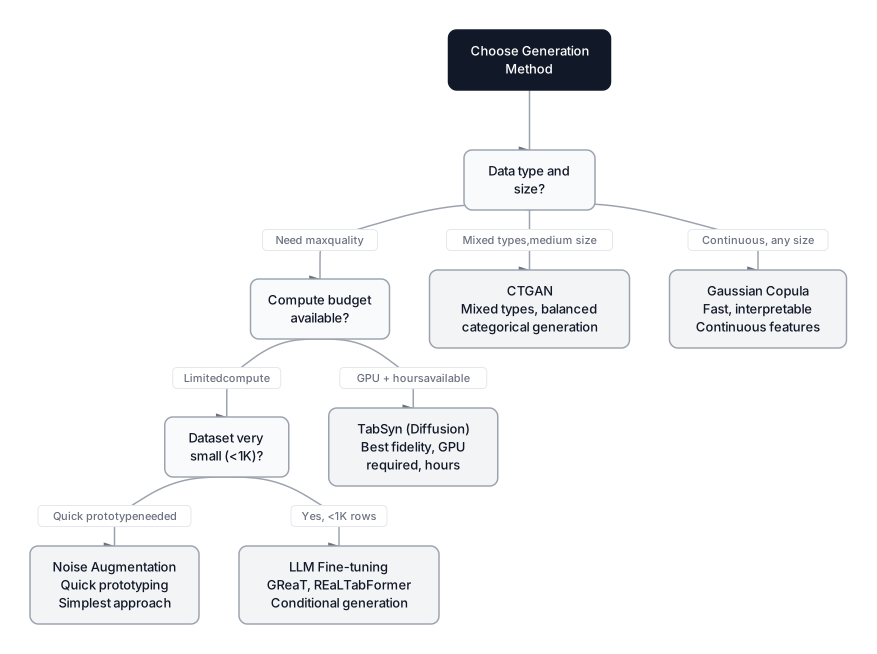 Click to expandComparison of synthetic data generation techniques and their tradeoffs
Key Insight: Diffusion models are overtaking GANs for tabular data quality in 2025-2026, but they require more computational resources and longer training times. For datasets under 10,000 rows, copulas or CTGAN remain more practical choices.
LLM-Based Generation
The most surprising development: fine-tuned language models can generate high-quality tabular data by treating each row as a text sequence. GReaT (Generation of Realistic Tabular data) serializes rows as natural language ("The patient is 67 years old, BMI 31.2, blood pressure 142...") and fine-tunes an autoregressive LLM to complete partial rows.
NVIDIA's Nemotron-4 340B took this to production scale: 98% of its supervised fine-tuning data was synthetically generated by an earlier model, then scored by a reward model on five quality attributes. This "synthetic data flywheel" is becoming standard practice for training large language models.
| Technique | Best For | Training Time | Mixed Types | Privacy |
|---|---|---|---|---|
| Gaussian Copula | Small-medium tabular, continuous features | Seconds | Limited | No formal guarantee |
| CTGAN | Medium tabular, mixed types | Minutes-hours | Strong | No formal guarantee |
| TabSyn (Diffusion) | High-fidelity tabular, any size | Hours | Excellent | Can add DP |
| GReaT (LLM) | Small datasets, conditional generation | Hours (fine-tune) | Native | Can add DP |
| Noise Addition | Quick augmentation, prototyping | Seconds | Manual | Tunable |
Measuring Synthetic Data Quality
Generating synthetic data is the easy part. Knowing whether it's actually useful requires evaluating three distinct pillars: fidelity, utility, and privacy.
Fidelity measures how closely the synthetic data matches the real data's statistical properties. Column-level checks (KS test, Wasserstein distance) verify that each feature's distribution is preserved. Pair-level checks confirm that correlations between features survive the generation process. We demonstrated both in the copula code block above.
Utility asks the practical question: can I train a model on synthetic data and have it perform well on real data? The standard protocol is Train-on-Synthetic, Test-on-Real (TSTR). You train a classifier entirely on synthetic records, then evaluate it against a held-out real test set. The closer TSTR performance matches Train-on-Real, Test-on-Real (TRTR), the more useful your synthetic data is.
Privacy quantifies how much information about individual real records leaks into the synthetic output. The Distance to Closest Record (DCR) measures the minimum distance between each synthetic point and the nearest real point. If synthetic records are too close to real ones, they might enable re-identification attacks. Membership inference tests check whether an attacker can determine if a specific record was in the training data.
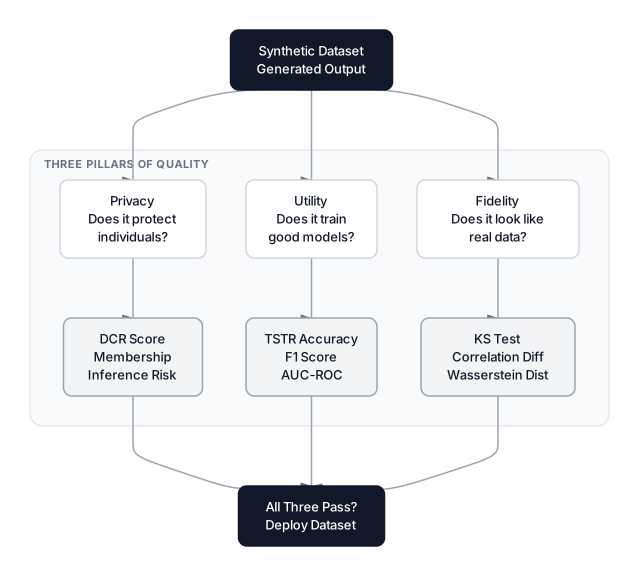 Click to expandThree pillars of synthetic data quality evaluation: fidelity, utility, and privacy
Here's TSTR in action on our hospital patient data. We simulate a realistic scenario where only 200 real records are available due to privacy restrictions:
Expected output:
Train-on-Synthetic, Test-on-Real (TSTR) Results
=======================================================
Training Data               Accuracy       F1      AUC
-------------------------------------------------------
200 real records               0.789    0.045    0.582
1000 synthetic only            0.801    0.329    0.693
200 real + 1000 synth          0.810    0.333    0.691
The AUC jumps from 0.582 to 0.693 when training on synthetic data instead of the limited real dataset. The model trained on just 200 real records barely learned any discriminative signal (F1 of 0.045 means it almost never predicts diabetes). With 1,000 synthetic records, the model starts identifying diabetic patients meaningfully. The combined approach offers slight accuracy gains but similar AUC, suggesting the synthetic records dominate the learning when they outnumber real records 5-to-1.
Key Insight: Synthetic data shines most when real data is severely limited. With 200 real records, our model was effectively guessing. Synthetic augmentation provided the volume needed for the Random Forest to learn real decision boundaries. The improvement is proportional to how scarce your real data is.
Privacy Guarantees and Differential Privacy
Synthetic data is not automatically private. If a generative model memorizes specific training records, those individuals' information leaks into every synthetic dataset it produces. This is why differential privacy (DP) has become the gold standard for privacy-preserving synthetic data.
Differential privacy provides a mathematical guarantee:
Where:
- is the synthetic data generation mechanism (the algorithm)
- and are any two datasets differing in exactly one record (one patient added or removed)
- is any possible synthetic output
- (epsilon) is the privacy budget controlling the strength of the guarantee
- bounds how much any single patient's presence can change the output
In Plain English: If we add or remove one patient from our hospital database, the synthetic data should look almost identical. A lower epsilon means stronger privacy: at , adding a patient changes the output by at most ~10%. At , the guarantee is weak enough to be meaningless.
The fundamental tradeoff is privacy versus utility. Strong DP guarantees (low ) inject enough noise to degrade the statistical patterns your model needs to learn. Research from Frontiers in Digital Health (2025) shows this tradeoff is acute for medical data: the epsilon values needed for meaningful HIPAA-level privacy often reduce downstream model accuracy by 5-15%.
GDPR regulators haven't issued definitive guidance on whether synthetic data with DP guarantees qualifies as "anonymized" data outside GDPR's scope. The conservative position, adopted by most European data protection authorities, is that synthetic data must be evaluated case-by-case. Gartner predicts synthetic data will help companies avoid 70% of privacy violation sanctions by 2030, but only when paired with formal privacy guarantees like DP.
When to Use Synthetic Data (and When NOT To)
Synthetic data is powerful, but it's not the right tool for every situation. Here's a decision framework based on real production experience:
Use synthetic data when:
- Privacy regulations block data sharing (GDPR, HIPAA). Synthetic records contain no real individuals.
- Your training set is too small. Augmenting 200 real records with 1,000 synthetic ones measurably improves model performance, as we demonstrated above.
- Class imbalance is extreme. If only 2% of transactions are fraudulent, synthetic minority oversampling via generative models outperforms basic SMOTE.
- You need realistic test environments. QA teams can use synthetic data without risking production PII exposure.
- You're building an evaluation benchmark. Synthetic question-answer pairs are standard for testing RAG pipelines.
Do NOT use synthetic data when:
- You have sufficient real data and no privacy constraints. Synthetic data is never better than more real data.
- Distribution shift matters. If your real data has subtle non-stationarities (seasonal patterns, demographic shifts), generators trained on historical data may produce outdated patterns.
- Rare edge cases are critical. Generative models learn the bulk of a distribution but routinely miss low-probability events. For safety-critical applications like autonomous driving, synthetic data supplements but never replaces real edge cases.
- Regulatory approval requires real data provenance. No drug or medical device has been approved using solely synthetic data in clinical trials as of March 2026.
- You're replacing data quality with data quantity. Generating 1 million synthetic records from a biased 500-record dataset amplifies bias, it doesn't fix it.
Common Pitfall: Teams sometimes treat synthetic data as a shortcut around data collection. If your real dataset is biased or incomplete, synthetic data inherits those flaws. The generator can only learn what's in the training data. Garbage in, synthetic garbage out.
The Model Collapse Trap
A landmark Nature paper (Shumailov et al., 2024) proved that training AI models on recursively generated synthetic data causes irreversible distribution degradation. Each generation loses information about the tails of the distribution: the rare, unusual cases that make real data valuable. After several recursive generations, outputs converge to a bland average that no longer represents reality.
This matters because by April 2025, over 74% of newly created web pages contained AI-generated text. Models trained on web scrapes increasingly consume their own output, creating a feedback loop that researchers call "model collapse." The most capable models in 2026 remain those anchored in human-generated, curated training data.
The prevention strategy is straightforward: always mix synthetic with real data, never replace real data entirely. The Nature study showed that accumulating synthetic data alongside preserved real data avoids the collapse. This aligns with what we saw in our TSTR experiment: the combined model (real + synthetic) matched the synthetic-only model's AUC while the real records grounded the synthetic augmentation. Understanding the bias-variance tradeoff helps here. Synthetic data reduces variance (more training samples), but excessive reliance on synthetic data introduces bias if the generator's learned distribution drifts from reality.
Conclusion
Synthetic data generation has matured from an academic curiosity into a production necessity. The technique hierarchy is clear: start with Gaussian copulas for quick prototyping on continuous tabular data, move to CTGAN for mixed-type tables requiring better categorical handling, and reach for diffusion models like TabSyn when maximum fidelity justifies the computational cost. LLM-based generation is the wildcard, particularly effective for small datasets where a fine-tuned language model captures complex feature interactions that statistical methods miss.
The three-pillar evaluation framework (fidelity, utility, privacy) is non-negotiable. Every synthetic dataset should pass column-wise distribution tests, demonstrate downstream ML utility via TSTR, and quantify privacy leakage through DCR or membership inference tests. Skipping any pillar risks deploying data that's statistically beautiful but practically useless or dangerously revealing.
Privacy remains the primary driver. As GDPR enforcement intensifies and HIPAA restrictions tighten, differential privacy paired with synthetic generation gives organizations a mathematically defensible path to sharing and using sensitive data. To properly validate any model trained on synthetic data, rigorous cross-validation against real held-out data remains essential. And for teams exploring how LLMs actually work under the hood, understanding how these models generate training data for themselves reveals one of the most important feedback loops in modern AI.
Start with a copula on your smallest dataset. Validate ruthlessly. Scale up the technique only when you've proven the simpler approach isn't enough.
Interview Questions
What is synthetic data, and why would you use it instead of collecting more real data?
Synthetic data is artificially generated information that preserves the statistical properties of real data without containing actual observations. You'd use it when privacy regulations prevent sharing real data (GDPR, HIPAA), when your dataset is too small for effective model training, or when class imbalance makes the minority class underrepresented. It's not a replacement for real data when real data is available and shareable.
Explain the difference between CTGAN and a Gaussian copula for tabular data generation.
Gaussian copulas model the dependency structure between features using a correlation matrix, then sample from a multivariate normal distribution mapped back through empirical CDFs. They're fast and interpretable but struggle with complex categorical features and multimodal distributions. CTGAN uses adversarial training with mode-specific normalization to handle multimodal continuous columns and a conditional generator to address categorical imbalance. CTGAN captures more complex relationships but requires GPU training and is susceptible to mode collapse.
How would you evaluate whether synthetic data is suitable for training a production ML model?
Use the three-pillar framework: fidelity, utility, and privacy. For fidelity, run KS tests and compare correlation matrices between real and synthetic. For utility, perform TSTR evaluation where you train on synthetic data and test on a real holdout set, comparing performance to a model trained on real data. For privacy, compute Distance to Closest Record and run membership inference attacks to quantify leakage risk. Only deploy if all three pillars pass your thresholds.
What is model collapse, and how does it relate to synthetic data?
Model collapse occurs when AI models trained on recursively generated synthetic data progressively lose information about the tails of the original distribution. Each generation smooths out rare cases, and after several iterations, outputs converge to a bland average. A 2024 Nature paper proved this is mathematically inevitable without intervention. The prevention is to always mix synthetic data with preserved real data rather than training exclusively on synthetic outputs.
A hospital asks you to generate synthetic patient data for external research collaboration. What privacy guarantees would you recommend?
I'd recommend combining synthetic generation with differential privacy (DP) to provide a formal mathematical guarantee. Specifically, I'd train the generative model with DP-SGD (differentially private stochastic gradient descent) at an epsilon between 1 and 10, depending on the sensitivity of the data. I'd also validate with membership inference attacks and DCR analysis. For HIPAA compliance, I'd ensure the synthetic records can't be linked back to real patients through quasi-identifiers like age-gender-zip code combinations.
You notice your synthetic dataset has excellent column-level distributions but poor downstream model performance. What went wrong?
The generator likely failed to capture feature interactions and conditional dependencies. Each column's marginal distribution matches, but the joint distribution is broken. For example, the synthetic data might have realistic age and BMI distributions individually, but lose the correlation that older patients with high BMI have elevated glucose. This is a common failure mode of independent column sampling. Switch to a method that explicitly models joint distributions: CTGAN, copulas, or diffusion models.
When would you choose diffusion models over GANs for tabular synthetic data?
Choose diffusion models when maximum statistical fidelity is the priority and you have the compute budget for longer training times. TabSyn (ICLR 2024) demonstrated 86% better column-wise distribution matching and 67% better correlation preservation than GANs. Diffusion models also avoid mode collapse entirely since they learn a denoising process rather than an adversarial game. Choose GANs when you need faster iteration cycles, when your dataset is small enough that diffusion training is impractical, or when the SDV/CTGAN ecosystem's tooling saves engineering time.