
A common production LLM decision is whether to fine-tune the model or build a RAG pipeline. It sounds like one big architectural decision, but it's actually two separate questions bundled together. What problem are you trying to solve? And which tool is designed for that specific problem?
Getting this wrong is expensive. Teams spend weeks building vector databases when they needed fine-tuning all along, or burn GPU hours training a model when a simpler retrieval pipeline would have worked better in an afternoon. This article gives you the mental model to make the call correctly the first time — including a third option most tutorials skip entirely.
Our running example is a legal document analysis system. A law firm wants an AI assistant that reads contracts, answers questions about clauses, cites specific provisions, and writes responses in precise legal language. It's a perfect test case because it demands everything: up-to-date facts, domain-specific style, and traceable answers.
What RAG Does
Retrieval-Augmented Generation (RAG) leaves the base model's weights completely unchanged. Instead, it gives the model an open-book exam at inference time.
When a query arrives, RAG embeds it as a vector, searches a knowledge base for semantically similar document chunks, and injects those chunks directly into the model's context window alongside the original query. The model reads those retrieved passages and generates an answer grounded in actual source documents, not memorized training data.
The full mechanics of RAG, including chunking strategies, reranking, and hybrid search, are covered in RAG Explained: Retrieval-Augmented Generation for LLMs. The key insight for this comparison: RAG changes what the model sees at inference time. Nothing about the model's underlying behavior changes.
For the legal assistant, RAG means: ingest the firm's 50,000 contracts into a vector store, and when a lawyer asks "does this NDA allow sublicensing?" the system retrieves the relevant clause and the model answers with a direct citation. New contracts added to the knowledge base are instantly queryable — no retraining required.
Anthropic's 2024 research on Contextual Retrieval showed that prepending chunk-specific context before embedding (rather than embedding raw chunks) reduces failed retrievals by 49% and by 67% when combined with reranking. These numbers matter when evaluating RAG vs the alternatives — a well-implemented RAG pipeline is far better than a naive one.
What Fine-Tuning Does
Fine-tuning modifies the model's weights using a curated training dataset. The model learns new patterns, styles, or behaviors that persist across every future query, with no retrieval step needed.
Modern fine-tuning almost always uses parameter-efficient methods like LoRA (Low-Rank Adaptation), which trains a small set of adapter weights rather than updating all billions of parameters. A thorough treatment of the mechanics is in Fine-Tuning LLMs with LoRA and QLoRA.
The critical distinction from RAG: fine-tuning changes how the model behaves on every query. It doesn't inject facts at runtime — it reshapes the model's generation tendencies permanently.
For the legal assistant, fine-tuning means: train the model on thousands of example legal memos, and every response it generates will naturally adopt formal legal phrasing, structured citation format, and conservative hedging language ("it appears that...", "subject to review...") without those instructions needing to appear in the prompt.
The Third Option: Long-Context Models
Before choosing between RAG and fine-tuning, ask a question most tutorials skip: does your knowledge base actually fit in a context window?
In 2024-2025, context windows exploded. Gemini 3.1 Pro handles up to 1 million tokens. Claude Opus 4.6 supports 200,000 tokens. Llama 4 Scout claims 10 million tokens. For many practical knowledge bases, you can stuff the entire corpus into the model's context and skip the retrieval infrastructure entirely.
The LaRA benchmark (Alibaba/ICML 2025, arxiv.org/abs/2502.09977) tested 11 LLMs across RAG vs long-context approaches on 2,326 cases. The main finding: there is no universal winner. The better approach depends on task type, context length, and retrieval quality. For small-to-medium knowledge bases, long-context models matched or beat RAG on most tasks.
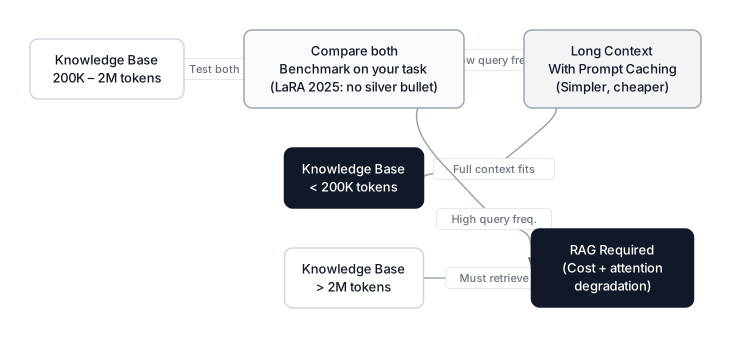 Click to expandLong context window vs RAG decision based on knowledge base size
When long context makes sense:
- Knowledge base under ~200,000 tokens. Inject everything directly. No vector database, no embedding pipeline, no retrieval latency. With prompt caching enabled, repeated queries over the same corpus become cheap because the cached tokens only count once.
- Low-to-medium query frequency. If you're not hammering an endpoint with thousands of requests per minute, the cost of sending a large context per query is manageable.
- Tasks requiring full-document understanding. Summarizing an entire legal agreement, identifying contradictions across clauses, or comparing two full contracts are hard to do well with fragmented retrieved chunks.
When long context falls short:
- High-volume queries at scale. Sending 200,000 tokens per request gets expensive fast. RAG retrieves 3-5 relevant chunks and costs a fraction of a cent per query. At 10M tokens per month, this difference is material.
- Attention can weaken across long inputs. The “Lost in the Middle” study found that tested models often performed worse when relevant information appeared in the middle of a long input rather than near its beginning or end. That study does not establish a universal 512K-token threshold for current models, so evaluate long-context behavior on the target workload.
- Access control and compliance. RAG lets you filter documents by user permissions before anything hits the model. Long-context prompting doesn't have a natural place for per-user document filtering.
- Truly large corpora. A 50,000-contract law firm archive is far beyond any context window. RAG remains the only option for terabyte-scale knowledge bases.
Key Insight: Long context is a genuine third option that often beats RAG for internal copilots, documentation assistants, and lightweight Q&A tools where the knowledge fits. Always measure before building retrieval infrastructure.
The Fundamental Difference Between RAG and Fine-Tuning
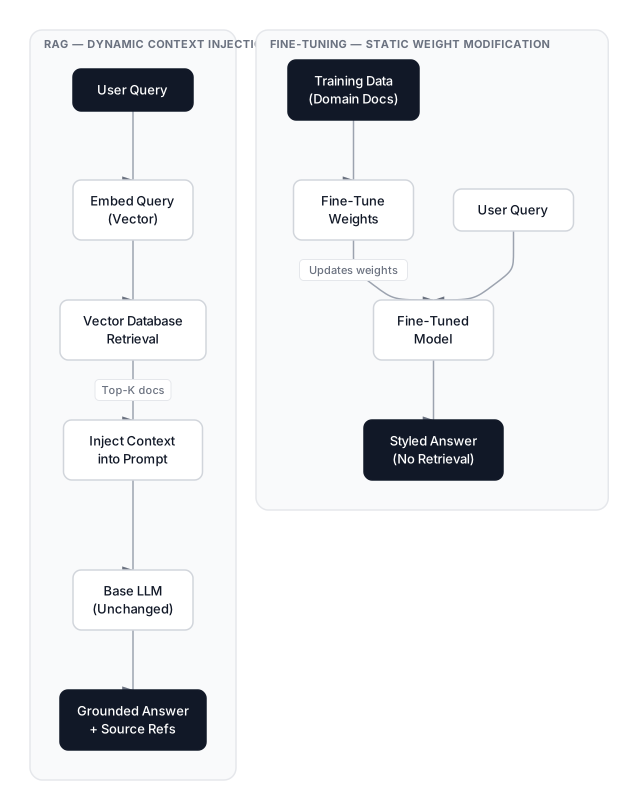 Click to expandRAG injects dynamic context at inference; fine-tuning modifies model weights permanently
The cleanest mental model for this entire decision:
- RAG changes what the model knows right now (volatile knowledge, context injection)
- Fine-tuning changes how the model behaves every time (stable behavior, weight modification)
A fine-tuned model asked about yesterday's court ruling will confidently give a wrong answer — it doesn't know about it. A RAG system asked to write in a specific voice will sound generic unless the style is painstakingly described in the system prompt every time. Each tool has a blind spot, and that blind spot is exactly what the other tool covers.
Key Insight: The failure mode is the diagnostic. If your model generates factually wrong or outdated answers, use RAG. If it generates accurate but poorly styled, incorrectly formatted, or behaviorally inconsistent answers, fine-tune.
Research supports this distinction strongly. A 2024 arXiv study (Fine-Tuning or Retrieval? Comparing Knowledge Injection in LLMs, Zhang et al.) found RAG substantially outperformed fine-tuning on knowledge-intensive tasks — the model retrieved facts more reliably than it memorized them. But fine-tuning beat RAG decisively on tasks requiring consistent behavioral output, where retrieval added no value. The 2025 LaRA benchmark confirmed this pattern persists across model generations.
When RAG Is the Right Choice
RAG wins when the problem is about what the model knows rather than how it behaves.
Factual knowledge that changes frequently. Legal regulations update. Company policies get revised. Product catalogs change weekly. Fine-tuning a model on current policy documents and then retraining it every time anything changes is impractical. A RAG pipeline with an updated knowledge base handles this with no retraining.
Traceable, auditable answers. In regulated industries — law, medicine, finance — you need to point to the source. RAG returns grounded answers with document citations. A fine-tuned model is a black box; there's no clean way to trace a specific claim back to training data.
Large, heterogeneous knowledge bases. If your knowledge corpus spans tens of thousands of documents, you can't pack all of it into a context window. RAG retrieves the relevant slice at query time. Vector Databases Compared: Pinecone, Weaviate, pgvector covers the infrastructure options for storing and querying at scale.
Cost-sensitive or rapid deployment scenarios. Building a RAG pipeline — choose an embedding model, set up a vector store, write a retrieval chain — can be done in hours. Fine-tuning requires curating labeled data, running training jobs, evaluating checkpoints, and serving a new model endpoint. For teams moving fast, RAG has dramatically lower time-to-production.
When Fine-Tuning Is the Right Choice
Fine-tuning wins when the problem is about how the model behaves rather than what it knows.
Style and tone adaptation. The base GPT or Claude model has a distinctive voice. If you need it to sound like a law firm, write like a Bloomberg terminal, or match a brand's specific register, you cannot prompt your way to reliable results at scale. Fine-tuning bakes the style into the weights.
Domain-specific structured output. If every response must follow a rigid schema — JSON with specific keys, a legal memo format with numbered clauses, a medical report with mandatory sections — fine-tuning enforces that format far more reliably than repeated prompt instructions. Models fine-tuned on structured output rarely hallucinate the structure.
Domain jargon and specialized reasoning patterns. General models understand common terms but sometimes mishandle highly specialized vocabulary or reasoning conventions. A model fine-tuned on legal depositions learns that "without prejudice" is a legal term of art, not a casual phrase. A model fine-tuned on medical case notes understands that "unremarkable" means normal, not unimportant.
Latency-critical applications. RAG adds at least one round-trip to a vector database plus a context-fattened prompt. On fast consumer apps or high-frequency API workflows, the retrieval overhead is measurable. A fine-tuned model answers from weights alone — faster, with lower per-query cost once training is amortized.
Reducing prompt length at scale. If you currently stuff 2,000 tokens of instructions into every system prompt to coax the right behavior, fine-tuning can internalize those instructions. At high query volumes, cutting 2,000 tokens per request translates directly to cost savings.
Common Pitfall: Teams sometimes fine-tune to inject factual knowledge — training on company documents in the hope the model "memorizes" the content. This rarely works well. LLMs learn statistical patterns from text, not key-value memory. They'll learn the style of your documents without reliably retrieving exact details. For factual knowledge injection, always use RAG.
When Neither RAG Nor Fine-Tuning Helps
Both tools address the same underlying model. If the underlying model cannot do the task, neither retrieval nor fine-tuning will fix it.
If a task requires multi-step causal reasoning, domain-expert judgment, or complex numerical computation, the bottleneck is model capability, not knowledge or style. No amount of retrieved context rescues a model that can't reason through a 15-clause indemnity chain. No fine-tuning turns a weak base model into a strong reasoner.
In these cases, the right moves are: upgrade to a more capable base model, break the task into simpler subtasks with explicit intermediate steps, or route to a specialized tool (a code interpreter for calculations, a rule engine for structured logic). The Agentic RAG pattern — where the model orchestrates multiple retrieval and reasoning steps — often handles tasks that single-shot RAG or fine-tuning can't.
The Hybrid Approach in Production
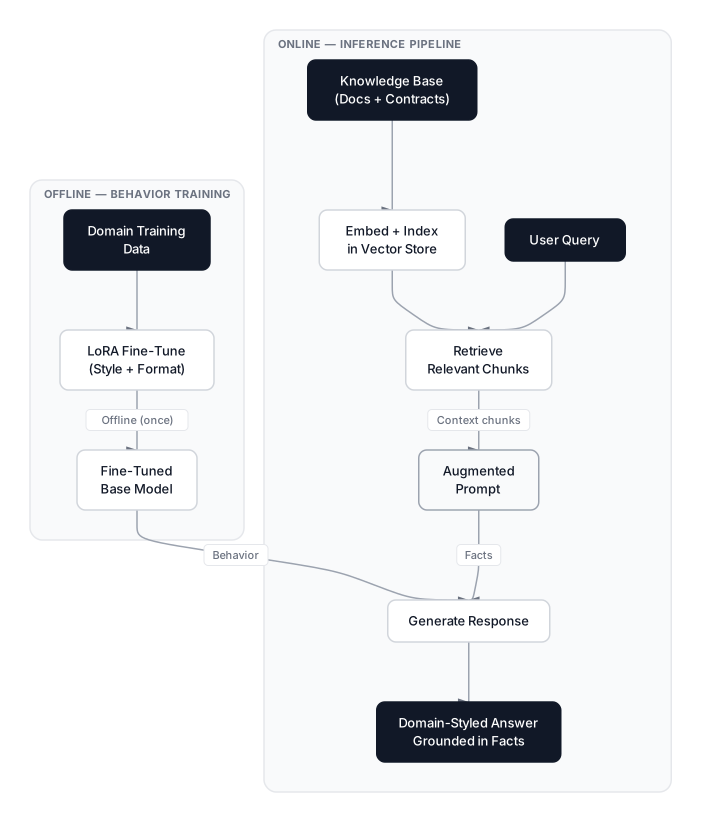 Click to expandHybrid pipeline: fine-tuned model handles style, RAG handles facts
For serious production applications, the practical default by 2026 is to combine both. Fine-tune for behavior. Use RAG for knowledge.
The split responsibilities are clean: fine-tuning runs once (or on a quarterly cadence) and encodes the behavioral baseline — the style, the format, the domain conventions. RAG runs at every inference, injecting current facts, specific documents, and traceable sources.
For the legal assistant, the hybrid looks like this:
# Offline — run once (or when style requirements change)
# Fine-tune base model on 10,000 sample legal memos using LoRA
trainer = SFTTrainer(
    model=base_model,
    train_dataset=legal_memos_dataset,       # Style examples
    peft_config=LoraConfig(r=16, lora_alpha=32),
    max_seq_length=2048,
)
trainer.train()
# Save adapter weights — model now writes in legal style
# Online — runs at every inference
def legal_qa(user_query: str) -> str:
    # Step 1: Retrieve relevant clauses from vector store
    relevant_chunks = vector_store.similarity_search(
        query=user_query,
        k=5,
        filter={"document_id": active_contract_id}
    )

    # Step 2: Build augmented prompt
    context = "\n\n".join([c.page_content for c in relevant_chunks])
    prompt = f"""You are a legal analyst reviewing a contract.

Relevant contract provisions:
{context}

Question: {user_query}

Provide your analysis with specific clause citations."""

    # Step 3: Fine-tuned model generates in legal style, grounded by retrieved facts
    response = fine_tuned_model.generate(prompt)
    return response
The research paper RAFT (Retrieval-Augmented Fine-Tuning, Zhang et al., UC Berkeley, 2024, arxiv.org/abs/2403.10131) formalized this pattern by training models specifically to use retrieved documents well. During RAFT fine-tuning, the model sees questions paired with both relevant documents and distractor documents, and is trained to identify which retrieved chunks actually support the answer. RAFT showed consistent improvements over both pure RAG and pure fine-tuning on domain-specific tasks — healthcare, legal, and code — where retrieval quality is imperfect (which is always, in practice). Meta validated this approach by applying RAFT to Llama models and publishing results showing strong gains on PubMed, HotpotQA, and Gorilla benchmarks.
Pro Tip: When building the hybrid, always fine-tune first on a held-out style evaluation set, then layer RAG on top and measure end-to-end quality. This order reveals whether the fine-tuning created any degradation in the model's ability to follow retrieval-grounded prompts — a failure mode worth checking explicitly.
Decision Framework: Use Case Mapping
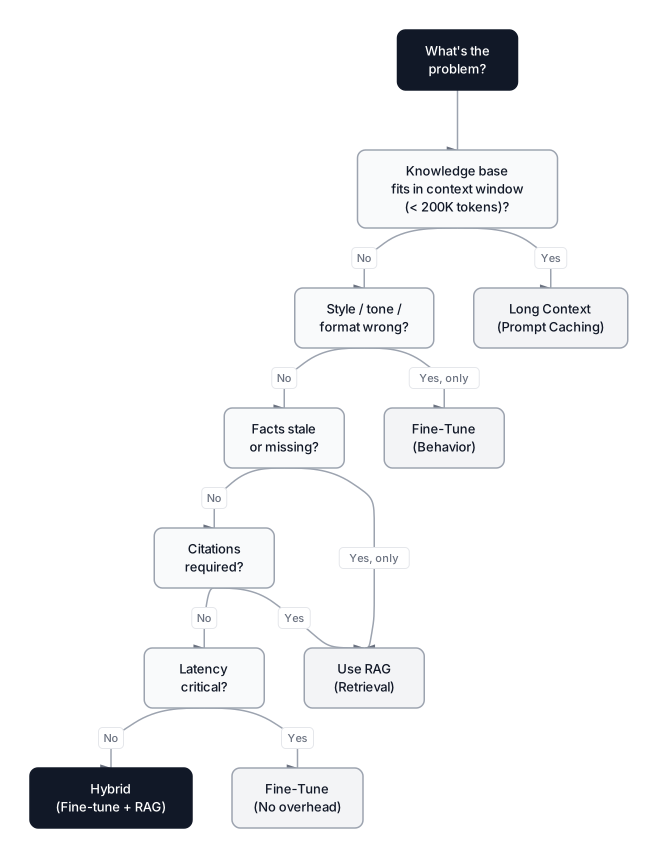 Click to expandDecision tree for choosing RAG, fine-tuning, long context, or hybrid approach
The table below maps 14 concrete production scenarios to the recommended approach, based on what the bottleneck actually is.
| Use Case | Primary Bottleneck | Recommended Approach |
|---|---|---|
| Customer support bot with a changing product FAQ | Stale knowledge | RAG |
| Legal contract analysis with clause citations | Traceability + current docs | RAG |
| Internal Q&A over a 100-page policy document | Small corpus | Long Context |
| Brand voice chatbot for marketing copy | Style consistency | Fine-tune |
| Medical symptom checker with drug interactions | Up-to-date clinical data | RAG |
| Code assistant that always outputs a specific JSON schema | Structured output format | Fine-tune |
| Internal HR policy Q&A tool | Private knowledge corpus | RAG |
| Financial analyst writing earnings summaries | Style + current data | Hybrid |
| Multi-turn customer service agent | Behavior + product knowledge | Hybrid |
| Domain-specific email drafting (legal, medical) | Tone + jargon | Fine-tune |
| Compliance documentation checker | Regulatory fact lookup | RAG |
| Docs assistant for a single library | Fits in context window | Long Context |
| API documentation generator | Output format + spec knowledge | Hybrid |
| Real-time news summarization | Freshness | RAG |
The pattern across the table: if the problem lives in the knowledge layer, use RAG. If it lives in the behavior layer, fine-tune. If the corpus is small and queries aren't high-frequency, long context may beat both. If both layers have problems, do both.
Cost and Latency in Practice
These two axes matter a lot in the architecture decision and are often underweighted in tutorials.
RAG costs (2026):
- Infrastructure: embedding model endpoint, vector database (Pinecone serverless from ~$70/month, Weaviate, pgvector on managed Postgres), reranker
- Per-query: retrieval latency (5 to 50ms for approximate nearest neighbor search), larger prompt (retrieved context adds tokens), increased inference cost per query
- Year-one total for a mid-sized deployment: roughly $18,000 ($4,000 setup + $1,200/month infrastructure)
- Maintenance: document ingestion pipelines, re-embedding on content updates, index monitoring
Fine-tuning costs (2026):
- Training: GPU compute for LoRA fine-tuning on a 7B model costs roughly $50 to $200 on cloud providers for a typical dataset. Full fine-tuning of larger models costs considerably more.
- Deployment: serving a custom model endpoint adds operational overhead versus using a managed API
- Year-one total: roughly $30,000 when you factor in data prep labor, training, evaluation, and quarterly retraining
- Maintenance: periodic retraining when requirements change, evaluation on regression benchmarks
Long context costs (2026):
- No vector database infrastructure
- Per-query cost scales with corpus size; with prompt caching, repeated context tokens cost ~10x less than uncached
- Most cost-effective for static or slowly changing corpora with moderate query volume
The crossover point: RAG systems typically cost less in the first year due to lower setup complexity, but fine-tuned models become cheaper after 12–18 months for applications with stable requirements and high query volume. If your knowledge changes less than once a week and your query volume is very high, the fixed cost of fine-tuning amortizes quickly and per-query latency savings compound. If your knowledge changes daily or you need to ship in days, RAG or long context is almost always the right starting point.
Key Insight: Start with long context if the corpus fits. If it doesn't, start with RAG. It's lower risk, faster to build, and easier to debug — you can inspect retrieved documents and trace exactly why the model said what it said. Fine-tune only after you've identified a specific behavioral gap that prompt engineering cannot close.
Conclusion
RAG, fine-tuning, and long-context prompting address genuinely different problems. RAG fixes what the model knows at runtime. Fine-tuning fixes how the model behaves permanently. Long-context prompting skips the retrieval step entirely when the corpus fits — often the simplest and cheapest choice that gets overlooked.
The decision collapses to a three-part diagnostic. First: does your knowledge base fit in a context window with prompt caching? If yes, try that first. Second: is your model failing because it lacks current knowledge, or because it generates outputs in the wrong style or format? Knowledge gaps point to RAG; behavioral gaps point to fine-tuning. Third: do you need both? Most production-grade systems over 6 months old have both knowledge and behavioral requirements — that's where the hybrid shines.
For the legal assistant that started this article: the team built RAG first. Contract clauses were instantly searchable, citations were accurate, and the system was in production in two weeks. Three months later, after identifying that the model's general-purpose voice didn't match the firm's formal style, they layered in a LoRA fine-tune on 8,000 sample memos. The hybrid took the system from "technically correct but awkward to read" to something partners trusted as their actual writing voice.
That sequence — long context or RAG first, fine-tune for behavior second, combine when both matter — is the standard pattern in production teams working with LLMs in 2026.
For a deeper understanding of how RAG pipelines work at scale, including self-correcting retrieval and query rewriting, see Agentic RAG: Self-Correcting Retrieval Systems. For the mechanics of LoRA fine-tuning with practical code, Fine-Tuning LLMs with LoRA and QLoRA covers training, evaluation, and deployment. For how long-context models handle million-token windows, Long Context Models: Working with 1M+ Token Windows covers the architecture and practical tradeoffs.
Interview Questions
What is the core architectural difference between RAG and fine-tuning?
RAG keeps model weights frozen and injects knowledge dynamically into the context window at inference time. Fine-tuning modifies model weights during a training phase so the behavioral change is permanent and requires no runtime retrieval. The practical distinction is: RAG changes what the model sees; fine-tuning changes how the model responds.
When would you choose fine-tuning over RAG for a production system?
Fine-tuning is the right call when the failure mode is behavioral inconsistency rather than missing knowledge. Specific cases: you need a reliable output format or schema, a consistent brand or domain voice, domain-specific reasoning conventions, or reduced per-query latency and token cost at scale. Fine-tuning cannot solve stale knowledge; it solves how the model generates given any input.
Why does fine-tuning fail at factual knowledge injection?
LLMs learn statistical patterns from text, not key-value memory. When fine-tuned on factual documents, a model learns the style and structure of those documents rather than reliably memorizing specific facts. Ask the fine-tuned model a specific detail from training data and it may generate a plausible-sounding but wrong answer. RAG retrieves the actual document and presents it directly — no memory required.
Your legal chatbot is generating accurate answers but the writing style is too informal for the firm's partners. How do you fix it?
This is a behavioral problem, not a knowledge problem, so fine-tuning is the right tool. Curate a training set of 5,000 to 10,000 example Q&A pairs written in the target legal voice, fine-tune with LoRA on top of the base model, and evaluate on a held-out style benchmark before deploying. Avoid retraining the full model — LoRA achieves the same result at a fraction of the compute cost.
What is RAFT and how does it combine RAG and fine-tuning?
RAFT (Retrieval-Augmented Fine-Tuning, UC Berkeley, 2024) is a training recipe that teaches a model to use retrieved documents effectively. During fine-tuning, the model sees questions paired with both relevant documents and distractor documents, and is trained to identify which chunks actually support the answer. The result is a model that retrieves and reasons with documents better than either plain RAG or plain fine-tuning alone, with validated gains on PubMed, HotpotQA, and code generation benchmarks.
A product manager asks you to add last week's regulatory changes to your compliance chatbot. Should you fine-tune or update the RAG knowledge base?
Update the RAG knowledge base. Fine-tuning to inject specific factual changes requires retraining (time and cost), and the model may not reliably retrieve those specific facts anyway. Adding the regulatory update documents to the vector store and re-indexing takes minutes. RAG is usually a strong fit for dynamic, frequently updated factual content because documents can be refreshed without retraining the model.
How do you evaluate which approach is working in a hybrid RAG + fine-tuning system?
Decompose the evaluation into two separate signals. Retrieval quality: measure recall and precision of the retrieval step using a labeled relevance set. Generation quality: measure format adherence, style consistency, and factual accuracy of the final output against a held-out benchmark. If retrieval recall is high but outputs are wrong, the bottleneck is in the fine-tuned model behavior. If retrieval recall is low, fix the indexing and query expansion layer first.
When would you use a long-context model instead of RAG?
When your entire knowledge base fits within the model's context window (roughly 200,000 tokens or less) and query frequency is moderate. With prompt caching, the cost of repeated large contexts drops substantially. Long-context approaches are simpler to build and debug than RAG pipelines, and the LaRA benchmark (ICML 2025) showed they match or beat RAG on most tasks at those scales. RAG becomes necessary when the corpus is too large to fit, query volume is high enough that per-token costs dominate, or per-user document access control is required.