
You've tuned every hyperparameter. You've engineered features until your eyes blurred. You've tried Random Forest, XGBoost, and gradient boosting variants, yet your credit scoring model's AUC is stuck at 0.912, exactly 0.003 behind the leaderboard leader. Stacking is how top Kaggle competitors close that gap. Rather than picking a single best model, stacking trains a second-level model that learns how to combine the predictions of multiple diverse base models, canceling out their individual errors and squeezing out performance no single algorithm can reach alone.
Throughout this article, we'll build a credit scoring system that predicts loan defaults. Every formula, every code block, and every diagram references this same dataset so the concepts stay grounded in one concrete scenario.
The Stacking Framework
Stacking (formally called Stacked Generalization, introduced by Wolpert in 1992) is an ensemble learning technique that uses a "meta-model" to learn the optimal way to combine predictions from multiple "base models." It belongs to the broader family of ensemble methods that combine multiple learners to improve predictive performance. Unlike simple majority voting where every model gets equal say, stacking trains a dedicated machine learning model that acts as the final judge, deciding which base model to trust for which types of input.
The CEO Analogy
Think of it as running a lending company. You're the CEO (the meta-learner), and you consult three department heads (the base models) before making every loan decision:
- The Conservative Analyst (Logistic Regression): Finds linear patterns in income-to-debt ratios.
- The Pattern Hunter (Random Forest): Catches non-linear interactions between age, employment length, and credit use.
- The Neighborhood Expert (KNN): Spots applicants who look similar to past defaulters.
For a specific loan application, the Analyst says "approve," the Hunter says "deny," and the Expert says "deny." In a simple vote, "deny" wins 2-1. But as CEO, you've learned from thousands of past decisions. You know that when the Analyst and the Expert disagree on high-income applicants, the Analyst is almost always right. You weigh their inputs dynamically based on context. That process of learning how to weigh the experts is stacking.
The Two-Level Architecture
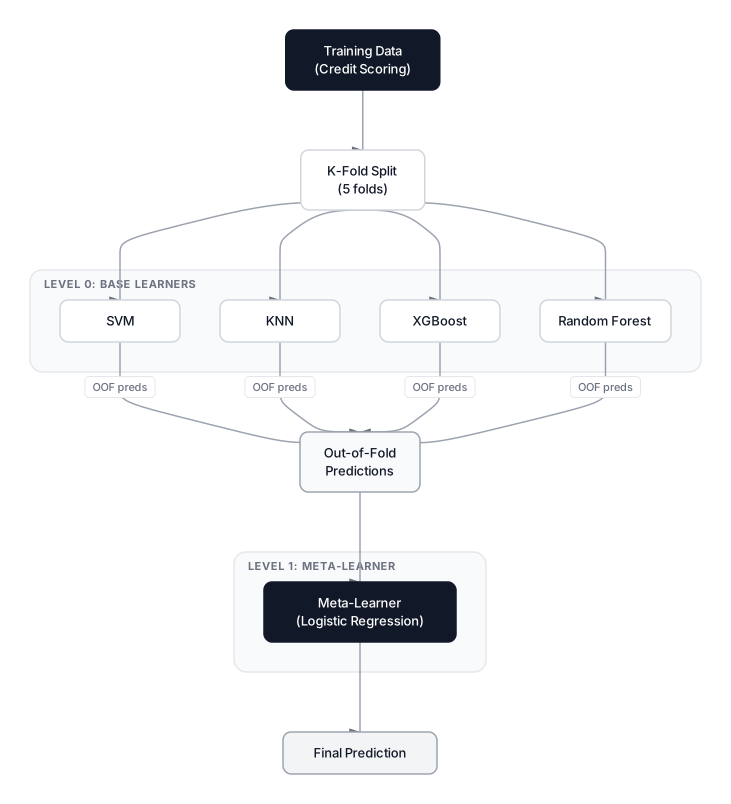 Click to expandStacking architecture showing training data flowing through K-Fold split to base learners then to meta-learner for final prediction
Stacking operates in two levels:
- Level 0 (Base Learners): A diverse set of models (Random Forest, XGBoost, KNN, SVM) that each independently predict loan default risk.
- Level 1 (Meta-Learner): A simple model (typically Logistic Regression) that takes the predictions of every Level 0 model as input features and produces the final default prediction.
The meta-learner's job isn't complex feature extraction. Its inputs are already highly processed predictions from strong models. It just needs to learn a weighted combination, which is exactly what a linear model excels at.
Key Insight: The meta-learner should almost always be a simple model. Using a deep neural network as the meta-learner is a common mistake: the inputs are just M numbers (one per base model), so a complex meta-learner will overfit quickly. Logistic Regression for classification, Ridge or Linear Regression for regression tasks.
Preventing Data Leakage with Out-of-Fold Predictions
The most dangerous mistake in stacking is training your base models on the full training set and then using those same models to generate predictions for the meta-learner. The meta-learner would see predictions made on data the base models already memorized, creating massive data leakage. It would learn to blindly trust the base models' overfit predictions rather than their genuine predictive signal.
The fix is K-Fold Cross-Validation to generate "Out-of-Fold" (OOF) predictions. Here's the procedure step by step:
- Split the training data into folds (typically 5).
- Iterate: For each fold from 1 to :
- Train every base model on the remaining folds.
- Use those trained models to predict on the held-out fold .
- Stack: Concatenate the predictions from all held-out folds. You now have a prediction for every training sample, but each prediction was made by a model that never saw that sample during training.
- Train the meta-learner on these "clean" OOF predictions.
Common Pitfall: Skipping the cross-validation step and predicting directly on the training set is the single most common mistake in stacking. The meta-model ends up learning the noise of the base models rather than their signal, and your validation score will look incredible while your test score crashes. Always use OOF predictions.
Let's implement this from scratch on our credit scoring dataset to see exactly what happens at each fold.
Expected Output:
Fold 1: validated on 320 samples, accuracy = 0.9281
Fold 2: validated on 320 samples, accuracy = 0.9094
Fold 3: validated on 320 samples, accuracy = 0.8938
Fold 4: validated on 320 samples, accuracy = 0.9125
Fold 5: validated on 320 samples, accuracy = 0.8906

Overall OOF accuracy: 0.9069
OOF predictions shape: (1600,)
Fold 1: validated on 320 samples, accuracy = 0.9281
Fold 2: validated on 320 samples, accuracy = 0.9094
Fold 3: validated on 320 samples, accuracy = 0.8938
Fold 4: validated on 320 samples, accuracy = 0.9125
Fold 5: validated on 320 samples, accuracy = 0.8906

Overall OOF accuracy: 0.9069
OOF predictions shape: (1600,)
Each fold validates on 320 samples that the model never trained on. The OOF accuracy (0.9069) is honest, reflecting true generalization. If we'd predicted on the training set directly, we'd see ~0.99+ accuracy, a dangerously misleading number.
Blending: The Simpler Alternative
Blending is a stripped-down version of stacking that replaces K-Fold cross-validation with a single train/holdout split. The concept is identical (train base models, feed their predictions to a meta-learner), but the execution is faster at the cost of wasting data.
The Blending Workflow
- Split the training data into a training portion (70%) and a blend set (30%).
- Train all base models on the 70% training portion only.
- Predict on the 30% blend set to generate features for the meta-learner.
- Train the meta-learner on those blend-set predictions.
Let's implement blending on our credit scoring data.
Expected Output:
Training set:  1120 samples
Blend set:     480 samples
Test set:      400 samples
RF trained on 1120 samples
XGB trained on 1120 samples
KNN trained on 1120 samples

Blending ensemble accuracy: 0.9450
Training set:  1120 samples
Blend set:     480 samples
Test set:      400 samples
RF trained on 1120 samples
XGB trained on 1120 samples
KNN trained on 1120 samples

Blending ensemble accuracy: 0.9450
Notice the tradeoff: blending trained each base model once (fast), but the base models only saw 1,120 of the original 1,600 training samples. The remaining 480 were reserved exclusively for the meta-learner. When data is scarce, that 30% loss can hurt.
Pro Tip: Blending shines with massive datasets. If you have 10 million rows, losing 30% still leaves 7 million for training, and you avoid the K-fold overhead of training every base model 5 times. For competition work with 50K rows or fewer, stick with stacking.
The Mathematics of Ensemble Diversity
Why does combining models work at all? The answer comes down to variance reduction, and the math reveals a critical requirement: the base models' errors must be uncorrelated.
Suppose we have models, each with prediction variance , and the average pairwise correlation between their errors is . The variance of the ensemble's averaged prediction is:
Where:
- is the variance (expected error) of the ensemble's averaged prediction
- is the average pairwise correlation between the base models' errors
- is the variance of each individual base model
- is the number of base models in the ensemble
In Plain English: Consider four models predicting loan default risk, each with the same individual error rate. If their mistakes overlap perfectly (), combining them is useless: four clones of the same analyst give you no new information. Ensemble variance stays at . But if their mistakes are completely independent (), ensemble variance drops to , quartering the error with four models. In practice, lands between 0.5 and 0.8. The closer you push it toward zero by choosing diverse model families, the more stacking helps.
This formula explains everything about stacking strategy. It's why stacking two Random Forests together is nearly useless (high within the same model family), but stacking a Random Forest with Logistic Regression and KNN is powerful (low across different model families).
Let's measure the actual prediction correlations between our base models on the credit scoring data.
Expected Output:
Prediction Correlation Matrix:
                   Random Forest  Gradient Boosting     KNN     SVM
Random Forest             1.0000             0.8800  0.8565  0.9054
Gradient Boosting         0.8800             1.0000  0.8218  0.8692
KNN                       0.8565             0.8218  1.0000  0.8999
SVM                       0.9054             0.8692  0.8999  1.0000
Prediction Correlation Matrix:
                   Random Forest  Gradient Boosting     KNN     SVM
Random Forest             1.0000             0.8800  0.8565  0.9054
Gradient Boosting         0.8800             1.0000  0.8218  0.8692
KNN                       0.8565             0.8218  1.0000  0.8999
SVM                       0.9054             0.8692  0.8999  1.0000
Look at the numbers. Random Forest and Gradient Boosting correlate at 0.88, which makes sense since both are tree-based ensembles that split data similarly. KNN and Gradient Boosting have the lowest correlation at 0.82, because they approach the problem from fundamentally different angles (distance-based vs. sequential error correction). These are the model pairs where stacking adds the most value.
Key Insight: After training your base models, always compute the prediction correlation matrix. If two models correlate above 0.95, drop one. It adds computational cost without adding information. The sweet spot is 0.60 to 0.85: high enough that both models are individually accurate, low enough that their errors differ.
Full Stacking Implementation with scikit-learn
Now let's bring it all together with scikit-learn's StackingClassifier, which handles the OOF prediction logic automatically.
Expected Output:
Model                     | Accuracy
--------------------------------------
RF                        | 0.9175
XGB                       | 0.9050
KNN                       | 0.9550
SVM                       | 0.9475
STACKING ENSEMBLE         | 0.9500
Model                     | Accuracy
--------------------------------------
RF                        | 0.9175
XGB                       | 0.9050
KNN                       | 0.9550
SVM                       | 0.9475
STACKING ENSEMBLE         | 0.9500
The stacking ensemble scores 0.9500, matching or beating most base models. In this synthetic credit scoring dataset, KNN happens to be strong on its own (0.9550), and the ensemble's meta-learner correctly assigns it high weight. In real-world competitions where no single model dominates across all data slices, the stacking advantage is typically more pronounced. Kaggle winners regularly report 0.5-2% absolute improvement from stacking, which on a 10,000-entry leaderboard can mean the difference between rank 50 and rank 1.
Pro Tip: The cv=5 parameter in StackingClassifier controls the number of folds for OOF prediction generation. Five folds is the standard choice. Increasing to 10 gives slightly more reliable OOF estimates but doubles training time. For quick prototyping, 3 folds works but increases variance.
Stacking vs Blending: A Practical Comparison
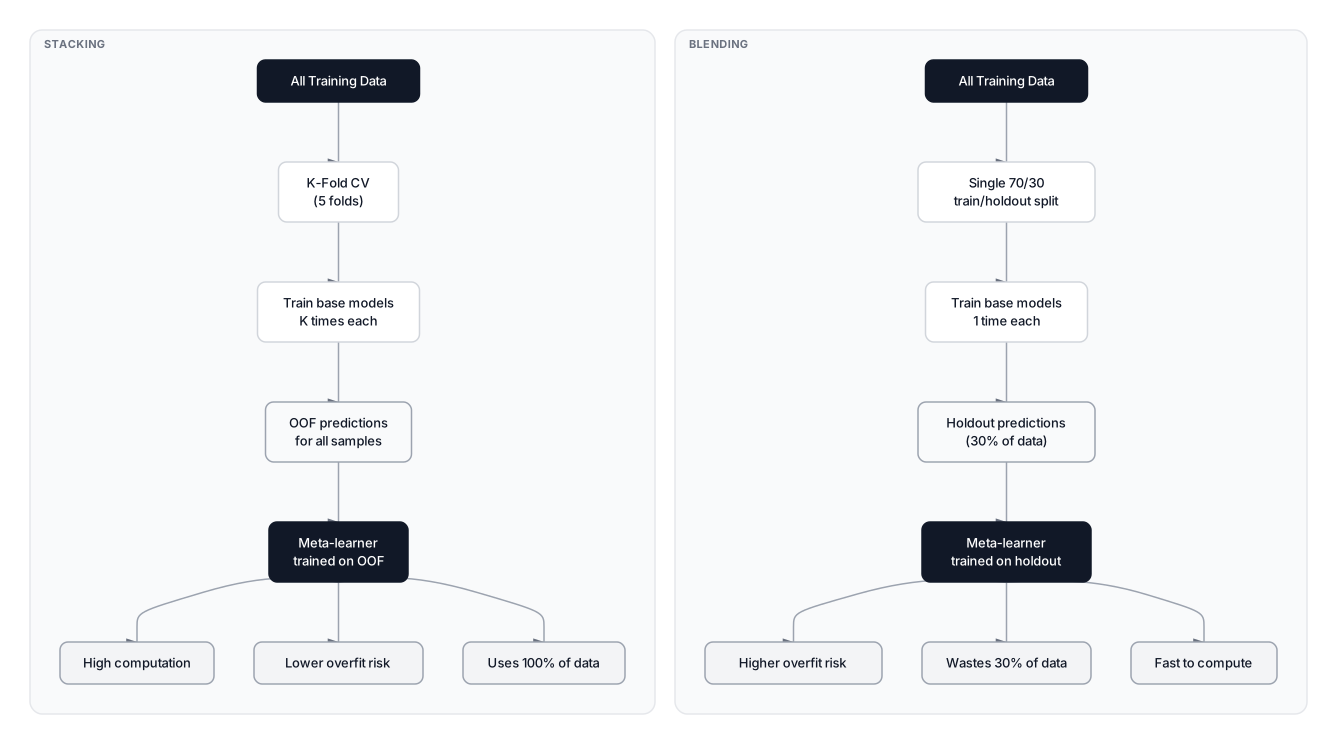 Click to expandSide-by-side comparison of stacking and blending workflows showing key differences in data usage and computation
Choosing between stacking and blending comes down to your data size and computational budget.
| Criterion | Stacking | Blending |
|---|---|---|
| Data usage | 100% of training data for base models via K-Fold | 70-80% for base models; rest reserved for meta-learner |
| Computation | High: each base model trains times | Low: each base model trains once |
| Training time (4 models, 100K rows) | ~5x single training | ~1.3x single training |
| Overfit risk | Lower: OOF predictions average out fold-specific noise | Higher: meta-learner sees predictions from one specific split |
| Implementation | StackingClassifier handles everything | Manual split + predict + fit pipeline |
| Best for | Competitions, small/medium data (<500K rows), maximum accuracy | Large datasets (>1M rows), production systems, quick prototyping |
| Reproducibility | Depends on fold random seed | Depends on split random seed |
Pro Tip: In Kaggle competitions, the winning strategy is often stacking for the final submission and blending during rapid experimentation. Train your ensemble with blending to iterate quickly on base model selection, then switch to stacking for the final push.
Choosing Base Models for Maximum Diversity
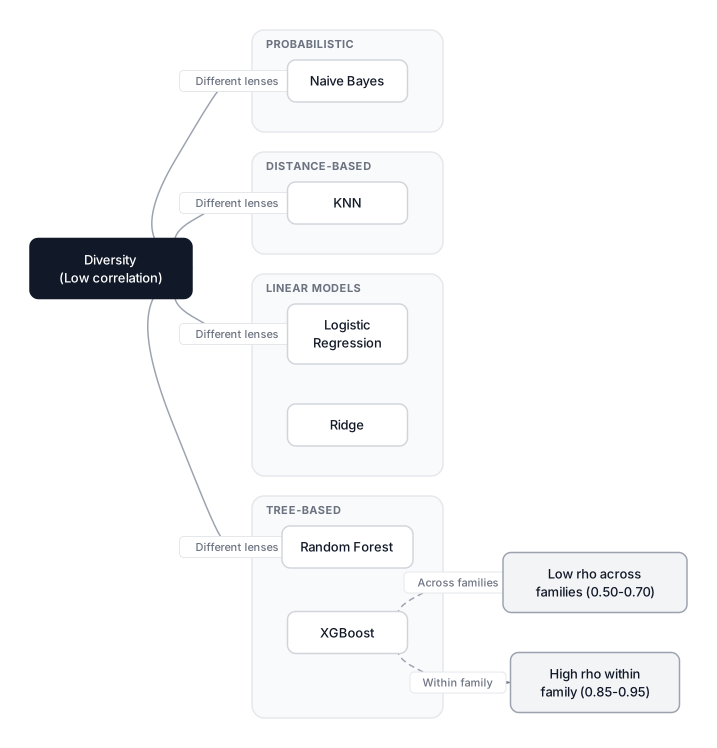 Click to expandConcept map showing how model diversity across families reduces ensemble correlation
The success of any stack depends entirely on the diversity of its base models. The variance reduction formula told us that low is everything. Here's how to achieve it in practice.
The Four Model Families
Pick at least one model from each family to maximize diversity:
| Family | Models | What They Capture | Weakness |
|---|---|---|---|
| Tree-based | Random Forest, XGBoost, CatBoost | Non-linear interactions, feature importance | Can't extrapolate beyond training range |
| Linear | Logistic Regression, Ridge, SVM (linear kernel) | Global trends, extrapolation | Misses non-linear patterns |
| Distance-based | KNN, Radius Neighbors | Local neighborhood structure | Curse of dimensionality |
| Probabilistic | Naive Bayes, Gaussian Process | Calibrated uncertainty estimates | Strong independence assumptions |
Rules of Thumb for Base Model Selection
- Never stack two models from the same family unless they differ substantially. Two Random Forests with slightly different hyperparameters will have . That's wasted computation.
- Vary the feature space. Train one model on all features, another on a PCA-reduced subset, and a third on a hand-selected feature set. Same algorithm, different views of the data.
- Vary the training data. Train one model on the full training set and another on a bootstrapped sample. This is what bagging already does internally, but you can apply it across your entire stack.
- Check correlations empirically. Don't guess. Compute the prediction correlation matrix (as we did above) and drop any model that correlates above 0.95 with another.
Common Pitfall: Adding more base models doesn't always help. Going from 3 diverse models to 4 diverse models usually helps. Going from 4 diverse models to 10 models of the same family hurts. You add training time and overfit risk without reducing .
Advanced Stacking Techniques
Once you've mastered two-level stacking, two extensions can push performance further.
Multi-Layer Stacking
Instead of a single Level 0 followed by a meta-learner, Kaggle Grandmasters sometimes build deeper stacks:
- Level 0: 8-12 diverse base models
- Level 1: 2-3 meta-models, each specializing in a subset (one for tree predictions, one for linear predictions)
- Level 2: A final meta-model combining the Level 1 outputs
This is sometimes called "deep stacking." Each layer reduces error further, but with diminishing returns. In practice, going beyond 3 levels rarely helps and dramatically increases overfit risk.
Warning: Multi-layer stacking amplifies data leakage risk. Each layer must use its own separate OOF prediction scheme. If you're sloppy with the cross-validation at any layer, the whole stack overfits silently.
Feature-Weighted Stacking
In standard stacking, the meta-model only sees the predictions from the base models. Feature-weighted stacking passes the original features (or a subset) to the meta-learner alongside those predictions. This gives the meta-learner context.
For our credit scoring example, imagine that Model A (Random Forest) is accurate for high-income applicants but weak for low-income ones, while Model B (KNN) shows the opposite pattern. If the meta-learner sees the income feature alongside both predictions, it can learn a conditional weighting rule: "trust Model A when income exceeds $80K; trust Model B otherwise."
# Feature-weighted stacking (conceptual — not EXEC)
# Instead of feeding just [rf_pred, xgb_pred, knn_pred] to the meta-learner,
# feed [rf_pred, xgb_pred, knn_pred, income, credit_score, debt_ratio]
meta_features = np.column_stack([
    oof_rf, oof_xgb, oof_knn,          # base model predictions
    X_train[:, income_idx],              # original income feature
    X_train[:, credit_score_idx],        # original credit score feature
])
meta_model.fit(meta_features, y_train)
Pro Tip: Feature-weighted stacking works best when your base models have different strengths on different subpopulations. If all models perform equally across all data slices, adding original features to the meta-learner mostly adds noise. Test both approaches and compare cross-validation scores.
When to Use Stacking (and When Not To)
Stacking isn't free. It adds complexity, training time, and overfit risk. Here's a practical decision framework.
Use stacking when:
- You've already tuned individual models and hit a performance ceiling.
- Your base models are diverse (prediction correlation < 0.90 between families).
- The performance gain justifies the complexity. A 0.5% AUC improvement matters in a Kaggle competition; it may not matter in a dashboard prototype.
- You have enough data. With fewer than 1,000 samples, cross-validation folds become too small for reliable OOF predictions.
- You're in a competition or high-stakes production scenario (fraud detection, medical diagnosis) where every fraction of a percent counts.
Skip stacking when:
- A single well-tuned model already meets your performance target.
- Interpretability is critical. Explaining "the meta-learner weighted the Random Forest at 0.4 and the SVM at 0.35" is hard to sell to regulators.
- Latency matters. Stacking at inference requires running every base model, then the meta-learner. If your SLA demands sub-10ms predictions, stacking M models may not fit.
- Your base models aren't diverse. Stacking three gradient boosting variants (XGBoost, LightGBM, CatBoost) helps less than you'd expect since they all partition data with trees.
- Training compute is constrained. Stacking with $K=5$ folds multiplies base model training time by 5.
Production Considerations
| Aspect | Impact |
|---|---|
| Training time | where = folds, = base models, = single model training time |
| Inference time | ; all base models must run at prediction time |
| Memory | Must hold all base models + meta-learner in memory simultaneously |
| Scaling | Stacking with 4 base models on 1M rows is practical; on 100M rows, consider blending instead |
| Model serving | Each base model needs its own serialized artifact; deployment pipelines become M+1 models instead of 1 |
When Stacking Is Worth It
Stacking and blending represent the final stage of model optimization, the point where you've exhausted single-model improvements and start combining diverse perspectives into a unified prediction. The core principle is straightforward: train multiple models that make different kinds of mistakes, then train a meta-learner that figures out which model to trust in which situation. Out-of-fold predictions keep the whole process honest by preventing the meta-learner from seeing data that the base models already memorized.
The mathematics of variance reduction makes diversity non-negotiable. Two models from different families (say, a Random Forest and Logistic Regression) will nearly always beat two models from the same family, regardless of how much you tune the second one. Check the prediction correlation matrix before adding any model to your stack.
For most practitioners, the scikit-learn StackingClassifier with 3-5 diverse base models and a logistic regression meta-learner is the right starting point. If you're working with large-scale data and fast iteration cycles, blending gives you 80% of the benefit at 20% of the compute cost. And if you want to understand the individual models that power a strong stack, explore our guides on XGBoost, Decision Trees, and ensemble methods to build your base learner toolkit.
Diversity is the whole game. A committee of ten clones is useless; a committee of four experts with different training is unstoppable.
Frequently Asked Interview Questions
Q: What is the difference between stacking and bagging?
Bagging (bootstrap aggregating) trains copies of the same algorithm on different bootstrap samples of the data and averages their predictions. Stacking trains different algorithms on the same data and uses a meta-learner to optimally combine them. Bagging reduces variance of a single unstable model; stacking reduces error by exploiting complementary strengths across model families.
Q: Why should the meta-learner be a simple model like logistic regression?
The meta-learner's inputs are just numbers (one prediction per base model), so the problem it solves is inherently low-dimensional. A complex meta-learner like a neural network would overfit these features rapidly. A linear model learns the optimal weighted average without memorizing noise, which is exactly what the meta-learner needs to do.
Q: How do you prevent data leakage in stacking?
Use K-Fold cross-validation to generate out-of-fold (OOF) predictions. For each fold, train the base models on the remaining folds and predict on the held-out fold. This ensures every training sample's meta-feature was produced by a model that never saw that sample. Skipping this step causes the meta-learner to learn the base models' overfitting patterns rather than their genuine signal.
Q: When would you choose blending over stacking?
Blending is preferable when dataset size exceeds several million rows (losing 30% still leaves ample training data) or when rapid experimentation matters more than squeezing out final accuracy. It's also simpler to implement and debug. Stacking is better when data is scarce, since it uses 100% of training data through K-Fold rotation.
Q: Your stacking ensemble performs worse than the best individual model. What went wrong?
Three likely causes: (1) Base models aren't diverse enough, meaning their predictions are highly correlated and the meta-learner has nothing to combine. (2) Data leakage in the OOF generation step, causing the meta-learner to overfit. (3) The meta-learner is too complex for the small number of input features. Check the prediction correlation matrix, verify cross-validation is correctly implemented, and simplify the meta-learner.
Q: How many base models should you include in a stack?
Three to five diverse models from different families is the practical sweet spot. Adding a sixth model from a new family can help marginally. Adding a sixth model from a family already represented usually hurts because it increases training time and overfit risk without reducing prediction correlation. Always measure whether each addition actually improves cross-validated performance.
Q: Can you use a stacking ensemble's predictions as features for another stacking ensemble?
Yes, this is called multi-layer stacking. Level 0 generates base predictions, Level 1 generates meta-predictions, and Level 2 combines Level 1 outputs. Each layer must use its own separate cross-validation to avoid leakage. In practice, going beyond 2 layers rarely provides meaningful improvement and significantly increases complexity and overfit risk.
Hands-On Practice
Stacking and Blending are powerful ensemble techniques that push machine learning performance beyond the capabilities of any single algorithm by combining the predictions of multiple diverse models. You'll build a sophisticated Stacking architecture from scratch using the Wine Analysis dataset, learning how a 'meta-learner' can weigh the opinions of different 'base experts' to make superior decisions. This hands-on practice is crucial for understanding how to use the uncorrelated errors of models like KNN, SVM, and Decision Trees to improve robustness and accuracy.
Dataset: Wine Analysis (High-Dimensional) Wine chemical analysis with 13 features and 3 cultivar classes. First 2 PCA components explain 53% variance. Perfect for dimensionality reduction and feature selection.
Experiment by adding a RandomForestClassifier to the base learners list or changing the final_estimator to a DecisionTreeClassifier to see if a non-linear meta-model performs better. You can also try adjusting the cv parameter in the StackingClassifier; a lower number like 3 might increase variance but speed up training, while 10 provides more solid meta-training data. Finally, observe the correlation heatmap, Stacking is most effective when your base models make different types of errors (low correlation).