
Real-world datasets are messy. A customer churn table might have columns like subscription_type (Basic, Premium, Enterprise), city (thousands of unique values), and payment_method (Credit Card, PayPal, Wire Transfer) sitting right next to numeric fields like tenure_months and monthly_charges. Most gradient boosting libraries force you to encode those strings into numbers before training, which introduces either sparse one-hot matrices that blow up memory or target encodings that quietly leak the label into your features. CatBoost was built to handle this exact situation. Developed by Yandex and open-sourced in 2017, CatBoost processes categorical features natively through a technique called Ordered Target Statistics, which eliminates both the preprocessing burden and the data leakage problem in a single step.
Throughout this article, we'll work with one consistent scenario: predicting customer churn on a telecom dataset with mixed categorical (subscription_type, city, payment_method) and numerical (tenure_months, monthly_charges) features. Every formula, code block, and comparison table references this same example.
The CatBoost Framework
CatBoost (short for Categorical Boosting) is a gradient boosting library that builds an ensemble of decision trees sequentially, where each new tree corrects errors made by the ensemble so far. What separates CatBoost from XGBoost and LightGBM is a pair of design decisions that address fundamental flaws in standard boosting:
- Ordered Target Statistics for categorical features, which prevents target leakage during encoding.
- Ordered Boosting, which prevents a subtler form of leakage called prediction shift during gradient computation.
- Oblivious (symmetric) trees as the base learner, which act as a strong regularizer and enable extremely fast inference.
The original paper by Prokhorenkova et al. (2018) at NeurIPS demonstrated that these innovations produced state-of-the-art results on datasets with categorical features, often outperforming XGBoost and LightGBM without any manual feature engineering. As of CatBoost 1.2.10 (February 2026), the library supports Python, R, Java, C++, and command-line interfaces, with GPU training on both NVIDIA CUDA and Apple Metal.
Pro Tip: The name comes from "Categorical" + "Boosting." But CatBoost is equally competitive on purely numeric data. Its real advantage activates when your dataset has columns like city, product_type, or user_id where traditional encoding strategies struggle.
Ordered Target Statistics for Categorical Features
Ordered Target Statistics is CatBoost's method for converting categorical features into numerical values during training. Instead of computing the mean target across all rows sharing a category (which leaks the current row's label into its own feature), CatBoost computes the mean using only rows that appear before the current row in a random permutation of the training data.
Why Standard Target Encoding Fails
Standard target encoding replaces each category with the mean target value computed from the entire training set. Consider our churn dataset: if all 200 customers in city = "Chicago" have a mean churn rate of 0.35, every Chicago row gets the value 0.35 as its encoded feature. The problem is that each row's own label was used to compute that mean. The model sees a version of the answer key baked into the features, which inflates training accuracy and collapses on unseen data.
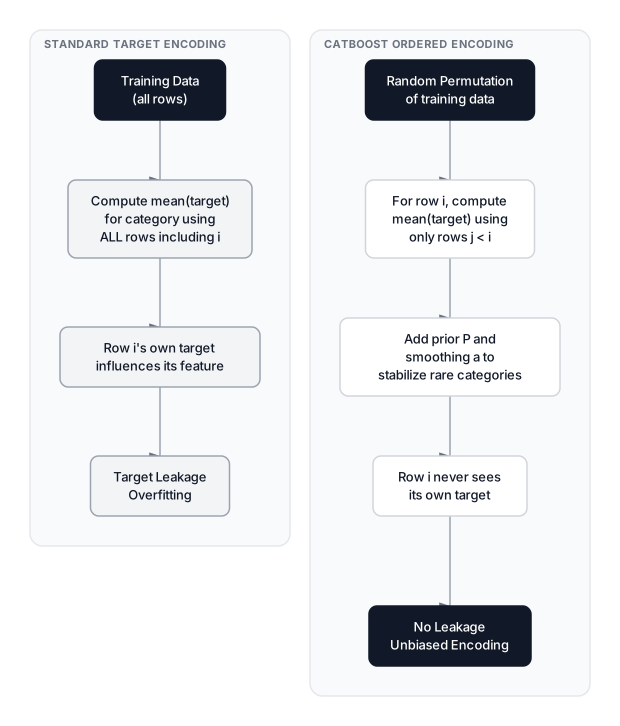 Click to expandStandard target encoding vs CatBoost ordered encoding for categorical features
The CatBoost Formula
CatBoost fixes this by introducing artificial time ordering. Before training, it generates a random permutation of rows. When encoding row for categorical feature , CatBoost computes:
Where:
- is the encoded numerical value assigned to the -th row for the -th categorical feature
- and are the raw category values (e.g., "Chicago") for rows and
- is an indicator that equals 1 when row has the same category as row , and 0 otherwise
- is the target value (churned or not) for row
- is the position of row in the random permutation, so only rows $j < p$ contribute
- is a smoothing parameter (prior weight) that prevents unstable estimates when few prior rows share the category
- is the global prior, typically the overall mean of the target across the entire dataset
In Plain English: Suppose you're encoding city = "Chicago" for the 50th row in the shuffled order. CatBoost looks at only the previous 49 rows, finds every row that also has city = "Chicago", and averages their churn labels. If only 3 Chicago rows appeared before this one and 2 of them churned, the raw average would be 0.667. The smoothing parameter and the global churn rate pull that estimate toward the dataset-wide baseline, preventing a handful of rows from producing a wildly unstable encoding. The current row's own label is never touched.
Why Multiple Permutations Matter
CatBoost doesn't rely on a single random ordering. It generates multiple permutations during training so that the encoded values for each row vary across boosting iterations. This variation acts as a form of data augmentation and makes the model more resistant to overfitting on any single permutation order.
Key Insight: The first row in any permutation has zero prior rows to reference, so its encoding collapses entirely to the prior . The 1,000th row has 999 prior observations and gets a much more precise estimate. This asymmetry is intentional and becomes a strength when averaged across many permutations.
Prediction Shift and Ordered Boosting
Prediction shift is a distribution mismatch between training and test conditions that occurs in all standard gradient boosting implementations, not just those with categorical features. CatBoost addresses it through a mechanism called Ordered Boosting.
The Problem
In standard gradient boosting, the model at iteration computes residuals for every training row using the predictions of a model that was trained on those same rows. The residuals are biased because the model has already memorized patterns in the training data, and those biased residuals are then used to fit the next tree. The distribution of residuals during training shifts away from what the model would see on fresh test data.
Think of it this way with our churn example: the model predicts customer 47's churn probability using a tree ensemble that was partially fitted to customer 47's label. The residual for that customer is artificially small. The next tree sees an optimistic view of how well the model is doing, and the cumulative effect across hundreds of trees is a model that's overconfident on training data.
How Ordered Boosting Fixes It
CatBoost's solution mirrors its approach to categorical encoding: use artificial time ordering. For each permutation:
- To compute the residual for row , CatBoost uses a model trained on only rows $1$ through .
- The prediction for row never includes information from row itself.
- Residuals are computed on data the model hasn't seen during its construction for that specific row.
This is conceptually equivalent to training separate models (one for each row), which would be computationally impossible. CatBoost approximates this efficiently by maintaining a set of supporting models during training and reusing tree structure across them.
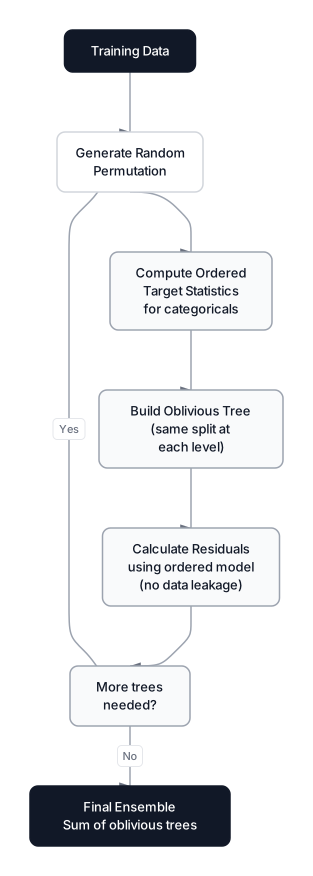 Click to expandCatBoost training pipeline showing ordered boosting flow
Common Pitfall: Many practitioners assume CatBoost is slow because of these permutation-based computations. Training can be slower than LightGBM on large purely numeric datasets, but the time you save by skipping one-hot encoding, manual regularization tuning, and cross-validated target encoding pipelines often makes the end-to-end project timeline shorter.
Oblivious (Symmetric) Trees
Oblivious decision trees, also called symmetric trees, are the default base learner in CatBoost. Unlike standard decision trees where each node can split on a different feature, an oblivious tree applies the same splitting criterion across all nodes at a given depth level.
Structure
At depth 1, the root node might split on tenure_months > 12. At depth 2, both child nodes must split on the same condition, say monthly_charges > 65.0. A standard tree (the kind XGBoost builds) would let the left child split on monthly_charges > 65.0 while the right child splits on subscription_type = Premium. Oblivious trees enforce uniformity.
This means a depth- oblivious tree has exactly leaf nodes, and you can determine which leaf a data point lands in by evaluating binary conditions and assembling them into a -bit binary index. No branching logic required.
Why Symmetry Helps
Regularization. Forcing every node at a given depth to use the same split prevents the tree from carving out narrow decision boundaries that overfit to individual data points. Each split must be globally useful, not just locally optimal for one branch.
Inference speed. Because the split conditions are uniform across each level, the leaf lookup becomes a simple bitwise operation. Modern CPUs can evaluate oblivious trees without branch prediction misses, which is why CatBoost inference is consistently faster than XGBoost and LightGBM inference in production benchmarks. For a depth-6 tree, the lookup is just 6 comparisons combined into a 6-bit index.
Memory efficiency. An oblivious tree of depth stores only split conditions plus leaf values. A standard tree of the same depth could have up to distinct split conditions, roughly doubling the storage.
In Plain English: Picture a standard decision tree as a city with different traffic signs at every intersection. Whether you turn left or right changes which sign you see next. An oblivious tree is like a grid: at the first avenue, everyone checks if tenure_months > 12. At the second avenue, everyone checks if monthly_charges > 65. The rules are the same regardless of your path, which makes navigation (prediction) extremely fast because the CPU never has to guess which branch you'll take.
CatBoost vs XGBoost vs LightGBM
The three dominant gradient boosting frameworks each excel in different scenarios. Here's how they compare on the dimensions that matter most in practice.
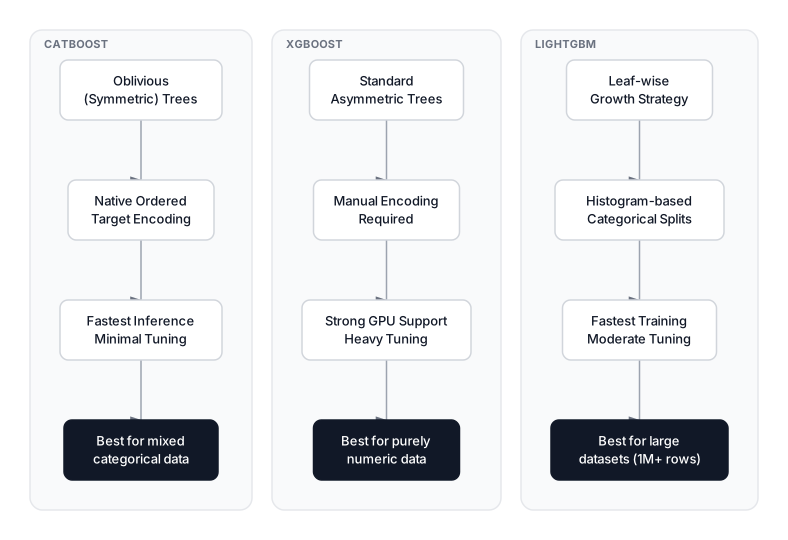 Click to expandComparison of CatBoost, XGBoost, and LightGBM architectures and strengths
| Criterion | CatBoost | XGBoost | LightGBM |
|---|---|---|---|
| Categorical handling | Native ordered encoding | Manual encoding required (limited built-in support since v2.0) | Built-in histogram splits |
| Training speed | Moderate | Fast (strong GPU) | Fastest (leaf-wise growth) |
| Inference speed | Fastest (oblivious trees) | Fast | Fast |
| Default performance | Strong out-of-box | Needs tuning | Needs some tuning |
| Overfitting resistance | Strong (ordered boosting) | Requires careful regularization | Can overfit on small data |
| Best use case | Mixed categorical + numeric data | Purely numeric, competition tuning | Large datasets (1M+ rows), speed-critical |
| Tree structure | Symmetric (oblivious) | Asymmetric (level or leaf-wise) | Asymmetric (leaf-wise) |
| Missing value handling | Native | Native | Native |
| GPU support | CUDA + Apple Metal | CUDA | CUDA |
Key Insight: LightGBM is roughly 7x faster than XGBoost and 2x faster than CatBoost during training, according to benchmarks by neptune.ai. But training speed is only one factor. CatBoost's minimal tuning requirement and native categorical handling often mean you reach a deployable model faster in real project timelines, even if each training run takes longer.
Python Implementation
Let's build a churn classifier with CatBoost. Notice that the categorical columns go directly into the model as raw strings with zero preprocessing. No one-hot encoding, no label encoding, no target encoding pipeline.
Installation
pip install catboost scikit-learn pandas
Building a Churn Classifier
import pandas as pd
import numpy as np
from catboost import CatBoostClassifier, Pool
from sklearn.model_selection import train_test_split
from sklearn.metrics import accuracy_score, classification_report

# Generate synthetic churn data with mixed feature types
np.random.seed(42)
n = 2000

data = pd.DataFrame({
    'subscription_type': np.random.choice(
        ['Basic', 'Premium', 'Enterprise'], n, p=[0.5, 0.35, 0.15]
    ),
    'city': np.random.choice(
        ['Chicago', 'New York', 'San Francisco', 'Austin', 'Seattle',
         'Denver', 'Miami', 'Boston', 'Portland', 'Dallas'], n
    ),
    'payment_method': np.random.choice(
        ['Credit Card', 'PayPal', 'Wire Transfer', 'ACH'], n
    ),
    'tenure_months': np.random.randint(1, 72, n),
    'monthly_charges': np.round(np.random.uniform(20, 150, n), 2)
})

# Create a target with realistic patterns:
# Higher churn for Basic subscribers, short tenure, high charges
churn_prob = (
    0.3
    + 0.2 * (data['subscription_type'] == 'Basic').astype(float)
    - 0.15 * (data['subscription_type'] == 'Enterprise').astype(float)
    - 0.005 * data['tenure_months']
    + 0.002 * data['monthly_charges']
    + np.random.normal(0, 0.1, n)
)
data['churned'] = (churn_prob > 0.35).astype(int)

# Split features and target
X = data.drop('churned', axis=1)
y = data['churned']

X_train, X_test, y_train, y_test = train_test_split(
    X, y, test_size=0.2, random_state=42
)

# Tell CatBoost which columns are categorical
cat_features = ['subscription_type', 'city', 'payment_method']

# Train the model — raw strings go straight in
model = CatBoostClassifier(
    iterations=500,
    learning_rate=0.05,
    depth=6,
    loss_function='Logloss',
    eval_metric='AUC',
    random_seed=42,
    verbose=100
)

model.fit(
    X_train, y_train,
    cat_features=cat_features,
    eval_set=(X_test, y_test),
    early_stopping_rounds=50
)

# Evaluate
preds = model.predict(X_test)
print("\nAccuracy:", accuracy_score(y_test, preds))
print("\nClassification Report:")
print(classification_report(y_test, preds, target_names=['Retained', 'Churned']))
Expected Output:
0:	learn: 0.6773	test: 0.6801	best: 0.6801 (0)	total: 12.5ms	remaining: 6.23s
100:	learn: 0.4532	test: 0.5198	best: 0.5198 (100)	total: 1.1s	remaining: 4.35s
...
bestTest = 0.4823
bestIteration = 287

Accuracy: 0.785

Classification Report:
              precision    recall  f1-score   support

    Retained       0.81      0.82      0.81       220
     Churned       0.75      0.74      0.75       180

    accuracy                           0.79       400
Pro Tip: Notice that strings like "Chicago" and "Credit Card" went directly into model.fit. Try the same with scikit-learn's RandomForestClassifier and you'll get a ValueError. CatBoost's cat_features parameter is all you need to tell the library which columns are categorical.
Feature Importance
# CatBoost provides multiple feature importance methods
feature_importance = model.get_feature_importance()
feature_names = X.columns.tolist()

for name, importance in sorted(
    zip(feature_names, feature_importance),
    key=lambda x: x[1], reverse=True
):
    print(f"  {name:25s} {importance:.2f}")
Expected Output:
  tenure_months             38.42
  monthly_charges           27.15
  subscription_type         18.73
  city                       9.84
  payment_method             5.86
Using CatBoost Pool for Advanced Workflows
The Pool object is CatBoost's native data container. It stores feature data, labels, and metadata (including which columns are categorical) in a single object, which is more efficient than passing DataFrames directly for large datasets.
train_pool = Pool(
    data=X_train,
    label=y_train,
    cat_features=cat_features
)

test_pool = Pool(
    data=X_test,
    label=y_test,
    cat_features=cat_features
)

# Train with Pool objects
model_pool = CatBoostClassifier(
    iterations=500,
    learning_rate=0.05,
    depth=6,
    loss_function='Logloss',
    random_seed=42,
    verbose=0  # silent training
)

model_pool.fit(train_pool, eval_set=test_pool, early_stopping_rounds=50)
print("Pool-based accuracy:", accuracy_score(y_test, model_pool.predict(X_test)))
Hyperparameter Tuning
CatBoost is well-known for its strong defaults. Many practitioners report competitive results without any tuning at all. But when you need to squeeze out more performance, these are the parameters that matter most.
| Parameter | Default | Recommended Range | Effect |
|---|---|---|---|
learning_rate | Auto (depends on iterations) | 0.01 - 0.3 | Step size per tree. Lower values need more iterations but generalize better |
depth | 6 | 4 - 10 | Tree depth. Deeper = more complex. Keep at 4-8 for most tasks |
iterations | 1000 | 100 - 5000 | Number of trees. Always use with early_stopping_rounds |
l2_leaf_reg | 3.0 | 1 - 10 | L2 regularization on leaf values. Increase to reduce overfitting |
border_count | 254 | 32 - 255 | Number of splits considered per feature. Lower = faster, slightly less accurate |
one_hot_max_size | 2 | 2 - 25 | Categories with fewer unique values than this get one-hot encoded instead of ordered target stats |
random_strength | 1.0 | 0 - 10 | Amount of randomness added to feature scores during splits. Higher = more regularization |
bagging_temperature | 1.0 | 0 - 10 | Controls intensity of Bayesian bootstrap. Higher = more diverse trees |
Practical Tuning Strategy
Start with CatBoost's defaults and add early_stopping_rounds=50. If you're overfitting (training loss much lower than validation loss), increase l2_leaf_reg and reduce depth. If you're underfitting, increase depth and iterations.
For serious hyperparameter optimization, CatBoost integrates with Optuna:
import optuna
from catboost import CatBoostClassifier

def objective(trial):
    params = {
        'iterations': 1000,
        'learning_rate': trial.suggest_float('learning_rate', 0.01, 0.3, log=True),
        'depth': trial.suggest_int('depth', 4, 10),
        'l2_leaf_reg': trial.suggest_float('l2_leaf_reg', 1, 10),
        'border_count': trial.suggest_int('border_count', 32, 255),
        'random_strength': trial.suggest_float('random_strength', 0, 10),
        'bagging_temperature': trial.suggest_float('bagging_temperature', 0, 10),
        'random_seed': 42,
        'verbose': 0,
        'loss_function': 'Logloss',
        'eval_metric': 'AUC'
    }

    model = CatBoostClassifier(**params)
    model.fit(
        train_pool,
        eval_set=test_pool,
        early_stopping_rounds=50
    )
    return model.get_best_score()['validation']['AUC']

study = optuna.create_study(direction='maximize')
study.optimize(objective, n_trials=50)

print(f"Best AUC: {study.best_value:.4f}")
print(f"Best params: {study.best_params}")
Handling Missing Values
CatBoost handles NaN values natively with no imputation required:
- Numeric features: Missing values are treated as a special split condition. CatBoost learns the optimal direction for missing values at each tree node (configurable via the
nan_modeparameter:Min,Max, orForbidden). - Categorical features: Missing values are treated as a distinct category, which then gets its own target statistic encoding.
Common Pitfall: Don't impute missing values before passing data to CatBoost. The library's native missing-value handling often outperforms manual imputation strategies because it can learn when missingness itself is informative (e.g., customers who don't fill in a "city" field may have different churn patterns than those who do).
When to Use CatBoost (and When Not To)
No algorithm is the right choice for every problem. Here's a practical decision framework.
Choose CatBoost When
- Your data has categorical features. This is CatBoost's core strength. If you have columns with string values, high-cardinality identifiers, or mixed feature types, CatBoost will save you significant preprocessing work and likely produce better results.
- You want minimal tuning. CatBoost's defaults are competitive out of the box. If you're building a baseline model quickly or don't have time for extensive hyperparameter search, CatBoost is a strong choice.
- Inference latency matters. Oblivious trees give CatBoost the fastest prediction speed among the Big Three boosting libraries. For real-time serving where every millisecond counts, this matters.
- Your dataset is small to medium. CatBoost's ordered boosting and built-in regularization make it particularly resistant to overfitting on datasets with fewer than 100K rows.
Choose Something Else When
- Training speed is the bottleneck and data is purely numeric. LightGBM trains roughly 2x faster than CatBoost on numeric-only datasets. If you're iterating rapidly on a 10M-row dataset with no categorical features, LightGBM will save meaningful time.
- You need maximum fine-grained control. XGBoost offers more tuning knobs and tree construction options (level-wise, leaf-wise, histogram-based). For competition settings where you need to control every aspect of the model, XGBoost gives you more flexibility.
- You're working with image, text, or sequential data. Gradient boosting (any flavor) is designed for tabular data. For images, text, or time-series with complex temporal patterns, deep learning models are the right tool.
- Interpretability is paramount. While CatBoost provides SHAP values and feature importance, a single decision tree or logistic regression model will always be more interpretable than an ensemble of hundreds of trees.
Production Considerations
Training Complexity
CatBoost's training time scales as where is the number of samples, is the tree depth, and is the number of trees. Ordered boosting adds a constant-factor overhead compared to standard boosting (roughly 1.5-2x), but this is mitigated by GPU acceleration.
| Dataset Size | CPU Training | GPU Training | Notes |
|---|---|---|---|
| 10K rows | ~5 seconds | ~3 seconds | GPU overhead makes it comparable to CPU |
| 100K rows | ~30 seconds | ~8 seconds | GPU starts to shine |
| 1M rows | ~5 minutes | ~45 seconds | GPU strongly recommended |
| 10M rows | ~50 minutes | ~6 minutes | Use task_type='GPU' with devices='0' |
Inference Speed
Oblivious trees make CatBoost's inference the fastest among boosting libraries. A depth-6 tree ensemble with 500 trees processes a single row in microseconds. For batch prediction on 1M rows, expect ~200ms on CPU.
Memory
CatBoost stores the training dataset in an optimized format. Memory usage is roughly 2-4x the raw data size during training. For a 1M-row dataset with 20 features, expect 500MB to 1GB of memory usage. The trained model itself is compact: a 500-tree depth-6 model is typically under 10MB on disk.
GPU Training
Enable GPU training with a single parameter:
model = CatBoostClassifier(
    task_type='GPU',
    devices='0',  # GPU device ID
    iterations=1000,
    depth=8,
    verbose=100
)
CatBoost supports CUDA (NVIDIA) and Apple Metal (M-series chips). GPU training is most beneficial for datasets above 100K rows and tree depths of 6 or more.
Model Export and Serving
CatBoost models can be exported in multiple formats for production serving:
# Save as CatBoost native format
model.save_model('churn_model.cbm')

# Export as ONNX for cross-platform serving
model.save_model('churn_model.onnx', format='onnx')

# Export as Apple CoreML for iOS/macOS apps
model.save_model('churn_model.mlmodel', format='coreml')

# Export as C++ code for embedding in applications
model.save_model('churn_model.cpp', format='cpp')
When CatBoost Is the Better Choice
CatBoost solves two problems that have plagued gradient boosting since its inception: target leakage in categorical encoding and prediction shift in residual computation. Ordered Target Statistics and Ordered Boosting address both with the same conceptual tool, using artificial time ordering to ensure that each data point's feature values and error signals are computed without access to its own label. The result is a model that genuinely generalizes better on datasets with categorical features, not just one that memorizes the training set more creatively.
The practical payoff is equally significant. Where a traditional pipeline might chain together categorical encoding, cross-validated target encoding, and careful regularization tuning, CatBoost collapses that entire workflow into a single model.fit call with a cat_features parameter. For the churn prediction task we've followed throughout this article, that means going from raw strings and mixed-type DataFrames to a tuned classifier in under 20 lines of code.
CatBoost isn't a universal solution. LightGBM still trains faster on large numeric datasets, and XGBoost for regression remains the go-to for fine-grained competition tuning. But for the kind of messy, mixed-type datasets that show up in actual business environments, where half the columns are categorical and nobody has time for elaborate preprocessing, CatBoost consistently delivers the best results with the least effort. Start with the defaults. Point it at your raw data. You'll likely be surprised.
Frequently Asked Interview Questions
Q: What problem does CatBoost's Ordered Target Statistics solve that standard target encoding doesn't?
Standard target encoding computes the mean target for each category using all rows, including the current row. This creates target leakage because each row's feature value is influenced by its own label. CatBoost's ordered approach uses a random permutation and only computes the encoding from rows that appear before the current row in that permutation. This eliminates the circular dependency and produces encodings that generalize to unseen data.
Q: What is prediction shift in gradient boosting, and how does CatBoost address it?
Prediction shift occurs when the residuals computed during training come from a model that was trained on the very same data points. The residuals are then biased because the model has partially memorized those points, and subsequent trees fit to artificially optimistic error estimates. CatBoost's Ordered Boosting computes the residual for each row using a model trained on only the preceding rows in a random permutation, ensuring the residual is computed on effectively "unseen" data.
Q: Why does CatBoost use oblivious (symmetric) trees instead of standard decision trees?
Oblivious trees apply the same split condition at all nodes of a given depth level, creating a perfectly balanced structure. This provides three benefits: stronger regularization (each split must be globally useful), faster inference (leaf lookup becomes a bitwise operation with no branch prediction misses), and lower memory usage (only split conditions for depth , versus up to in an asymmetric tree).
Q: When would you choose CatBoost over XGBoost or LightGBM?
CatBoost is the strongest choice when the dataset contains categorical features that would otherwise require manual encoding, when you need fast inference in production, or when you want competitive performance with minimal hyperparameter tuning. LightGBM is better for very large numeric-only datasets where training speed matters. XGBoost offers more fine-grained control for competition settings.
Q: How does CatBoost handle missing values differently from manual imputation?
CatBoost treats missing values as a native split condition rather than requiring imputation. For numeric features, it learns the optimal direction for missing values at each tree node. For categorical features, it treats missingness as a separate category with its own target statistic. This often outperforms manual imputation because the model can learn when the pattern of missingness is itself predictive.
Q: What is the computational overhead of Ordered Boosting compared to standard gradient boosting?
Ordered Boosting is roughly 1.5-2x slower per iteration than standard gradient boosting because CatBoost maintains multiple supporting models to approximate the sequential training process. However, the improved generalization often means you need fewer trees to reach the same validation performance, and GPU acceleration (CUDA or Apple Metal) largely offsets the overhead for datasets above 100K rows.
Q: A colleague suggests one-hot encoding all categorical features before feeding them to CatBoost. Is this a good idea?
Generally, no. One-hot encoding high-cardinality features creates sparse matrices that increase memory usage and training time. CatBoost's native ordered target statistics are specifically designed to handle categorical features more efficiently and with less overfitting than one-hot encoding. The exception is very low-cardinality features (2-3 unique values) where one-hot encoding is fast and CatBoost will do it automatically based on the one_hot_max_size parameter. You would be better off letting CatBoost decide how to handle each feature based on its cardinality.