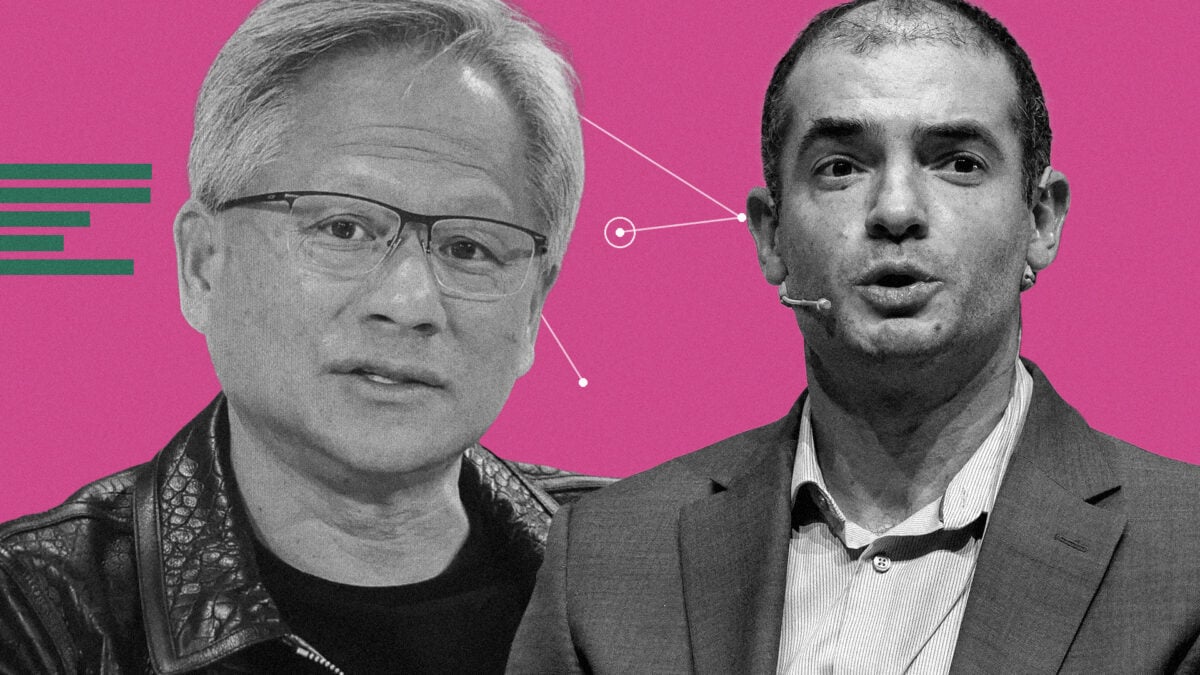
Nvidia and SK Group Formalize $500 Billion AI Partnership

Nvidia and South Korea's SK Group signed letters of intent on July 24 in San Francisco for an AI infrastructure partnership valued at more than $500 billion over multiple years. CNBC reports the agreement includes SK Hynix high-bandwidth-memory supply and co-development, while SK Telecom is targeting a 2-gigawatt cloud buildout using Nvidia Vera Rubin systems, with the first facility expected in 2027.
Nvidia and SK Group signed letters of intent in San Francisco for a multi-year AI infrastructure relationship valued at more than $500 billion, according to CNBC and Tom's Hardware. The announcement came during South Korean President Lee Jae Myung's July 24 meetings with Nvidia CEO Jensen Huang and other Silicon Valley executives.
The disclosed arrangement combines memory supply, hardware deployment and data-center development. CNBC reports that Nvidia secured high-bandwidth memory supply from SK Hynix and agreed to co-develop next-generation AI memory. Raj Mirpuri, Nvidia's enterprise vice president, said on a call with reporters that the co-development opportunity would help Nvidia secure a stable HBM supply.
A 2-gigawatt AI data-center target
SK Telecom, an SK Hynix affiliate, is targeting a cloud business built on Nvidia's Vera Rubin systems. Nvidia told CNBC that the planned capacity would require 2 gigawatts of power, a scale that implies hundreds of thousands of GPUs. The first facility is expected to enter service in 2027, according to CNBC and Tom's Hardware.
Tom's Hardware reports that the proposed South Korean deployment is intended to use Nvidia's DSX AI factory platform, Vera Rubin accelerated systems and SK Hynix HBM4 memory. The companies described potential uses spanning sovereign AI, enterprise AI, physical AI and agentic AI across South Korea and the Asia-Pacific region.
The $500 billion figure represents the stated value of a broad intended relationship rather than a disclosed single purchase order. Tom's Hardware noted that the public announcement provided limited detail on the calculation behind the valuation. That distinction matters for infrastructure buyers and suppliers assessing near-term demand signals versus longer-term capacity commitments.
Memory becomes a central constraint
Nvidia's agreement with SK Hynix arrives as high-bandwidth memory has become a critical input for accelerated AI systems. CNBC reports that Nvidia is seeking to lock down HBM supply amid a global memory shortage, and identifies SK Hynix as the leading HBM producer according to analysts cited by the outlet.
The broader industry pattern is that AI infrastructure commitments increasingly bind together compute, memory, electricity and physical data-center capacity. For ML platform teams, this makes memory bandwidth and supply availability first-order deployment considerations alongside GPU availability, networking and power. The announced 2027 timetable also underscores the long lead times involved in building large AI clusters.
Separately, CNBC reports that Samsung Electronics signed a memorandum of understanding with Broadcom, estimated by Samsung at $200 billion, covering expanded work in memory and foundry technologies.
Key Points
- 1Nvidia and SK Group's intended $500 billion relationship combines HBM supply, GPU systems and data-center capacity, tying core AI infrastructure layers together.
- 2SK Telecom's 2-gigawatt target illustrates how frontier-scale AI deployments increasingly depend on power availability alongside accelerators and memory.
- 3The disclosed valuation lacks a detailed breakdown, so practitioners should distinguish announced long-term relationships from immediate hardware procurement commitments.
Scoring Rationale
The agreement links a leading AI accelerator supplier with a major HBM producer and a proposed 2-gigawatt cloud deployment. Its stated value is unusually large, though the letters of intent and limited disclosure on the valuation reduce certainty about near-term procurement volumes.
Sources
Public references used for this report.
Practice interview problems based on real data
1,625 SQL & Python problems across 15 industry datasets — the exact type of data you work with.
Try 250 free problems