
Delhi High Court Suggests Fresh Plea on Protest Surveillance
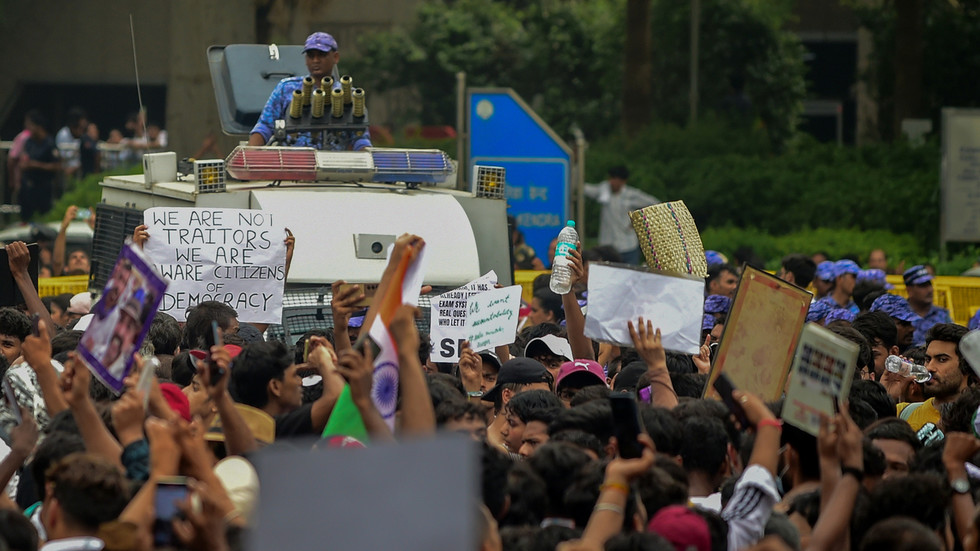
At a July 28 hearing, the Delhi High Court orally suggested that Aishe Ghosh examine existing statutory provisions, police procedures and India's data-protection law before deciding whether to file a broader challenge to surveillance of Jantar Mantar protesters. The court did not resolve whether the monitoring was lawful or order data deletion. Reporting and civil-liberties records describe live facial recognition and CCTV, while Delhi Police says the deployment served law-and-order purposes.
At a July 28 hearing, the Delhi High Court orally suggested that former Jawaharlal Nehru University Students' Union president Aishe Ghosh examine the existing legal framework, including statutory provisions, police standard operating procedures and India's data-protection law, before deciding whether to file a broader challenge to protest surveillance.
The court did not decide whether the monitoring at New Delhi's Jantar Mantar was lawful, and the retrieved reporting did not identify an order requiring deletion of collected data. The hearing therefore narrowed the immediate outcome: the bench pointed toward a better-framed challenge rather than resolving the constitutional and data-governance questions in the current petition.
What the petition challenged
Ghosh's petition alleged continuous photography, videography and monitoring of student protesters who had gathered over examination irregularities. It asked for disclosure of the legal authority, purpose, scope, retention policy and data-sharing rules behind the collection, along with deletion of data that was not tied to a specific offence.
The government argued during the proceedings that recording demonstrations is a routine public-order measure. The petition, by contrast, said persistent monitoring without disclosed safeguards could chill speech and peaceful assembly. Those positions remain allegations and legal arguments; the July 28 hearing did not settle them.
What reporting documented at the site
The Indian Express reported two surveillance vehicles near Jantar Mantar. A Mobile Command and Control Vehicle displayed live CCTV feeds, while an eight-camera van called Ikshana provided a 360-degree view. The outlet observed footage being processed by facial-recognition software that drew boxes around detected faces and compared them with images in police databases.
Delhi Police said the system was intended to maintain law and order and identify known criminals. The force did not publicly detail the database's size or composition, the system's accuracy at the protest site or the procedure followed after a possible match. Reporting about other devices did not establish that every tool discussed online was deployed in this operation, so this article does not treat those claims as confirmed.
The unresolved safeguard questions
The Internet Freedom Foundation said its earlier right-to-information work found no specific Delhi Police rule governing facial recognition, no privacy impact assessment and an 80% similarity threshold for a positive match. On July 24, it asked the police commissioner to halt live facial recognition at peaceful assemblies, delete unrelated biometric data and publish the governing procedures. IFF is an advocacy party in the dispute, so those requests are attributed to the organization rather than presented as a court finding.
For data and ML teams, the case highlights the controls that become material when biometric systems move into public operations: a documented legal purpose, disclosed reference databases, validated thresholds, human review, access logs, retention limits, deletion procedures and a process for challenging false matches. The court has not yet prescribed those controls in this matter, but the dispute shows the evidence a deployment may need when its legality and proportionality are challenged.
Key Points
- 1On July 28, the Delhi High Court orally suggested examining existing law and police procedures before deciding whether to file a broader surveillance challenge.
- 2The hearing did not determine whether the Jantar Mantar monitoring was lawful and did not produce a reported data-deletion order.
- 3Fresh reporting documented CCTV and live facial recognition in two police vehicles, while database scope, accuracy, retention and match procedures remained undisclosed.
Scoring Rationale
The case puts live facial recognition, biometric-data retention and protest monitoring before a major court, making it relevant to AI-governance and public-sector data teams. Its immediate impact remains limited because the July 28 hearing produced an oral suggestion to consider a broader plea, not a merits ruling or nationwide regulatory change.
Sources
Public references used for this report.
Practice interview problems based on real data
1,625 SQL & Python problems across 15 industry datasets — the exact type of data you work with.
Try 250 free problems

