Microsoft Previews Azure API Management AI Gateway Tier
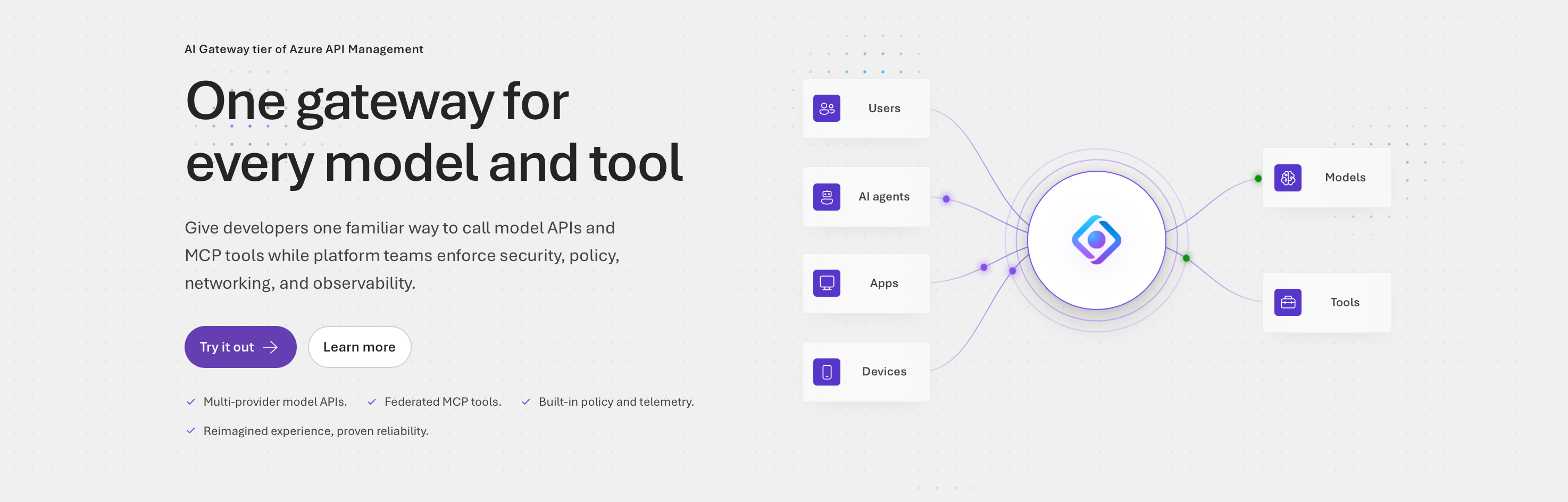
Microsoft announced the AI Gateway tier of Azure API Management in public preview on July 27, providing a dedicated control plane for publishing and governing models, MCP servers, and tools. According to Microsoft's Azure Integration Services blog, the tier uses portal policy cards rather than XML expressions and supports model backends across Microsoft Foundry, AWS Bedrock, Google Vertex AI, OpenAI, and Anthropic.
Microsoft has released the AI Gateway tier of Azure API Management in public preview, introducing a dedicated gateway resource whose control plane is organized around AI models, Model Context Protocol (MCP) servers, and tools rather than conventional APIs.
Microsoft announced the preview on July 27 through its Azure Integration Services blog. The company describes the tier as an AI-focused experience for platform teams that need to publish and govern models and MCP servers. Existing Azure API Management tiers retain their AI gateway capabilities, while the new tier is a separate experience aimed at AI workloads, according to the announcement.
Model and tool governance
The preview supports models hosted through Microsoft Foundry, including OpenAI, Anthropic, Mistral, and other Foundry-hosted options. Microsoft also lists AWS Bedrock, Google Vertex AI, OpenAI, and Anthropic as supported model sources. InfoQ reports that OpenAI-compatible providers share one endpoint path, with request routing based on an exact match of the model field; published models therefore require unique names. Anthropic support uses a custom provider with Messages API passthrough, according to InfoQ.
Rather than configuring policies through the XML and expression-based approach familiar to API Management users, AI Gateway presents policy cards in the portal. Microsoft and InfoQ list controls covering token and request limits, quotas, content safety, and model fallback. The resource runs in a customer's Azure subscription, uses its Entra tenant, and exports telemetry to destinations controlled by that customer, Microsoft states.
For MCP and other tool backends, InfoQ reports that the gateway can federate a remote MCP server specified by URL, an OpenAPI specification, or a built-in connector. Each backend operation can be exposed as a tool. Available authentication options include no authentication, API keys, OAuth 2.0, and managed identities.
Operational model for platform teams
Microsoft describes a shared operating model in which a central platform group connects approved models and tools, publishes them, and maintains shared guardrails. Application teams can test published assets through a test console and create named runtime keys to call the gateway, according to the company.
The broader Azure API Management documentation frames AI gateway functions around securing, scaling, monitoring, and governing model, agent, and tool backends. It also identifies authentication, authorization, load balancing, logging, token-usage management, and quotas as common gateway functions across AI workloads.
For engineering organizations using several model providers, a gateway layer can reduce integration variance by centralizing provider-specific routing, identity controls, observability, and policy enforcement. Comparable multi-provider deployments still require careful evaluation of API-schema compatibility, model naming conventions, telemetry retention, and the behavior of fallback routes under quota or availability constraints.
Microsoft's public preview comes as MCP adoption expands the set of services that AI applications can invoke. In that environment, a centralized catalog and access-control layer can help platform teams apply conventional API-management disciplines to tool access, while application teams retain a self-service path to approved model and tool endpoints.
Key Points
- 1Microsoft's preview adds an AI-specific Azure API Management tier for governing models, MCP servers, and tools through a dedicated control plane.
- 2The gateway supports multiple provider backends, centralizing routing, quotas, token controls, and observability for teams operating heterogeneous model stacks.
- 3As MCP tool use expands, comparable platform architectures commonly require centralized authentication, cataloging, policy enforcement, and audit-ready telemetry.
Scoring Rationale
This is a notable enterprise AI platform release for teams building governed, multi-provider model and MCP integrations on Azure. Its relevance is strongest for platform engineers and ML infrastructure teams that need centralized policy, telemetry, identity, and tool-access controls.
Sources
Primary source and supporting public references used for this report.
Practice interview problems based on real data
1,625 SQL & Python problems across 15 industry datasets — the exact type of data you work with.
Try 250 free problems