DeepTimeGate improves optical imaging through scattering media
Researchers led by UCLA and the University of Rochester published DeepTimeGate on July 21, a two-stage machine-learning system for reconstructing images captured through scattering media. In laboratory tests, it improved average peak signal-to-noise ratio by 124% over raw time-gated inputs while removing edge darkening, but the authors say biological-sample validation is still future work.
Researchers led by UCLA and the University of Rochester published DeepTimeGate in *Light: Science & Applications* on July 21. The system combines an optical method for filtering scattered light with a two-stage machine-learning pipeline that reconstructs the captured image.
What the system does
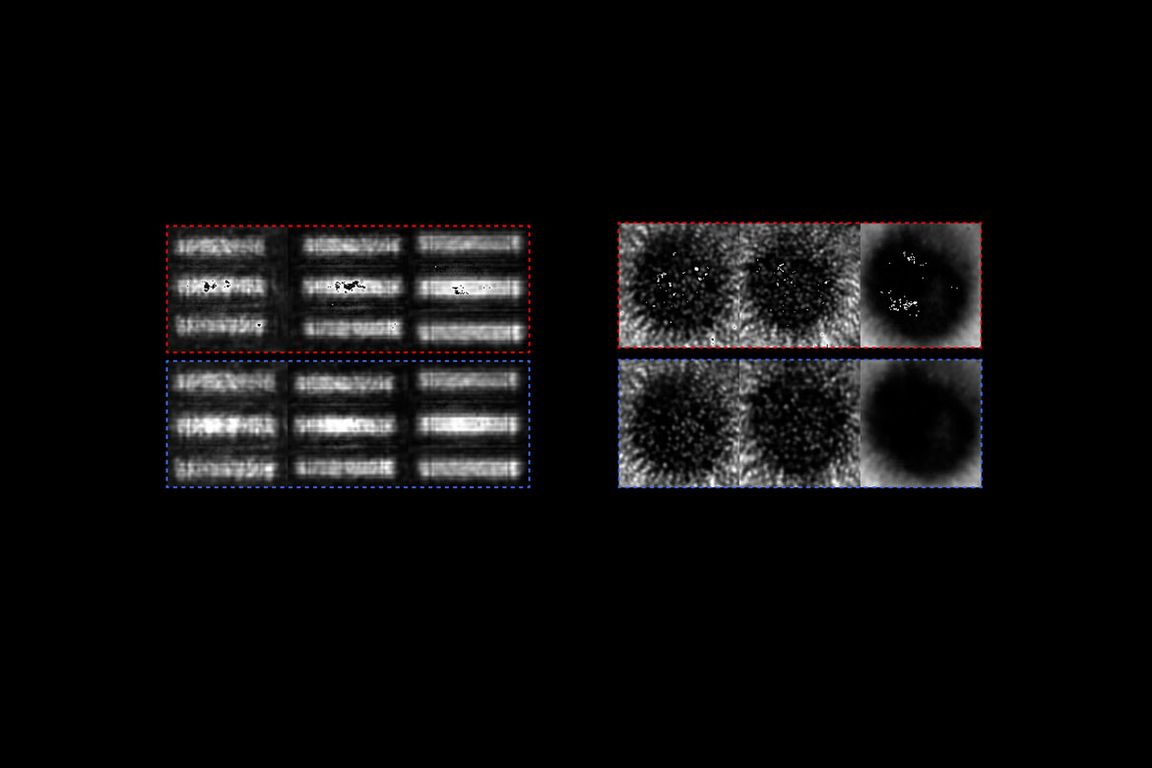
The experimental setup sends an infrared image through a scattering medium, then uses four-wave mixing in a thin indium tin oxide film to convert selected light into a visible signal that a conventional CMOS camera can record. A supervised U-Net first produces a coarse reconstruction. A lightweight Deep Image Prior module then refines that output using a self-consistency constraint intended to suppress speckle and repair fine detail.
The researchers evaluated the system on standard resolution charts and vortex-phase patterns under six scattering conditions. Compared with the raw four-wave-mixing inputs, the paper reports average gains of 124% in peak signal-to-noise ratio, 231% in structural similarity and tenfold in intersection-over-union. It also reports that the combined pipeline removed the vignetting, or edge darkening, that limited the usable field of view.
Where the evidence is strongest
The clearest result is a proof of concept for computational reconstruction in the team's controlled optical setup. The paper also compares DeepTimeGate with several neural baselines: its reported PSNR matched Attention U-Net at 31.8 dB, while training took 6.18 hours rather than 9.64 hours. The residual-refinement stage reduced the reported speckle artifact ratio to 0.16%.
Those measurements do not yet show clinical performance or road-ready sensing. The experiments used calibration patterns, polystyrene suspensions and optical diffusers rather than tissue, patients, rain or fog encountered by a vehicle. The authors explicitly identify tests on live cells, tissue sections and organoids as future work.
Why it matters
For data-science and imaging teams, DeepTimeGate is a concrete example of a hybrid system in which the measurement physics and the learned reconstruction model are designed together. That can be more defensible than treating image restoration as a generic denoising task, because the second stage is constrained by the acquired signal.
Potential uses include lower-cost biomedical imaging, fluid diagnostics and sensing in poor visibility, but those remain proposed applications. Reproducibility is helped by the paper's open code and dataset deposit; the next meaningful test is whether the reported gains hold on real biological samples and across independent optical setups.
Key Points
- 1DeepTimeGate combines a supervised U-Net with a self-supervised Deep Image Prior refinement stage.
- 2The paper reports a 124% average PSNR gain over raw time-gated inputs and removal of vignetting in controlled tests.
- 3Clinical imaging and autonomous-vehicle sensing remain potential applications, not validated deployments.
Scoring Rationale
A peer-reviewed hybrid optical and machine-learning method reports substantial reconstruction gains and releases data and code, but validation is limited to controlled targets and scattering media rather than biological or deployed sensing conditions.
Sources
Primary source and supporting public references used for this report.
Practice with real Health & Insurance data
90 SQL & Python problems · 15 industry datasets
250 free problems · No credit card
See all Health & Insurance problems