GitHub rolls out Gemini 3.6 Flash across Copilot
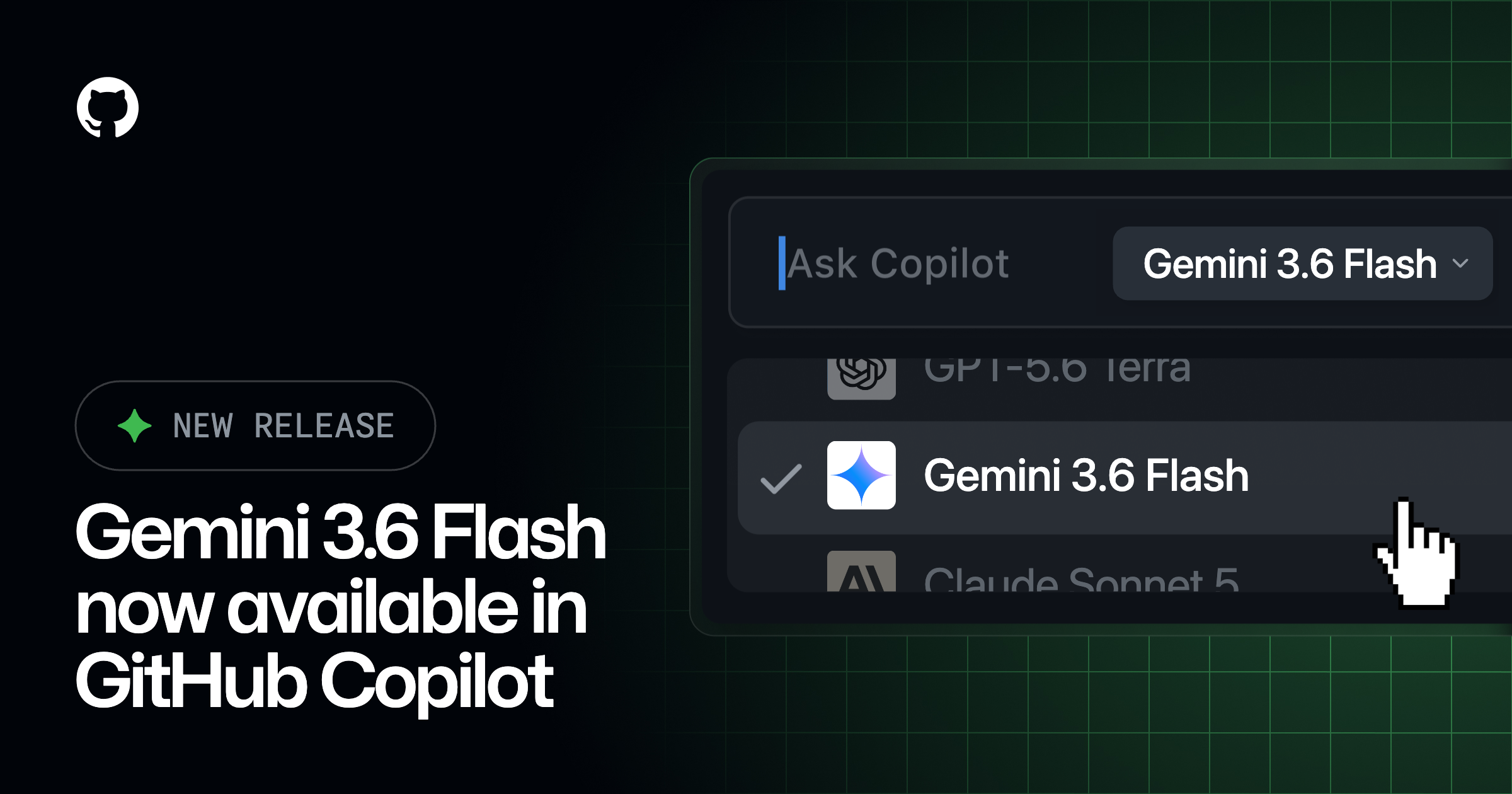
GitHub began a gradual rollout of Google's Gemini 3.6 Flash to Copilot on July 21, 2026, covering paid individual and business plans across major editors, the CLI, the cloud agent and the Copilot app. Business and Enterprise administrators must enable a preview policy before members can select it, while GitHub bills usage at provider list pricing.
GitHub began rolling out Google's Gemini 3.6 Flash model across GitHub Copilot on July 21, 2026. The release adds another model choice for paid Copilot users, but availability is gradual and organizations have an extra administrative gate.
Where the model is available
GitHub says Gemini 3.6 Flash will be offered to Copilot Pro, Pro+, Max, Business and Enterprise users. The model picker will expose it in Visual Studio Code, Visual Studio, Copilot CLI, GitHub's cloud agent and Copilot app, as well as JetBrains IDEs, Xcode and Eclipse. Accounts may not see it immediately because the rollout is staged.
For Copilot Business and Enterprise, administrators must first enable the Gemini 3.6 Flash Preview policy. GitHub also says use of the model is billed at provider list pricing under its usage-based billing system, so model access and actual consumption costs are separate questions for teams planning a rollout.
The performance claim is still vendor evidence
GitHub reports that its early testing found higher task-completion rates and better token efficiency than Gemini 3.5 Flash for coding and agentic workflows. Google separately launched Gemini 3.6 Flash the same day and described improvements in coding, knowledge work and token efficiency, including 17% fewer output tokens than 3.5 Flash on the Artificial Analysis Index. Those figures describe vendor or cited benchmark results, not an independent evaluation of the model inside each Copilot surface.
An independent QA-focused report corroborated the Copilot rollout, eligible plans, supported tools and administrator policy. It did not provide new comparative benchmark results.
What teams should measure
The practical change is broader access to a faster Flash-class model within the Copilot interfaces teams already use. LDS interpretation: before making it a default, teams should compare it with their current model on a fixed set of repository tasks and track accepted changes, test results, completion rate, latency and AI-credit cost. Copilot's prompts, tools and context layer can materially affect results, so Gemini API benchmarks should not be treated as a guarantee of Copilot performance.
Key Points
- 1Gemini 3.6 Flash is rolling out gradually to Copilot Pro, Pro+, Max, Business and Enterprise across major editors, the CLI, cloud agent and Copilot app.
- 2Business and Enterprise administrators must enable the Gemini 3.6 Flash Preview policy before organization members can select the model.
- 3GitHub's task-completion and token-efficiency comparisons are early vendor results; teams still need workload-specific evaluation inside Copilot.
Scoring Rationale
The rollout adds a current Google model across widely used Copilot surfaces and affects both individual and enterprise workflows. Its practical impact is meaningful but bounded by gradual availability, administrator policy controls, usage-based billing and the absence of independent Copilot performance results.
Sources
Primary source and supporting public references used for this report.
Practice with real Ad Tech data
90 SQL & Python problems · 15 industry datasets
250 free problems · No credit card
See all Ad Tech problems