Book Teaches AI-Driven HTML and CSS Workflows
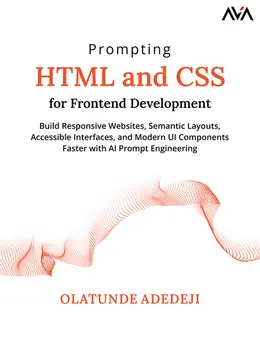
Prompting HTML and CSS for Frontend Development is a new practitioner guide by Olatunde Adedeji that teaches AI-assisted frontend workflows. According to Google Books, the title was published by Orange Education Pvt. Ltd. on May 30, 2026 and is listed at 287 pages on that platform. The book describes an end-to-end prompt-driven workflow, including semantic HTML, responsive CSS, reusable UI components, accessibility checks, and deployment via GitHub and Vercel, per the Google Books listing. Google Books also notes the book teaches prompt-engineering techniques to identify AI hallucinations and refine code for production. The edition is available from multiple retailers, including Amazon, which lists a price of $39.95, and VitalSource, which carries digital licences and the print ISBN 9789349887459.
What happened
Prompting HTML and CSS for Frontend Development is a practitioner-oriented book by Olatunde Adedeji published by Orange Education Pvt. Ltd. According to Google Books, the title was published on May 30, 2026 and is listed at 287 pages; VitalSource and other retailer pages list the print ISBN 9789349887459. Retail listings show the book as available in paperback and digital formats, and Amazon lists a retail price of $39.95.
Technical details
Per the publisher and the Google Books description, the book concentrates on using AI prompt engineering to produce clean, semantic HTML and responsive CSS, and on assembling reusable UI components such as navigation bars, modals, and forms. Google Books highlights practical outcomes including building accessible interfaces, deploying sites with GitHub and Vercel workflows, and creating a personalised prompt library. The listing also states the book covers prompt techniques to detect and correct AI hallucinations so generated code meets production standards.
Editorial analysis - technical context
Industry observers increasingly treat prompt engineering as an operational skill rather than a research topic, especially for developer-facing tasks. For practitioners: documenting patterns for translating natural-language intent into semantic markup, as this book attempts, matches a broader trend where teams codify prompt templates, verification checks, and deployment automation to reduce iteration time. Books and guides that couple prompt patterns with CI/CD primitives such as GitHub and Vercel reflect a practical approach to moving generated UI code closer to shipping quality.
Context and significance
educational resources that focus on AI-assisted development workflows are proliferating across publishers and learning platforms. The presence of this title on multiple retail channels, and its stated emphasis on production-readiness and hallucination correction, places it in the category of applied how-to references rather than theoretical introductions. For front-end engineers and designers exploring AI integration, compact operational guides that merge prompt patterns with accessibility and responsive design checks have immediate utility, even though they do not introduce new models or APIs.
What to watch
For practitioners
whether the book publishes example prompt libraries, test harnesses, or companion repositories on GitHub will determine its practical reuse value. Observers should watch for community forks or adaptations of the book's prompt templates, and for any supplemental materials that demonstrate end-to-end deployment with modern hosting platforms. Industry context: as models and tooling evolve, the shelf life of prompt patterns depends on how tied they are to specific API behaviors; durable guides pair prompts with verification strategies rather than relying solely on one model's outputs.
Bottom line
The book is a practical, market-facing manual that packages prompt engineering into standard frontend tasks. Reported by Google Books, VitalSource, and retailer listings, the title targets practitioners who want hands-on, production-focused techniques for using AI to accelerate HTML and CSS development.
Key Points
- 1Practical handbook codifies AI prompt patterns into frontend tasks, helping engineers translate intent into semantic HTML and responsive CSS.
- 2Emphasis on hallucination detection and production-ready deployment reduces risk when integrating generated UI code into GitHub and Vercel workflows.
- 3Availability across retailers and digital platforms signals demand for applied AI tooling guides rather than new model research.
Scoring Rationale
A book-listing announcement covering a retail publication on AI-assisted HTML and CSS workflows. The topic has niche relevance to practitioners adopting AI coding tools, but the event is a product listing rather than original journalism, and coverage is limited to retail book platforms (Google Books, Amazon, VitalSource). Score reflects minor scope relative to tool launches or research advances.
Sources
Public references used for this report.

Practice interview problems based on real data
1,625 SQL & Python problems across 15 industry datasets — the exact type of data you work with.
Try 250 free problems