
Training a deep neural network from scratch on 200 labeled images of manufacturing defects is a losing battle. Too many parameters, too little data, no prior understanding of edges, textures, or shapes. Yet swap in a ResNet pretrained on ImageNet's 14 million images, replace the final classification head, and train for 20 minutes on a single GPU? You'll hit 94% accuracy before lunch. That gap is the entire promise of transfer learning.
Transfer learning reuses knowledge from one task (the source) to improve performance on a different but related task (the target). Deep networks learn hierarchical features: early layers capture universal patterns like edges and color gradients, middle layers recognize textures and object parts, and final layers compose task-specific concepts. Those universal features transfer remarkably well across domains. As of March 2026, transfer learning is the default starting point. The Hugging Face Hub hosts over 2 million pretrained models, PyTorch 2.10 ships with dozens of ImageNet-pretrained architectures, and the Transformers library (v5.x) makes fine-tuning a three-line operation. Training from scratch has become the exception.
Why Transfer Learning Works
Transfer learning succeeds because of feature reuse. Neural networks trained on large datasets learn representations that generalize far beyond their original training task.
A convolutional neural network trained on ImageNet develops a layered understanding of visual information. Early convolutional layers detect edges at various orientations. Middle layers combine edges into textures (fur, metal, fabric) and parts (wheels, eyes, handles). Only the final layers learn to distinguish "golden retriever" from "labrador retriever." When you transfer this network to classify manufacturing defects, those edge detectors and texture recognizers remain just as useful. You're starting from millions of images worth of visual understanding.
The same principle applies to language. Large language models pretrained on trillions of tokens develop rich representations of grammar, semantics, and world knowledge. Fine-tuning BERT on 5,000 labeled customer support tickets produces a sentiment classifier that outperforms one trained from scratch on 50,000 examples.
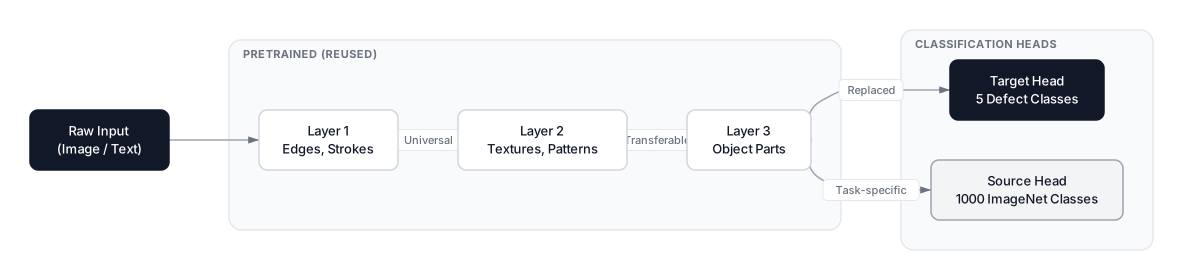 Click to expandHow transfer learning reuses hierarchical features from source to target task
The intuition is straightforward. When two tasks share an underlying data distribution or require similar feature representations, the loss surface of the target task starts at a much better initialization point. Instead of random weights, you begin optimization where features are already meaningful.
Key Insight: Transfer learning is most powerful when labeled data is scarce. With 100 labeled images, transfer learning can outperform a from-scratch model trained on 10,000 images.
Pre-Training and Fine-Tuning
The pre-training and fine-tuning workflow is the backbone of modern deep learning. Pre-training happens once on a massive dataset, producing a foundation model. Fine-tuning adapts that model to your specific task using a much smaller dataset.
Pre-training trains a model on a large, general-purpose dataset. For vision, this is typically ImageNet (14M images, 21K classes) or LAION-5B. For NLP, models are pretrained on internet-scale text using self-supervised objectives like masked language modeling or next-token prediction. The compute cost is enormous, but the resulting representations are extraordinarily rich.
Fine-tuning continues training on your specific dataset. The key difference: a much smaller learning rate (typically 10x to 100x smaller) preserves learned representations while adapting them to your task.
Here's our running example. You're building a defect classifier for a semiconductor fab with 500 labeled wafer images across 5 defect categories. Instead of training from scratch (which would need tens of thousands of images), load a pretrained ResNet-50, replace the final layer, and fine-tune:
import torch
import torch.nn as nn
from torchvision import models

# Load pretrained ResNet-50
model = models.resnet50(weights=models.ResNet50_Weights.IMAGENET1K_V2)

# Replace classification head for 5 defect classes
num_features = model.fc.in_features
model.fc = nn.Linear(num_features, 5)

# Use a small learning rate to preserve pretrained features
optimizer = torch.optim.AdamW(model.parameters(), lr=1e-4, weight_decay=0.01)

# Standard training loop (simplified)
criterion = nn.CrossEntropyLoss()
for epoch in range(10):
    for images, labels in train_loader:
        outputs = model(images)
        loss = criterion(outputs, labels)
        loss.backward()
        optimizer.step()
        optimizer.zero_grad()
This pattern transfers directly to NLP. Fine-tuning a pretrained transformer for text classification with Hugging Face looks like this:
from transformers import AutoModelForSequenceClassification, TrainingArguments, Trainer

model = AutoModelForSequenceClassification.from_pretrained(
    "bert-base-uncased",
    num_labels=5
)

training_args = TrainingArguments(
    output_dir="./defect_reports",
    learning_rate=2e-5,
    per_device_train_batch_size=16,
    num_train_epochs=3,
    weight_decay=0.01,
)

trainer = Trainer(
    model=model,
    args=training_args,
    train_dataset=train_dataset,
    eval_dataset=eval_dataset,
)
trainer.train()
Pro Tip: Always start with the smallest viable model. For vision, ResNet-50 or EfficientNet-B0 before ViT-Large. For NLP, BERT-base before a 7B LLM. Larger models need more data to fine-tune without overfitting, and compute savings compound across every experiment.
Feature Extraction vs. Fine-Tuning
These two strategies represent opposite ends of a spectrum: how much of the pretrained model you actually modify during training.
Feature extraction freezes the entire pretrained backbone and only trains a new classification head. The pretrained layers act as a fixed feature extractor, transforming raw inputs into high-dimensional representations that a simple classifier can separate. Fast, memory-efficient, and effective when your target domain closely matches the source domain.
Fine-tuning unfreezes some or all pretrained layers and trains them alongside the new head, giving the model freedom to adapt its representations to your data distribution. More powerful but riskier: with too little data or too high a learning rate, you can destroy the pretrained features entirely.
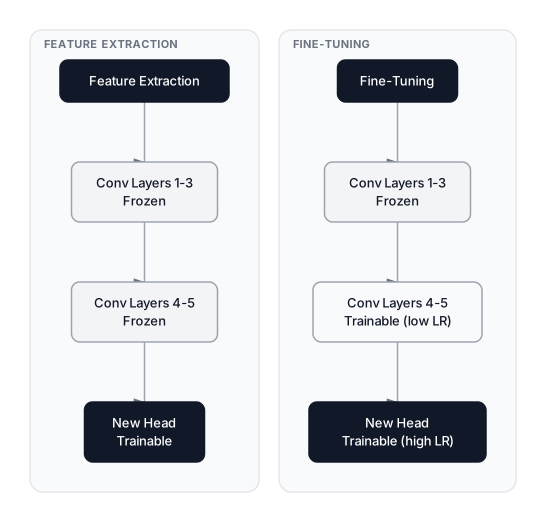 Click to expandComparison of frozen vs unfrozen layers in feature extraction and fine-tuning
For our wafer defect classifier, the choice depends on how different semiconductor wafer images look compared to ImageNet's natural photographs:
# Feature extraction: freeze everything, train only the head
model = models.resnet50(weights=models.ResNet50_Weights.IMAGENET1K_V2)
for param in model.parameters():
    param.requires_grad = False  # Freeze all layers

model.fc = nn.Linear(model.fc.in_features, 5)
# Only model.fc parameters will be updated

# Fine-tuning: unfreeze later layers progressively
model = models.resnet50(weights=models.ResNet50_Weights.IMAGENET1K_V2)
# Freeze early layers (edges, textures — universally useful)
for name, param in model.named_parameters():
    if "layer4" not in name and "fc" not in name:
        param.requires_grad = False

model.fc = nn.Linear(model.fc.in_features, 5)
# layer4 + fc will be updated; earlier layers stay frozen
| Criterion | Feature Extraction | Fine-Tuning | Training From Scratch |
|---|---|---|---|
| Target data size | < 1,000 samples | 1,000 to 50,000 | > 50,000 |
| Domain similarity | High (natural images to natural images) | Medium (natural images to medical scans) | Low or N/A |
| Training time | Minutes | Hours | Days to weeks |
| GPU memory | Low (gradients for head only) | Medium to high | High |
| Risk of overfitting | Low | Medium | High with small data |
| Accuracy ceiling | Good (85-92%) | Excellent (92-98%) | Depends on data volume |
Common Pitfall: Unfreezing too many layers with too little data leads to catastrophic forgetting, where the model overwrites its pretrained knowledge with noise from your small dataset. Start frozen, then unfreeze one block at a time while monitoring validation loss.
Discriminative Learning Rates
A flat learning rate across all layers is suboptimal for fine-tuning. Early layers should change slowly, while later layers can adapt faster.
Discriminative fine-tuning assigns progressively higher learning rates to later layers. The original ULMFiT paper by Howard and Ruder (2018) demonstrated that this technique reduces overfitting and improves convergence when fine-tuning on small datasets.
Where:
- is the learning rate for layer
- is the base learning rate for the final layer
- is a decay factor (typically 0.1 to 0.3)
- is the total number of layer groups
- is the current layer group index (0 = first layer)
In Plain English: The final classification head trains at full speed (), while each earlier layer group trains progressively slower. For our wafer defect model, the newly added head might train at , layer4 at , and layer3 at . This preserves the universal edge and texture detectors while letting the task-specific layers adapt freely.
# Discriminative learning rates for wafer defect classifier
param_groups = [
    {"params": model.layer1.parameters(), "lr": 1e-6},
    {"params": model.layer2.parameters(), "lr": 3e-6},
    {"params": model.layer3.parameters(), "lr": 1e-5},
    {"params": model.layer4.parameters(), "lr": 3e-5},
    {"params": model.fc.parameters(), "lr": 1e-4},
]
optimizer = torch.optim.AdamW(param_groups, weight_decay=0.01)
Pairing discriminative learning rates with a cosine annealing schedule works especially well. The learning rate warms up over the first 10% of training, then decays smoothly to near zero. This has become standard practice for fine-tuning in both vision and NLP. For a deeper understanding of how these optimizers work, see our companion guide.
Choosing the Right Pretrained Model
Selecting the right backbone is as important as the fine-tuning strategy itself. The field has consolidated around a few families for vision, and a clear hierarchy for NLP.
Computer Vision Backbones
| Model | Params | ImageNet Top-1 | Best For |
|---|---|---|---|
| EfficientNet-B0 | 5.3M | 77.1% | Edge deployment, mobile |
| ResNet-50 | 25.6M | 80.4% | General purpose, well-understood |
| EfficientNetV2-S | 21.5M | 84.2% | Best accuracy-to-compute ratio |
| ConvNeXt-Tiny | 28.6M | 82.1% | Modern CNN, ViT-competitive |
| ViT-Base/16 | 86M | 84.5% | Large datasets, high compute |
| Swin-Tiny | 28.3M | 81.3% | Dense prediction (detection, segmentation) |
For our wafer defect task with 500 images, EfficientNet-B0 or ResNet-50 are pragmatic choices. ViTs are data-hungry; without extensive augmentation, a CNN backbone will outperform a ViT on small datasets.
NLP Foundation Models
The NLP side has moved almost entirely to foundation models. BERT (2018) established that pretraining on unlabeled text and then fine-tuning produces state-of-the-art results on virtually every NLP benchmark. By March 2026, the practical hierarchy is:
- < 1B params: BERT-base, DistilBERT, DeBERTa-v3 for classification, NER, and extraction
- 1B to 10B: Mistral 7B, Llama 3.x 8B for instruction-following and generation tasks
- 10B+: Llama 3.x 70B, Qwen 2.5 72B for complex reasoning, typically via LoRA
The right model depends on your latency budget, data volume, and whether you need generative capabilities. For classification, encoder models like DeBERTa-v3 still beat similarly-sized decoder models while being 5x faster at inference.
Efficient Fine-Tuning with LoRA and Adapters
Full fine-tuning updates every parameter. For a 7B parameter LLM, that means storing 7 billion float32 gradients and optimizer states, requiring 80+ GB of GPU memory. Parameter-efficient fine-tuning (PEFT) methods solve this by updating only a tiny fraction of the model.
LoRA (Low-Rank Adaptation) injects small trainable matrices into the model's attention layers. Instead of updating the full weight matrix , LoRA learns a low-rank decomposition:
Where:
- is the frozen pretrained weight matrix ()
- is a trainable down-projection matrix
- is a trainable up-projection matrix
- is the rank (typically 8 to 64), much smaller than or
In Plain English: Instead of modifying all 7 billion weights, LoRA captures useful adaptation in a small matrix. With rank $r = 16$ on a layer with $d = k = 4096$, you train parameters instead of . Less than 1% of the layer's parameters, yet 90-95% of full fine-tuning quality.
QLoRA combines LoRA with 4-bit quantization of the base model. Fine-tune a 70B parameter model on a single A100 (80GB), or a 7B model on a consumer RTX 4090 (24GB). The base weights are stored in 4-bit NormalFloat format, dequantized on the fly for LoRA computation, with gradients flowing only through the LoRA adapters. Memory drops 10-20x compared to full fine-tuning.
from peft import LoraConfig, get_peft_model
from transformers import AutoModelForCausalLM, BitsAndBytesConfig
import torch

# QLoRA configuration: 4-bit quantized base + LoRA adapters
bnb_config = BitsAndBytesConfig(
    load_in_4bit=True,
    bnb_4bit_quant_type="nf4",
    bnb_4bit_compute_dtype=torch.bfloat16,
)

model = AutoModelForCausalLM.from_pretrained(
    "meta-llama/Llama-3.1-8B",
    quantization_config=bnb_config,
)

lora_config = LoraConfig(
    r=16,                  # Rank
    lora_alpha=32,         # Scaling factor
    target_modules=["q_proj", "v_proj", "k_proj", "o_proj"],
    lora_dropout=0.05,
    task_type="CAUSAL_LM",
)

model = get_peft_model(model, lora_config)
model.print_trainable_parameters()
# Output: trainable params: 13,631,488 || all params: 8,043,339,776
# || trainable%: 0.1695
Adapter layers insert small bottleneck modules between existing transformer layers, typically adding 0.5-8% parameters. Unlike LoRA, adapters add new parameters rather than decomposing existing ones. You can swap different adapters for different tasks without touching the base model, making them popular for multi-task serving.
Pro Tip: Start with LoRA rank 16. Simple tasks (sentiment classification) work fine at rank 4 or 8. Complex tasks (code generation, medical summarization) may need 32 or 64. Monitor validation loss to find the sweet spot.
Domain Adaptation and Negative Transfer
Domain adaptation addresses scenarios where source and target domains differ significantly: natural photographs to satellite imagery, Wikipedia text to legal contracts. The distribution shift between domains determines whether transfer helps or hurts.
Negative transfer occurs when pretrained features actually harm target task performance. This happens when domains are too dissimilar, or when the pretrained model overfits to source-specific patterns that mislead target predictions. Classic example: an ImageNet-pretrained model transferred to classify chest X-rays may perform worse than training from scratch, because ImageNet features are optimized for color, texture, and object-level patterns absent in grayscale medical imagery.
Warning signs of negative transfer:
- Validation accuracy is lower with the pretrained model than with random initialization
- Training loss decreases but validation loss increases from epoch 1
- The model confidently predicts wrong classes that correspond to ImageNet categories
Mitigation strategies:
- Gradual unfreezing: Start with only the head unfrozen, then progressively unfreeze deeper layers across training epochs
- Intermediate domain pre-training: Fine-tune first on a dataset closer to your target domain before final fine-tuning (e.g., medical images from PubMed before your specific radiology dataset)
- Lower learning rates for early layers: Use discriminative learning rates to constrain how much early features can change
- Regularization: L2 penalty toward pretrained weights (not toward zero) keeps the model close to its pretrained initialization
The bias-variance tradeoff offers useful framing here. Transfer learning reduces variance through strong initialization but can increase bias if pretrained representations don't match your domain. The right level of unfreezing balances this tradeoff.
When to Use Transfer Learning: A Decision Framework
Not every problem benefits from transfer learning. Here's a concrete decision framework:
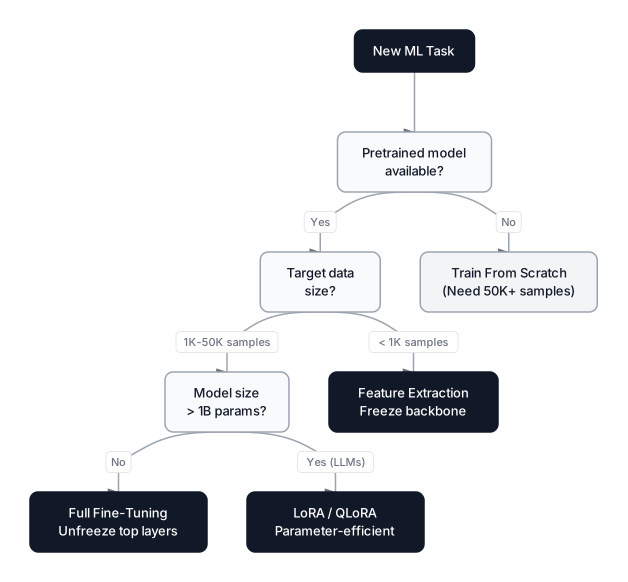 Click to expandDecision tree for choosing between transfer learning strategies
Use feature extraction when:
- Your target dataset has fewer than 1,000 labeled examples
- The source and target domains are similar (natural images to natural images)
- You need fast iteration (experiment turnaround in minutes)
- Compute is limited (single GPU, no multi-GPU setup)
Use fine-tuning when:
- You have 1,000 to 50,000 labeled examples
- The domains are related but not identical (photographs to satellite imagery)
- You need maximum accuracy and can afford hours of training
- You want to adapt the backbone's internal representations
Use LoRA/QLoRA when:
- The base model has billions of parameters (LLMs, large ViTs)
- Full fine-tuning exceeds your GPU memory
- You need to serve multiple task-specific adapters from one base model
- You want 90-95% of full fine-tuning quality at 10% of the memory cost
Train from scratch when:
- Your target domain has zero overlap with available pretrained models
- You have hundreds of thousands of labeled examples
- Your data modality has no pretrained models (novel sensor types, custom data formats)
- Regulatory requirements prohibit using pretrained models with unknown training data
Key Insight: With transfer learning, 100 labeled images per class often suffice for > 90% accuracy on binary classification. Without it, you typically need 5,000+ images per class. That 50x data efficiency is why transfer learning dominates production ML.
Common Pitfalls and Production Considerations
Catastrophic forgetting is the most common failure mode. Aggressive fine-tuning overwrites the pretrained features that made transfer learning valuable. The model "forgets" its general knowledge while memorizing your small dataset. Prevention: small learning rates ( to for transformers), early stopping, and weight decay. If validation loss spikes in the first few epochs, your learning rate is too high.
Data preprocessing mismatch is subtle but devastating. ImageNet models expect images normalized with mean [0.485, 0.456, 0.406] and std [0.229, 0.224, 0.225]. BERT expects specific tokenization. Wrong preprocessing silently degrades accuracy by 10-30%.
Freezing batch normalization matters. When fine-tuning with small batches, batch norm layers compute statistics from tiny samples that don't represent the population. Set model.eval() for batch norm layers, or use torch.nn.SyncBatchNorm for multi-GPU training.
Checkpoint selection is often overlooked. The best checkpoint isn't always the final epoch. Save the model with the lowest validation loss, not the lowest training loss.
A fine-tuned model has the same inference cost as one built from scratch. The savings are entirely in training time and data requirements. LoRA adapters can be merged into base weights at deployment, adding zero inference latency.
When Transfer Learning Helps
Transfer learning has evolved from a clever trick into the foundation of production ML. The core idea remains simple: start with a model that already understands the world, then teach it your specific task. Whether you freeze the backbone for feature extraction, fine-tune with discriminative learning rates, or attach LoRA adapters to a billion-parameter foundation model, the principle is identical. Reuse learned representations instead of learning from nothing.
Tasks that once required millions of labeled examples and weeks of GPU time now converge in hours with hundreds of examples. The Hugging Face Hub's 2+ million models mean that for almost any domain, someone has already pretrained a relevant backbone. Your job is choosing the right one and adapting it effectively.
For related topics, text embeddings are themselves a product of transfer learning, where pretrained models produce vector representations useful across tasks. RAG systems combine transferred knowledge with retrieval for even more capable applications, and understanding feature engineering helps you decide when manual features outperform automatic feature transfer.
Start with a pretrained model. Freeze the backbone. Train the head. Evaluate. Then unfreeze one layer at a time until validation loss stops improving. That recipe solves 90% of transfer learning problems.
Interview Questions
Q: What is the difference between feature extraction and fine-tuning in transfer learning?
Feature extraction freezes all pretrained layers and only trains a new classification head, treating the backbone as a fixed feature transformer. Fine-tuning unfreezes some or all layers and trains them with a smaller learning rate. Feature extraction is faster and safer with very small datasets; fine-tuning achieves higher accuracy when you have enough data to update the backbone without overfitting.
Q: When would transfer learning hurt performance (negative transfer)?
Negative transfer occurs when source and target domains are sufficiently dissimilar that pretrained features mislead the model. Transferring an ImageNet model to classify spectrograms or molecular structures can perform worse than random initialization because learned edge detectors have no relevance to the target data. Signs include validation accuracy below random-init baselines and confident misclassifications into source-domain categories.
Q: How do you prevent catastrophic forgetting during fine-tuning?
Use a learning rate 10-100x smaller than pre-training (typically for transformers), apply discriminative learning rates so early layers update slowly, use early stopping on validation loss, and apply L2 regularization toward pretrained weights. Gradual unfreezing is especially effective when data is scarce.
Q: Explain LoRA and why it matters for fine-tuning large models.
LoRA decomposes weight updates into two low-rank matrices ($W' = W + BA$), training only small matrices whose rank is typically 8 to 64. This reduces trainable parameters by 99%+ while retaining 90-95% of full fine-tuning quality. Combined with quantization (QLoRA), you can fine-tune a 70B model on a single GPU instead of a multi-node cluster.
Q: How do you choose the right pretrained model for a new task?
Consider three factors: domain similarity (how close source data is to your target), model size vs. data volume (larger models need more data to avoid overfitting), and inference constraints (latency and memory). For vision with small data, EfficientNet or ResNet; for NLP classification, DeBERTa-v3; for generation, the smallest LLM that meets your quality bar. Start small and scale up only when the smaller model's accuracy ceiling is confirmed.
Q: Your fine-tuned model achieves 99% training accuracy but only 72% validation accuracy. What happened?
The model has overfit to the training data, a common failure mode when fine-tuning on small datasets. The pretrained features were overwritten by memorizing training examples. Remedies: freeze more layers, lower the learning rate, add data augmentation, increase weight decay, or reduce epochs with early stopping.
Q: When should you train a model from scratch instead of using transfer learning?
Train from scratch when no pretrained model exists for your data modality (custom sensor data, novel signal types), when you have hundreds of thousands of labeled samples with compute to match, or when regulatory constraints prevent using models with unknown training provenance. In practice, this is increasingly rare as foundation models now cover vision, language, audio, protein structures, and many specialized domains.
Q: What preprocessing mistakes can silently degrade transfer learning performance?
The most common mistake is incorrect input normalization. ImageNet models expect specific per-channel means and standard deviations; wrong normalization can drop accuracy by 10-30% without any obvious error. For NLP, the wrong tokenizer silently corrupts inputs. Always use the preprocessing pipeline that shipped with the pretrained model.