
The Bureau of Labor Statistics says the median data scientist earns $112,590 per year. That number is technically accurate and practically useless. It aggregates a PhD-level ML research scientist at Anthropic earning $583K total comp into the same average as an analytics-titled data scientist at a regional bank pulling $85K base. The median tells you nothing about what your next offer should be.
The real story is the gap — and in 2026, that gap has become a canyon. Workers with genuine AI skills earn a 56% wage premium over colleagues in the same role without those skills, according to PwC's 2025 Global AI Jobs Barometer, which analyzed close to a billion job ads across six continents. One year earlier, that premium was 25%. Something has shifted in how the labor market values AI depth, and the practitioners closest to production AI systems are capturing nearly all of it.
This article breaks down what that premium actually looks like by level, company tier, geography, and skill cluster, so you can benchmark yourself against the numbers that matter.
Why Aggregate Salary Statistics Lie
Three effects conspire to make every published salary median nearly useless for individual benchmarking.
The composition effect. "Data scientist" covers an enormous range of actual work. A person cleaning spreadsheets in Tableau and a person fine-tuning a 70B parameter model and deploying it on custom CUDA kernels are both called data scientists on LinkedIn. When you average their salaries, you get a number that describes neither of them. The BLS median of $112,590 reflects a population that is overwhelmingly composed of analysts at non-tech companies — insurance, healthcare, finance, retail — where "data scientist" means something much closer to business intelligence than ML engineering.
The geography effect. San Francisco AI engineers earn a median of $246,250 in base salary alone (Built In, March 2026). A data scientist in a mid-size Midwestern city earns $78,000 to $95,000 for work that would be titled "junior analyst" at a tech company. Both data points enter the BLS sample. Their average is meaningless to anyone in either city.
The level effect. Compensation at Staff level is not a linear extrapolation of entry-level pay. At Meta, the difference between an IC3 (entry) data scientist at $170K total comp and an IC8 (principal) at $1.11M total comp is a factor of six and a half. These are not the same job category; they are fundamentally different relationships with the company (Levels.fyi, Q1 2026). Every aggregate statistic blends these levels into a soup.
Key Insight: The BLS median describes the center of the entire working data scientist population. If you work in tech, or are targeting tech, that center is not your reference point. Your reference point is the median for your level and company tier, which is often 60 to 120 percent above the BLS figure.
The Dallas Fed Finding on AI and Wages
The Federal Reserve Bank of Dallas published research in February 2026 tracking wage changes across AI-exposed sectors. The paper by J. Scott Davis documents a bifurcation: since the fall of 2022, nominal average weekly wages in the computer systems design sector rose 16.7%, compared to 7.5% across the economy overall. Within the top 10% of AI-exposed industries, wages grew 8.5%.
The deeper finding is about experience. AI is simultaneously replacing entry-level workers whose tasks can be codified and learned from documentation, while complementing experienced workers whose value comes from tacit knowledge — the intuition and judgment built through years of solving actual production problems. The median experience premium across occupations is 40%, but for specialized technical roles, it runs well above 100%.
This maps cleanly to what Levels.fyi data shows. Entry-level ML roles are facing compression as AI tools automate the routine parts of the job. But senior and staff engineers with deep production experience are seeing compensation accelerate, not stagnate.
Real Numbers: Computer systems design sector wages rose 16.7% since fall 2022 vs. 7.5% for the broader economy (Dallas Fed, February 2026). The premium accrues almost entirely to experienced practitioners.
The separate finding — that workers with AI skills earn a 56% premium over same-role workers without those skills — comes from PwC's 2025 Global AI Jobs Barometer, which compares workers in the same occupation who differ only on whether they hold AI skills. The premium has more than doubled from 25% in 2024. Companies have realized that an ML engineer who can fine-tune foundation models and deploy them at scale is not substitutable with someone who can only run scikit-learn pipelines.
The Real Salary Tiers
The table below reflects Q1 2026 data from Levels.fyi, with BLS data for context on the non-tech segment.
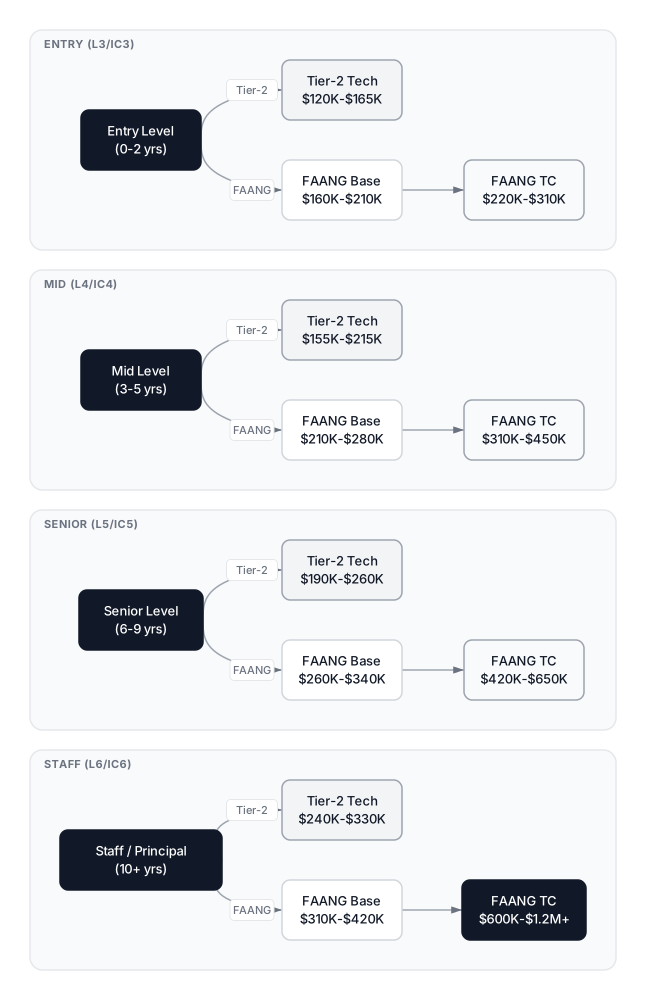 Click to expandAI/ML Engineer salary bands by experience level and company tier
| Level | Experience | FAANG Base | FAANG TC | Tier-2 Tech TC | Startup TC | Finance/Quant |
|---|---|---|---|---|---|---|
| Entry (L3/IC3) | 0-2 yrs | $160K-$210K | $220K-$310K | $130K-$190K | $110K-$160K | $120K-$180K |
| Mid (L4/IC4) | 3-5 yrs | $210K-$280K | $310K-$450K | $165K-$240K | $145K-$210K | $155K-$230K |
| Senior (L5/IC5) | 6-9 yrs | $260K-$340K | $420K-$650K | $200K-$290K | $180K-$260K | $210K-$320K |
| Staff (L6/IC6) | 10+ yrs | $310K-$420K | $600K-$1.2M+ | $260K-$370K | $230K-$350K | $280K-$450K |
Source: Levels.fyi, Q1 2026 (n=9,517 verified AI/ML compensation data points); FAANG figures represent Google, Meta, Amazon, Apple, Microsoft, Netflix, Anthropic, OpenAI.
FAANG TC includes base salary, annual bonus, and RSU grants amortized over a standard 4-year vesting schedule. At senior and staff levels, RSU grants dominate: a Google L6 ML engineer might have a $310K base but $350K-plus in annual equity value, pushing TC above $650K.
At the outlier end: Netflix ML engineer median TC is $585K (Levels.fyi, Q1 2026). OpenAI software engineer median TC across all levels is $555K, with research scientists at $1.26M. These numbers are real, not aspirational. They reflect actual signed offers from verified data points.
Real Numbers: BLS median for data scientists is $112,590 (May 2024, most recent published). Levels.fyi median for ML engineers across all companies is $261,000 (Q1 2026, n=9,517). The gap exists because BLS captures the full US working population; Levels.fyi skews heavily toward tech, FAANG-adjacent, and self-selected high earners.
The AI Skills That Command Real Premiums
Not all AI skills pay equally. The market in Q1 2026 has clear price discovery on specific competencies.
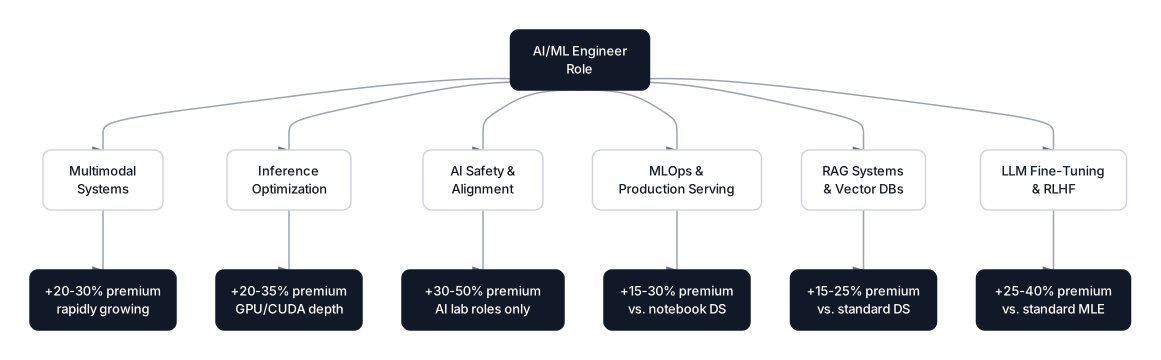 Click to expandAI skills that command salary premiums in 2026
LLM fine-tuning and RLHF. This is the single highest-paid technical skill in AI right now. Engineers who can take a base foundation model, assemble instruction-tuning datasets, run LoRA or full fine-tuning, evaluate alignment, and deploy the result are earning a 25 to 40% premium over standard ML engineers. The shortage is real: fewer than one in four ML engineers has hands-on production fine-tuning experience. Senior specialists in this area are seeing base salaries of $240K to $350K at AI labs. OpenAI, Anthropic, and xAI are paying $300K-plus base for this skill alone. If you have fine-tuned a 7B or larger model on a real task and can articulate the training dynamics, you are in a small cohort.
RAG systems and vector databases. Retrieval-augmented generation architecture has become the dominant deployment pattern for LLM applications in the enterprise. Engineers who can design a production RAG pipeline — chunking strategy, embedding model selection, vector database (Pinecone, Weaviate, pgvector), reranking, and hallucination mitigation — are commanding a 15 to 25% premium over data scientists who work exclusively on tabular models. NLP engineers specifically average $170,000 annually, placing them among the highest-paid AI specialists (Second Talent, March 2026). The skill is accessible but depth matters: hiring managers distinguish between engineers who copy a LangChain tutorial and engineers who have debugged retrieval quality in production at scale.
MLOps and production serving. A common barrier for junior data scientists seeking senior compensation is a lack of experience shipping models to production. Knowing how to build a model in a notebook is table stakes. Knowing how to wrap it in an API, monitor prediction drift, manage model versions, automate retraining on new data, and alert when something breaks — that is worth $15K to $30K in additional base over a pure modeling background (Kore1, 2026). MLOps engineers average $165,000 annually. At senior levels with production inference experience in Triton, Ray Serve, or vLLM, that ceiling rises to $280K.
AI safety and alignment. This is a small market with extreme compensation. Anthropic's Research Scientist (Interpretability) roles are posted at $315K to $560K base. The alignment research roles at Anthropic and DeepMind are not accessible to most practitioners — they require deep technical depth in mechanistic interpretability, formal verification, or RLHF theory, plus a publication record. But adjacent "AI safety engineering" roles, focused on red-teaming, evaluation frameworks, and responsible deployment, are more accessible and pay a 30 to 50% premium over generalist roles. This niche will grow as regulation increases.
Inference optimization. Someone who can take a trained model and make it run 3x faster on the same GPU hardware is extremely rare and compensated accordingly. The core skills are CUDA programming, quantization (int4, int8, GPTQ), speculative decoding, and serving frameworks like vLLM and TensorRT-LLM. NVIDIA ML engineers in this specialty range from $205K to $331K TC (Levels.fyi). OpenAI and Google have open roles specifically for model inference engineers at $400K-plus TC. This skill requires going significantly below the framework API level, which is why few people have it.
Multimodal systems. Vision-language models, audio-text pipelines, and video understanding are expanding the AI engineering surface area. Engineers who can work across modalities command a 20 to 30% premium, particularly at labs building foundation models (Google, Meta AI, Mistral). The premium is growing alongside the broader market: overall AI/ML hiring grew 88% year-over-year in 2025, faster than any other engineering discipline (Ravio, 2026 Compensation Trends Report).
Worth Knowing: Two AI skills listed on a job posting pay 43% more than comparable roles with none, according to job market analysis from CuroMinds (2026). The premium is not linear — going from zero to one skill moves the number most. But depth in any one of these clusters is worth more than surface knowledge across all of them.
Why Staff Level Is Where Compensation Goes Nonlinear
The jump from senior to staff is unlike any other level transition. It is not just more of the same work. It is a different relationship with the company.
At the senior level (L5 at Google, E5 at Meta, L2 at Netflix), you own execution within a defined scope. You ship models, review code, mentor, and solve hard technical problems. Total comp at FAANG senior level runs $420K to $650K.
At staff level (L6, E6, L3 at Netflix), the scope becomes organizational. You are responsible for technical direction across multiple teams, external partnerships, and decisions that compound over multiple years. The company invests in you differently because replacing a staff engineer means losing context that took years to build.
That investment shows up in equity. Going from L5 to L6 at Google or Meta typically involves a refresh grant that amounts to 30 to 70% of your prior total equity annually, on top of your existing vesting schedule. At Meta, the median E6 package sits near $720K total comp (Levels.fyi, Q1 2026). At Netflix, which has a famously non-standard compensation philosophy with high cash rather than large equity grants, the ML engineer range of $520K to $650K applies broadly across senior-to-staff levels.
The demand concentration matters, too. There are far fewer companies that can absorb staff-level AI talent than there are senior engineers looking to reach that level. Google, Meta, Microsoft, Netflix, OpenAI, Anthropic, and a handful of AI infrastructure companies (Databricks, Cohere, Mistral, Scale AI) are realistically competing for the same two or three hundred staff-level AI engineers globally in any given hiring cycle. That supply constraint is why packages at this level look like outliers from the aggregate statistics but are ordinary outcomes for people who reach it.
The Geography Effect: Real Numbers Across Markets
Geographic compensation variation in AI is large enough to affect life decisions. Here is what the data shows as of Q1 2026.
| Location | Median AI/ML Engineer Base | Cost-of-Living Index | Effective Purchasing Power |
|---|---|---|---|
| San Francisco Bay Area | $246,250 | 100 (baseline) | 1.00x |
| New York City | $218,000 | 91 | 1.08x |
| Seattle | $205,000 | 82 | 1.13x |
| Austin, TX | $172,000 | 63 | 1.24x |
| Denver, CO | $168,000 | 67 | 1.13x |
| Boston, MA | $195,000 | 84 | 1.05x |
| Remote (LCOL city) | $180,000 | 55 avg | 1.48x |
Source: Built In, March 2026; MIT Living Wage Calculator for cost-of-living index.
San Francisco base salaries are 43% above the national median for the role, but the purchasing-power-adjusted advantage collapses to zero once you account for housing, state income taxes (13.3% top marginal rate in California), and cost of living. A $220K remote salary in Austin outperforms a $260K San Francisco salary after taxes and rent, often significantly.
The remote story has changed since 2023. Geographic pay bands for remote roles have largely disappeared at top tech companies. In the 2022 to 2023 correction, companies cut remote salaries to local-market rates. By 2025, talent competition reversed this — FAANG-adjacent companies paying remote engineers 90 to 100% of their San Francisco pay bands are now common. The median remote AI engineer salary for senior roles is $206,600, which is $40K above the national median for in-office roles at the same level (Built In, 2026).
The practical implication: if your goal is maximizing total financial outcome, the highest-compensation path is often a FAANG-adjacent remote role from a low-cost city, not relocating to San Francisco. Relocation makes sense specifically if you want access to in-person mentorship at an AI lab, want to be physically present for early-stage startup equity, or are targeting one of the very few companies (Anthropic, OpenAI, Google DeepMind) where the senior-staff equity packages are materially different from what remote roles offer.
Positioning Yourself to Capture the AI Premium
The skills commanding premiums share a common characteristic: they require you to have done them in production, not just in a tutorial. This matters because hiring managers for AI roles in 2026 screen heavily for the difference. The questions that eliminate candidates are operational: "Walk me through the last time a model you deployed drifted in production. How did you detect it? What did you change?" A person who has only worked in notebooks cannot answer that question.
Three concrete moves that close the gap between knowing about AI skills and being compensated for them:
Build one production RAG system, end to end. Pick a real domain — legal documents, technical documentation, customer support transcripts. Choose an embedding model, build the chunking strategy, stand up a vector store, write the retrieval logic, evaluate retrieval quality, and deploy it as an API that handles at least one real user. Document what broke and how you fixed it. This project, done properly, is worth $20K to $40K in negotiating power versus having no deployed AI experience.
Get a single LLM fine-tuning project to production. Take a base model — Llama 3.1 8B, Mistral 7B, or a Gemma variant — and fine-tune it for a specific task using a dataset you assembled yourself. LoRA fine-tuning on a single GPU is accessible; the knowledge barrier is not hardware but methodology. Understanding learning rates, eval loss interpretation, catastrophic forgetting, and dataset quality issues puts you in the top quartile of practitioners who claim LLM experience. The differential in offers for candidates who can demo a fine-tuned model versus those who cannot is measurable.
Contribute one MLOps primitive to a system someone else uses. Deploy a model with a monitoring layer that tracks input distribution shift. Set up a retraining pipeline triggered by model performance degradation. Instrument a model endpoint with latency and throughput metrics. These contributions are boring to build and hard to find in junior portfolios, which is exactly why they signal production readiness to hiring teams.
If you have working knowledge in RAG systems or want to deepen your understanding of how LLMs actually work under the hood, those fundamentals translate directly to the production skills employers are paying a premium for.
When You Are at the Premium Tier / When You Are Not
The 56% premium is real, but it is not uniformly accessible. Here is an honest self-assessment framework.
You are likely at or near the premium tier if:
- You have deployed at least one AI model that handles real traffic from real users
- You can explain a training or inference failure you diagnosed in production
- You have written evaluation harnesses for LLM outputs, not just checked accuracy on a test set
- You have experience with at least one of: fine-tuning, RAG architecture, MLOps monitoring, or inference optimization
- You can discuss tradeoffs between serving frameworks (vLLM vs TensorRT vs Triton) from personal experience
You are not yet at the premium tier if:
- Your AI experience is primarily Kaggle competitions and structured notebook exercises
- You have not taken a model from training to a deployed endpoint that handles real requests
- Your LLM experience is limited to calling the OpenAI API with prompts
- You cannot describe the failure modes of the last production system you worked on
- You describe your skills as "familiar with" rather than "have shipped with"
The gap between these two profiles is not primarily about credentials. It is about whether you have accumulated the tacit knowledge that comes from systems failing on you in production. That is exactly what the Dallas Fed research describes as the asset AI cannot easily replicate: judgment built from experience rather than from documentation.
Conclusion
The BLS median of $112,590 for data scientists and the Levels.fyi median of $261,000 for ML engineers are both accurate. They describe different populations. The practitioners who close the gap between those numbers share a profile: production experience with AI systems, depth in at least one premium skill cluster, and the ability to discuss real failures and how they resolved them.
The Staff-level nonlinearity is worth keeping in mind if you are mid-career. The jump from senior to staff is not incremental — it involves a scope change, an equity change, and a supply-demand dynamic that looks nothing like the market for senior roles. If you are at L5/E5/Senior and targeting Staff, the bottleneck is rarely additional technical knowledge. It is organizational scope and the track record of technical decisions that held up over time.
Geography has become less deterministic than it was three years ago. Remote-first FAANG-adjacent roles in low-cost cities often produce better financial outcomes than relocating to San Francisco after accounting for taxes and cost of living.
The 56% premium is accessible, but only to practitioners with genuine production depth. Surface familiarity with AI tools is now table stakes, not a differentiator. The premium goes to the people who have fixed things when they broke — and can explain how.
For broader context on the 2026 AI engineer career path and what skills are being hired for right now, see the AI Engineer Roadmap 2026 on LDS.
Career Q&A
How do I verify my own market rate without revealing my current salary to employers?
Use Levels.fyi directly — filter by your role title, level (ask your manager which level you map to), company tier, and city. Pull 20 to 30 data points. Compare your current total comp against the P50 and P75. If you are below P50 for your level, you are likely underpaid relative to the market, not relative to your employer's band. In California, New York, Colorado, and several other states, employers cannot legally ask your current salary. Outside those states, deflect with "I'd prefer to understand the full compensation structure before we discuss specific numbers."
When does switching companies for a raise actually make sense versus staying for the next promotion?
The math usually favors switching if your current total comp is more than 20% below market for your level and your current employer is unlikely to close that gap within 12 months. Internal promotions in tech typically come with 10 to 15% base increases. Lateral moves at the same level to a different company routinely produce 20 to 40% total-comp increases, sometimes more if you have a competing offer. The exception is equity: if you have significant unvested RSUs (more than 1x your annual base), stay and model the math carefully before leaving. The signing bonus from a new employer often needs to cover the unvested stock you are walking away from.
How does the equity component change the calculus at senior and staff levels?
At entry and mid levels, equity is meaningful but base salary dominates the near-term calculation. At senior and staff levels, the calculation inverts. An L6 at Google might have $310K base and $400K-plus in annual RSU value. When the stock price moves, so does your TC. A 20% stock price increase on a $400K RSU grant adds $80K to your effective annual compensation — more than most people get in a raise. This is why senior and staff candidates spend more time negotiating the initial RSU grant size and the refresh grant terms than the base. The compounding effect of equity at high-TC levels is the reason FAANG staff roles produce outcomes that look extreme from the outside.
What is the actual career cost of staying at a non-FAANG company through the senior level?
In total compensation, the gap is significant: Tier-2 tech senior roles pay $200K to $290K TC versus $420K to $650K at FAANG for comparable levels. Over a 5-year senior tenure, that is a $1M to $1.8M difference, before accounting for FAANG equity appreciation. The non-financial costs matter too: at non-FAANG companies, you may have less exposure to large-scale AI systems, which affects your competitiveness for FAANG senior roles later. The career cost is real, but not irreversible — many people make the move from Tier-2 to FAANG at the senior-to-staff transition and close the gap quickly.
Do I need a PhD to reach staff or principal level at an AI lab?
No, but the path without one requires substituting publications or notable open-source contributions for the credentialing signal. At Anthropic and OpenAI, a significant fraction of research engineers at senior and staff levels do not have PhDs — they have track records of shipping AI systems at scale. The research scientist track (which does skew heavily toward PhDs) is distinct from the research engineer track. If you are targeting staff engineering roles rather than research scientist roles, a master's degree plus 8 to 10 years of production ML experience is a realistic path to those levels.
What specific AI skills are most likely to remain premium in 2027 and beyond, versus which will commoditize?
The skills most likely to retain their premium are those involving system-level judgment: debugging production failures, evaluating model behavior on edge cases, designing evaluation frameworks, and optimizing inference for novel hardware. These require accumulated experience that cannot be quickly learned from documentation. Skills likely to commoditize over 18 to 24 months include basic RAG implementation, standard fine-tuning pipelines, and most "prompt engineering" work — these are being abstracted by tooling. The durable advantage is in going deeper than the tooling layer.
How should I think about the finance/quant sector as an alternative to tech for AI roles?
Quantitative hedge funds and prop trading firms are paying $210K to $450K TC for AI-skilled engineers, with performance bonuses that can exceed base salary in strong years. The work involves applying ML to market data, execution algorithms, and risk models — legitimately interesting technical problems. The tradeoff versus tech: quant finance has steeper technical screens (heavy on statistics and probability), more opaque total compensation due to variable bonuses, and typically requires on-site work in New York or London. The ceiling is very high for top performers but the spread is also wider — a weak year means a much lower bonus. Treat finance as a parallel premium tier with different risk characteristics, not a fallback.
Sources
- PwC 2025 Global AI Jobs Barometer: AI linked to 56% wage premium (June 2025)
- Dallas Fed: AI is simultaneously aiding and replacing workers, wage data suggest (February 2026)
- Dallas Fed: Young workers' employment drops in occupations with high AI exposure (January 2026)
- Bureau of Labor Statistics: Data Scientists Occupational Outlook (May 2024)
- Bureau of Labor Statistics: Computer and Information Research Scientists (May 2024)
- Levels.fyi: Machine Learning Engineer Salary (Q1 2026)
- Levels.fyi: End of Year Pay Report 2025 (December 2025)
- Levels.fyi: Netflix Machine Learning Engineer Salary (Q1 2026)
- Levels.fyi: OpenAI Software Engineer Salary (Q1 2026)
- Levels.fyi: Anthropic Software Engineer Salary (Q1 2026)
- Ravio: Compensation Trends 2026 — AI/ML Hiring and Pay Premiums (2026)
- Built In: AI Engineer Salary in San Francisco, CA (March 2026)
- Built In: AI Engineer Salary in Remote (March 2026)
- Second Talent: Most In-Demand AI Engineering Skills and Salary Ranges (2026)
- Kore1: AI Engineer Salary Guide 2026 (2026)
- Stack Overflow: 2025 Developer Survey Results (December 2025)