
A job posting says "AI Engineer." Another says "ML Engineer." A third says "Data Scientist." The titles sound similar, the Venn diagram overlaps in places, and yet the actual work — what you do at 10am on a Tuesday — is completely different across all three. Even hiring managers mix them up, which is how teams end up with a data scientist who's been asked to deploy microservices, or an ML engineer who spends half the year making PowerPoints.
The three roles exist because they solve three fundamentally different problems. Data scientists answer questions about the world. ML engineers build systems that make predictions at scale. AI engineers ship products powered by large language models. Get that framing right, and everything else — the skills, the tools, the salary, the career path — falls into place.
One more thing worth stating upfront: AI engineer is now the fastest-growing job in the U.S., according to LinkedIn's Jobs on the Rise 2026 report, and AI engineering tops LinkedIn's Skills on the Rise 2026 list for the first time. That context shapes everything about how these three roles relate to each other right now.
The Data Scientist: From Data to Insight
A data scientist is a professional who extracts meaning from data to drive business decisions. They sit closest to the business, translating ambiguous questions ("why did churn spike in Q3?") into structured analyses, running experiments, and communicating findings to non-technical stakeholders.
On a typical Tuesday, a data scientist might be running a customer segmentation analysis in a Jupyter notebook, writing SQL to pull cohort data, debugging a wonky A/B test, or preparing a slide deck explaining which product feature drove conversion. The goal is always an insight or a recommendation, not a deployed artifact.
Core skills: Statistics and probability (hypothesis testing, confidence intervals, regression), experimentation design (A/B testing, causal inference), SQL, Python with pandas and matplotlib, and — often underrated — business communication. The ability to translate a p-value into an executive decision is a genuine skill.
Tools of the trade: Jupyter, pandas, statsmodels, scikit-learn, matplotlib/seaborn, Tableau or Looker, dbt for data transformations, and SQL-heavy data warehouses like Snowflake or BigQuery.
What they deliver: Insight reports, experiment results, dashboards, predictive models for internal use, and recommendations. A data scientist's output is consumed by humans (executives, product managers, engineers), not by other systems.
Salary in 2026: Entry-level roles start around $90K–110K. Mid-career data scientists at established tech companies earn 138K–175K in total compensation. Senior roles at FAANG companies hit 200K–280K when stock is included. The median across all data scientist roles per Levels.fyi sits at roughly 175K total comp, though top-of-market outliers at Meta and Google run 400K–900K+ for staff-level positions.
Job market in 2026: Data scientist hiring is bifurcated. Senior specialized roles are growing, while generic entry-level positions face real competition. The U.S. Bureau of Labor Statistics projects 36% growth in data science occupations through 2031 — one of the fastest of any occupation — but that growth is concentrated in companies that have built data cultures, not in every employer.
Where you'll find them: Any company with data and questions — consumer internet, fintech, healthcare, e-commerce, retail. They thrive where there's established data infrastructure and business stakeholders who actually want to make decisions from data.
Key Insight: The data scientist's biggest edge isn't the model — it's the question. Framing the right business question precisely is harder than fitting a regression, and it's what separates strong data scientists from average ones.
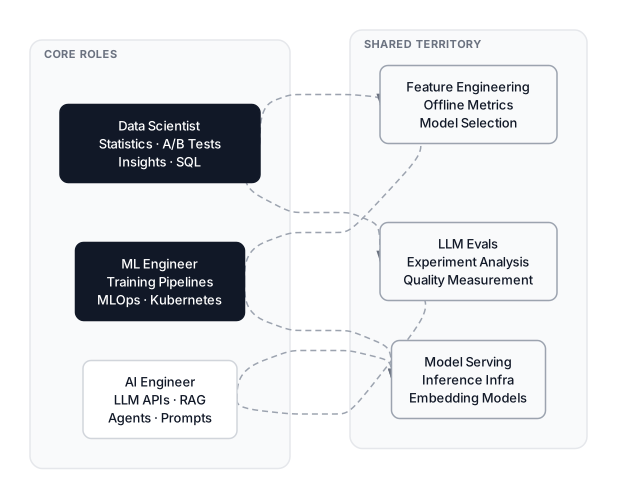 Click to expandRole overview showing how Data Scientist, ML Engineer, and AI Engineer core competencies overlap
The ML Engineer: From Prototype to Production
A machine learning engineer takes the model a data scientist proved works in a notebook and makes it run reliably in the real world — at millions of requests per day, with monitoring, versioning, retraining pipelines, and zero downtime deployments.
This is a hybrid role: half software engineering, half ML. ML engineers write production Python (not just notebook Python), understand distributed computing, and know enough about ML to catch when a model is drifting or when a feature store is leaking. They're the people who get paged at 2am when the recommendation system starts returning garbage.
On a typical Tuesday, an ML engineer might be writing a Spark job to compute features at scale, setting up a model registry in MLflow, debugging a memory leak in a PyTorch serving container, or designing the schema for a feature store. The ML engineer at a mature company has more in common with a backend engineer than with a data scientist.
Core skills: Software engineering fundamentals (clean code, testing, CI/CD), ML theory (gradients, loss functions, overfitting), distributed computing, MLOps practices (experiment tracking, model versioning, drift monitoring), and containerization. An ML engineer who can't read a Docker Compose file or write a proper unit test isn't production-ready.
Tools of the trade: PyTorch or TensorFlow for training, Apache Spark for feature computation, Airflow or Prefect for pipeline orchestration, Docker and Kubernetes for deployment, MLflow for experiment tracking, Weights & Biases for training monitoring, feature stores like Feast, and cloud ML platforms (SageMaker, Vertex AI, AzureML).
What they deliver: Production ML systems — model training pipelines, serving APIs, feature engineering infrastructure, monitoring dashboards. An ML engineer's output is a system that other systems consume.
Salary in 2026: Entry-level ML engineers earn $130K–145K base. Mid-level roles run 145K–190K base (total comp often hits 160K–230K with equity). Senior ML engineers at top companies earn 185K–260K base, with total comp regularly crossing 400K at FAANG. Built In's 2026 salary data puts the average ML engineer total compensation at 212K in the U.S. Mid-level ML engineer salaries increased 9% year-over-year in 2025, one of the larger YoY jumps in tech.
Where you'll find them: Companies with mature ML platforms — big tech, recommendation-heavy products, fraud detection, search, ads. The role is rare at companies that haven't yet operationalized ML. An ML engineer at a startup often doubles as data engineer, data scientist, and DevOps simultaneously.
Common Pitfall: Many data scientists try to become ML engineers by learning more ML algorithms. That's the wrong direction. The missing skill is software engineering rigor: version control discipline, testing, system design, and production debugging.
The AI Engineer: From APIs to Products
An AI engineer builds products and applications that run on top of large language models and other foundation models. They are not training models from scratch — they're composing APIs, designing prompts, building RAG pipelines, orchestrating agents, and shipping user-facing features.
This role barely existed in 2022. It exploded in 2023 with the GPT-4 API and hasn't slowed down. Per LinkedIn's 2026 data, AI engineering is both the fastest-growing job role and the top skill on the rise globally. According to job market analysis from Axial Search covering 10,000+ AI/ML postings, AI and ML engineering role postings grew 163% from 2024 to 2025 alone.
On a typical Tuesday, an AI engineer might be debugging why a RAG retrieval step is returning irrelevant chunks, writing evals to measure how often the agent completes a task correctly, integrating a new function-calling tool into a LangGraph workflow, or tuning a prompt to reduce hallucination rate by 15%. The work is more similar to product engineering than research.
Core skills: LLM APIs (OpenAI, Anthropic, Gemini, open-source via Hugging Face), prompt engineering, RAG architecture, vector databases, agent orchestration, LLM evaluation frameworks, and enough software engineering to ship reliable applications. Increasingly, AI engineers also need familiarity with fine-tuning via LoRA/QLoRA for domain-specific adaptations. For a full treatment of building RAG systems and agents, the advanced prompt engineering guide and the article on building AI agents with ReAct and planning are worth reading before your first AI engineering interview.
Tools of the trade: LangChain and LangGraph for orchestration, Hugging Face Transformers for open models, Pinecone or Qdrant for vector search, Ragas or DeepEval for evals, vLLM for self-hosted inference, and standard cloud infrastructure.
What they deliver: Production AI applications — chatbots, document processors, autonomous agents, AI-powered search, code generation tools. The AI engineer's output is a product feature or a standalone application that end users interact with.
Salary in 2026: AI engineers are the highest-paid of the three roles right now at the junior and mid levels. Entry-level starts at $100K–150K. Mid-level earns 150K–250K total compensation. Senior and specialist AI engineers (particularly those focused on LLM infrastructure or agentic systems) regularly see 250K–500K+ at AI-first companies. Built In reports the average AI engineer total compensation at 211K in 2026, comparable to ML engineers in base salary but with faster growth trajectories and a tighter supply of experienced candidates. Mid-level AI engineers saw 9.2% year-over-year salary increases in 2026.
Where you'll find them: AI-first startups, enterprise software companies embedding AI into existing products, and increasingly every industry adding AI-powered features. This is the broadest distribution of the three — an AI engineer can work at a healthcare startup, a legal tech company, or a fintech just as naturally as at an AI research lab.
Key Insight: The supply shortage of engineers who can ship production LLM applications is real and still wide as of March 2026. That's why AI engineer salaries are pulling ahead of generalist ML engineering, and why job postings specifically calling for RAG, agent orchestration, and LLM eval experience are commanding a 25 to 40% premium over comparable backend engineering roles.
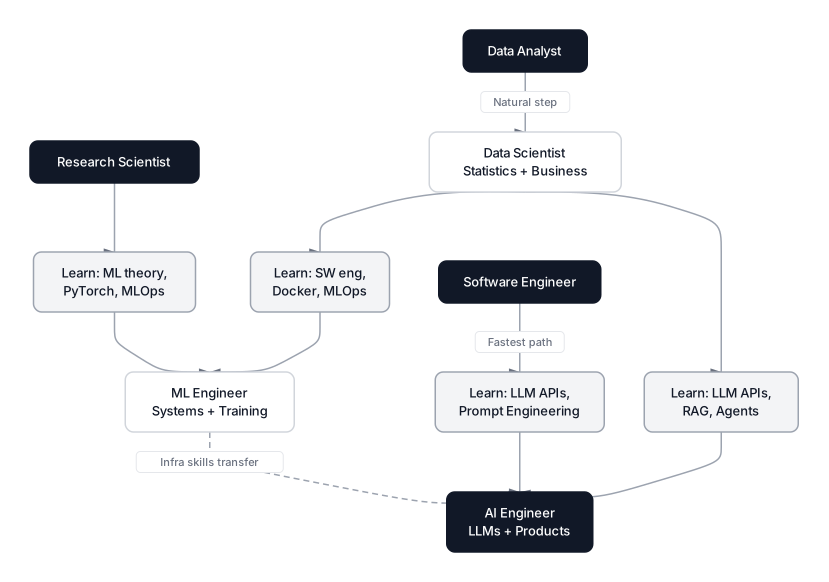 Click to expandCareer transition paths showing how Data Analysts, Software Engineers, and Research Scientists move into the three roles
Side-by-Side Comparison
| Data Scientist | ML Engineer | AI Engineer | |
|---|---|---|---|
| Core focus | Insights from data | Production ML systems | LLM-powered applications |
| Primary skills | Statistics, SQL, communication | SW engineering, MLOps, distributed systems | LLM APIs, RAG, agents, evals |
| Main tools | Jupyter, pandas, Tableau | PyTorch, Spark, Kubernetes, MLflow | LangChain, Pinecone, Hugging Face |
| Output | Reports, experiments, dashboards | Training pipelines, model APIs | Chatbots, agents, AI features |
| Avg total comp, USD (2026) | 115K–175K | 160K–230K | 150K–250K |
| Entry barrier | Statistics + Python | SW eng + ML theory | Python + LLM API experience |
| Best fit at | Established data orgs | ML-mature companies | Any company shipping AI products |
| Remote availability | ~5% fully remote | ~8% fully remote | ~6% fully remote |
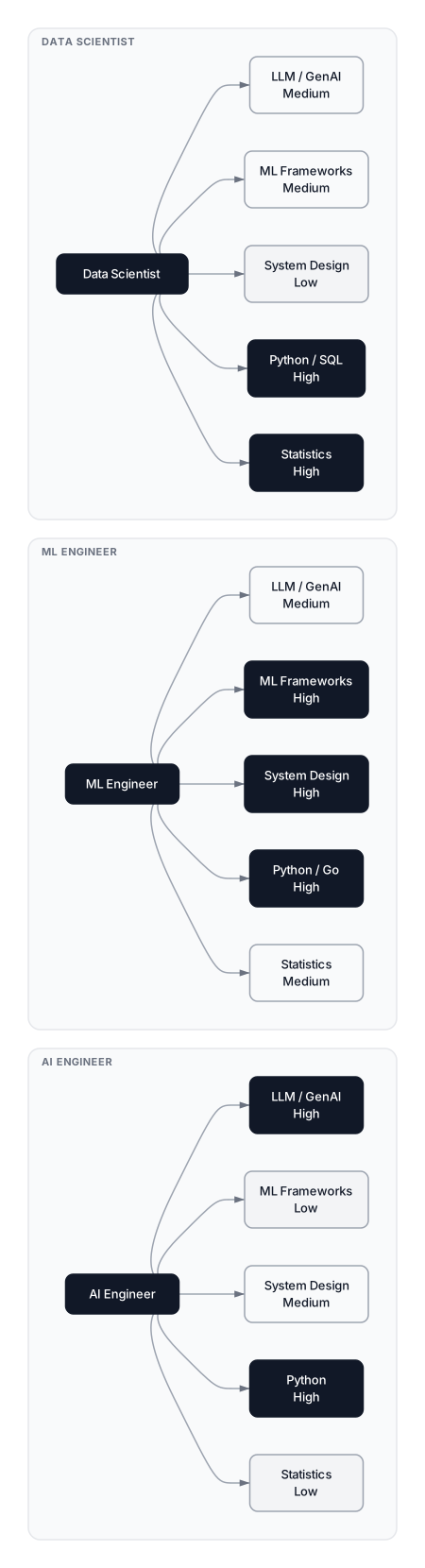 Click to expandSkill depth by role showing Statistics, Python, System Design, ML Frameworks, and LLM depth for each role
Startup vs Big Tech: The Same Title, Different Jobs
The role you get at a 40-person startup and the role you get at Google share a job title and almost nothing else.
Data Scientist at a startup: You're the analytics department. You build and maintain dashboards, write all the SQL, run A/B tests by yourself, and make product recommendations directly to the CEO. No data engineering team to hand off to. No ML platform to put models on. When you build a model, you probably deploy it yourself. The upside is variety and speed; the downside is that you can't go deep on any one thing.
Data Scientist at FAANG: You specialize. Google and Meta have dedicated archetypes — product scientist, research scientist, ML specialist — and you go deep in one of them. You work on problems at a scale most data scientists never see: millions of users, hundreds of features, teams of statisticians reviewing your experimental designs. Career progression is structured and competitive, with clear leveling from L3 to Staff and beyond.
ML Engineer at a startup: You often hold four roles simultaneously. You're writing the training pipeline, doing the data engineering, deploying on bare cloud infra, and handling the monitoring. The breadth builds excellent intuition. But without senior mentors or established best practices, it's easy to build fragile systems you'll regret later.
ML Engineer at big tech: You work on one piece of a massive infrastructure. Your job might be purely optimizing the feature store, or building the model serving layer, or improving training throughput. The work is deep, the tools are exceptional, and the engineering culture is rigorous — but your impact is measured in fractions of a much larger system.
AI Engineer at a startup: This is the highest-impact role in the company right now. You're building the product's core differentiation. Speed matters: ship the MVP chatbot, run evals, iterate on prompts, swap models when a better one ships. Startups hired more AI engineers per headcount than any other role in 2025 because the product is the AI.
AI Engineer at a large enterprise: The work shifts toward integration and governance. You're fitting LLM applications into existing enterprise systems, dealing with data privacy constraints, building internal tooling, and navigating procurement cycles for cloud AI services. Less greenfield, more careful — but higher stability and often better tooling budget.
Pro Tip: When evaluating offers at different company sizes, ask specifically what the data infrastructure looks like. A "data scientist" role at a company with no data warehouse, no dbt, and a single Redshift table is really an analyst/data engineer role. Title inflation is rampant in smaller companies.
Where the Roles Overlap
The three roles share real territory, and in smaller companies that overlap becomes full collision.
Data Scientist + ML Engineer: Feature engineering lives here. A data scientist designs which features should exist; an ML engineer builds the pipeline that computes them at scale. In practice, both roles touch this work, often in tension. They also share the model evaluation layer — data scientists care about offline metrics (AUC, RMSE), ML engineers care about online metrics (latency, throughput, drift).
ML Engineer + AI Engineer: Model serving is the shared ground. An ML engineer deploying a custom fine-tuned model and an AI engineer deploying a hosted LLM with an inference wrapper are doing similar infrastructure work. The AI engineer building a RAG system versus fine-tuning needs to understand embedding models and vector indexes — fundamentally ML engineering concerns.
Data Scientist + AI Engineer: Evaluation and analysis overlap significantly. AI engineers need to run systematic evals to measure hallucination rate, retrieval quality, and task completion — this is A/B testing methodology applied to LLM outputs. Data scientists moving into AI engineering find this transition surprisingly natural. The gap is mostly tooling, not methodology.
Career Transition Paths
Data Scientist to ML Engineer is the hardest transition because it requires building genuine software engineering depth — not just learning a new tool, but rewiring how you think about code quality, systems reliability, and debugging. The data scientist who wants to make this jump should start contributing to production code in their current team, get comfortable with Docker, write tests, and build something that serves requests outside a notebook.
Data Scientist to AI Engineer is currently the most popular transition, and for good reason. The stats background transfers well (especially for evals), Python skills carry over, and the new tools (LangChain, vector databases, prompt engineering) can be learned in weeks. Data scientists who understand how models behave make better AI engineers than software developers who don't. This is the path seeing the most traffic in 2026 — and the one with the fastest ramp to a new job.
Software Engineer to AI Engineer is the quickest path for someone with strong coding skills. The engineering fundamentals are already there — the learning curve is mostly LLM APIs, prompt engineering, and RAG architecture. Most software engineers can ship a competent RAG application within a month. A solid understanding of building AI agents with ReAct and planning will put them ahead of most candidates.
ML Engineer to AI Engineer requires less of a technical leap than people expect. The infrastructure skills transfer directly. What changes is the problem framing: instead of optimizing a training run, you're optimizing a pipeline of LLM calls. Instead of feature drift, you're monitoring prompt sensitivity. The mental model shift is real but the engineering skills are almost directly portable.
Pro Tip: Don't try to transition by taking courses alone. Build something real — a RAG application over a domain you care about, a working agent that completes a multi-step task, a fine-tuned model on custom data. A GitHub repo with working code beats a certification in every hiring conversation.
Choosing the Right Role for You
This is a decision framework, not a definitive answer. Your background, personality, and what you actually enjoy doing at 10am on a Tuesday matter more than the salary table.
Choose Data Science if you're drawn to statistical thinking and enjoy the puzzle of "what's actually happening in this data." If you love designing experiments, communicating findings to non-technical people, and operating close to business questions — this is your domain. The role is less prominent in 2026 media coverage than AI engineering, but companies with strong data cultures pay extremely well for exceptional data scientists, and the statistical foundation becomes more valuable as every company needs to measure whether their AI is actually working.
Choose ML Engineering if you're a software engineer who wants to go deeper on ML, or a data scientist who keeps getting frustrated that nobody ever deploys the models you build. If you find production systems satisfying — the reliability, the scale, the monitoring — and you're willing to invest in serious software engineering skills, ML engineering has strong long-term value. The role also provides the deepest technical foundation if you later want to move into AI infrastructure. Understanding vector databases and embedding systems is a natural extension of this path.
Choose AI Engineering if you want to ship AI products right now, at the layer where users actually touch the technology. If you're energized by the fast pace of the LLM ecosystem, enjoy working close to product and design, and want maximum career optionality in 2026 — this is where hiring demand is highest and the supply shortage is most acute. LinkedIn's 2026 data confirms AI engineering as the single fastest-growing job in the U.S. The role rewards action: you can go from zero to a deployed LLM application faster than in almost any other technical specialty. For a comprehensive skill roadmap, the AI Engineer Roadmap for 2026 is a good place to start.
What about company size? At companies under 100 people, you'll likely wear all three hats regardless of your title. The most important skill in a startup AI context isn't choosing the right role — it's being able to move between all three depending on what the company needs that week.
A note on remote work: All three roles skew heavily toward in-person or hybrid in 2026. Data from job postings shows roughly 5 to 8% of roles are advertised as fully remote across all three categories. Hybrid arrangements (2 to 3 days in office) are the current norm, particularly at larger companies. If remote flexibility is a priority, smaller startups and companies outside major tech hubs are more likely to offer it.
Conclusion
The data scientist, ML engineer, and AI engineer are genuinely different jobs with different required skills, different daily work, and meaningfully different compensation trajectories in 2026. The confusion arises because all three work with data and models — but so do a structural engineer and an architect. Both work with buildings; you wouldn't ask one to do the other's job.
Data scientists answer questions. ML engineers build systems. AI engineers ship products. When you encounter a job posting, ask which of those three describes the primary deliverable. That tells you more than the job title ever will.
If you're making a career decision, pick the direction that aligns with what you actually enjoy doing, then build toward it deliberately. The LLM ecosystem has created enormous demand for AI engineers right now, but data science and ML engineering are not disappearing — they're the foundation AI engineering builds on. Every AI engineer who doesn't understand model evaluation or production systems eventually hits a wall that data scientists and ML engineers already know how to climb.
For role-specific deep-dives, the AI Engineer Roadmap for 2026 covers the full AI engineering skill stack. The LLM and Agentic AI Interview Questions guide is worth working through before any AI engineering interview. If you're evaluating the ML engineering path, RAG vs Fine-Tuning is a good way to understand where the two engineering disciplines meet.