Whale Raises $40M Series C Extension
For practitioners, funding for edge-heavy enterprise AI is relevant because production deployments that combine video, sensor, and audio data typically require substantial integration, operations, and regional support. PR Newswire coverage carried by Yahoo Finance and ANTARA reports that Singapore-headquartered Whale raised a $40 million Series C3 extension, taking its total Series C funding to $100 million. CMB International and SMBC Asia Rising Fund led the round. Whale reports serving more than 1,600 enterprises in 45+ countries and managing more than 600,000 edge AI nodes through its AI Operating System and proprietary Business World Model.
For practitioners, the relevant technical-business question is whether enterprise AI vendors can operationalize multimodal data outside conventional data-center workflows. Industry context: deployments spanning cameras, sensors, audio, local edge nodes, and enterprise systems commonly require more than a model API. They depend on data governance, inference reliability, device management, observability, and integrations tailored to operational environments.
PR Newswire coverage carried by Yahoo Finance and ANTARA reports that Whale raised a $40 million Series C3 extension, bringing its aggregate Series C funding to $100 million. The round was led by CMB International and SMBC Asia Rising Fund, with participation from Krungsri Finnovate, Singtel Innov8, Hyundai Motor Group, and Charisma Partners. Earlier Series C investors listed in the release include Bosch Ventures, MTR Lab, MDI Ventures, Gentree Fund, and Linear Capital.
Multimodal enterprise operations
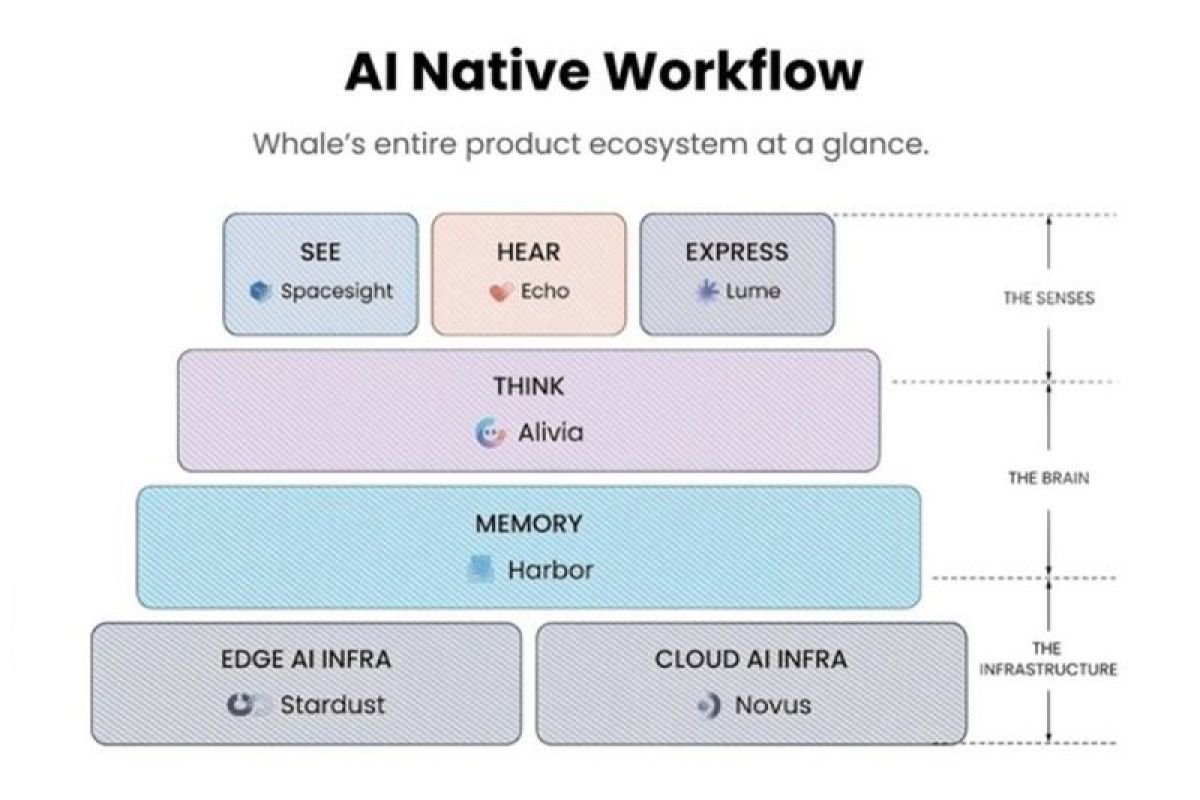
According to the company release, Whale builds an AI Operating System (AIOS) for enterprise operations around its proprietary Business World Model (BWM). Whale describes BWM as a model intended to interpret camera, sensor, and audio signals in an analogous manner to how large language models process text. The release identifies applications including compliance auditing, service quality, and operational efficiency across retail, automotive, food and beverage, manufacturing, and financial services.
Whale reports that its systems serve more than 1,600 enterprises in 45+ countries and manage more than 600,000 edge AI nodes. Dealroom similarly describes the platform as covering perception, cognition, and execution for online and offline operators. These are company-reported operating metrics, not independently verified deployment benchmarks.
Founder and CEO Jerry Ye said in the PR Newswire release, "This new funding isn't about starting from scratch. It's about advancing what we've built here." He added that the company is scaling global teams, enterprise partnerships, and platform integrations with local infrastructure. The release frames the expansion around North America and Asia-Pacific, while naming the Middle East, North Africa, and Europe as subsequent regions.
Practitioner implications
Editorial analysis
The architecture described by Whale belongs to a broader category of operational AI where model quality is only one component of system performance. In comparable edge deployments, teams need to evaluate sensor and camera data quality, connectivity loss, local-versus-cloud inference placement, latency requirements, retention policies, annotation workflows, and integration with systems that can act on generated recommendations.
A reported footprint of 600,000+ nodes, if measured consistently across deployments, would make fleet management a central engineering concern. At that scale, practitioners generally assess version rollout controls, hardware heterogeneity, monitoring coverage, failure recovery, security patching, and mechanisms for detecting model or data drift across locations.
Dealroom reports that Whale intends to use the funding to iterate BWM, develop standardized cross-industry solutions with industrial partners, and expand overseas regional headquarters and localized service systems. Dealroom also reports that the company claims overseas revenue grew more than 200% year over year and accounts for more than half of revenue. Those commercial figures and intended uses of proceeds originate from company-related reporting and have not been independently substantiated in the available sources.
What observers can measure
For practitioners evaluating vendors in this category, publicly demonstrable indicators are likely to be more informative than funding alone: documented model evaluation across environments, edge-node uptime and latency metrics, deployment and rollback tooling, data governance controls, and evidence that operational outputs integrate with customer workflows. Industry context: standardized metrics for multimodal operational systems remain less mature than benchmark reporting for general-purpose language models, making production references and technical validation especially important.
Key Points
- 1Whale raised $40 million in Series C3 funding, bringing Series C to $100 million for enterprise AI and edge deployment expansion.
- 2Whale's reported platform combines camera, sensor, and audio inputs, a multimodal pattern that increases requirements for edge operations and data governance.
- 3Industry context: large edge fleets make device management, monitoring, model rollout, and recovery as consequential as underlying model capability.
Scoring Rationale
The funding is notable for enterprise AI practitioners because Whale reports a large global edge-node footprint and a multimodal operations platform. The available reporting is largely syndicated company press-release material, and the July 15-16 announcement is more than three days old, limiting its immediate news impact.
Sources
Primary source and supporting public references used for this report.
Practice interview problems based on real data
1,625 SQL & Python problems across 15 industry datasets — the exact type of data you work with.
Try 250 free problems