Users Treat Claude as Workflow Operating System
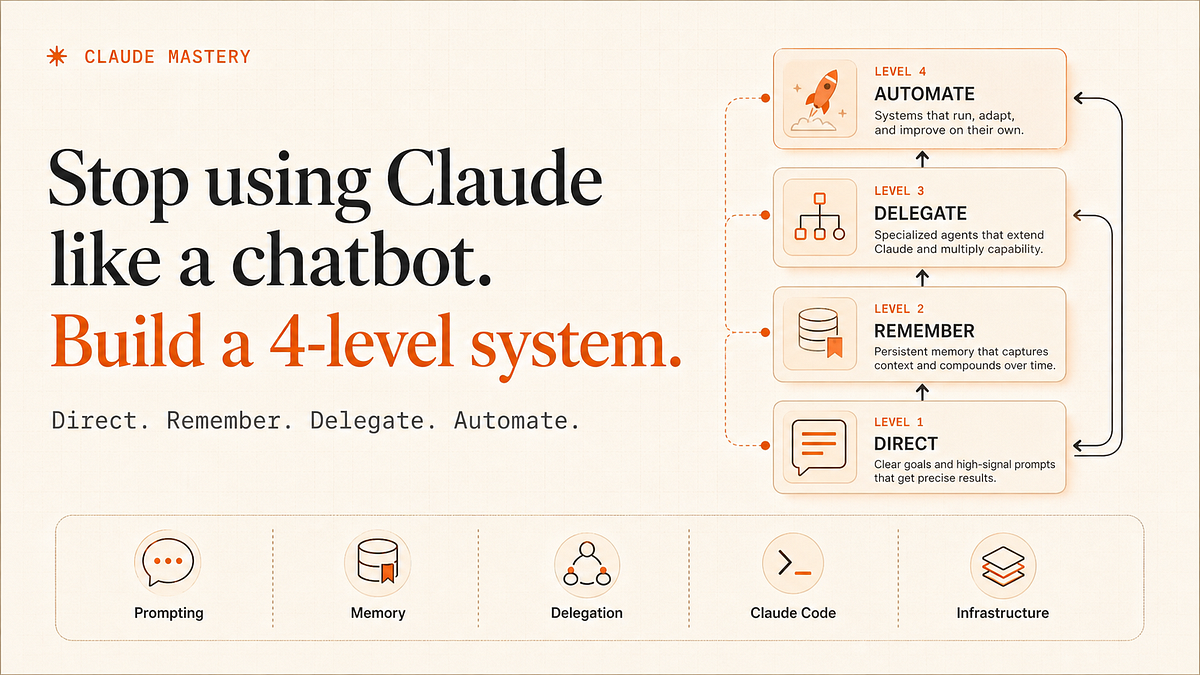
Stackademic published a July 6, 2026 guide arguing that Claude users get more value when they treat Claude as a workflow system rather than a one-off chatbot. The post describes a four-level progression from ad hoc prompts to persistent context, files, projects, guardrails, subagents, Claude Code, MCP, hooks, and automation. Anthropic's own materials support the technical backdrop: recent Claude releases emphasize coding, tool use, agentic workflows, and extended reasoning. For practitioners, the practical takeaway is to make assistant work reproducible with clear goals, saved context, review criteria, and integration boundaries instead of relying on improvised prompts.
The interesting part of the Stackademic post is not that Claude can answer better prompts, it is the shift from chat behavior to workflow design. For AI practitioners, that means treating assistant use as process engineering: context management, delegation, criteria, and auditability.
What happened
Stackademic's guide, "Stop Using Claude Like a Chatbot: The 4-Level System for Mastering It," describes a progression from one-off prompting to a layered system built around persistent context, files, projects, completion criteria, guardrails, subagents, Claude Code, MCP, hooks, and automation. Anthropic's public Claude materials provide the technical backdrop for why such workflows are plausible, including model releases focused on coding, tool use, extended reasoning, and agentic tasks.
Technical context
The durable lesson is that assistants become more reliable when the surrounding system reduces ambiguity. That usually means reusable instructions, known data sources, explicit acceptance criteria, logs of what changed, and human review for irreversible actions.
For practitioners
The post is best read as a workflow checklist, not a benchmark. Teams adopting Claude-style systems should start with repeatable low-risk tasks, document the prompts and constraints that work, and only then connect tools that can edit files, call APIs, or automate production workflows.
Key Points
- 1Claude workflows improve when users define persistent context, completion criteria, guardrails, and review steps before automation.
- 2Developer-tier features such as Claude Code, MCP, hooks, and subagents need boundaries because they can affect real files and systems.
- 3The article is a practical workflow guide rather than new model evidence, so claims should stay operational and cautious.
Scoring Rationale
This is useful practitioner guidance because it turns Claude usage into an operational workflow checklist around context, guardrails, and automation. The score is lower because the primary source is a how-to article, not a new model release, benchmark, enterprise deployment, or policy change.
Sources
Public references used for this report.
Practice interview problems based on real data
1,625 SQL & Python problems across 15 industry datasets — the exact type of data you work with.
Try 250 free problems